
This training option is one of the most important decisions that an aspiring aviator will ever have to make. The training path you choose might affect your money, time, learning speed to gain confidence, and how quickly you transition into a career as an aviation professional.
The big question for many of the new students is a simple one: Accelerated Flight School vs Standard Training: Which is best?
Each approach can arrive at the same result but is a completely different experience. Accelerated training condenses flight instruction, ground study and practical preparation into an abbreviated time period. The normal training is spread more than a couple of weeks or months, so students can work around the workplace, school, family unit, and other obligations.
The right local flight school for students rarely depends solely on speed alone. Things such as aircraft availability, the instructor quality, weather effect on the airport traffic, personal learning habits and financial flexibility can all impact, much like how it compares to other training routes, such as flight school vs. air force pilot training.
Understanding Accelerated Flight Training
Accelerated flight school is built around intensive learning. Rather than flying once or twice weekly, students may train four or more days a week with multiple training activities taking place in a single day.
This immersive approach creates continuity. Equality is not just for races or classes of people, it’s even on the playing field too. Less time doing the maneuvers they have allowed to get rusty during long breaks, autofails frequently help students retrain quickly but usually in small spurts.
Accelerated Flight School vs Practical Training, Which is Best?, this consistency is one of the more convincing arguments for speeding up training.
An accelerated schedule could encompass a morning full of ground instruction, an in-air flight lesson that afternoon, a timeshare use of the sim, and individual study work later that evening. The rhythm can be demanding. Well, for that kind of student, that intensity may yield improvement at a rapid pace.
Aviation Careers Especially Attracted to Accelerated Training: If you are looking to advance through private pilot, instrument, commercial or instructor training, you might be better off in a more regimented environment where aviation is your sole focus each day.
A Traditional Flight Training Overview
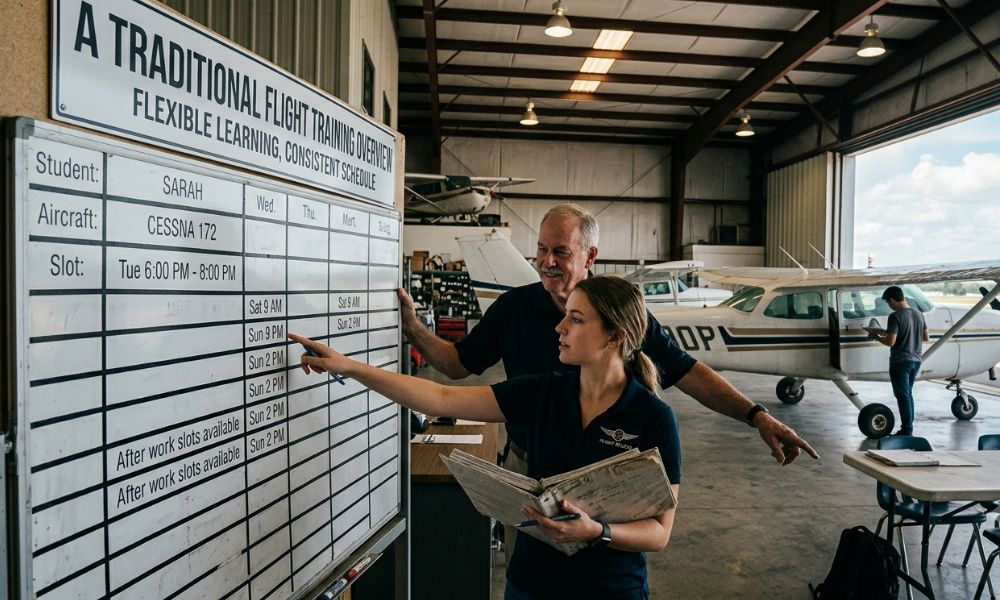
Entry is much more agile than traditional flight training. Lessons are typically organized around the availability of the student, and at the same time on how many people have signed up for a slot at your flight school.
This student could be doing two flights a week after work, training every weekend, or booking additional lessons in blocks of free time. This renders traditional training feasible for those who are unable to temporarily reorganize their lives around aviation.
The slower pace is not the same as lower quality instruction. In fact, some students learn more when they have longer time intervals because they can engage in concept review and procedure study as well as mental practice of difficult maneuvers.
On the contrary, bigger break between flights could also lead to inefficiency. Where there are several weeks between lessons, getting back to where the child was can take up part of the next session rather than helping them progress.
This is why having a consistent schedule is crucial in Accelerated Flight School vs Traditional Training: Which Is Better? comparison.
Training Speed and Completion Time
The main visible difference between both systems is speed.
Accelerated programs are specifically designed to minimize the calendar time needed to finish training. The students here train very often, keep their momentum and pass the syllabus stages one after another in a brief span of time.
Traditional students, schedule permitting may have more flexibility in completion but it will be much harder to predict when they are likely to finish. Weather cancellations, instructor availability (or scarcity), work and family commitments along with the usual aircraft working issues can lag your training out for quite a time.
None of those approaches promise an end date. Local conditions matter.
An active flight school at a busy airport may lead to longer taxi times or traffic congestion in scheduling. Alternatively, a regional airport with less traffic could offer quicker access to practice areas for another school. So weather is actually seasonally dependent as well to how often kids actually get up into the air.
Cost Comparison of The Two Types of Training
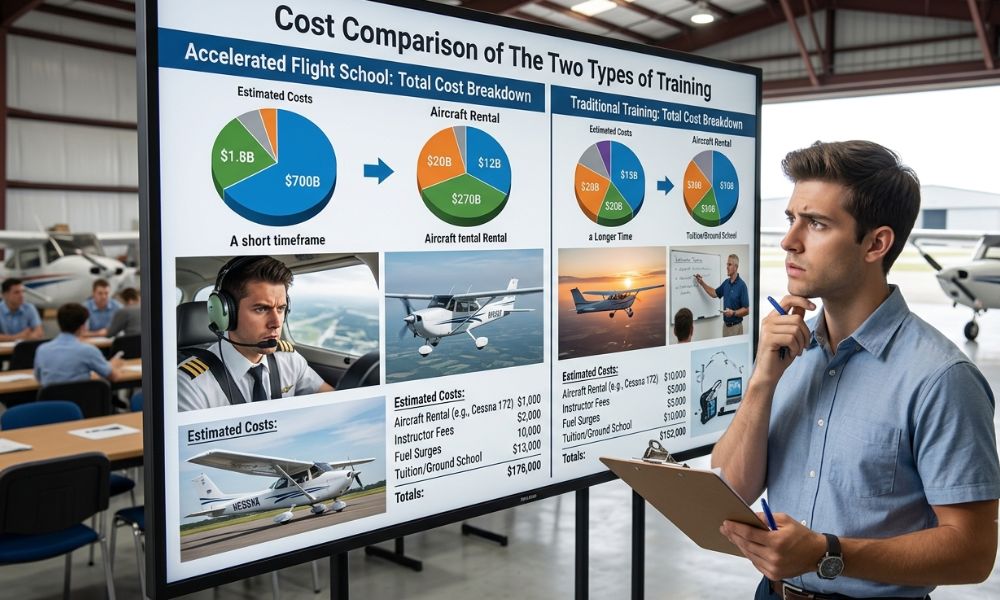
When deciding between Accelerated Flight School vs Traditional Training: Which Is Better?, it is easy to confuse cost.
Accelerated programs seem pricey because students are billed large sums in shortened time windows. Since trainers are paid progressively, traditional training may seem like a lower-cost solution.
However, the total amount is strongly influenced by training efficiency.
Students that fly less frequently may need a few additional hours to re-familiarize themselves with flying. The cost of those recurring lessons include things like aircraft rental fees, instructor charges and fuel.
Students should look at more than just the advertised tuition amount by comparing before they enroll.
Important expenses may include:
- Aircraft Rental and Flight Instructor Fees
- Live classes or online ground-school programs
- Training aids, charts, books & equipment
- Medical examinations and licensing expenses
- Written examinations and practical tests
- Flight hours above estimates of TAO packages
- Transportation, accommodation, or temporary housing
- Cancellation, rescheduling or aircraft change-fee
A contingency fund must be in a realistic budget. Aviation training rarely goes in a straight line. If you’re also weighing whether to go through an FTO entirely or explore a self-funded training route, it’s worth comparing both financing paths before committing.
Learning Retention and Skill Development
One of the biggest advantages of accelerated training is that you keep repeating often.
Flying consistently reinforces procedural memory. This is because students are exposed repeatedly to radio communications, checklists, aircraft control and navigation procedures conceptually and practically hands-on in the first five hours.
Retaining in traditional training needs to be a more deliberate process.
A student who only gets in the air once a week is ideal for using chair flying, simulator practice, going over his checklists, recording himself on radio calls and regular groundschool.
Easier for Beginners: Which Training Style?
Neither method is universally easier.
Accelerated trainings are useful for novices as they can retain the new information. Students are rapidly able to correlate concepts learned in the classroom with actions taken in the cockpit. The drawback is cognitive saturation. It can be overwhelming to juggle learning aerodynamics, communications, navigation, regulations, aircraft systems and practical flying all at once.
With traditional training, you have more space to breathe. Difficult content can be absorbed slowly by students. But if there are too many gaps between lessons, then it can break the continuity of learning.
The best beginner schedule generally provides ample rehearsal without inducing mental fatigue.
Schedule Flexibility
This category is very much hitting the traditional training area in the head.
If you are working full time, going to university, have a business or have a family then doing flight training on a daily basis may be unrealistic. Flying is made much more accessible through local flight schools providing lessons during the evening and weekends.
Accelerated programs typically necessitate firmer schedule dedication. Although this structured training schema is sequenced with such care, skipping a few days can derail it altogether.
So, anyone curious about Accelerated Flight School vs Traditional Training: Which Is Better? must first evaluate how much distraction-free time they actually have to train.
Instructor and Aircraft Availability
A strong program is only effective when the needed resources are present.
When evaluating the local flight school, students need to start asking how many instructors and training aircraft are available. So a school with lots of students, but only a small fleet could find it hard to maintain regularised schedules.
Instructor turnover also matters. When you have different instructors throughout the year, it can affect class procedures when they do not align with your students and their shift styles and expectations.
Students should have to go in person to local airports. Speak with instructors. Observe the aircraft. Inquire about addressing maintenance interruptions and if aircraft replacements are available.
Such nitty-gritty details probably say more than promotional material does.
Weather and Local Airport Conditions
Location is a crucial factor in flight training. Frequent storms, heavy rain, strong winds or fog can lead to cancellations and delay even an expedited pattern. The quality of training is also affected by airport conditions. While lasting experience with air traffic control is gained at extremely busy airports, the congestion can limit real flying time. While allowing departures with more replication in most cases, smaller airports can mean less time for complex traffic and quicker departures. When contrasting accelerated flight school vs traditional training keep local weather, airport activity, aircraft availability and their ability to keep your schedule on point in mind.
What Is The Quick Answer For Recreational Pilots?

This made traditional training well-suited for the recreational pilot.
If someone who learns to fly for transportation or recreation, there is little reason (or incentive) to leave work or other responsibilities for an intensive process. A good local flight school can get you making steady progress without the pressure of things getting out of control.
Throttle on throttles as such an fast personal pilot route need make moment regard for relaxation students along with administer ample additional time also settle wholeness.
The choice is not made because of ambition or lack thereof, but rather lifestyle.
How To Pick A Flight School Near You
Do not select a school simply because they advertise the lowest cost or quickest degree completion when comparing local schools.
How often can you realistically travel. Discover if the same instructor will typically be teaching you. Be sure to ask for clarification on what the quoted price of training will cover.
You can also get a lot out of taking a discovery flight. It gives you a chance to sample the airplane, airport, instructor and general experience without beginning to part with large amounts of money.
Advantage Accelerated Flight School Vs Traditional Flying Training
Which is the best flight-training path for you? If your schedule is flexible, and you can cement with focused type of training that may be repetitive that’s suited for accelerated programs. This implies that traditional, self-paced programs are better for people who need more flexibility, prefer a slower alternative or wish to spread their costs over time.
The best plan is the one that you can stick with. In addition to the options mentioned above, instructor quality, aircraft availability at location, local weather/cross airway traffic/airport infrastructure and cost/scheduling reliability all factor into the decision vice personal preference. Either way can create confident, competent pilots. You are not only looking to train faster but the environment that helps you safely learn, develop and achieve your long term flying goals.
Leave a Reply