Air India Express has official listings for experienced Boeing 737 and Airbus A320 co-pilots, along with A320 captains. These opportunities have specific aircraft experience requirements, so they are not suitable for every newly qualified pilot.
The first question is not simply, “Which airline is hiring?” It is, “Which recruitment route matches my qualifications?”
A fresh Commercial Pilot Licence (CPL) holder and an experienced first officer need different plans. This guide explains the recruitment pages to check, what their requirements mean, and how to prepare an application.
Airlines Hiring Pilots in India in 2026: Recruitment Status
Before applying, check which airlines are accepting applications and whether their pilot vacancies match your qualifications and flying experience.
| Airline or programme | Role or recruitment route | Status | Important eligibility or date information |
| Air India Express | B737 First Officer / Senior First Officer | The official listing displayed an application button. The advertisement was dated 9 October 2026. | Requires a valid B737 co-pilot endorsement and at least 100 hours of commercial airline experience after line release on B737. |
| Air India Express | A320 First Officer / Senior First Officer | The official listing displayed an application button. The advertisement was dated 10 October 2026. | Requires a valid A320 co-pilot endorsement and at least 500 hours on the A320 family after line release. |
| Air India Express | A320 Captain | The official listing displayed an application button. The advertisement was dated 11 October 2026. | Requires an ATPL, a valid A320 pilot-in-command endorsement and at least 100 pilot-in-command hours on the A320 family, alongside other conditions. |
| Air India Group | Trainee Pilot Programme | The programme page asked candidates to await upcoming opportunities. | Published eligibility information does not establish an open application window. |
| IndiGo | A320 Captain (Non-Type-Rated) and A320 Captain & Above (Type-Rated). Junior First Officer eligibility is published separately. | Check IndiGo’s official Flight Operations careers page for available pilot vacancies, eligibility requirements and application instructions. | Check the required pilot licence, aircraft rating, medical validity and flying hours for your chosen role. Follow the application instructions in IndiGo’s official vacancy notice. |
An accessible advertisement and an application button do not confirm that a submission can currently be completed. Reopen the official notice, follow its application route and check for updated instructions.
Pilot Jobs for Freshers: Which Opportunities Should You Check?
A fresh CPL holder should look for an advertisement that explicitly accepts their present licence, ratings, and experience.
However, the full eligibility section matters more than the job title.
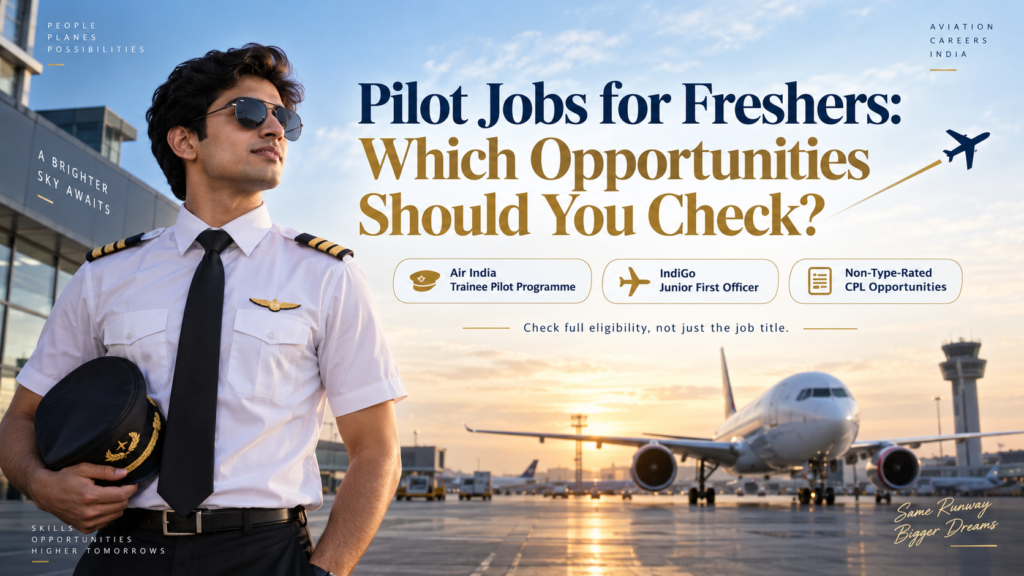
Air India Group Trainee Pilot Programme
Air India Group’s Trainee Pilot Programme offers training pathways for eligible CPL holders. Licence and aircraft-rating requirements differ between pathways, so candidates should check which route matches their qualifications.
Candidates should await the next recruitment announcement before applying. Keep your documents ready and follow Air India’s official programme updates for application dates, eligibility requirements and selection instructions.
IndiGo Junior First Officer Eligibility
IndiGo’s A320 Junior First Officer requirements include a DGCA-issued Indian CPL with an A320 endorsement, a current Class 1 medical assessment and valid radio-telephony qualifications. Applicants must be between 18 and 40 years old.
Candidates also need a multi-engine endorsement with at least 25 hours of multi-engine experience, including a minimum of 15 hours on an actual aircraft and a maximum of 10 hours on a simulator. These requirements apply specifically to IndiGo’s A320 Junior First Officer category.
Pilot Vacancies for Non-Type-Rated CPL Holders
Some pilot vacancies accept CPL holders who have not yet completed an aircraft-specific type rating. However, “non-type-rated” does not mean “untrained”. You still need the pilot qualifications required for the position.
Akasa Air’s September 2026 recruitment invited non-type-rated freshers who already held a CPL. Its application deadline was 23 September 2026. Alliance Air also invited non-type-rated CPL holders for Trainee First Officer positions, with an application deadline of 15 March 2026. Both deadlines have passed, so candidates should look for a new recruitment announcement before applying.
Check the airline’s official vacancy announcements and hiring events for application instructions and any additional conditions.
Can You Apply for an Airline Pilot Job After Class 12?
Becoming an airline pilot after Class 12 starts with learning to fly and earning your commercial pilot licence. You can then look for pilot vacancies that match your qualifications and experience.
You do not need flying experience to apply for pilot training in India. Air India’s cadet pilot programme, for example, accepts beginners who meet its admission requirements. Other programmes have their own entry conditions, so check these before you apply.
Before choosing a pilot training course, establish your academic eligibility, medical requirements and complete training budget. Then compare the training route with your longer-term career goal.
Do not choose a course only because an airline has a vacancy today. A current advertisement cannot establish which positions will be available when you finish training.
How to Apply for Pilot Jobs in India
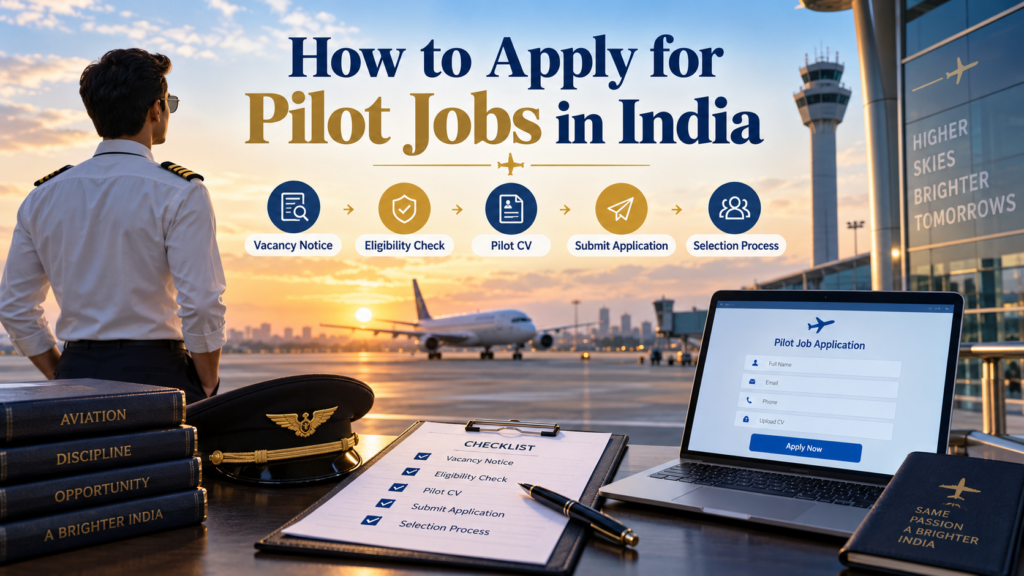
Start with the official recruitment notice and work through its conditions one by one. A useful application is not simply a collection of certificates. It should make your eligibility easy to understand and verify.
- Save the exact vacancy notice
Record the airline, role title, job reference, advertisement date, closing date and application method. Save a dated copy before preparing your application.
Keep advertisements for different roles separate. A Junior First Officer notice and an experienced First Officer notice may look similar but require different qualifications.
Revisit the official page before submitting. Do not rely only on a forwarded PDF, a screenshot or a social media repost.
- Compare the requirements with your current records
Create a simple eligibility checklist. Mark each condition as met, not met or needs clarification.
Air India Express A320 notice, for example, requires valid licences and related qualifications, a Class 1 medical assessment, appropriate English proficiency and an eGCA account with validated documents. These requirements belong to that advertisement; always check the role you are applying for.
Use the following table to organise your preparation.
| Area to check | What to compare with the advertisement |
| Licence and ratings | Check whether the role requires a CPL or ATPL, a particular aircraft endorsement, an instrument rating or other current qualifications. |
| Flying experience | Identify whether the threshold refers to total time, time on an aircraft type, commercial airline experience, post-line-release hours or pilot-in-command time. |
| Medical and language records | Check the required medical assessment, English proficiency evidence and validity dates. |
| Radio qualifications | Confirm which radio-telephony documents the airline requests and whether they are current. |
| Personal eligibility | Compare nationality, age, educational qualifications and any category-specific conditions. |
| Supporting records | Review requirements for logbooks, proficiency checks, employment records, declarations and validated digital documents. |
Use this as a preparation checklist and not as a replacement for the airline’s complete notice.
- Prepare a pilot CV and document pack
Make your qualifications easy to find. Place your licence, ratings, flying-hours summary and contact details near the beginning of your CV.
Date your hours summary and make sure it agrees with your logbook. Keep total flying time, multi-engine time, aircraft-type experience and simulator time separately identifiable.
For instance, do not combine aircraft and simulator hours into a single figure that appears to meet an aircraft-experience threshold. IndiGo’s published Junior First Officer criteria specifically distinguish actual multi-engine aircraft time from simulator time.
Prepare readable copies of the documents requested by the airline. Use clear filenames, check that every page is present and avoid uploading expired records without explaining their status where the application permits it.
- Submit through the specified application route
Use the application link or submission instructions in the official advertisement. Follow its requirements for document formats, email subject lines or application references.
Do not assume that creating a candidate profile, joining a talent pool or subscribing to vacancy alerts means you have applied for a particular role.
After submission, retain the acknowledgement, application number and a copy of the information supplied. A simple tracker can help you record each application’s status and follow-up requirements.
When an application link redirects to a general careers page, search for the exact job title again. Confirm the correct route through the airline’s official recruitment channel before sending documents elsewhere.
- Prepare for the airline’s stated selection process
Selection stages should be checked against the individual notice. The Air India Express captain advertisement lists a psychometric assessment, a personal interview, a simulator flight proficiency test and a pre-employment medical examination.
Build your preparation around the assessment you have actually been invited to attend. Review relevant technical subjects, practise explaining your decisions clearly, and prepare to discuss your training and experience honestly.
VFTI’s guide, “What Skills Do Pilots Need to Get Hired as a Pilot?”, provides further reading on technical knowledge, communication, teamwork and professional conduct.
Do You Need a Type Rating Before Applying?
Not for every recruitment route. Some advertisements require an existing type endorsement, while others specifically invite non-type-rated CPL holders. The Alliance Air notice is an example of the second route.
Before paying for a type rating, answer three questions:
- Does the intended vacancy require the rating before application, or does it accept non-type-rated candidates?
- Would the rating complete your eligibility, or would you still lack the required airline experience?
- What are the written training costs, additional charges and employment conditions?
Keep these as three separate decisions: gaining a qualification, meeting the requirements of a job vacancy, and securing employment.
A rating may meet one requirement without fulfilling the others. If a requirement is unclear, ask for clarification before spending money on expensive training based solely on a job title.
Pilot Recruitment Fees: How to Avoid Misleading Claims
Be cautious about anyone promising guaranteed selection, a faster joining date or special access to an airline recruiter. Akasa Air’s official recruitment warning specifically cautions candidates about scammers charging pilot-recruitment fees and making selection promises.
However, the statement “every legitimate airline application is free” is also inaccurate.
Alliance Air’s closed February 2026 notice specified a ₹10,000 application and written-examination fee, with an exemption for SC/ST candidates. This was a condition of that particular notice and not a current instruction to pay.
Before making any payment, verify the current advertisement, amount, exemption rules, beneficiary and payment method directly through the airline’s official channel.
A payment request should match a verifiable process.
Prepare for Your Pilot Career with VFTI
Understanding pilot vacancies is useful even before you begin training. It helps you see the difference between earning a licence, developing the required skills and applying for a suitable airline position.
Vision Flying Training Institute offers DGCA ground classes, CPL training and foreign-licence conversion support. These programmes serve different starting points, so your choice should reflect the qualifications you already hold and the training you still need.
| Your current stage | VFTI programme to discuss |
| You need preparation for the relevant pilot theory examinations. | DGCA ground classes, including the applicable subjects and preparation requirements. |
| You are planning to earn your first commercial pilot licence. | CPL training, with a review of eligibility, course structure and current fees. |
| You already hold a foreign CPL and need an Indian licensing pathway. | Foreign CPL conversion support, based on your licence, flight records and remaining requirements. |
Before enrolling, request a current, itemised training proposal. Ask what is included, which costs are additional and what requirements you must complete before starting.
Speak with VFTI’s admissions team about the next step in your pilot training.
Call: +91 9319193602 or +91 9319193605
Email: enquiry@vfti.in.
A suitable pilot vacancy is one that matches your qualifications. Begin with a clear pilot training plan, maintain accurate records and apply against the airline’s actual requirements.
Your next step should move you towards the qualifications you need, without confusing course admission with guaranteed airline employment.
Frequently Asked Questions About Pilot Vacancies in India
- Can I apply while my CPL is still being issued?
Only when the relevant recruitment process permits it. Air India’s published trainee programme information allows certain pending-document applications, but candidates must hold the required valid documents by the stated offer stage.
The reviewed Alliance Air notice, by contrast, excluded licences under process. Check the next live advertisement rather than assuming that one airline’s conditions apply elsewhere.
- Is an ATPL required for every airline pilot vacancy?
No. The Air India Express B737 co-pilot advertisement identifies First Officer applicants with a CPL and Senior First Officer applicants with an ATPL. The captain advertisement requires an ATPL.
Licence requirements, therefore, depend on the position.
- Does a cadet pilot programme guarantee employment?
Read the actual programme terms. Air India’s post-training information links an employment offer to successful completion, the group’s requirements and its stated conditions.
That wording should not be replaced with a promise of automatic employment. Before enrolling in any programme, request clear written information about training completion, selection conditions and the route to an employment offer.
- What should I check about salary before accepting an offer?
Request a written breakdown of any training stipend, fixed pilot salary, flying-related payments, allowances and deductions. Ask when each payment starts and whether the amount changes during training or after release to line operations.
Also review any stated training costs, repayment conditions and service commitments. Do not use a general online salary range as a substitute for the terms of your own offer.
- When will the next fresher pilot vacancy open?
Air India Group’s trainee page asks candidates to await upcoming opportunities, while the reviewed Akasa Air and Alliance Air notices have passed their application deadlines.
Follow the official recruitment pages and prepare your records in advance rather than relying on an unconfirmed hiring calendar.
Leave a Reply