For any Indian student, choosing a country for flight training is a significant decision. It has direct implications for costs, timelines, licence conversions and airline employment opportunities. Popularity alone does not make a destination the right fit. The best country for pilot training in 2026 depends on a student’s budget, career plan and ability to meet Indian regulatory requirements.
Those applying to Indian airlines must ultimately answer to the Directorate General of Civil Aviation. Under DGCA CPL requirements in India, a Commercial Pilot Licence candidate must be at least 18 years of age, have completed 10+2 or equivalent with Physics and Mathematics, and satisfy medical, examination, training and flying stage requirements.
Why Indian Students Consider Training Abroad
Many Indian students are drawn to training abroad for stable weather, uncongested airspace and consistent flying windows. Foreign programmes can also offer exposure to different airspace environments and international radio procedures.
However, a foreign CPL does not automatically convert to an Indian licence. Students who want to fly commercially in India must go through the DGCA licence conversion process and meet all Indian licensing requirements. This is a specialised procedure managed entirely by DGCA, and students should research it thoroughly before committing to an overseas academy. The best country for pilot training in 2026 should never be chosen solely on the basis of an advertisement promising fast completion or reduced hourly rates.
For students interested in the conversion pathway specifically, understanding what the best pilot licence conversion academy in India involves is a useful step before making any overseas enrolment decision.
India: The Direct Option Most Aligned With DGCA
India is the most straightforward option for many candidates. Training within the domestic system means students become familiar with Indian weather, airspace and radio procedures from the outset. It also eliminates costs associated with foreign visas, accommodation and currency exposure.
The single largest benefit is regulatory alignment. Training in India produces an Indian licence directly, removing the need to complete a foreign qualification and then navigate a conversion process afterwards.
Training quality and pace vary between academies. Students should investigate aircraft availability, monthly flying hours logged by current students and recent completion records. India can be the right choice when the selected academy offers reliable pricing, consistent scheduling and a strong safety culture.
South Africa: Value With Good Weather
South Africa attracts Indian students seeking lower flying costs and favourable weather. Quieter airspace can make it easier to practise circuits and cross-country navigation during early training stages.
School selection requires care. Verify that the academy is properly approved, check its maintenance arrangements, accommodation standards and support with documentation for Indian licence conversion.
A low headline price is misleading when it excludes examination charges, fuel surcharges, equipment costs, additional hours or conversion expenses. South Africa can represent good value — but only if the full cost is calculated honestly, not just the opening quote.
United States: Broad Aviation Infrastructure
The US offers an extensive general-aviation network and varied training environments. Students gain exposure to controlled airspace, regional airports and professional radio communication standards.
A well-managed school with a reliable fleet can support efficient progress. However, the full budget must account for visa compliance, travel, accommodation, insurance and FAA-to-DGCA licence conversion. Currency fluctuations can also alter the final cost unpredictably.
Students who prioritise wide operational exposure and can manage a less predictable financial commitment may find the United States a strong option.
Canada, Australia and New Zealand
Canada offers structured flight training with the added dimension of winter flying, which can strengthen decision-making and weather management skills, though it may slow overall progress in some regions.
Australia has well-regarded aviation training organisations, large training airspace and strong airline industry standards. For many Indian families, the cost of tuition and living expenses remains a significant drawback.
New Zealand offers coastal scenery, variable weather and challenging terrain that can sharpen situational awareness. As with any destination, costs and timelines must be compared carefully against what the training environment actually delivers.
The best country for pilot training in 2026 is the one that remains financially viable across the full span of training, licence conversion and pre-employment preparation, not just the first few months.
Compare the Complete Cost
The headline price of any academy rarely tells the full story. A realistic budget must include aircraft hire, instructor fees, simulator hours, examinations, medicals, books, headset, uniform, accommodation, food, transport, visa fees, insurance and any additional flying hours required. A detailed breakdown of pilot course fees and what they typically cover in India can help students benchmark what a genuine all-in cost should look like before comparing overseas options.
Request a written fee breakdown from any school under consideration and confirm whether prices are fixed or fuel-linked. Check the payment schedule, refund policy and the fee applicable if a flight test needs to be retaken.
A school that interrupts training or requires multiple revision flights can become far more expensive than its initial price suggested. A modestly priced school with reliable aircraft and stable instructors may cost less overall than a cheaper-looking alternative with operational inconsistencies.
Medical and Academic Preparation
Candidates should confirm all academic and medical requirements are complete before paying any significant training fee.
Confirm eligibility, specifically 10+2 with Physics and Mathematics
Complete a DGCA Class 2 Medical Examination before the start of flight training
Obtain DGCA Class 1 medical clearance at the Commercial Pilot Licence stage
Resolve any medical, academic or documentation issues before departing for overseas training
Keep medical certificates, academic records and identification documents current and organised
Confirm eligibility for overseas training and the requirements for converting a foreign licence in India
Addressing these steps early avoids delays, additional costs and licensing complications. Even the best training country cannot compensate for missing eligibility, incomplete documents or inadequate preparation.
Choosing the Right Flight School
Comparing countries is only part of the decision — the quality of the individual school usually matters more than the destination. Rather than relying on testimonials, speak directly to current students. Ask how many aircraft are actively flying, how frequently students are completing flying hours and how long recent CPL candidates took to finish their training.
Be cautious of schools that promise guaranteed airline employment, obscure fees within broad tuition descriptions or request large upfront payments with vague refund terms. A credible academy should be as forthright about its limitations as it is about its strengths.
Comparing DGCA-approved flying institutes in India is a useful reference point for understanding what a transparent, well-structured training organisation should offer — whether you ultimately train domestically or abroad.
VFTI also guides Indian aspirants in comparing training paths, understanding DGCA-oriented planning and evaluating the cost implications of training in India versus overseas.
Final Verdict
India offers direct DGCA regulatory alignment and is the most straightforward choice for the majority of Indian students. South Africa offers competitive pricing and favourable weather. The United States provides broad aviation exposure. Canada, Australia and New Zealand each offer disciplined training environments with their own logistical and financial considerations.
There is no single country that suits every student. The right choice is one that provides recognised instruction, safe flying conditions, reliable aircraft, qualified instructors, honest pricing and a clear pathway to an Indian licence.
Students should verify requirements, calculate total costs and speak to alumni before enrolling anywhere. The right country, and the right school gives an aspiring aviator the foundation to build skill, confidence and sound professional judgement without creating avoidable financial or licensing difficulties along the way.
Every pilot who flies over Indian skies first had to sit down, open a book, and pass the DGCA exams.
The DGCA (Directorate General of Civil Aviation) exams are the official theory tests that every aspiring pilot in India must clear to earn a Commercial Pilot Licence (CPL). These exams test your knowledge of aviation subjects before you are ever allowed to fly commercially.
These exams are designed to make sure that when you sit in that cockpit, you know exactly what you are doing.
Here is everything you need to know to clear your DGCA exams and earn your wings.
Overview of Passing the DGCA Exams on the First Attempt
The requirements for qualifying DGCA exams on the first attempt are as follows:
First, meet the basic eligibility: you should have passed Class 10+2 with Physics and Maths, hold a valid Class 2 Medical Test Certificate, and be at least 17 years old.
Get your DGCA Computer Number through the Pariksha portal.
Prepare for and clear all five CPL theory subjects: Air Navigation, Meteorology, Air Regulations, Technical General, and Technical Specific, with at least 70% in each paper.
Exact eligibility requirements for DGCA CPL exams.
How to apply for a DGCA Computer Number (step-by-step)
All 5 CPL subjects and their full syllabusExam pattern, passing marks, and format details
DGCA exam schedule & OLODE on-demand exams
How to register on the DGCA Pariksha portal
Best books and study resources for each subject
Subject-wise preparation strategies that actually work
A realistic 12–18 month study timeline
Common mistakes that cause students to fail
How VFTI’s DGCA-approved program prepares you
You need to clear five CPL theory subjects along with RTR(A).
The minimum passing marks are 70% in each subject.
DGCA exams are usually held around four times a year.There is no negative marking in the exam.
There is no limit on the number of attempts.Each passed exam result remains valid for five years.
The minimum age to appear is 17 years.The exam is conducted in computer-based mode through the Pariksha Portal.
What Are DGCA Exams?
The DGCA exams are a mandatory series of Computer-Based Theory Tests (CBT) that every aspiring pilot in India must clear before obtaining a Commercial Pilot License (CPL), Private Pilot License (PPL), or Airline Transport Pilot License (ATPL). DGCA, the regulatory authority under the Ministry of Civil Aviation, Government of India, conducts the exams.
The DGCA CPL exams test your theoretical knowledge in aviation, including navigation, weather, aircraft systems, and Indian aviation law. They do not test your flying ability. But pilots who understand aviation theory deeply become more confident in the cockpit. The DGCA exams build that foundation.
Important: All DGCA CPL theory exams are conducted online through DGCA’s official Pariksha portal.All results, admit cards, exam schedules, and applications are managed through this single portal.
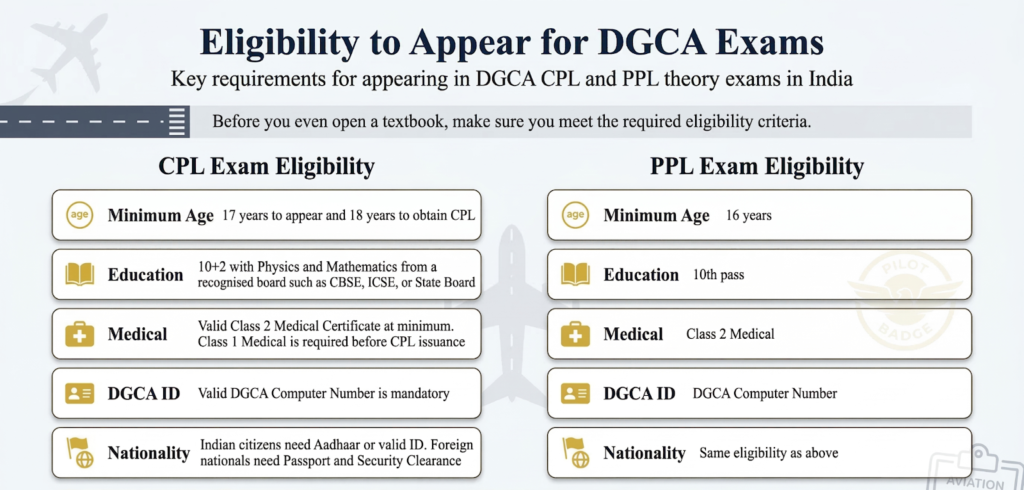
Eligibility to Appear for DGCA Exams
Before you even open a textbook, you need to make sure you qualify.
Here is the eligibility checklist for appearing in DGCA CPL theory exams:
Requirement
CPL Exam
PPL Exam
Minimum Age
17 years (to appear) and 18 years (to obtain CPL)
16 years
Education
10+2 with Physics & Mathematics from a recognised board (CBSE/ICSE/State Board)
10th pass
Medical
Valid Class 2 Medical Certificate (minimum); Class 1 required before CPL issuance
Class 2 Medical
DGCA ID
Valid DGCA Computer Number – mandatory
DGCA Computer Number
Nationality
Indian citizens (Aadhaar/ID); Foreign nationals need Passport + Security Clearance
Same
💡 Don’t Have Physics & Maths in Class 12?
You can still fulfil this requirement through NIOS – the National Institute of Open Schooling. DGCA accepts NIOS pass certificates for Physics and Mathematics. Many students have taken this route and gone on to become commercial pilots.
The DGCA Computer Number (CN) is a unique 10-digit alphanumeric identification number issued by DGCA to every aspiring pilot in India. Think of it as your official student ID in the DGCA system. Without a Computer Number, you cannot register for any DGCA exam. It is the very first administrative step in your pilot journey.
How to Apply for DGCA Computer Number Step by Step
Visit the Pariksha Portal: Go to the Pariksha portal using Chrome or Firefox, which are the recommended browsers. Select “New Candidate Registration” under the Flight Crew section.
Fill in Your Personal Details: Enter your full name exactly as it appears on your Class 10th certificate, date of birth, gender, nationality, and contact information. Even a minor spelling mismatch can delay your application.
Verify via OTP & Create Login: Verify your email and mobile number using OTPs. Create a unique login ID and password. Keep these credentials safe; you will use them every time you interact with DGCA.
Upload Required Documents: Upload your Class 10th & 12th mark sheets, Aadhaar card, a passport-size photograph (MATT finish, white background, max 70KB), and your digital signature (max 20KB).
Submit & Send Hard Copy: After submitting online, print the application form, get it attested by a Gazetted Officer/Notary, attach self-attested copies of all documents, and send via Speed Post to DGCA within 10 working days.
Receive Your Computer Number: DGCA verifies documents and issues your Computer Number within 15–30 working days (faster for DigiLocker users). Download and keep your CN PDF safely.
DGCA CPL Exam Subjects & Syllabus
Earning a Commercial Pilot License in Indiarequires you to clear five core ground theory subjects along with one separate radio examination. Here is a complete breakdown of each subject:
Subject
Key Topics Covered
Format
Air Navigation
Flight planning, UTC/IST/LMT time calculations, great circle & rhumb line, VOR, DME, ADF, ILS, drift correction, ETA/ETD, fuel planning, aviation charts
Aircraft-type specific systems, performance & limitations for your training aircraft (piston single/multi-engine). Study from the POH/AFM.
~50 MCQs · 2 hrs
RTR(A) – Radio Telephony
Aviation radio communication, standard phraseology, emergency communication, ATC interactions. Separate from the 5 theory papers.
Written and Viva · Pass/Fail
Exam Pattern, Format & Passing Marks
Understanding exactly how the exam works before you sit in the exam chair is as important as knowing the syllabus.
Subject
Questions
Duration
Pass Mark
Negative Marking
Air Navigation
~100 MCQs
3 hours
70%
None
Aviation Meteorology
~50 MCQs
2 hours
70%
None
Air Regulations
~50–100
2 hours
70%
None
Technical General
~50–100
2–3 hours
70%
None
Technical Specific
~50 MCQs
2 hours
70%
None
RTR(A)
Written + Oral
As per WPC
Pass/Fail
—
DGCA Exam Schedule & OLODE Exams
DGCA conducts flight crew theory exams in two modes: Regular Sessions and Online On-Demand Exams (OLODE).
Exam Type
Frequency
Approx. Sessions
Notes
Regular Session
4 times per year
March · June · September · December
Main scheduled cycle; most seats available
OLODE (On-Demand)
Intermittent
Between regular sessions
Limited seats; check Pariksha portal regularly
Failing a subject in a regular session means waiting for the next cycle, which is roughly a 2 to 3-month gap. This is why every attempt matters. A single failed paper can delay your overall training timeline by a quarter.
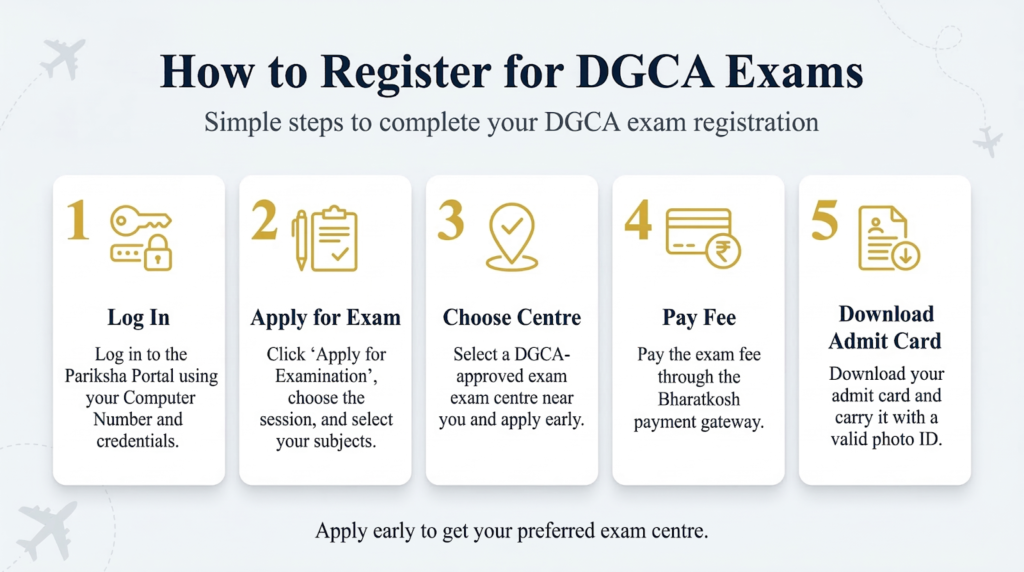
How to Register for DGCA Exams
Once you have your DGCA Computer Number, registering for an exam is a straightforward process:
Log In to the Pariksha Portal: Visit and log in with your Computer Number and date of birth (for first-time login) or your registered credentials.
Select Exam Application: Click ‘Apply for Examination.’ Select the session (Regular or OLODE) and choose the subjects you wish to attempt. You can appear for one or multiple subjects in a single session.
Choose Your Exam Centre: Select a DGCA-approved exam centre near you. Available centres include Delhi, Mumbai, Bengaluru, Chennai, Kolkata, Hyderabad, and other approved locations. Apply early because popular centres fill up fast.
Pay the Exam Fee: Exam fees range from approximately ₹2,500 to ₹5,000 per subject. Payment is processed through the Bharatkosh government payment gateway via net banking, debit, or credit card.
Download Your Admit Card: Once confirmed, download and print your admit card from the portal. Carry it with a valid photo ID proof to the exam centre on exam day.
Best Books for DGCA CPL Exam Preparation
The right study material can make all the difference between a first-attempt pass and repeated retakes.
Subject
Recommended Books / Materials
Key Tip
Air Navigation
RK Bali (Air Navigation) · Oxford Aviation Navigation · Keith Williams Navigation
Practice numericals daily. Understand the concepts, not just the formulas.
Focus on METAR/TAF decoding, fronts, and icing conditions.
Air Regulations
RK Bali (Air Regulations) · DGCA CARs directly · Mock test guides
Always cross-check with the latest official DGCA circulars before the exam.
Technical General
RK Bali (Technical General) · AC Kermode – Mechanics of Flight · Ground school notes
Conceptual understanding matters more than rote learning here.
Technical Specific
Aircraft Flight Manual (AFM) · Pilot Operating Handbook (POH) · Ground school notes
Study with your CFI. This paper aligns directly with your training aircraft.
RTR(A)
WPC RTR Syllabus · ICAO Aviation Phraseology Manual · RT Communication Practice Guides
Practise speaking aviation phraseology aloud. The viva tests fluency, not just knowledge.
Mock Tests
DGCA question bank guides via ground schools · Online DGCA mock test platforms
Reputable question banks reflect years of exam patterns. Essential for exam readiness.
Subject-Wise Preparation Tips for Qualifying the DGCA Exams
Air Navigation – The Most Challenging Subject
Solve at least 10–15 numerical problems every single day. Understand the concepts behind magnetic variation, deviation, and track calculations; do not just memorise formulas. Spend extra time on radio navigation aids (VOR, DME, ILS). This subject has the most questions and the longest exam duration.
Aviation Meteorology -Begin your Preparation with this Subject
Learn to decode METAR and TAF reports fluently. Understand how fronts develop and how they affect flying conditions practically. Study cloud types and their associated weather. Connecting theory to real-world aviation scenarios, this improves recall during the exam.
Air Regulations – The Most Scoring Subject
Read DGCA’s Civil Aviation Requirements (CARs) directly, especially sections on licensing, flight rules, and airspace. This subject is regularly updated; always check for the latest DGCA circulars. Memorise specific numbers (altitudes, distances, time limits) that frequently appear in questions.
Technical General – Build Your Aircraft Knowledge
Start with aerodynamics and build upward to aircraft systems. Understand how each system works at a conceptual level. Diagrams and flowcharts help. Avoid the trap of memorising without understanding. Exam questions test whether you truly understand the concepts.
Technical Specific – The Easiest Paper If Prepared
Study the Pilot Operating Handbook (POH) of your training aircraft thoroughly. This subject rewards students who have been paying close attention during their actual flying. Work closely with your Certified Flight Instructor (CFI) to identify the exact systems and limitations covered in this paper.
RTR(A) – Radio Telephony Restricted (Aeronautical)
Practise radio calls aloud. Record yourself doing standard Air Traffic Control (ATC) communication and listen back. Study the phonetic alphabet until it is completely automatic. Speak clearly and at the right pace during the viva; confidence and fluency are assessed, not just knowledge.
How to Prepare for DGCA Exams After Class 12th
Most students who want to fly have no idea what to do the day after their Class 12 results come out. The process is straightforward; you just need to know the right order.
Step 1: Get Your Class 2 Medical Certificate: Get your DGCA-approved pilot medical testsdone first. If you don’t clear the medical, nothing else matters.
Step 2: Get Your DGCA Computer Number: Register on the eGCA portal. Upload your Class 10 and 12 marksheets, Aadhaar, photo, and signature. CBSE/DigiLocker students get it in 48 hours. State board students wait 20–30 days. You cannot register for any exam without this.
Step 3: Download the Official DGCA Syllabus: Go to the DGCA portal → Examinations section. Download the syllabus PDF for each subject. Study from this only and not from outdated notes or third-party material.
Step 4: Join a DGCA Ground School: Self-study works, but a structured ground school keeps you on track, gives you updated notes, and runs mock tests. At VFTI, ground school runs alongside your flight training, so theory and flying reinforce each other.
Step 5: Study One or Two Subjects at a Time: Spread preparation over 6 to 9 months. Start with Air Regulations and Meteorology. Tackle Air Navigation and Technical General later, both are calculation-heavy and need more time.
Step 6: Take Mock Tests Before Every Exam: Do at least 2 to 3 full mock tests per subject before the actual exam. This is where you catch gaps, build speed, and get comfortable with the CBT format.
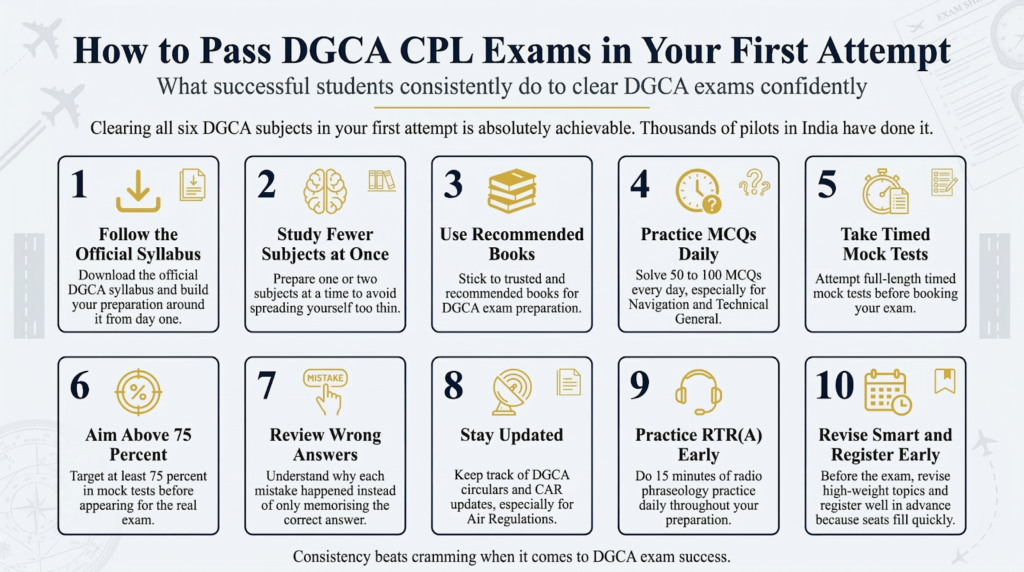
How to Pass DGCA CPL Exams in Your First Attempt
Clearing all six DGCA subjects in your first attempt is absolutely achievable. Thousands of pilots in India have done it. Here is what the successful ones consistently do:
Follow the official DGCA syllabus for pilot courses from day one. Download it from and build your entire preparation around it.
Study one or two subjects at a time. Attempting too many subjects in one exam session often leads to spreading yourself too thin and failing multiple papers.
Use recommended books to prepare for your DGCA exams.
Solve at least 50 to 100 MCQs daily. Particularly for Navigation and Technical General, daily practice is non-negotiable.
Take full-length timed mock tests for every subject before booking your exam. Aim for 75% or above in mock tests before you sit for the real one.
Review every wrong answer in your mock tests. Do not just note the correct answer; understand why you got it wrong.
Stay current with DGCA circulars and CAR updates, especially for Air Regulations.
Start RTR(A) practice early and never stop. Do 15 minutes of radio phraseology practice daily throughout your preparation period.
Before the exam, re-read high-weight topics, not the entire syllabus. Focus on areas where questions are most frequently asked.
Register for the exam well in advance. Do not wait until the last week of registration; exam seats fill quickly, especially in major cities.
Suggested Study Timeline for DGCA Exams (12-18 Months)
Most students who pass all five DGCA subjects without repeating spend 12 to 18 months in dedicated preparation alongside their actual flight training. All the effort, discipline, and long study hours are worth it when you consider the salary of a pilot in India, which makes this career path both prestigious and financially rewarding. Here is a realistic study timeline:
Phase
Duration
Focus Areas
Goal
Phase 1
Month 1–2
DGCA Computer Number · Class 2 Medical · Enroll in ground school · Begin Air Regulations and Meteorology
Administrative groundwork complete; first two subjects started
Phase 2
Month 3–5
Complete Air Regulations and Meteorology · Start Air Navigation · Begin mock tests for completed subjects
Attempt Air Regulations and Meteorology in Session 1
Phase 3
Month 6–9
Complete Air Navigation (high revision focus) · Begin Technical General · Mock tests daily
Attempt Air Navigation in Session 2
Phase 4
Month 10–14
Complete Technical General and Technical Specific · RTR(A) preparation · Full syllabus revision for all subjects
Clear Technical General, Specific and RTR(A) in Sessions 3–4
Phase 5
Month 15–18
Complete flying hours · Class 1 Medical · CPL application preparation
All 5 DGCA subjects and RTR(A) cleared; CPL application ready
Common Mistakes to Avoid while Preparing for DGCA Exams
Thousands of Indian students appear for DGCA exams every year. Many who fail do so not because they lack ability, but because they fall into predictable traps:
❌ Relying Only on Memorisation
DGCA questions are crafted to test understanding, not memory. Students who memorise without understanding are easy to trip up. Focus on the ‘why’ behind every concept, not just the ‘what.’
❌ Skipping the DGCA Question Bank
Well-established question banks reflect years of repeated exam patterns. Ignoring them means missing out on high-frequency topics and predictable question phrasing, costly for a 70% pass threshold.
❌ Underestimating Meteorology and Navigation
Many students treat Meteorology and Navigation as ‘easy theory.’ Both involve calculations, charts, and decoding real-world data. These two subjects consistently have among the lowest pass rates.
❌ Attempting All Subjects in One Session
Registering for all five subjects at once stretches your preparation too thin. Focus on one or two subjects per session. A first-attempt pass in two subjects beats a fail in five.
❌ Not Tracking the 5-Year Validity Window
If you pass Air Navigation in 2025 and delay the rest of your training, your result expires in 2030. Students who delay flight training often find their earlier results have lapsed, costing them time and money on retakes.
❌ Ignoring RTR(A) Preparation
The RTR(A) exam’s oral/viva component surprises many candidates who have only prepared for the written part. If your radio communication sounds hesitant during the viva, you will not pass, even if you aced the written test.
❌ Not Keeping Up with DGCA Regulation Updates
Air Regulations is a dynamic subject. DGCA frequently updates its Civil Aviation Requirements (CARs). Studying outdated material is one of the most avoidable errors.
Can You Clear DGCA Exams Through Self-Study, or Should You Join a Ground School?
Yes, you can self-study, but a ground school gets you there faster and with fewer failed attempts.
This is one of the most common questions among aspiring pilots.
It is possible to clear DGCA exams through self-study. People have done it. However, the path is significantly harder and longer. Self-study for all six subjects typically takes 12 to 18 months or more. You have to figure out everything on your own, including which books to use, which topics are high-priority, how to interpret complex navigation formulas, and how to practise RTR. Without structured guidance, you will spend time on the wrong materials and miss important syllabus updates.
Self-study works reasonably well for Air Regulations and Aviation Meteorology because they are more conceptual and text-based.
Air Navigation and Technical General are a different matter. Both involve complex calculations and system-level knowledge, and without proper guidance, most students fail these on the first attempt.
On the other side, a good DGCA ground school condenses months of self-study into 6 to 8 weeks per subject. They provide structured concept teaching and offer mock tests that reflect the actual DGCA exam pattern. Expert instructors help you understand the concept better.
The most efficient approach is a combination of both.
At Vision Flying Training Institute, our integrated ground school programme runs alongside your flight training. You get structured theory instruction, subject-wise mock tests, and instructor support, all in one place. This means your theory preparation stays aligned with what you are actually learning in the cockpit, creating a deeper understanding of both.
How VFTI Prepares You for DGCA Exams
Clearing DGCA exams requires more than self-study. The students who consistently pass on the first attempt are those who have access to structured ground school training, experienced instructors, and an environment where theory is connected to real flying. Vision Flying Training Institute (VFTI) is a DGCA-approved Flying Training Organisation (FTO) based in Amreli, Gujarat, with its admission office in Dwarka, New Delhi. VFTI is part of the Vision Group of Institutions, an organisation with over two decades of experience in education.
Experienced Flight Instructors: Seasoned CPL-certified instructors who teach ground theory from real-world cockpit experience, not just textbook knowledge. Theory and flying are taught in context.
Modern Aircraft Fleet: Tecnam P2008 JC, Cessna 172 Skyhawk, Tecnam P-Mentor, Multi-Engine Simulator. Your Technical Specific preparation aligns with the actual aircraft you fly.
365-Day Flying Weather: Amreli, Gujarat, offers year-round ideal flying conditions. Your flight hours are never delayed by poor weather, keeping your 5-year result validity window well within reach.
In-House MRO & CAMO: CAR-145 approved Maintenance, Repair & Overhaul facility on-site. Minimum aircraft downtime keeps your training and exam preparation schedule on track.
International Standards: Training delivered to ICAO-aligned standards, giving you both DGCA exam readiness and preparation for international aviation careers.
Career Support: Dedicated career guidance to help you navigate from ground school to airline selection, including support with documentation, licensing, and placement.
When you train at Vision Flying Training Institute, your ground theory classes and your flying hours happen in the same environment. The instrument panel you studied in Technical Specific class is the same one in the cockpit you fly. That alignment is what makes the difference between a student who barely passes and a pilot who understands aviation.
Frequently Asked Questions (FAQs)
What is the passing mark for DGCA exams?
You must score a minimum of 70% in each subject to pass the DGCA Commercial Pilot License theory exams. This threshold applies to all five ground theory papers. There is no negative marking and no combined average; each paper stands independently. For RTR(A), the assessment is pass/fail.
How many times is the DGCA exam conducted in a year?
DGCA conducts Regular exams approximately 4 times a year (roughly in March, June, September, and December). In addition, DGCA also holds OLODE (Online On-Demand Examination) sessions in between regular cycles, subject to availability.
What subjects are there in DGCA CPL exams?
DGCA CPL theory exams consist of 5 core subjects:
Air Navigation,
Aviation Meteorology,
Air Regulations,
Technical General, and
Technical Specific.
All CPL candidates must also clear RTR(A), the Radio Telephony exam.
Is there a limit on the number of attempts for DGCA Exams?
No. DGCA does not impose any limit on the number of attempts for any subject. However, all subjects must be cleared within 5 years of passing your first paper, as individual subject results expire after 5 years.
What is a DGCA Computer Number, and how do I get one?
The DGCA Computer Number is a unique 10-digit alphanumeric ID issued by DGCA to every aspiring pilot. Apply on the Pariksha portal by submitting your Class 10 & 12 mark sheets, Aadhaar, photograph, and signature. CBSE/DigiLocker students can receive it in ~48 hours; others may take 20–30 days.
What is the eligibility to appear for DGCA CPL exams?
You must be at least 17 years old, have passed Class 10+2 with Physics and Mathematics from a recognised board, hold a valid Class 2 Medical Certificate, and possess a valid DGCA Computer Number. A Class 1 Medical Certificate is required before the final CPL is issued.
How long are DGCA exam results valid?
Each passed DGCA subject paper is valid for 5 years from the date of passing. You must clear all remaining subjects and complete your CPL requirements within this 5-year window.
Can I clear DGCA exams while doing my flying training?
Yes, and this is the recommended approach. Most students pursue their DGCA ground theory exams simultaneously with their flight training at an FTO. Studying theory alongside actual flying reinforces concepts practically, especially for Technical Specific and Air Navigation.
Is there negative marking in DGCA exams?
No. DGCA CPL theory exams carry zero negative marking. A wrong answer costs you nothing. Always attempt every question; an educated guess is always better.
Is the DGCA Exam tough?
Yes, DGCA CPL exams are genuinely challenging. They are not designed to be easy, and they should not be. A commercial pilot carries the responsibility of hundreds of lives, and the DGCA exam system exists to ensure that every certified pilot has solid, tested aviation knowledge.
Can I appear for DGCA exams without joining a flying school?
Yes, you can appear for DGCA theory exams independently; you do not need to be enrolled in a flying school at the time of the exam. However, for CPL issuance, you will need to complete your flying hours at a DGCA-approved Flying Training Organisation.
Is the RTR(A) exam conducted by the DGCA?
No. The RTR(A) – Radio Telephony Restricted (Aeronautical) exam is conducted by the WPC (Wireless Planning and Coordination) Wing of the Ministry of Communications. However, passing RTR(A) is mandatory for CPL issuance. It includes both a written paper and an oral viva component.
Can students from arts or commerce backgrounds appear for DGCA exams?
Yes, but they must first complete Physics and Mathematics at the Class 12 level. This can be done through NIOS (National Institute of Open Schooling) or another recognised open schooling platform. Once these subjects are cleared, arts and commerce students are fully eligible to apply for a Commercial Pilot License.
How much does it cost to appear for DGCA exams?
DGCA exam fees are nominal compared to your overall pilot training cost. You pay per subject when you register through the Pariksha DGCA portal. Ground school fees vary depending on the institute; most reputed DGCA ground school programmes charge between ₹1.5 lakh and ₹2.5 lakh for all six subjects, though this varies significantly by provider and format (offline, online, or hybrid).
Your Path to the Cockpit Starts Here
Every aviation professional who flies in Indian skies has cleared these same DGCA papers at some point in their career. The path is simple: get your DGCA Computer Number, enrol in structured ground school training, follow a subject-wise study plan, practise numericals daily, and step into the cockpit as a pilot who genuinely understands the sky.
At Vision Flying Training Institute (VFTI), we do not just train pilots; we build aviation professionals. Our DGCA-approved program at Amreli, Gujarat, combines world-class ground instruction with hands-on flying on a modern aircraft fleet, in weather conditions that allow you to fly 365 days a year. This is where your pilot journey should begin.
A common myth circulates in Indian households: “If you want to be a pilot, you must take Science in 12th grade.”
We are here to tell you that they are wrong. A commerce student can become a pilot in India.
Historically, the profession of a Commercial Pilot was viewed through a exclusionary lens. It was perceived as the exclusive domain of “Science Stream” students, especially those who had mastered the rigors of Physics, Chemistry, and Mathematics in their higher secondary education.
However, the actual guidelines from Directorate General of Civil Aviation (DGCA)does not match what many people assume. The academic pathways to the cockpit are far more flexible than many Indian parent or career counselor realises.
In this guide, we will explain how a Commerce student can become a pilot in India. We will also show how Vision Flying Training Institute (VFTI), the best flying institute in India, helps you prepare for your DGCA exams and earn your Commercial Pilot License (CPL).
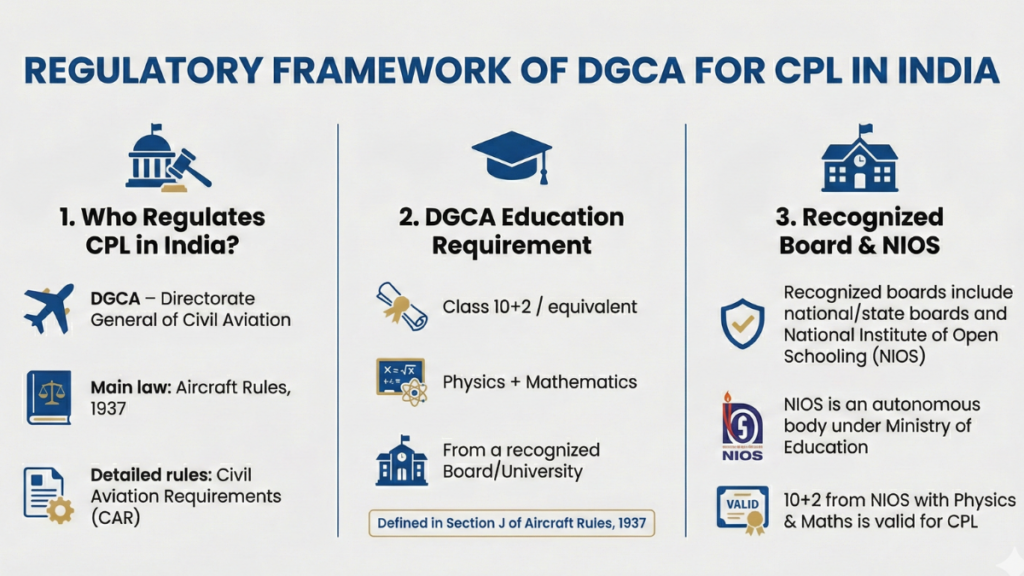
Regulatory Framework of the Directorate General of Civil Aviation for the Commercial Pilot Licence in India
Before understanding how a Commerce student can become a pilot, one must first go through the legal texts that govern Indian civil aviation. The main governing document is the Aircraft Rules, 1937. This is supported by the Civil Aviation Requirements (CAR).
The Specificity of Educational Requirements:
recognisedThe requirements for the issuance of a Commercial Pilot License (CPL) are detailed in Section J of the Aircraft Rules, 1937. An applicant must have passed Class 10+2 or an equivalent examination with Physics and Mathematics, from a recognized Board/University.
The Legitimacy of National Institute of Open Schooling (NIOS):
The second critical component is the term “recognised Board.” The National Institute of Open Schooling (NIOS) is an autonomous institution under the Ministry of Education, Government of India. It was established precisely to provide flexibility in education.
Table 1: Comparative Validity of Boards for DGCA Licensing
Feature
CBSE / ICSE / State Boards
National Institute of Open Schooling (NIOS)
Legal Status
Recognized by Ministry of Education
Recognized by Ministry of Education
DGCA Acceptance
Fully Accepted
Fully Accepted
Subject Flexibility
Rigid Streams (Science/Commerce/Arts)
Pick Individual Subjects
Exam Schedule
Fixed (March/April)
On-Demand (Year-round)
Primary Use Case
Foundational Education
Bridging & Up-skilling
The marks sheet from NIOS containing Physics and Mathematics is not distinguishable in law from the marks sheet of CBSE for the issuance of a pilot license. It is a designed feature of the Indian educational framework to allow career shifts without repeating entire academic years.
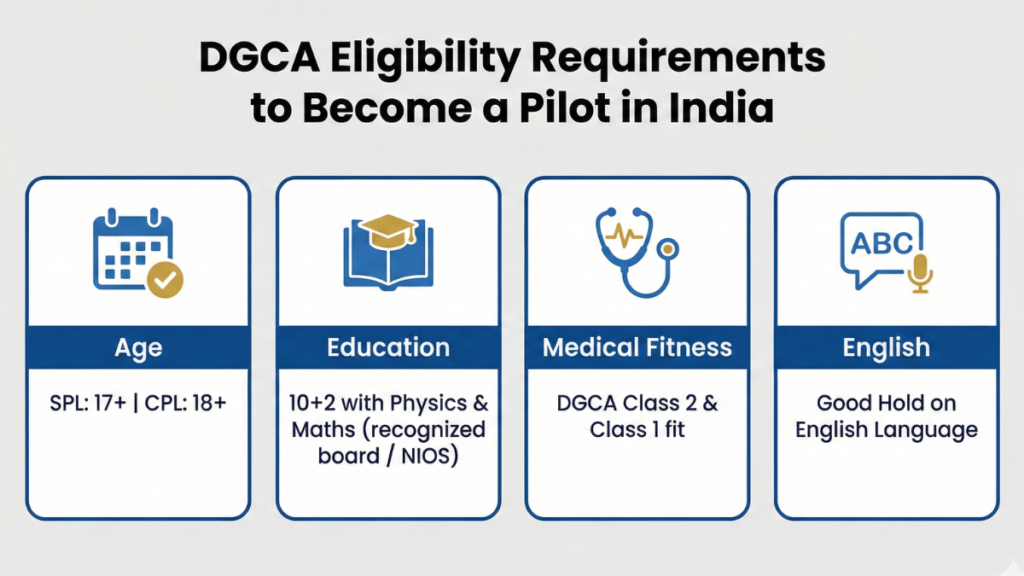
DGCA Eligibility Requirements to Become a Pilot in India
You need to fulfill some requirements specified by the DGCA in order to become a Commercial Pilot in India.
The eligibility criteria for a Commercial Pilot License (CPL) are:
Age: Must be at least 17 years old to start flight training for a Student Pilot License (SPL), and 18 years old to get a CPL issued.
Educational Qualification: Need to have 10+2 (Class XII) with Physics and Mathematics, or an equivalent qualification recognized by any board.
This is the key requirement where commerce students need to pay attention. If you have completed 12th in commerce (or arts) without Physics/Math, you can still fulfill this requirement by passing those subjects through an approved board like NIOS or a state open school.
Medical Fitness: Must be declared fit by DGCA-approved doctors (Class 2 and Class 1 Medicals).
English Proficiency: Since all pilot training exams, cockpit communications, and Air Traffic Control instructions are in English, you need a good command of English.
The eligibility criteria for a Private Pilot License (PPL), which is a license for personal/recreational flying are different and actually less strict on the academic side. In fact, to do a PPL in India you only need to be 10th pass (Class X) and 17 years old, with a DGCA Class 2 medical.
This means a PPL could be pursued even without Physics/Math at 12th. However, a PPL only allows you to fly private aircraft for non-commercial purposes. You cannot get a paid flying job with just a PPL. So, if your goal is an airline or commercial flying career, you will eventually need to meet the CPL requirements.
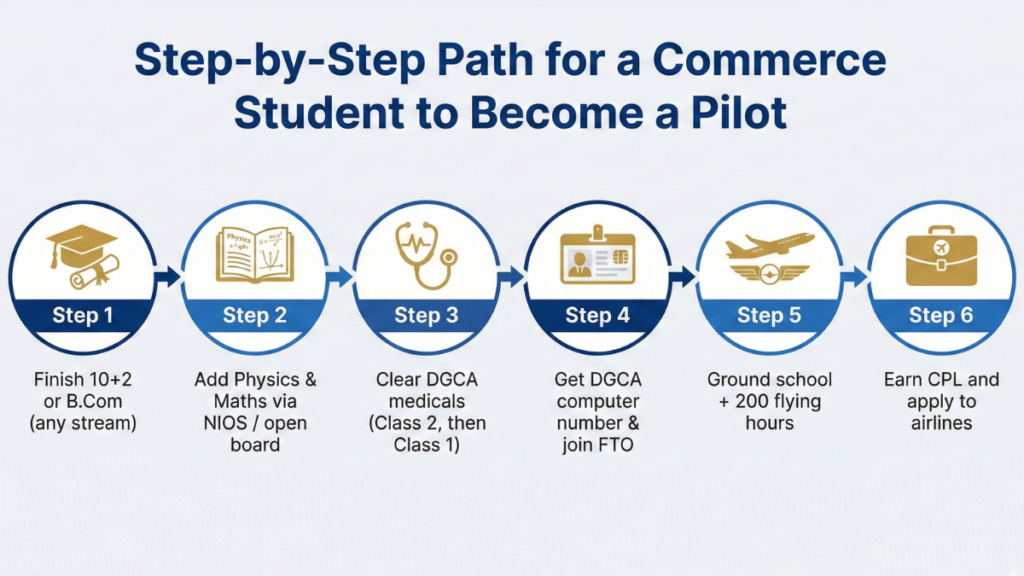
Step-by-Step Path for a Commerce Student to Become a Pilot
Now let’s put it all together. Here is a step-by-step roadmap for a commerce student (12th pass or even a graduate) to become a licensed pilot:
Step 1: Finish High School in any stream. Whether you have just cleared your 12th in Commerce or already have a B.Com degree, you are eligible. The DGCA simply requires a 10+2 passing certificate to get the ball rolling.
Step 2: Bridge the Gap with NIOS. Since you did not take Physics and Math, you will sit for these two subjects via the National Institute of Open Schooling (NIOS). It’s a recognized, flexible way to meet DGCA requirements without repeating high school.
Step 3: Clear Your Medicals Early. Before investing in training, be sure you are fit to fly. Start with a Class 2 Medical (initial checkup), followed by a Class 1 Medical. At Vision Flying Training Institute (VFTI), we always suggest doing this early so you can fly with peace of mind.
Step 4:Secure Your Computer Number & Join an Flying Training Organization (FTO). Your “Computer Number” is your official DGCA ID. Once you have that and your medicals, you can enroll in a Flying Training Organization (FTO). We help you navigate the paperwork so you can focus on the flying training course.
Step 5: Master the Ground School & Flight Hours. You will balance theory (Navigation, Meteorology, and Regulations) with 200 hours of actual flying. Do not worry about the “Science” aspect, our instructors at VFTI translate complex concepts into practical pilot knowledge.
Step 6: Earn Your CPL and Take Off. Once you pass your DGCA exams and complete your flying hours, you will receive your Commercial Pilot License (CPL).
From here, you are ready to apply to major airlines or charter companies and start your career.
Vision Flying Training Institute (VFTI) is an “infrastructure-first” institute. We have helped many commerce students rewrite their journey from balancing ledgers to flying aircraft thousands of feet above the ground. When you have the passion, the discipline, and the dream to wear the white uniform, your school stream will never hold you back.
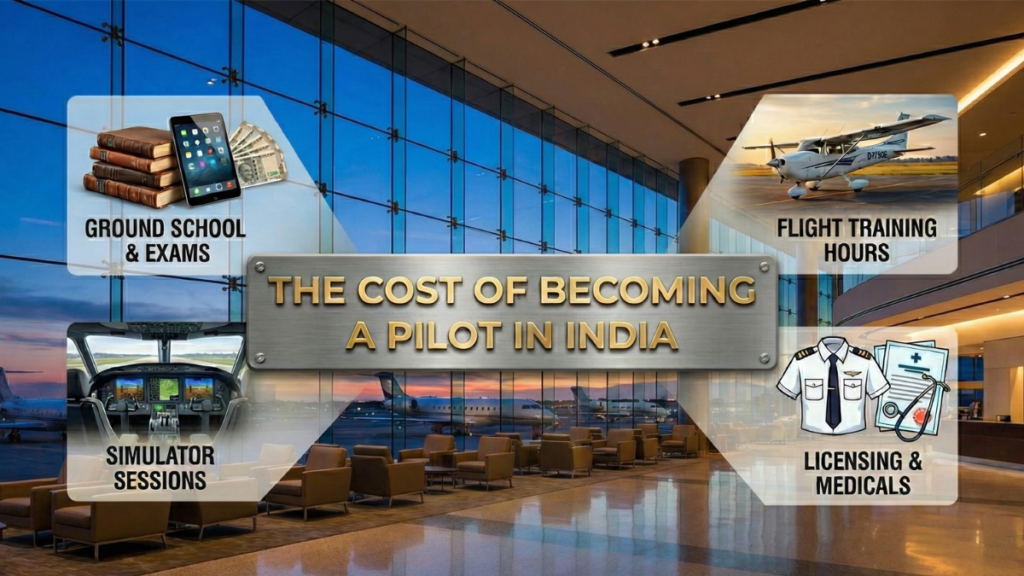
The Cost of Becoming a Pilot in India
Pilot training is an investment. While the cost is significant, the starting pilot salary for a First Officer in Indian airlines (like Indigo, Air India, or SpiceJet) ranges from ₹2 Lakhs to ₹5 Lakhs per month, making it one of the most financially rewarding careers in the country.
The following table provides a comprehensive breakdown of the various cost components.
Table 2: The “Commerce-to-Pilot” Cost Structure
Cost Component
Approximate Cost (INR)
NIOS Registration & Exams
₹5,000 – ₹15,000
DGCA Class 2 Medical
₹5,000 – ₹8,000
DGCA Computer Number & Exams
₹15,000 – ₹20,000
CPL Ground School (VFTI)
₹1,50,000 – ₹2,50,000
Flying Training (200 Hrs at VFTI)
₹35,00,000 – ₹45,00,000
Accommodation & Living (Amreli)
₹2,00,000 – ₹3,00,000
DGCA Class 1 Medical
₹5,000 – ₹10,000
TOTAL ESTIMATED COST
₹40 Lakh – ₹55 Lakh
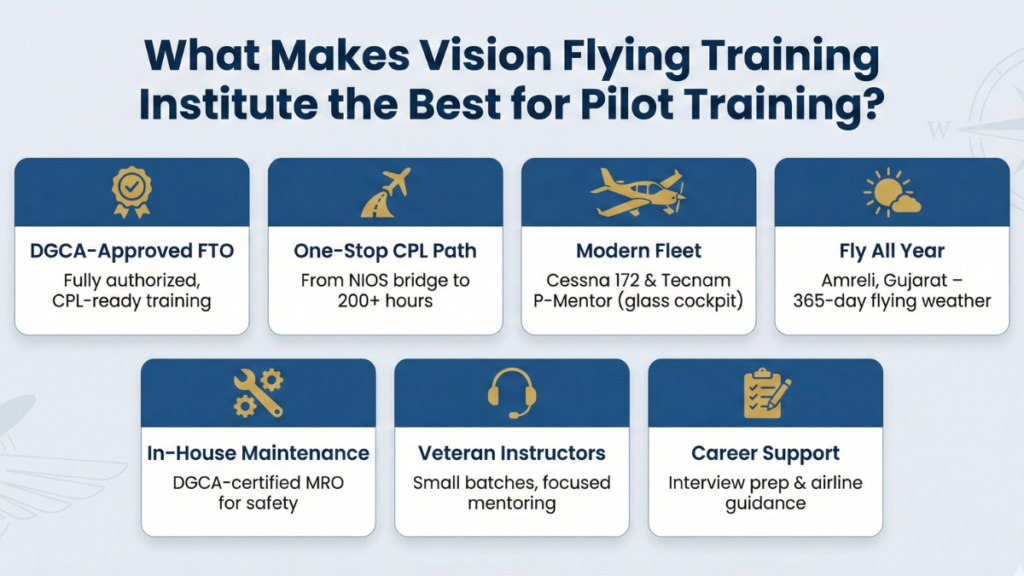
What Makes Vision Flying Training Institute the Best for Pilot Training?
Your choice of training institute for becoming a pilot is important, as it will shape your learning experience and career opportunities.
The best option for aspiring pilots, especially those from commerce or non-science backgrounds is Vision Flying Training Institute (VFTI) . Here’s why:
DGCA-Approved and Highly Rated: We are a fully authorized Flying Training Organization (FTO). Every hour you log and every exam you pass here is 100% recognized by the DGCA and international airlines.
A “One-Stop” CPL Program We handle everything, from helping you clear NIOS for Physics and Math to finishing your 200 flying hours. You focus on the sky; we handle the paperwork.
Modern Fleet & Glass Cockpits Forget outdated planes. You will train on the Cessna 172 Skyhawk and the next-gen Tecnam P-Mentor, featuring the same “Glass Cockpit” technology used in modern Airbus and Boeing jets.
Fly 365 Days a Year Based in Amreli, Gujarat, we enjoy near-perfect flying weather year-round. While other schools are grounded by monsoons or winter fog, our students finish their 200 hours months ahead of schedule.
Safety First (In-House Maintenance) We don’t outsource our safety. VFTI has its own DGCA-certified maintenance facility (MRO) on-site, ensuring every aircraft is in peak condition before you ever turn the key.
Industry-Veteran Mentors Our instructors are not just teachers; they are seasoned captains. We maintain small batch sizes to make sure Commerce students get the personalized attention needed to master technical aviation subjects.
Placement & Career Support Our job is not done when you get your license. We provide interview prep, airline entrance coaching, and career counseling to help you transition from our tarmac to an airline cockpit.
The transition from a Commerce background to a professional pilot is a path well-traveled at VFTI. We have the tools, the weather, and the expertise to help you earn your wings efficiently and safely.
Frequently Asked Questions
Q1.Can I become a pilot after BCom without having Physics in 12th?
Yes, but you must first clear Physics and Mathematics from NIOS or another recognized open board. Once you have these subject certifications, your BCom degree combined with 10+2 (now including Physics and Maths) meets all DGCA requirements.
Q2. Is the NIOS marksheet valid for airline jobs?
Yes. All major airlines, including Indigo, Air India, and Vistara, recognize NIOS marksheets as long as they are verified and meet the DGCA requirements.
Q3. How long does it take for a Commerce student to become a pilot?
The timeline is roughly 18 to 24 months. This includes 4-6 months for ground school and exams, and 12-14 months for flying training (CPL).
Q4. Can I fly if I wear glasses?
Yes. As long as your vision is corrected to 6/6 with glasses and you have no underlying ocular diseases, you can pass the Class 1 Medical.
Q5. Is the DGCA exam difficult for Commerce students?
It requires hard work, but it is not impossible. With the right coaching at VFTI, the “Maths and Physics” involved are purely functional. You won’t be doing theoretical calculus; you will be calculating fuel burn, wind correction angles, and pressure altitudes.
Conclusion
The physics can be learned. The passion must be innate.
Being a Commerce student is not a barrier; it is simply a different starting point. The sky does not ask what subjects you took in 12th grade, it only cares about your ability to handle an aircraft and your dedication to safety.
Visit VFTI to learn more about their CPL training programs, or check the NIOS website for registration windows. Connect with VFTI’s admission counselors to understand how they can guide you through this journey.
Don’t let another year fly by. Contact us today for a free counselling session.
![How to Clear DGCA Exams in India [2026]](https://blog.vfti.co.in/wp-content/uploads/2026/03/E1-scaled.png)