Learn how to become a DGCA-licenced Aircraft Maintenance Engineer (AME) in India. Eligibility, AME course duration, Category A & B licences
Every aircraft that takes off from an Indian airport carries the signature of one person, a DGCA-licenced Aircraft Maintenance Engineer (AME).
Before the pilot starts the engine, an AME has inspected the aircraft and certified that it is fit to fly. That single signature is why becoming an Aircraft Maintenance Engineer is one of the most respected and secure aviation careers in India today.
Below is an overview of how to become an Aircraft Maintenance Engineer in India. The information here is based on the latest DGCA CAR-66 and CAR-147 regulations.
| Quick Overview | Details |
| Course Name | Aircraft Maintenance Engineering (AME) |
| Regulatory Body | Directorate General of Civil Aviation (DGCA), Government of India |
| Eligibility | 10+2 with Physics, Chemistry, Maths (min 50%) OR 3-year Engineering Diploma |
| Minimum Age | 16 years (no upper age limit) |
| Basic Course Duration | 2 years / 2,400 training hours (60% theory, 40% practical) |
| Mandatory Experience | 2 years at a CAR-145 approved MRO (1 year for Cat A) |
| Total Time to Licence | 3 – 4 years for Category B |
| Course Fees | ₹5 – ₹8 lakh for the full programme |
| Licence Categories | Cat A, B1.1, B1.2, B1.3, B1.4, B2, C |
| Total CAR-66 Modules | 17 modules (study 10–11 based on chosen category) |
| DGCA Exam Frequency | 3 times a year via pariksha.dgca.gov.in |
| Starting Salary (Fresher B1.1) | ₹1.25 lakh+ per month / ₹15 LPA and above |
| Top Earning Potential | ₹4 – ₹10 lakh per month (Gulf / EU senior roles) |
| Top Recruiters | IndiGo, Air India, AIESL, GMR Aero Technic, Akasa Air, SpiceJet |
| Licence Validity | Indian-registered aircraft (convertible to EASA Part-66 / FAA) |
Who is an Aircraft Maintenance Engineer (AME)?
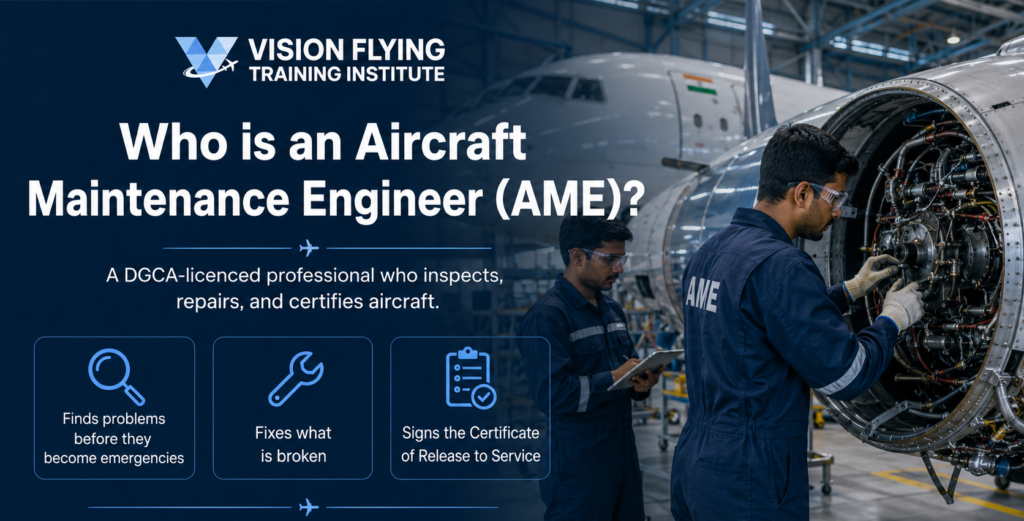
An Aircraft Maintenance Engineer is a DGCA-licenced professional who inspects, repairs, and certifies aircraft. After every flight or scheduled check, an AME examines the aircraft’s mechanical structure and electronic systems.
The job comes down to three things.
- First, you find problems before they become emergencies, like daily walk-arounds, scheduled maintenance, and troubleshooting whenever a pilot reports a fault.
- Second, you fix what is broken, from a worn tyre to a faulty avionics box.
- Third, you sign off on the Certificate of Release to Service. It is the document that legally clears the aircraft for its next flight.
Different countries use different titles. In the US, they are called Aircraft Mechanics, in Europe Aircraft Technicians, and in India, we say Aircraft Maintenance Engineers. The work is essentially the same, and the responsibility is essentially absolute.
Why Choose AME as a Career in India in 2026?
India is now the third-largest domestic aviation market in the world, and the demand for licenced AMEs is rising. Here are the numbers that show why this is the right time to enter the field:
- India’s airport network has grown from 74 airports in 2014 to 163 airports by October 2025.
- IndiGo has ordered over 500 Airbus aircraft, and Air India has committed to 570 new aircraft between Airbus and Boeing. India’s airline fleet is projected to reach 1,100 aircraft by 2027.
- India currently produces only about 3,500 licenced AMEs every year from 57 DGCA-approved institutes, a number considered far below the industry’s actual need.
- Government schemes like UDAN are opening Tier-2 and Tier-3 airports, creating fresh maintenance jobs across the country.
The supply-demand gap is what makes this career so attractive. Every new aircraft that joins the Indian fleet needs trained engineers to maintain it, and that opportunity is yours to claim.
Eligibility Criteria to Become an Aircraft Maintenance Engineer in India
DGCA has clear minimum requirements for anyone entering the AME profession. You must meet every one of them.
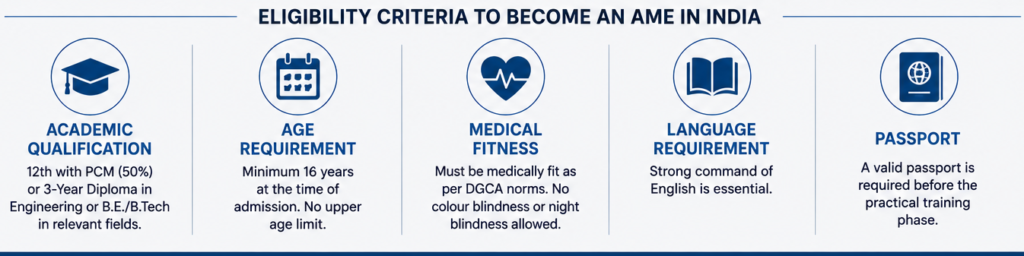
- Academic Qualification: Candidates must meet one of the following educational requirements:
- Pass Class 12 with Physics, Chemistry, and Mathematics from a recognized board, with a minimum of 50% aggregate marks. Some institutes may allow 45% for reserved categories.
- Complete a 3-year Diploma in Mechanical, Electrical, Electronics, or Aeronautical Engineering from a board recognized by the All India Council for Technical Education (AICTE).
- Hold a B.E./B.Tech degree in Mechanical, Electrical, Electronics, Aeronautical, or Aerospace Engineering, which may provide relaxation in the licensing experience requirement.
- Age Requirement: Minimum 16 years at the time of admission. There is no upper age limit, despite what a few outdated articles claim.
- Medical Fitness: The candidate must be medically fit as per DGCA norms. No colour blindness or night blindness is allowed, as these are strict grounds for rejection, so candidates should get tested before applying. A medical fitness certificate from a registered medical practitioner is also required.
- Language Requirements: A strong command of English is essential, as all technical manuals, DGCA papers, and aircraft documentation are in English.
- Passport: A valid passport is needed before the practical training phase, since airport-side training requires an entry pass.
A Six-Step Guide to Becoming an Aircraft Maintenance Engineer in India
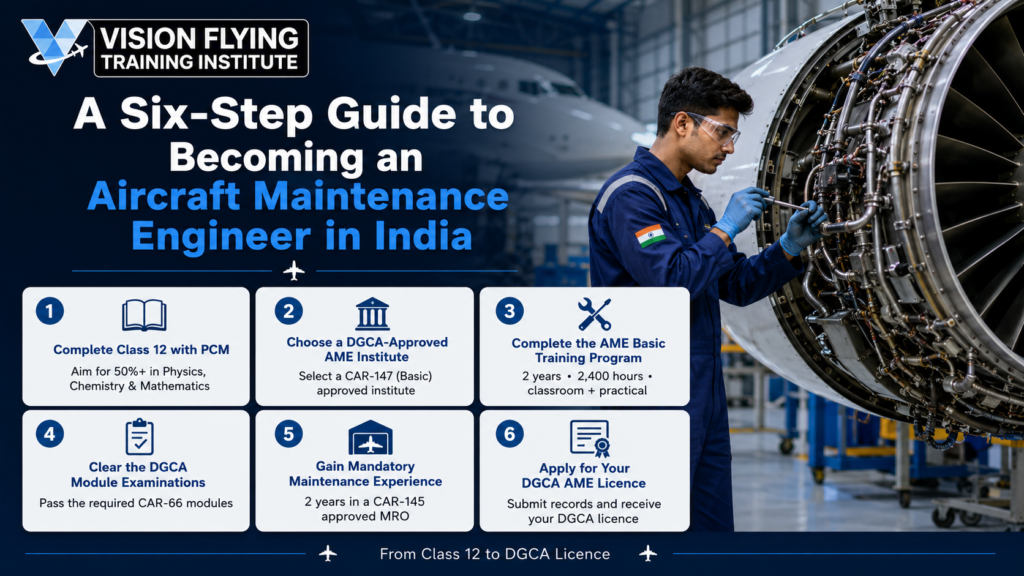
Here is the exact path from Class 12 to a DGCA AME licence. Follow it in order to become an Aircraft Maintenance Engineer in India.
Step 1: Complete Class 12 with PCM
Choose the non-medical (PCM) stream in classes 11 and 12. Aim for at least 50% in physics, chemistry, and mathematics combined. If you are already a diploma or engineering graduate, you can move straight to step 2.
Step 2: Choose a DGCA-Approved AME Institute (CAR-147 Basic)
This is the most important decision of your career. Only candidates trained at a CAR-147 (Basic) approved institute are eligible for the DGCA licence. If the institute is not on the official DGCA list, your time and money are wasted.
Step 3: Complete the AME Basic Training Program
The DGCA-approved AME 147 (Basic) course runs for 2 years and includes 2,400 hours of training, split into 1,440 hours of classroom learning and 960 hours of practical training.
Of the practical hours, a minimum of 288 hours (30%) must be done on actual flying aircraft inside a CAR-145-approved MRO.
A four-year integrated program (offered by some institutes) bundles the basic course with the mandatory two years of maintenance experience needed for licensing.
Step 4: Clear the DGCA Module Examinations
The Directorate General of Civil Aviation (DGCA) holds module-wise examinations through its Central Examination Office (CEO)on the official pariksha portal. The exams are conducted on a regular cycle (quarterly), and a candidate must clear every module of the chosen category.
You do not need to clear all 17 CAR-66 modules, only the ones relevant to your stream. Module 1 (Mathematics) and Module 2 (Physics) are exempted in India because they are already covered in Class 12.
Step 5: Gain Mandatory Maintenance Experience
After clearing the modules, candidates receive a Certificate of Recognition from DGCA. This is the first stamp on the road to a licence, but it is not the licence itself.
In order to obtain the actual AME licence, you must complete 2 years of recorded work experience in a CAR-145 approved Aircraft Maintenance Organisation (AMO). Category A licences require only 1 year of experience. Engineering graduates without a CAR-147 basic course can apply through the “un-organised” route with 5 years of recorded experience, or 4 years for engineering graduates with the one-year DGCA relaxation, but this path is much harder.
Step 6: Apply for Your DGCA AME Licence
Once the module exams are cleared and the maintenance experience is logged, the candidate becomes eligible to apply for the AME licence under Aircraft Rule 61. The DGCA verifies the records, conducts type-rating exams and vivas where required, and issues the licence in the chosen category.
This licence is the gateway. With it, you can legally sign maintenance documents for Indian-registered aircraft anywhere in the country.
DGCA AME Licence Categories
An AME licence is not a general licence that covers every aircraft and every type of maintenance. Some categories focus on mechanical systems, some on avionics, and some on specific aircraft types such as aeroplanes or helicopters. Your AME licence category decides what kind of aircraft maintenance work you will be trained and authorised to do. Knowing the difference helps you choose a licence category that matches your interest and career goals.
| Category | What it covers | Aircraft examples |
| Cat A -Transit / Line Maintenance | Allows limited certification for minor maintenance tasks and routine checks between aircraft landings and take-offs. | Commercial aircraft, within a limited scope |
| Cat B1.1 – Aeroplane Turbine | Covers mechanical maintenance on turbine-engine aeroplanes, typically commercial aircraft above 5,700 kg Maximum Take-Off Mass (MTOM). | Airbus A320/A350, Boeing 737/787, ATR family |
| Cat B1.2 – Aeroplane Piston | Applies to mechanical maintenance of piston-engine aeroplanes, usually smaller training and general aviation aircraft. | Cessna 172, Tecnam P2008, Piper, Cirrus, Diamond |
| Cat B1.3 – Helicopter Turbine | Relates to mechanical maintenance of turbine-engine helicopters. | Sikorsky, Bell, Airbus H145, Leonardo |
| Cat B1.4 – Helicopter Piston | Applies to mechanical maintenance of piston-engine helicopters. | Robinson R44, Enstrom, Schweizer |
| Cat B2 – Avionics | Deals with electrical systems, electronics, instruments, communication systems, and radio navigation systems. | Applicable across aircraft types |
| Cat C – Base Maintenance | Provides senior-level certification authority for base maintenance and release of aircraft after major maintenance. | Aeroplanes and helicopters |
The right AME licence category should match the kind of aircraft and maintenance work you want to build your career around. Students who want to work with commercial airlines often choose B1.1 because most airline fleets in India operate turbine aircraft such as the Airbus A320 family and Boeing 737 family. This makes B1.1 one of the most practical and in-demand AME licence categories.
B2 Avionics is another strong path, especially if you are interested in aircraft electrical systems, electronics, instruments, communication, and radio navigation systems. Avionics specialists are fewer in number than mechanical AMEs, which makes B2 a valuable category in airlines, Maintenance, Repair and Overhaul (MRO) companies, and other aircraft maintenance organizations.
Students who want a stronger long-term career profile can also consider building toward both B1.1 and B2. A dual-category AME has knowledge of both mechanical and avionics systems, which can open better opportunities in senior technical roles and make the candidate more useful to airlines, aircraft MROs, and operators.
AME Course Duration and Fees in India
| Item | Details |
| Category B Basic course duration | 2 years (2,400 training hours) |
| Category A Basic course duration | About 1 year (800 training hours) |
| Mandatory maintenance experience | 2 years for Category B, 1 year for Category A |
| Total time to AME licence | 4 years for Category B, around 2 years for Category A |
| Course fees (Cat B1.1 / B2) | ₹5 – ₹8 lakh for the full programme |
| Type rating after licence (optional) | ₹2 – ₹8 lakh per aircraft type |
Skills Required to Succeed as an Aircraft Maintenance Engineer
Clearing the exam is only half the story. The other half is becoming the kind of engineer airlines want to hire and trust with their fleet.
- Technical proficiency: Strong grip on physics, mechanics, electronics, and aircraft systems.
- Attention to detail: One missed bolt, one wrong reading, one signature without verification, and lives are at risk. AMEs are trained to be obsessive about checking.
- Problem-solving under pressure: Aircraft go unserviceable at 2 a.m. with the next flight at 5 a.m. The AME on duty has to diagnose, fix, and certify in time.
- Physical and mental stamina: Long shifts, night duties, and outdoor work in all weather are normal.
How VFTI Supports the Indian Aviation Career Ecosystem
Vision Flying Training Institute (VFTI) is widely known as a Directorate General of Civil Aviation (DGCA)-approved Flying Training Organisation (FTO) in Amreli, Gujarat. It offers different pilot courses, including Commercial Pilot Licence (CPL), Private Pilot Licence (PPL), and Conversion Flying programmes.
VFTI’s aviation environment goes beyond pilot training. It is also connected to the kind of aircraft maintenance ecosystem that Aircraft Maintenance Engineer (AME) aspirants will work in during their careers.
VFTI has its own CAR-145 approved in-house Maintenance, Repair and Overhaul (MRO) facility and a Continuing Airworthiness Management Organisation (CAMO) department, both certified by the DGCA. Its modern fleet, including the Tecnam P2008 JC, Cessna 172 Skyhawk, Tecnam P-Mentor, and Multi-Engine Simulator, is maintained on campus by licenced engineers. This gives students and aviation aspirants a real view of how aircraft are inspected, maintained, and kept airworthy in a professional DGCA-regulated environment.
Whether your goal is to work on the ground as an AME or fly in the cockpit as a pilot, the industry is opening up meaningful opportunities for well-trained aviation professionals.
Conclusion
Aviation in India has never offered as many opportunities as it does right now. Aircraft Maintenance Engineering and commercial pilot training are two of the strongest, most stable career paths within this growing industry. One keeps aircraft safe and airworthy on the ground, while the other takes them into the sky.
Both careers demand discipline, technical understanding, responsibility, and consistent effort. They also offer something many students look for: long-term career stability and professional respect. The first important step is choosing the right DGCA-approved institute.
Students who have decided to pursue AME should look for a CAR-147 approved college with a strong practical training setup and a real CAR-145 Maintenance, Repair and Overhaul (MRO) tie-up.
Students who feel drawn to flying can explore VFTI’s DGCA-approved CPL, PPL, and Conversion Flying programs. VFTI offers a focused environment for serious pilot training.
A career in aviation starts with the right training. Visit our website or download the latest brochure to explore VFTI’s DGCA-approved pilot training courses.
You can also call +91 9319193602 or email enquiry@vfti.in to speak with our admissions team.
Frequently Asked Questions (FAQs)
- Is AME a good career in India in 2026?
Yes. With India set to become the world’s third-largest air passenger market by 2030 and the country needing thousands of additional licenced engineers to maintain a growing fleet, AME is one of the most stable and rewarding aviation careers. The role is recession-resistant because every aircraft requires daily certification.
- What is the salary of an AME in India?
A fresher AME earns around ₹4-8 LPA, while AMEs with 5+ years of experience and type endorsements earn ₹12-20 LPA. Senior AMEs and Chief Engineers can earn ₹25-50 LPA, and AMEs working abroad (Gulf, EU) often cross ₹30 LPA.
- Can I become an AME after a diploma instead of 10+2?
Yes. A 3-year diploma in Mechanical, Electrical, Electronics, or Aeronautical engineering from a recognised board is accepted by DGCA-approved AME institutes as an alternative to 10+2 PCM.
- How many years does it take to become a licenced AME in India?
Typically 3 to 4 years , 2 years of CAR-147 Basic training plus 2 years of practical maintenance experience in a CAR-145 organisation. Some institutes offer an integrated 4-year program that combines both.
- Is the DGCA AME licence valid abroad?
The DGCA licence is valid for Indian-registered aircraft. To work abroad, most AMEs convert to EASA Part 66 (Europe and most Gulf countries) or FAA (the USA). Conversion requires additional exams but is widely done.
- What is the difference between AME B1 and B2?
B1 is mechanical (engines, airframe, structures, fuel, hydraulics, and landing gear). B2 is avionics (electrical, electronic, navigation, communication, and instruments). B2 is generally rarer and carries a salary premium, while B1.1 has more open positions in Indian airlines.
- Is there an entrance exam for AME admission?
DGCA does not conduct a mandatory entrance exam for AME admission; most DGCA-approved colleges accept direct admission based on 10+2 PCM marks and a medical check. National-level tests like AME CEE, AME CET, and SOACET are conducted by private bodies and are used by some institutes for scholarship-based admission.
- Can a woman become an Aircraft Maintenance Engineer in India?
Absolutely. Indian airlines including IndiGo have launched all-women AME batches, and several women are now senior engineers at MROs, airlines, and the Indian Air Force. The DGCA eligibility rules are gender-neutral.
- Do AMEs work only at airports?
Most AMEs work at airports (line maintenance) or at MRO hangars (base maintenance). Some work at OEM facilities, defence bases, helicopter operators, or even with charter and corporate aviation operators. The work is always around aircraft.
Leave a Reply