Many Indian students choose to complete their Commercial Pilot Licence (CPL) training abroad because of better flying conditions, aircraft availability, faster training timelines, and international exposure. Countries like the USA, Australia, New Zealand, and South Africa are popular destinations for aspiring pilots. Understanding the training cost, requirements, and career opportunities can help students choose the best country for pilot training based on their goals.
However, completing a CPL from another country does not automatically allow you to fly commercially in India.
Before planning your next step in India, there is a question to answer: Do your licence, logbook and recent flying meet DGCA’s requirements?
Foreign CPL to DGCA conversion allows eligible pilots to obtain an Indian licence using their overseas qualifications and experience. You do not automatically need to repeat your entire CPL course. However, the hours you have logged, the aircraft you have flown and the dates of your tests all matter.
This guide explains what to prepare, which exams to take, how conversion flying works and how to plan the time between returning to India and receiving your Indian CPL.
What is Foreign Licence Conversion?
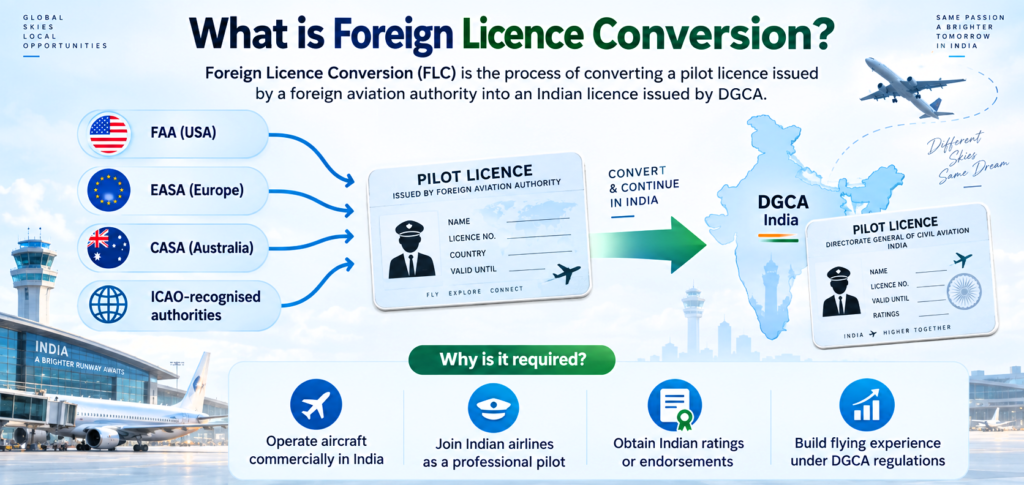
Foreign Licence Conversion (FLC) is the process of converting a pilot licence issued by a foreign aviation authority, such as the FAA (USA), EASA (Europe), CASA (Australia), or other ICAO-recognised authorities, into an Indian licence issued by the Directorate General of Civil Aviation (DGCA).
A foreign pilot licence is valid under the regulations of the country that issued it. However, pilots who wish to continue their aviation career in India must complete the DGCA conversion process and meet Indian licensing requirements.
Foreign Licence Conversion is required if you plan to:
- Operate aircraft commercially in India
- Join Indian airlines as a professional pilot
- Obtain Indian aircraft ratings or endorsements
- Continue building flying experience under DGCA regulations for career progression
The conversion process ensures that foreign-trained pilots meet Indian aviation standards, including DGCA examinations, medical requirements, documentation verification, and applicable flying assessments.
How Do You Convert a Foreign CPL to an Indian DGCA CPL?
Converting a foreign CPL into an Indian DGCA CPL requires meeting Indian licensing requirements, passing the applicable DGCA examinations, holding the required medical and radio qualifications, submitting verified flying experience records, completing necessary skill tests in India, and applying through the eGCA portal. DGCA reviews the application and supporting documents before issuing the Indian licence.
The main conversion framework is governed by CAR Section 7, Series G, Part I, along with the Aircraft Rules and relevant DGCA licensing circulars.
Does a foreign CPL automatically allow you to fly commercially in India?
No. A foreign licence does not automatically give you commercial flying privileges on Indian-registered aircraft. Conversion involves the issue of an Indian licence. Validation is a separate process that recognises a foreign licence subject to specified conditions.
Foreign CPL to DGCA Conversion Requirements
Check your basic eligibility before booking conversion flying.
| Requirement | What you need to check |
| Age | You must be at least 18 when applying for the Indian CPL. |
| Education | You must have passed 10+2 or an equivalent examination with Physics and Mathematics from a recognised board or university. |
| Foreign licence | You need a valid CPL issued by an International Civil Aviation Organization (ICAO) Contracting State, with the relevant rating and currency evidence. |
| Medical fitness | You need valid Indian and foreign Class 1 medical assessments for the conversion application. |
| English proficiency | You need acceptable evidence of English Language Proficiency, at least ICAO Level 4. |
| Radio qualifications | Your RTR and FRTOL documents must meet the applicable Indian requirements. |
DGCA’s licence conversion process requires candidates to complete eGCA registration and maintain accurate records of their required flying experience in the electronic logbook. The conversion guidelines also recognise a valid English Language Proficiency (ELP) endorsement on the foreign licence or an acceptable ELP assessment conducted through a DGCA-approved organisation in India.
Candidates with qualifications or training records issued by overseas institutions should review the applicable verification and equivalence requirements well in advance to avoid delays during the conversion process.
Which DGCA Exams Are Required for Foreign CPL Conversion?
Foreign CPL conversion requires candidates to clear the applicable DGCA theory examinations. The conversion pathway generally includes the following papers:
| Paper | Subjects covered |
| Air Regulations | The applicable aviation rules and procedures. |
| CPL Composite | Air Navigation and Aviation Meteorology. |
The prescribed passing standard for DGCA theory examinations is 70%. CPL theory examination passes must have been obtained within the five years immediately preceding the date of licence application.
Candidates applying under the foreign licence conversion category must hold the relevant foreign pilot licence and meet the applicable eligibility requirements.
DGCA’s eGCA conversion guidelines also recognise separate passes in Air Navigation and Aviation Meteorology as an alternative to the CPL Composite paper. Technical Specific examinations may also be required where applicable, depending on the aircraft type and licence category.
Can you complete DGCA exams before pilot training abroad?
Yes, candidates can plan and complete the required DGCA theory examinations before obtaining their foreign licence, provided they meet the applicable eligibility requirements.
However, the examination pathway for foreign licence conversion may have specific requirements related to holding a valid foreign pilot licence. Candidates should confirm the correct examination category and eligibility criteria with their ground school before registration to avoid complications later during the conversion process.
Foreign CPL to DGCA Conversion: Step-by-Step Process
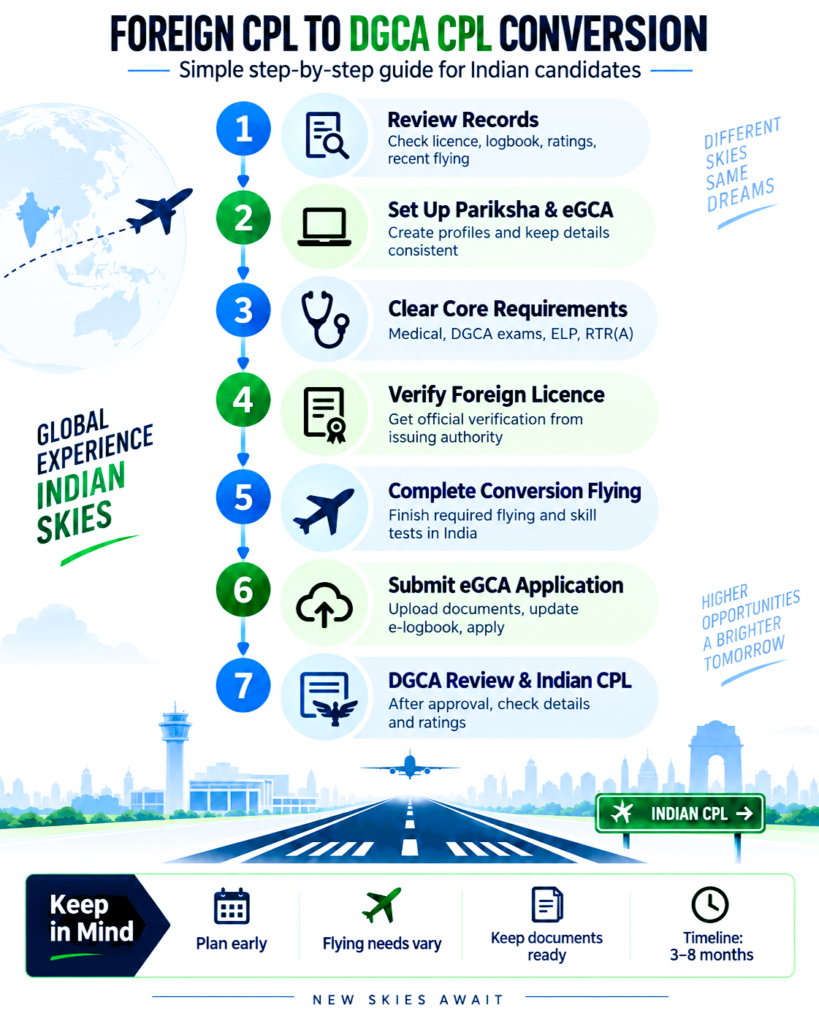
Step 1: Review your records before returning to India
Request a complete review of your training records while your overseas flight school and examiner are still available to help you obtain any missing documents or clarifications.
Prepare a summary of your flying experience, including total flight hours, Pilot-in-Command (PIC) time, cross-country flights, night flying, and instrument experience. Include the dates of your recent flights, checks, and tests alongside these records.
You should also confirm the aircraft category and instrument ratings you want to include on your Indian licence. Completing this review early allows sufficient time to correct missing endorsements, resolve documentation issues, or plan any additional flying requirements before starting the DGCA conversion process.
Step 2: Set up Pariksha and eGCA Correctly
DGCA uses two separate online platforms for different stages of the licensing process.
| Portal | Main purpose |
| Pariksha | Computer Number registration, examination applications and results. |
| eGCA | Licensing applications, relevant medical records and electronic logbook services. |
Your DGCA Computer Number acts as your identification number for flight crew examinations. Make sure that your personal details remain consistent across Pariksha, eGCA, passport records, academic documents, and your foreign licence.
Always follow the latest portal instructions regarding document uploads, verification procedures, and application requirements to avoid unnecessary delays.
Step 3: Complete medical, examination and radio requirements
Complete all pending requirements well in advance instead of waiting until your recent flying experience or test results approach their validity limits.
Create a timeline that includes:
- DGCA examination dates and results
- Medical assessment validity
- RTR(A) status
- Intended licence application date
- Any pending documentation requirements
Maintaining a clear schedule helps identify potential delays early and ensures that one pending requirement does not affect the entire conversion process.
Step 4: Arrange foreign licence verification
Confirm the verification procedure with the aviation authority that issued your foreign CPL before starting the conversion application.
DGCA may verify the authenticity, validity, and details of your foreign licence, training records, and associated documents with the issuing authority and training organisation.
A scanned copy uploaded during the application process and an official verification response from the foreign aviation authority serve different purposes. Maintain records of all verification requests, reference numbers, correspondence, and responses for future reference.
Step 5: Complete conversion flying and skill tests
Complete the required conversion flying and skill tests through a DGCA-approved Flying Training Organisation (FTO).
The applicable conversion requirements include skill tests in India on at least one aircraft type that is intended to be endorsed on the Indian licence. These may include:
- A general flying test by day.
- A general flying test by night.
- A day cross-country test of at least 250 nautical miles, with a full-stop landing away from the departure aerodrome.
- A night cross-country test of at least 120 nautical miles, returning without landing elsewhere.
- An instrument-rating test where applicable.
The required tests must generally be completed within the six months before submitting the licence application.
Candidates should also ensure that supporting evidence, including instrument and navigation-related records, is properly maintained. If acceptable evidence from the foreign training organisation is unavailable, additional requirements may apply in India.
Step 6: Submit a complete eGCA application
Complete your electronic logbook entries and submit the conversion application through eGCA along with all required documents and applicable fees.
Before final submission, cross-check the following details:
- Original logbook entries
- Electronic logbook records
- Flying summary
- Flight dates
- Aircraft registrations
- Pilot status during flights
- Total flight hours
- Ratings and endorsements
Ensure that all uploaded documents are clear, complete, and include visible signatures, stamps, and endorsements wherever required.
After submission, regularly monitor the application status and respond promptly to any clarification or document requests raised by DGCA.
Once the conversion is approved, review your issued licence carefully to confirm that your personal details, aircraft ratings, and endorsements have been recorded correctly. Our visual guide to pilot licences explains the information shown on a licence.
Documents Required for Foreign CPL Conversion
Use this as a preparation checklist alongside the current eGCA requirements.
| Document group | Records to organise |
| Identity and education | Passport, date-of-birth evidence, academic certificates and applicable verification or equivalence documents. |
| Foreign qualifications | CPL, relevant ratings, currency evidence and licence-verification records. |
| Medical and language | Indian and foreign medical assessments, plus ELP evidence. |
| Radio communication | Applicable RTR and FRTOL documents, including exemption decisions where relevant. |
| Flying experience | Authenticated logbooks, electronic entries and category-wise flying summaries. |
| Tests and examinations | DGCA results, flight-test reports, applicable IR records and signal-reception evidence. |
| Application records | Required declarations, photograph, signature and payment acknowledgement. |
Ask the FTO which police-verification, security-clearance or student-licence formalities apply before local flying. Foreign nationals and OCI applicants should check their additional requirements separately.
Can You Convert Your Instrument and Multi-Engine Ratings Too?
Your CPL, instrument rating, and aircraft ratings should be reviewed separately during the conversion process. A rating issued by a foreign aviation authority does not automatically guarantee that every endorsement will transfer directly to an Indian licence.
The standard aeroplane instrument rating pathway requires specific experience requirements, including 100 hours of Pilot-in-Command (PIC) time, with at least 50 hours of cross-country flying, and 40 hours of instrument time, of which no more than 20 hours may be completed through approved instrument ground time. The required instrument experience and skill test must also be completed within the applicable validity period before submitting the licence application.
Before selecting a multi-engine conversion package, discuss the following points with the FTO:
- Whether your aircraft type and existing ratings are eligible for the intended endorsement.
- Which overseas flight records and documents can support the conversion application.
- Which additional technical examinations, training, or skill tests are still required.
- Whether suitable aircraft availability and examiner slots match your planned timeline.
This review should be completed before committing to a conversion package based on a fixed number of flying hours. A personalised assessment helps avoid unnecessary training costs and ensures that the conversion plan matches your actual DGCA requirements.
How Long Does Foreign CPL to DGCA Conversion Take?
There is no fixed end-to-end conversion timeline for every pilot. Your preparation, flying and application processing must be considered separately.
The Ministry of Civil Aviation published an indicative 30-working-day processing timeline for CPL conversion in September 2023. It also explained that processing depends on the complexity and completeness of the application. This is a dated official benchmark for the application stage, not a promise that the whole conversion will finish in 30 days.
| Stage | What determines the time required? |
| Record review and verification | Missing documents, academic verification and the foreign authority’s response. |
| Medical, theory and RTR preparation | Your existing qualifications, appointment availability, examination windows and repeat attempts. |
| Conversion flying and tests | Any hour shortfall, aircraft familiarity, weather, aircraft serviceability and examiner availability. |
| DGCA application processing | Completeness of the submission, document checks and responses to queries. |
What Does Foreign CPL Conversion Cost in India?
There is no single price that applies to every foreign-trained pilot. Your budget should reflect the work still required.
| Cost item | What to clarify before enrolling |
| Ground preparation | Which subjects, refresher classes and study materials are included? |
| Flying | What are the aircraft rates and estimated additional hours? |
| Skill tests | Are examiner, aircraft, airport and repeat-test charges included? |
| Medical and radio requirements | Which assessments, examinations and licence fees remain payable? |
| DGCA application | Which government fees and documentation services are included? |
| Stay and travel | How will a longer stay affect accommodation and travel expenses? |
For reference, the 2025 RTR rules prescribe ₹2,000 for the written examination, ₹500 for the practical examination and ₹5,000 for licence issue. These are radio-qualification charges, not the total CPL conversion cost. Exemptions and repeat attempts affect what an applicant pays.
Request an itemised quote after your logbook review. It should explain the assumptions behind the estimated hours and what happens if you need additional training.
Plan Your Foreign CPL Conversion with VFTI
At Vision Flying Training Institute (VFTI), foreign CPL conversion support is designed around each pilot’s individual requirements. The process includes reviewing training gaps, providing ground-school refreshers, assisting with documentation, arranging additional flying where required, and supporting candidates with radio examination preparation.
VFTI is a DGCA-approved Flying Training Organisation based at Amreli Airport in Gujarat. If you are completing your pilot training overseas or have already returned to India, our team can help you understand the remaining requirements and create a practical conversion plan based on your records.
Before your initial discussion, keep the following details ready:
- The country and aviation authority that issued your CPL.
- Your aircraft ratings and instrument rating details.
- Your total flying hours, flying-hour breakdown, and most recent flight date.
- The DGCA examinations you have already completed.
- Your medical status, English Language Proficiency (ELP) endorsement, and radio licence status.
Contact VFTI to discuss your foreign CPL conversion requirements, expected timeline, and training fees
Contact our admission consultants today!
Call: +91 9319193602, +91 9319193605
Email: enquiry@vfti.in
Conclusion
A successful foreign CPL to DGCA conversion begins with understanding your current qualifications, identifying the requirements that remain, and creating a structured plan before starting the application process.
A detailed review of your licence, flight records, examinations, medical status, and required skill tests can help prevent delays and unnecessary expenses.
Pilots planning to return to India after overseas training should begin preparing early, especially before important documents, medicals, or recent flying experience approach their validity limits.
Vision Flying Training Institute (VFTI) helps aspiring pilots understand their conversion requirements, prepare for pending training needs, and move confidently towards obtaining their Indian DGCA CPL.
Frequently Asked Questions
- Can an FAA CPL be converted to a DGCA CPL?
Yes, an FAA CPL can be converted into a DGCA CPL if the candidate fulfils the applicable Indian licensing requirements. The conversion process involves reviewing your US flight records, verifying the aircraft and instrument ratings you want to transfer, and completing any pending DGCA examinations, documentation, or skill requirements.
- Do I need another 200 hours of flying in India?
No. A pilot does not necessarily need to complete another 200 hours of flying in India for foreign CPL conversion. Eligible overseas flying experience can be considered during the conversion process.
The additional flying requirements depend on your accepted flight experience, recency of flying, aircraft ratings, documentation, and any skill tests or training requirements identified during the review.
- Can I complete the entire conversion while abroad?
Many preparation steps, including document collection, examination planning, and record verification, can be completed while you are overseas.
However, certain requirements, including applicable skill tests on aircraft types intended for endorsement on the Indian licence, must be completed in India as per DGCA requirements.
- Is a foreign Class 1 medical enough?
No. A foreign Class 1 medical certificate alone does not replace the medical requirements established by DGCA.
Candidates must complete the required Indian Class 1 medical assessment and ensure that the medical validity aligns with the planned licence application timeline.
- Does an Indian CPL guarantee an airline job?
No. Obtaining a DGCA CPL is an important milestone, but it does not automatically guarantee airline employment.
Airline recruitment is a separate process that depends on factors such as airline selection criteria, simulator assessments, type ratings, training performance, and operational requirements.
Leave a Reply