You want to fly. Maybe you have had that idea for years, the cockpit, the Boeing or Airbus, the Commercial Pilot License. Before any of that moves forward, there is one step that decides everything.
The pilot medical test.
The Directorate General of Civil Aviation (DGCA) requires every aspiring pilot in India to pass a medical exam to prove they are physically and mentally fit to operate an aircraft. It is the most important eligibility checkpoint on your path to becoming a licensed pilot.
A pilot at 35,000 feet is responsible for hundreds of lives. A blood pressure problem, uncorrected vision, or a heart condition that slipped through screening doesn’t just affect the pilot; it affects everyone on board. That’s why the DGCA sets strict medical standards aligned with the guidelines of the International Civil Aviation Organization (ICAO).
This guide covers everything you need to know about the pilot medical test in India.
What are DGCA Medicals?
DGCA medicals are fitness assessments run by India’s civil aviation regulator. They determine whether a candidate is physically and mentally fit to fly at any stage.
The pilot medical examination covers vision, hearing, heart health, neurological function, blood work, respiratory fitness, and mental health. Every licensed pilot in India, from a student pilot to an airline captain, must hold a valid DGCA medical certificate at all times.
Quick Overview of Class 2 vs Class 1 Medical Tests
Before we go into details, here is a quick look at the medical categories you will encounter as an aspiring pilot in India:
| Parameter | Class 2 Medical | Class 1 Medical |
| Purpose | Student Pilot License (SPL) / Private Pilot License (PPL) | Commercial Pilot License (CPL) / Airline Pilot (ATPL) |
| Minimum Age | 17 years | 18 years |
| Conducted By | DGCA-approved Class 2 Medical Examiners (125+ centres across India) | DGCA-approved Class 1 Medical Centres: AFCME (Delhi), IAM (Bangalore), MEC(E) (Jorhat), Nanavati Hospital (Mumbai), Apollo (Chennai & Delhi) |
| Validity | 24 months (under 40 years) and 12 months (40 years and above) | 12 months (under 40 years) and 6 months (40 years and above) |
| When to Do | Before joining any DGCA-approved flying school | After Class 2, before issuing the Commercial Pilot License |
| Approx. Cost | ₹4,000 – ₹7,000 | ₹7,000 – ₹12,000 |
| Processing Time | 2–4 weeks (DGCA approval) | 4–6 weeks (DGCA approval) |
| Prerequisite | None | Valid Class 2 Medical Certificate |
| Portal | eGCA Portal | eGCA Portal + NOC from DGCA required |
Class 1 is not required until the CPL stage, but most pilots and aviation counsellors suggest getting it done before you spend on CPL training. If you are declared permanently unfit after paying for a pilot course, that money doesn’t come back.
Eligibility for DGCA Medicals
Eligibility varies across the three medical classes. The requirements shift depending on which class you are applying for and which pilot licence you are working toward.
Here is what you need to meet before booking your medical examination:
- Age is the first checkpoint. The DGCA has set minimum age requirements for each stage of the pilot medical and licensing journey. There is no upper age limit for appearing at a DGCA medical; however, older candidates are subject to more frequent renewals and more detailed cardiac and neurological scrutiny.
| Licence / Medical | Minimum Age Required |
| Student Pilot Licence (SPL) + Class 2 Medical | 16 years |
| Private Pilot Licence (PPL) | 17 years |
| Commercial Pilot Licence (CPL) + Class 1 Medical | 18 years |
| Air Traffic Controller (ATC) + Class 3 Medical | 18 years |
- The medical exam has no educational requirement. Your pilot licence does. A CPL in India requires 10+2 with Physics and Mathematics from a recognised board; DGCA won’t issue it without this, regardless of medical fitness.
A Commerce or Arts background does not disqualify you from the medical field. You can sit it now. An arts or a Commerce student can become a pilot; they will need to clear Physics and Mathematics through NIOS or any equivalent recognised board before the CPL licensing process can be completed.
- Both Indian citizens and foreign nationals are eligible to undergo DGCA medicals in India, provided they are training at a DGCA-approved Flying Training Organisation (FTO). OCI (Overseas Citizen of India) cardholders are also eligible.
| Important: DGCA medical certificates are valid only under the Indian DGCA licensing framework. Flying under the FAA (USA), EASA (Europe), or any other authority requires their respective aviation medical assessments separately. |
- This is where many aspiring pilots get confused. The DGCA medical classes must be cleared in the correct order. You cannot directly apply for a Class 1 Medical without first holding a valid Class 2. The correct sequence is:
| a | Clear Class 2 MedicalRequired for SPL/PPL enrolment and to establish your DGCA Computer Number on the eGCA portal. |
| b | Receive DGCA File NumberGenerated after your Class 2 results are submitted to DGCA by your examiner. This becomes your lifelong DGCA identity. |
| c | Apply for Class 1 MedicalOnly possible after you hold a valid Class 2 certificate. Your Class 1 appointment is applied for through the DGCA Medical Directorate via the eGCA portal. |
Skipping or reversing this order is not permitted. Your Class 2 certificate establishes your eGCA identity and enables you to progress to Class 1 and, ultimately, your CPL.
- When you appear for your DGCA medical, you will be required to fill in a medical history declaration form. This form asks about any past or current health conditions, surgeries, medications, and mental health history.
Concealing a known medical condition, even a past one, is a serious aviation offence. If it is discovered later during renewals or DGCA record reviews, it can result in permanent cancellation of your pilot licence.
Types of DGCA Medicals
The DGCA classifies pilot medicals into three categories based on the licence being applied for. Each one maps to a different stage of the pilot journey.
| Medical type | Who usually needs it | Where it fits in the pilot journey |
| DGCA Class 2 | Student pilots, early-stage aspirants, SPL/PPL path, CPL starters | First medical step for most aspiring pilots in India |
| DGCA Class 1 | Commercial pilot applicants, CPL/ATPL pathway | Required before exercising professional commercial pilot privileges |
| DGCA Class 3 | Certain other aviation/remote pilot use cases | Not the standard starting point for aeroplane CPL students |
DGCA Class 2 Medical
Who needs a Class 2 Pilot Medical Test?
Every aspiring pilot starts here. The Class 2 medical is required for:
- Student Pilot Licence (SPL)
- Private Pilot Licence (PPL)
- Commercial Pilot License (CPL), as a prerequisite to Class 1
- Flight Radio Telephone Operator’s Licence (FRTOL)
When should you get your Class 2 Pilot Medical Test done?
Before applying to best DGCA-approved flying school. Without Class 2 medical test clearance, pilot training cannot begin.
Which centers conduct the Class 2 Pilot Medical Test?
Class 2 Pilot Medical Tests are conducted by DGCA-empanelled medical examiners across India. There are more than 125 approved centres spread across Delhi, Mumbai, Bengaluru, Hyderabad, Chennai, Kolkata, Pune, and other cities.
DGCA Class 1 Medical
Who needs a Class 1 Pilot Medical Test?
Any pilot pursuing a Commercial Pilot Licence (CPL) or an Airline Transport Pilot Licence (ATPL). This is the most rigorous medical assessment in Indian aviation and is mandatory for professional flying.
When should you get your Class 1 Pilot Medical Test done?
Many Flying schools only require a Class 2 medical exam to begin pilot training. But clearing the Class 1 medical test before enrolling in CPL training is the smarter move. CPL training runs ₹25–45 lakhs, and a failed Class 1 medical after that spend is a risk worth avoiding entirely.
Which centers conduct the Class 1 Pilot Medical Test?
Class 1 medicals are conducted only at DGCA-approved IAF Aeromedical Centres and select empanelled civil hospitals.
DGCA Class 3 Medical Exams
Who needs a Class 3 Medical Test?
The DGCA Class 3 medical test is for Air Traffic Controllers (ATC officers), Flight Engineers, and other aviation professionals in critical safety roles who are not flying but are actively involved in aviation operations.
Class 3 includes standard physical checks similar to Class 2 but places a stronger emphasis on mental alertness, concentration, decision-making, and stress tolerance.
Step-by-Step Process of DGCA Medical Examination
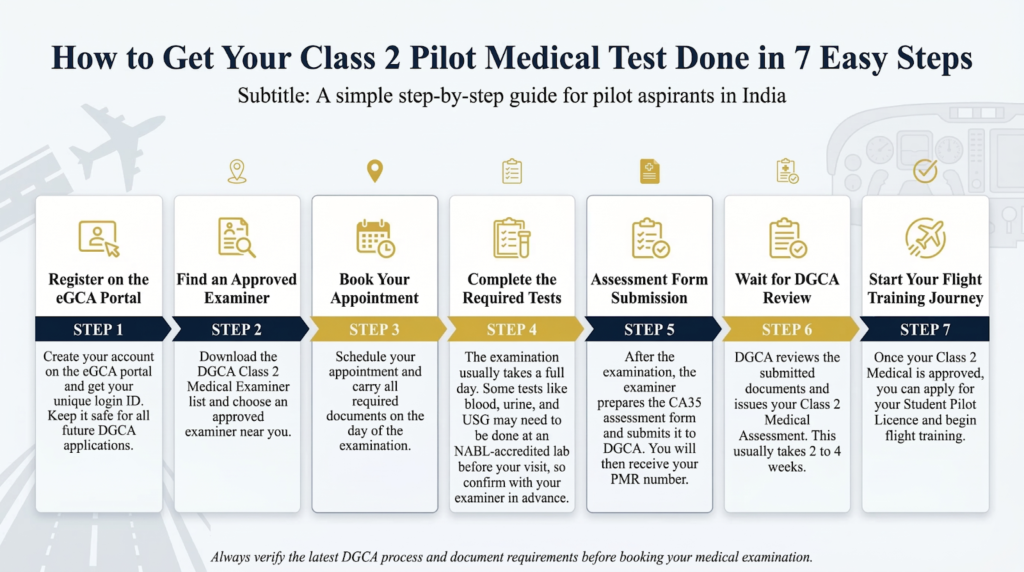
How to Get Your Class 2 Pilot Medical Test Done in 7 Easy Steps
- Register on the eGCA portal and create your account. You will get a unique login ID. Keep it safe, as every future DGCA application runs through it.
- Download the DGCA Class 2 Medical Examiner list and find an approved examiner near you.
- Book an appointment and carry all required documents on the day of the examination.
- The examination usually takes a full day. Some tests (blood, urine, USG) may need to be done at a National Accreditation Board for Testing and Calibration Laboratories (NABL) accredited lab before your appointment, so check with your examiner in advance.
- After the exam, the examiner generates a CA35 assessment form and submits it to DGCA. You will receive a PMR (Permanent Medical Record) number. This is unique to you and stays the same throughout your career.
- DGCA reviews the submission and issues your Class 2 Medical Assessment. Expect this to take 2 to 4 weeks.
- Once approved, you can apply for your Student Pilot Licence and begin flight training.
Step-by-Step Guide to Applying for a Class 1 Medical Exam for a Pilot
- A valid DGCA Class 2 Medical Certificate is required before applying. Without it, your Class 1 application won’t be accepted.
- Log in to the eGCA portal and apply for a No Objection Certificate (NOC) from DGCA. Appointments are only confirmed after the NOC comes through.
- Submit the required documents, choose your preferred centre, and pay the applicable fee through the portal.
- DGCA will forward your Permanent Medical Record (PMR) file to the selected centre roughly 2 to 3 weeks before your appointment.
- Attend the examination with all original documents, medical reports, and your Class 2 certificate.
- If all tests are clear, your report goes to DGCA for final review. Processing takes 4 to 6 weeks, after which you will receive your Class 1 Medical Certificate, valid for one year if you are under 40.
- If declared Temporarily Unfit (TUF), complete the recommended treatment and reapply. Permanent unfitness is rare and applies only to serious conditions.
What Tests Are Included in Each Medical Class?
DGCA Class 2 Medical Tests
| Test | What is Checked |
| Vision Test | Distant vision (6/6), near vision (N5), colour vision (Ishihara), depth perception, peripheral vision |
| Hearing Test | Pure Tone Audiogram, hearing across frequency ranges |
| Chest X-Ray | Rules out lung infections, tuberculosis, and structural anomalies |
| Sinus X-Ray | Checks for sinusitis affecting pressure equalisation in flight |
| Blood Tests | CBC, blood sugar, and kidney function |
| Urine Test | Kidney and metabolic health screening |
| ECG (if indicated) | Basic heart rhythm check |
| General Physical | BMI, blood pressure, neurological reflexes, and musculoskeletal check |
DGCA Class 1 Medical Tests
The Class 1 exam includes everything in Class 2, plus the following:
| Test | What is Checked |
| Detailed Eye Exam | Class 2 tests + ophthalmoscopy, fundus check, slit-lamp where needed |
| Pure Tone Audiometry | Detailed hearing threshold test across frequencies |
| Cardiovascular Evaluation | Resting ECG + Stress Test (TMT) for older candidates |
| Pulmonary Function Test | Lung capacity and airway health |
| Neurological Evaluation | Reflexes, coordination, balance, cranial nerve function |
| Psychological Assessment | Mental fitness, stability, and cognitive function |
| Blood Tests (Detailed) | Lipid profile, liver, kidney, blood sugar, thyroid, if needed |
| Urine Analysis | Full panel |
| ENT Examination | Ear, nose, throat, Whisper Test, and Tympanometry |
| Dental Check (if needed) | Relevant for pressurisation tolerance |
| Radiology | Chest X-Ray, additional imaging if clinically indicated |
Vision Standards
| Standard | Requirement |
| Distant Vision (Unaided) | 6/60 or better in each eye |
| Distant Vision (Corrected) | 6/6 in one eye and 6/9 in the other, or 6/6 in both |
| Near Vision | N5 or better (cockpit instrument reading) |
| Colour Vision | Must pass Ishihara Test — no colour blindness |
| Glasses Allowed? | Yes, corrective lenses (spectacles or contacts) permitted |
| LASIK/PRK Surgery | Allowed, but with a minimum 6-month waiting period before medical |
| Contact Lenses | Permitted for distance correction, not for presbyopia |
Hearing Standards
| Standard | Requirement |
| Speech Reception | Must understand normal speech clearly at 2 metres |
| Hearing Loss Threshold | Must not exceed 35 dB in either ear at 500 Hz, 1000 Hz, 2000 Hz |
| Tests Involved | Pure Tone Audiometry, Whisper Test |
Cost of DGCA Medicals in India
DGCA does not publish a single flat fee that covers every candidate and scenario. In practice, the cost depends on the examiner, the city, the centre, and whether lab tests are billed separately. Based on current Indian aviation sources, the range typically seen is:
| Medical Type | Govt / Air Force Centre | Private / Civil Hospital |
| DGCA Class 2 Medical | ₹3,000 – ₹4,000 | ₹5,000 – ₹8,000 |
| DGCA Class 1 Medical (Initial) | ₹4,000 – ₹6,000 | ₹7,000 – ₹10,000 |
| DGCA Class 1 Medical (Renewal) | ₹3,000 – ₹5,000 | ₹5,000 – ₹8,000 |
| DGCA Class 3 Medical | ₹3,000 – ₹5,000 | ₹4,000 – ₹6,000 |
There is generally no standard “free pilot medical test in India” under the normal DGCA pathway; if you see “free” offers online, they are usually counselling, screening, or marketing hooks, not the official aviation medical itself.
All figures are approximate. The final amount depends on your centre, city, and whether any additional specialist tests are required. Always confirm current fees directly with your chosen centre.
Validity of DGCA Medical Certificates
Your DGCA medical certificate is not a lifetime document. It expires, and you must renew on time. Flying with an expired medical is illegal.
You can renew your Class 2 or Class 1 medical within 30 days before the expiry date without losing the original expiry date.
| Certificate | Age Group | Validity |
| Class 2 (SPL/PPL) | Under 40 | 24 months |
| Class 2 | 40 and above | 12 months |
| Class 1 (Multi-crew, Commercial Air Transport) | Under 60 | 12 months |
| Class 1 (Single-crew / Instructional) | 40 and above | 6 months |
DGCA Approved Medical Centers & Examiners
Initial Class 1 medicals are conducted only at the following IAF Aeromedical Evaluation Centres and DGCA-empanelled civil hospitals:
| Centre | Location | Type |
| IAM, IAF (Institute of Aerospace Medicine) | Bengaluru, Karnataka | IAF Centre |
| AFCME (Air Force Central Medical Establishment) | New Delhi | IAF Centre |
| MEC(E) (Medical Evaluation Centre East) | Jorhat, Assam | IAF Centre |
| 11 Air Force Hospital (11 AFH) | Hindon, Ghaziabad | IAF Centre |
| Command Hospital Air Force Bangalore | Bengaluru, Karnataka | IAF Centre |
| Dr. Balabhai Nanavati Hospital | Mumbai, Maharashtra | Civil Hospital |
| Apollo Hospitals | Chennai, Tamil Nadu | Civil Hospital |
| Indraprastha Apollo Hospital | New Delhi | Civil Hospital |
Over 125 DGCA-empanelled Class 2 Medical Examiners are spread across India, covering most major cities and many smaller towns. The list is available on DCGA under Personnel, then Medical, then Class 2 Examiners List.
Common Reasons for Rejection in DGCA Medicals
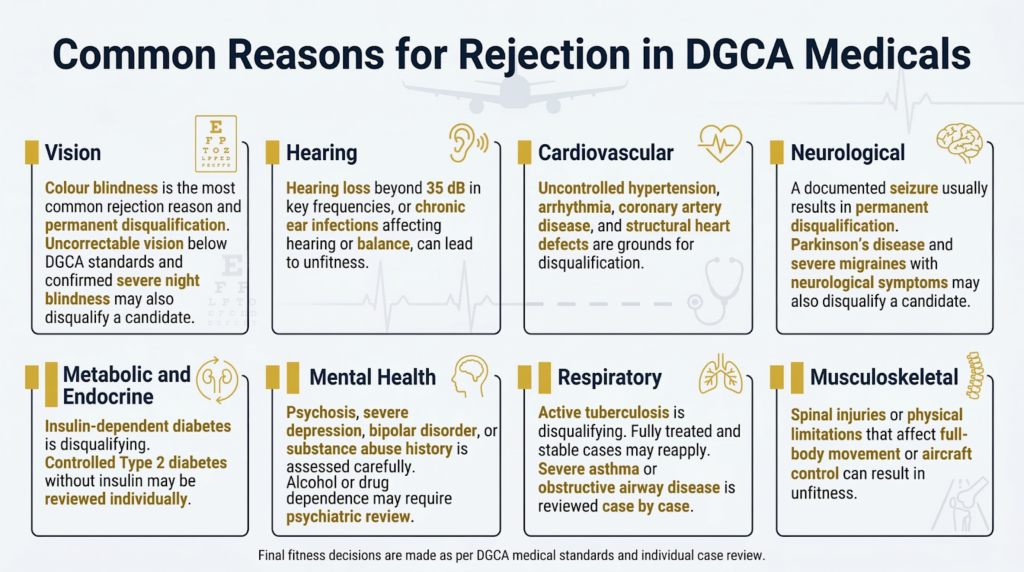
Most healthy young candidates pass without issues. Here are the most common reasons for rejection or temporary unfitness.
Vision: Colour blindness is the single most common rejection reason and results in permanent disqualification. Uncorrectable vision that can’t reach DGCA’s minimum standard, even with lenses, will also disqualify, as will confirmed severe night blindness.
Hearing: Hearing loss beyond 35 dB in key frequencies, or chronic ear infections affecting balance or hearing, can result in unfitness.
Cardiovascular: Uncontrolled hypertension beyond permissible limits, arrhythmia, coronary artery disease, and structural heart defects are all grounds for disqualification.
Neurological: A single documented seizure typically results in permanent disqualification. Parkinson’s disease and severe migraines with neurological symptoms are also disqualifying.
Metabolic and Endocrine: Insulin-dependent diabetes is disqualifying. Controlled Type 2 diabetes (non-insulin) may be considered under individual medical review.
Mental Health: A history of psychosis, severe depression, bipolar disorder, or substance abuse will be assessed carefully. Alcohol or drug dependence is evaluated by DGCA-approved psychiatrists in borderline cases.
Respiratory: Active tuberculosis is disqualifying, though fully treated and certified stable cases can reapply. Severe asthma or obstructive airway disease is evaluated on a case-by-case basis.
Musculoskeletal: Spinal injuries or physical limitations that affect full-body movement or aircraft control can result in unfitness.
Temporarily Unfit (TUF) vs Permanently Unfit
Temporarily Unfit means the condition is correctable. Once addressed, whether that’s reducing BMI, controlling blood pressure, or treating an infection, you can reappear for the medical.
Permanently Unfit means the condition cannot be reversed: colour blindness, a history of seizures, or severe heart defects. A pilot licence cannot be obtained in these cases.
How to Prepare for your Pilot Medical Test in India
The best preparation is a consistent, healthy lifestyle. Not a last-minute scramble. Here is a practical timeline:
6 Months Before
- Get a routine eye check-up, particularly for colour vision. If you wear glasses, confirm your corrected vision meets DGCA standards.
- Run a full blood panel covering blood sugar, cholesterol, haemoglobin, and kidney function.
- If you are considering LASIK or PRK surgery, get it done at least 6 months before your medical.
- Start a regular exercise routine and keep your BMI in check.
1 Month Before
- Register on the eGCA portal and get your Computer Number if you have not already.
- Find and shortlist a DGCA-approved examiner near you.
- Class 1 candidates should send their NOC request to the DGCA Medical Directorate well in advance.
1 Week Before
- Avoid alcohol and smoking for at least 72 hours before the test.
- Sleep properly. Fatigue can push blood pressure up and affect concentration.
- Skip heavy meals, especially if a fasting blood test is involved.
- Stay hydrated, but do not overdo fluids right before urine tests.
- Avoid starting any new medications unless necessary, and let your examiner know about anything you are currently taking.
On the Day of your Exam
- Carry all required documents: Aadhaar, photographs, your 10th certificate, and glasses if you use them.
- Arrive on time. Nerves alone can temporarily spike blood pressure.
- Be honest with your examiner. Hiding a medical condition is a serious aviation offence and can result in permanent licence cancellation down the line.
Conclusion
The pilot medical is not something most candidates need to lose sleep over. If you are a reasonably healthy young person with no major medical history, clearing Class 2 and Class 1 is both manageable.
Book your appointments well in advance.
Get a basic check-up beforehand so there are no surprises on the day. Eat and sleep decently in the weeks leading up to it.
Be honest on your medical history form; undisclosed conditions cause far more trouble down the line than the condition itself.
Once you are cleared, pick the best DGCA-approved pilot training school, such as Vision Flying Training Institute.
Frequently Asked Questions (FAQs)
Q: What is a DGCA medical for pilots?
A DGCA medical is a government-mandated health fitness certificate issued by the Directorate General of Civil Aviation. It confirms that a pilot or aspiring pilot is physically and mentally fit to fly. There are three classes: Class 2 for student pilots, Class 1 for commercial pilots, and Class 3 for air traffic controllers.
Q: Can I become a pilot if I wear glasses in India?
Yes. Wearing glasses does not disqualify you. The DGCA allows corrective lenses, provided your corrected vision meets the required standard: 6/6 in one eye and 6/9 in the other at a minimum. Many working pilots in India fly with spectacles or contacts. Colour vision must be normal regardless.
Q: What medical conditions disqualify a pilot in India?
The most commonly disqualifying conditions are: colour blindness, uncontrolled hypertension, history of epilepsy or seizures, insulin-dependent diabetes, active tuberculosis, severe cardiac conditions, Parkinson’s disease, psychosis, and substance addiction. Colour blindness is the single most common reason for rejection.
Q: What condition makes you unable to fly?
Any condition that causes sudden incapacitation, impairs judgement, reduces sensory perception, or limits physical control makes you unable to fly. This includes seizure disorders, severe heart arrhythmias, psychiatric disorders, colour blindness, and insulin-dependent diabetes. Even temporary conditions like an active ear infection can temporarily ground you.
Q: What is the pilot medical test price in India?
The Class 2 medical costs are between ₹3,000 and ₹8,000, depending on the centre. The Class 1 medical costs are between ₹5,000 and ₹10,000. Air Force centres are generally more affordable than private hospitals. Additional specialist tests, if required, may add to the cost.
Q: Is there an online pilot medical test in India?
No. The physical examination must be done in person at a DGCA-approved centre. The application process, however, is handled online through the eGCA portal (egca.dgca.gov.in).
Q: What is the Class 2 pilot medical?
The DGCA Class 2 medical is the basic pilot fitness test required to obtain a Student Pilot Licence and begin flight training in India. It checks vision, colour vision, hearing, blood, urine, blood pressure, ECG (if indicated), general physical health, and X-rays. It is valid for 24 months for pilots under 40 years of age.
Q: Which is the best Class 1 medical centre in India?
All DGCA-approved centres follow the same regulated standards. IAM IAF Bangalore and AFCME New Delhi are the most authoritative for Class 1 medicals; these are the same centres that evaluate Indian Air Force aircrew.
Q: How long does the DGCA medical process take?
The Class 2 examination takes one day. DGCA then issues the certificate in 2–4 weeks. The Class 1 examination also takes one day at the centre, with a 4–6 week processing time.
Leave a Reply