Have you ever dreamed of flying?
This is your moment. The timing could not be better to earn a Commercial Pilot License (CPL) from the top Flying Institutes in India.
The salary of pilots in India is among the highest in any profession. A fresh CPL holder starts at ₹50,000 per month and can earn ₹15 lakh or more per month as a senior captain, all within a single career. The career commands respect worldwide. And the demand for licensed commercial pilots is only going to grow.
India’s aviation sector is growing faster. CAPA-Centre for Aviation India projects demand for over 22,400 commercial pilots by FY 2030. India’s Civil Aviation Ministry has gone further, stating that the country will need 30,000 pilots over the next 15–20 years.
Let’s get deeper into what a CPL actually is, how much it costs, and how much you will earn as a pilot once you are in the cockpit.
What Is a Commercial Pilot License (CPL) in India?
A Commercial Pilot License (CPL) is a professional aviation certification issued by the Directorate General of Civil Aviation (DGCA), the Government of India’s regulatory authority for civil aviation. It is not a degree or diploma. It is a licensed qualification that legally authorises you to fly an aircraft and get paid for it.
The CPL is the minimum certification required to work as a co-pilot (First Officer) for commercial airlines, charter operators, cargo companies, and regional carriers.
Without it, you cannot earn money from flying. With it, you become eligible to fly with airlines like IndiGo, Air India, and Akasa Air and build a career that can take you from a First Officer’s seat to a Captain’s command in just 6 to 8 years.
Who Can Apply for a Commercial Pilot License in India?
The DGCA lays down clear eligibility criteria for obtaining a Commercial Pilot License (CPL) in India. Before you invest in pilot training, confirm you meet all of the following:
| Criteria | Requirement |
| Age | Minimum 18 years to receive CPL. |
| Education | 10+2 with Physics and Mathematics from a recognised board. Non-PCM students in the commerce and arts streams can qualify for Physics and Mathematics through the National Institute of Open Schooling (NIOS) bridge course. |
| Medical | Must pass a DGCA Class 1 Medical Examination by an authorised Aviation Medical Examiner (AME). |
| Language | English proficiency is mandatory. DGCA requires you to read, write, speak, and understand English fluently. |
| Nationality | Indian citizens and Overseas Citizens of India (OCI) are eligible as per DGCA norms. |
| Vision | Correctable vision is accepted. Colour blindness is a disqualifying condition. |
Students who did not study Physics and Mathematics in Class 12 need not lose hope. Commerce students can become pilots in India, too. The DGCA allows students to clear these subjects independently through NIOS (National Institute of Open Schooling), after which they become eligible to enrol in a DGCA-approved flying school.
Which Pilot License is needed for airline jobs?
A valid CPL with an Instrument Rating (IR) and a Multi-Engine Rating (ME) is what you need to fly with a commercial airline as a co-pilot or First Officer. These two endorsements are essential for airline operations and are generally completed as part of your CPL program at a DGCA-approved Flying Training Organization (FTO).
The Airline Transport Pilot License (ATPL) distinguishes a First Officer from a Captain. It is the goal every ambitious pilot works toward. An ATPL requires a minimum of 1,500 total flying hours and additional DGCA theory exams. Airlines also require a Type Rating on specific aircraft, such as the Airbus A320 or Boeing 737, which is completed after being hired.
How to Become a Commercial Pilot After 12th Class?
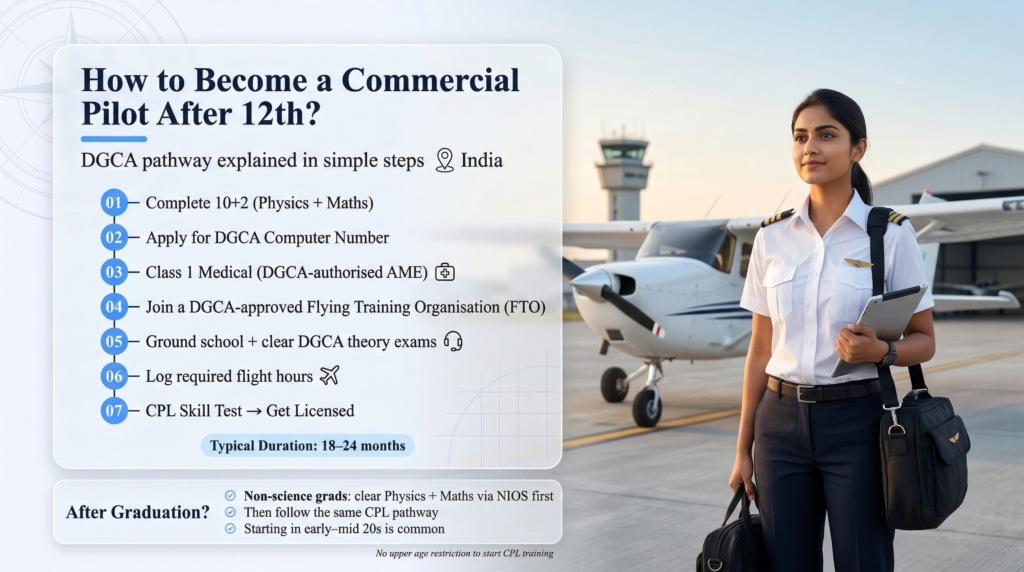
Completing 10+2 with Physics and Mathematics is the most direct route to a CPL. Once your board exams are done, you can get started right away:
- Apply for your DGCA Computer Number as the first official step.
- Sit for a Class 1 Medical examination at a DGCA-authorised Aviation Medical Examiner.
- Enrol in a DGCA-approved Flying Training Organisation (FTO) of your choice.
- Complete your ground school, clear DGCA theory exams, and log your required flight hours.
- Appear for the CPL Skill Test and receive your license.
The full training journey, from ground school to CPL skill test, takes approximately 18 to 24 months.
How to Become a Pilot After Graduation?
Having a bachelor’s degree does not disqualify you from pursuing a CPL. In fact, it can work in your favour during airline recruitment interviews. Here is what graduate aspirants need to know:
- If you graduated in a non-science stream without Physics and Maths, clear those subjects through NIOS first.
- Once you clear the required subjects, the path to a CPL is the same as for a 12th-pass student.
- Many pilots begin their CPL training in their early-to-mid twenties after graduation, and that is perfectly normal.
- There is no upper age restriction for starting CPL training.
- The maximum age for holding a CPL in India is 65 years.
Challenges Aspiring Commercial Pilots Should Know
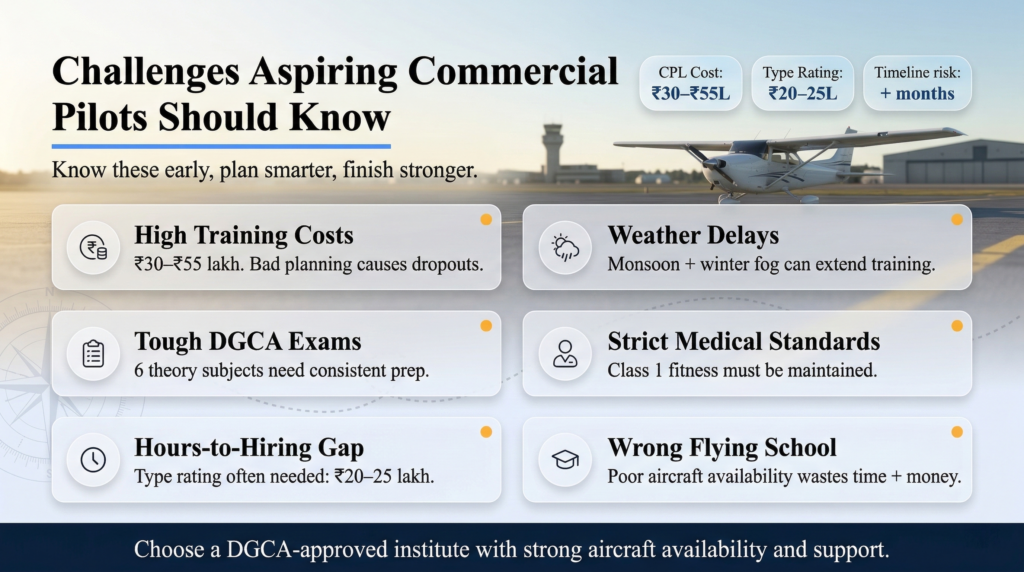
Aviation is one of the most rewarding careers you can choose. But like any great career, it comes with its own set of challenges. Knowing them in advance will help you prepare better and plan smarter.
High Training Costs: CPL training costs between ₹30 to ₹55 lakh. Poor financial planning is the single biggest reason students drop out midway.
Weather Delays: Flight training is weather-dependent. Monsoon seasons and fog-heavy winters can slow down your flying hours, extending your timeline by months.
Tough DGCA Exams: You must clear six DGCA theory subjects. These are rigorous and require consistent ground school preparation.
Strict Medical Standards: A DGCA Class 1 Medical must be maintained throughout your career. Any disqualifying health condition can pause or end your flying career.
Hours-to-Hiring Gap: After getting your CPL, most airlines require a Type Rating (costing ₹20-25 lakh) before hiring. Fresh CPL holders often start as flight instructors to build hours.
Choosing the Wrong Pilot Training School: A flying school without serviceable aircraft, experienced instructors, or proper DGCA approvals can waste both your time and money.
Every challenge on this list becomes easier when you train at the right place. Choose a DGCA-approved flying institute that is equipped, experienced, and committed to your success, like Vision Flying Training Institute.
Step-by-Step Process to Get a Commercial Pilot License in India
The journey from aspiring pilot to licensed CPL holder follows a defined path set by the DGCA. Here is every step you need to take to get there.
- Meet Eligibility Criteria: Complete 10+2 with Physics and Maths (or clear via NIOS). Confirm you are at least 18 years old by the time you apply for the CPL.
- Apply for a DGCA Computer Number: Register on the eGCA portal. This unique DGCA Computer Number is your identity for all DGCA exams, medicals, and license applications.
- Clear DGCA Class 1 Medical Examination: Visit a DGCA-authorised Aviation Medical Examiner (AME). You need a Class 2 Medical before you start flying and a Class 1 before applying for your CPL.
- Enrol in a DGCA-Approved FTO: Choose a DGCA-approved Flying Training Organisation with modern aircraft, experienced instructors, and a good serviceability record, like Vision Flying Training Institute (VFTI) in Amreli, Gujarat.
- Complete Ground School & Clear DGCA Theory Exams: Study six DGCA subjects: Air Navigation, Aviation Meteorology, Air Regulations, Aircraft Technical (General & Specific), and RTR. Exams are held four times a year.
- Complete 200 Hours of Flight Training: Log a minimum of 200 hours of flight time, including solo flying, cross-country navigation, night flying, and instrument flying at your FTO.
- Pass the CPL Skill Test: Appear for a practical skill test (check ride) conducted by a DGCA-authorised examiner. This is your final flight evaluation before the license is issued.
- Receive Your Commercial Pilot License: Submit all documents through the eGCA portal. DGCA issues your CPL. You become a licensed commercial pilot.
Commercial Pilot License Course Details
The DGCA prescribes a fixed syllabus for every CPL candidate in India. The Commercial Pilot License course’s syllabus covers six core theory subjects alongside mandatory flight training. Each subject is examined by the DGCA, and every flying hour is logged and verified. Here is exactly what you will study and train on before you earn your license.
| Subject / Component | What It Covers |
| Air Navigation | Charts, instruments, GPS, radio navigation, flight planning |
| Aviation Meteorology | Weather patterns, turbulence, wind shear, METAR/TAF reading |
| Air Regulations | DGCA rules, ICAO standards, aviation law, ATC procedures |
| Aircraft Technical – General | Aerodynamics, aircraft systems, engines, and instruments |
| Aircraft Technical – Specific | Systems specific to the training aircraft type |
| RTR (Radio Telephony Restricted) | Standard phraseology, ATC communication, FRTOL exam |
| Flight Training (Practical) | Solo, cross-country, night flying, instrument flying – minimum 200 hours |
| Simulator Training for Pilots | Emergency procedures, instrument approach, multi-crew coordination |
Commercial Pilot License Training Course Duration
The total Commercial Pilot License (CPL) training duration in India is typically 18 to 24 months of full-time commitment. However, students who train at well-equipped schools in favourable flying weather zones tend to finish significantly faster. VFTI’s base at Amreli, Gujarat, benefits from 365-day flying weather, which means fewer delays and more consistent flying hours. In fact, if you clear your DGCA theory papers early and stay on track with your flight training, you can earn your CPL in as little as 10 to 12 months.
CPL Flight Training Breakdown
| Type of Flying | Minimum Hours Required (DGCA) |
| Dual Flying (with instructor) | 100 hours |
| Solo Flying | 100 hours |
| Cross-Country Solo | Included in solo hours |
| Night Flying | Minimum 5 hours solo at night |
| Instrument Flying | Minimum 10 hours (can include simulator) |
| Total Minimum | 200 hours |
Commercial Pilot License Cost in India
Flight training is one of the most significant financial investments you will make in your life. Here is a transparent, realistic cost breakdown for getting a CPL in India in 2026:
- Ground School / DGCA Theory Classes – ₹1,50,000 to ₹4,00,000
- Flight Training (200 hrs @ ₹8,000-₹15,000/hr) – ₹25,00,000 to ₹30,00,000
- Simulator Sessions – ₹1,00,000 to ₹2,00,000
- DGCA Medical (Class 1 & Class 2) – ₹10,000 to ₹50,000
- DGCA Exam Fees (6 subjects) – ₹25,000 to ₹45,000
- RTR License & FRTOL Exam – ₹10,000 to ₹20,000
- Pilot Kit (headset, logbook, charts, flight bag) – ₹50,000 to ₹1,00,000
- Accommodation & Living (18-24 months) – ₹54,000 to ₹3,60,000 (varies by city)
Total Approximate CPL Cost – ₹30 Lakhs to ₹55 Lakhs
Why is it so expensive to become a commercial pilot?
The highest single cost in any Commercial Pilot License program is flight time. Aircraft fuel, maintenance, instructor salaries, landing fees, and insurance all add up with every flying hour. Modern training aircraft like the Cessna 172 or Tecnam P-Mentor cost ₹8,000 to ₹15,000 per hour to operate. At a minimum of 200 hours, the arithmetic is unforgiving.
Most nationalised banks in India, including SBI, Bank of Baroda, and Canara Bank, offer education loans for pilot training under their aviation loan schemes. Loan amounts can go up to ₹40 to ₹50 lakh.
Career Scope, Placement Options & Jobs for Commercial Pilots in India
India is the world’s third-largest aviation market as of 2024, and it is growing fast. Indian airlines, led by IndiGo, Air India, and Akasa Air, have collectively placed orders for over 1,700 new aircraft. This translates into a projected need for 25,000 to 30,000 new pilots over the next 15 years, according to India’s Civil Aviation Ministry.
| Job Role | Employer Type | Starting Pay |
| First Officer / Co-Pilot | Scheduled commercial airlines (IndiGo, Air India, Akasa) | ₹1.5 – ₹3 lakh/month |
| Flight Instructor (CFI) | Flying schools / FTOs | ₹50,000 – ₹1 lakh/month |
| Charter / Private Jet Pilot | Corporate aviation companies, HNI clients | ₹1 – ₹3 lakh/month |
| Cargo Pilot | Blue Dart, SpiceXpress, IndiGo Cargo | ₹1.5 – ₹3 lakh/month |
| Regional / Turboprop Pilot | Airlines under UDAN scheme, regional carriers | ₹80,000 – ₹1.5 lakh/month |
| Aerial Survey Pilot | Survey and mapping companies, government organisations | ₹60,000 – ₹1.2 lakh/month |
Commercial Pilot Salary in India (2026)
The salary of a pilot in India is among the highest in any profession. It is structured around a base pay plus flying hour allowances, and total compensation rises significantly with experience and rank.
CPL Salary Growth & Career Progression
| Stage | Experience | Monthly Salary (INR) | Annual Package |
| Flight Instructor / Building Hours | 0–1 year post-CPL | ₹30,000 – ₹1,00,000 | ₹3.6 – ₹12 lakh |
| Junior First Officer | 1–3 years | ₹1,50,000 – ₹2,50,000 | ₹18 – ₹30 lakh |
| First Officer | 3–5 years | ₹2,50,000 – ₹3,50,000 | ₹30 – ₹42 lakh |
| Senior First Officer | 5–7 years | ₹3,50,000 – ₹4,50,000 | ₹42 – ₹54 lakh |
| Captain (Narrow Body) | 7–12 years | ₹5,00,000 – ₹8,00,000 | ₹60 – ₹96 lakh |
| Senior Captain / Commander | 12+ years | ₹8,00,000 – ₹15,00,000+ | ₹1 crore+ |
CPL Salary Per Month for Freshers
A fresh CPL holder in India earns between ₹30,000 and ₹1,00,000 per month as a flight instructor while building flying hours. Once hired by a commercial airline as a Junior First Officer, the starting salary ranges from ₹1.5 lakh to ₹2.5 lakh per month.
The exact figure depends on the airline, aircraft type, and number of flying hours logged per month.
CPL Salary Per Month for Experienced Pilots
An experienced pilot with 3 to 7 years of flying earns between ₹2.5 lakh and ₹4.5 lakh per month as a First Officer or Senior First Officer.
Pilots who upgrade to Captain, typically within 7 to 12 years, earn between ₹5 lakh and ₹8 lakh per month on narrow-body aircraft.
Senior Captains flying wide-body or international routes can earn ₹10 lakh to ₹15 lakh or more per month.
Commercial Pilots’ Salary in Top Indian Airlines
Pilot salaries vary across airlines depending on the fleet, routes, and seniority level. Here is a look at what the top Indian airlines are paying their pilots per month in 2026.
| Airline | First Officer | Senior FO | Captain |
| IndiGo (6E) | ₹1.7L – ₹2.5L | ₹3.5L – ₹4.5L | ₹6L – ₹8L |
| Air India (AI) | ₹2.35L – ₹3.45L | ₹4L – ₹5L | ₹7.5L – ₹10L+ |
| Akasa Air (QP) | ₹2.6L – ₹3.4L | ₹3.4L ₹4.3L | ₹5.5L – ₹7.75L |
| SpiceJet (SG) | ₹1.5L – ₹2.5L | ₹3L – ₹4L | ₹5L – ₹7L |
| Air India Express (IX) | ₹2L – ₹3L | ₹3.5L – ₹4.5L | ₹6L – ₹8L |
Comparison of commercial pilot salaries in India and abroad
The aviation world is borderless, and so is your earning potential as a CPL holder. International pilot salaries look impressive on paper, and they are. But it is important to understand that the higher pay is directly tied to the significantly higher cost of living in those markets.
Here is how pilot salaries in India compare to what airlines in the Middle East, Europe, and the USA pay their crew.
| Role | India (INR/month) | Middle East (USD/month) | Europe / USA (USD/month) |
| First Officer | ₹1.5L – ₹3L | $4,000 – $7,000 | $6,000 – $10,000 |
| Senior First Officer | ₹3.5L – ₹4.5L | $7,000 – $11,000 | $9,000 – $14,000 |
| Captain | ₹5L – ₹10L+ | $12,000 – $20,000 | $16,000 – $30,000+ |
Indian pilots who gain sufficient experience and hold valid International Civil Aviation Organisation (ICAO) aligned certifications are increasingly being recruited by airlines in the Middle East, Southeast Asia, and Europe.
Many Indian pilots build their early career in India and then transition abroad after accumulating 2,000 to 3,000 flying hours. This is a well-established career strategy in the industry.
Additional Benefits to Commercial Pilots Along with Salary
A pilot’s salary is only part of the total compensation package. Airlines in India routinely offer benefits that significantly increase the overall value of the career.
| Benefit | Details |
| Free / Discounted Air Travel | Pilots and their immediate family get complimentary or heavily discounted tickets on their airline and partner airlines |
| Comprehensive Medical Insurance | Full medical and life insurance coverage, including aviation-specific Class 1 Medical requirements |
| Housing Allowance | Many airlines provide accommodation benefits or monthly housing allowances for outstation postings |
| Flying Hour Pay | Flying allowances add 30–50% to your base salary. More hours flown = more income, within DGCA fatigue limits |
| Layover / Per-Diem Allowance | Per-diem for overnight stays during outstation or international flights, ₹50,000 to ₹1.5 lakh/month for active flyers |
| Retirement Benefits | PF contributions, gratuity, and, in some airlines, profit-sharing bonuses during profitable years |
| Uniform Allowance | Annual uniform and grooming allowances are standard across most Indian carriers |
A commercial pilot’s life is genuinely unlike any other profession. You wake up in different cities, wear one of the most respected uniforms in the country, and build a career that is both financially rewarding and personally extraordinary.
The rosters are demanding. Early mornings, late nights, and time away from home are real. But India’s airlines are increasingly improving crew welfare with better scheduling and fatigue management systems under the DGCA’s updated FDTL (Flight Duty Time Limitations) rules.
Lifestyle of Commercial Airline Pilots
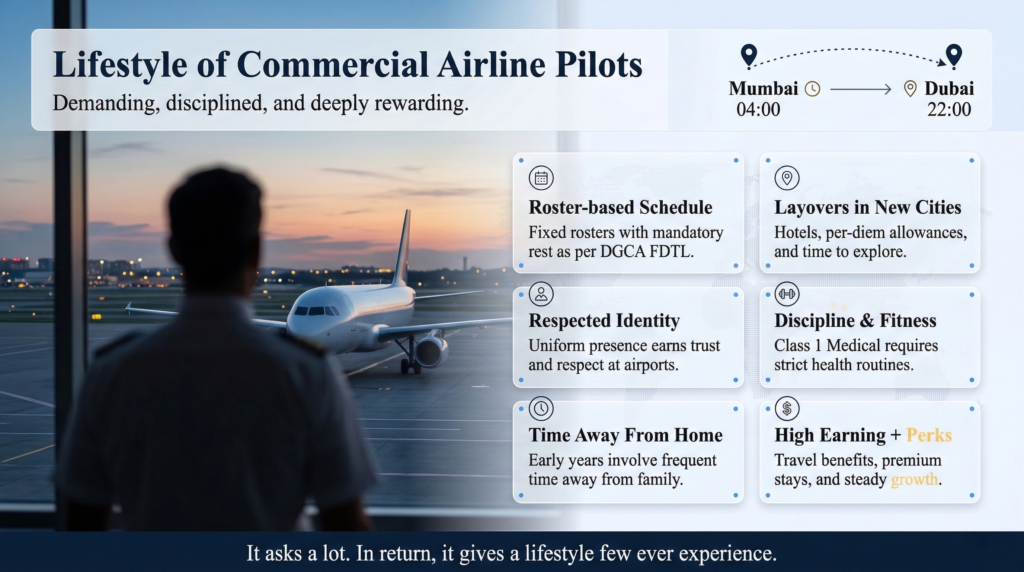
The lifestyle of a commercial airline pilot is one of the most unique and envied in any profession. No two days look the same, and that is exactly what makes it extraordinary.
A pilot’s day can begin at 4 AM in Mumbai and end in Dubai. One week, you are flying domestic sectors across India, and the next, you are on an international layover in a city most people only dream of visiting.
Here is what everyday life looks like for a commercial airline pilot in India:
- Roster-based schedule: Pilots work on a fixed roster with scheduled flying days and mandatory rest days regulated by the DGCA’s FDTL (Flight Duty Time Limitations) rules.
- Layovers in different cities: Outstation flights mean hotel stays, per-diem allowances, and time to explore new places, all while getting paid.
- A highly respected identity: Walking through an airport in uniform commands a level of respect that very few professions can match.
- Physical and mental discipline: Pilots maintain strict health routines to hold their Class 1 Medical certificate. A fit body and a sharp mind are non-negotiable.
- Time away from home: This is the real trade-off. Pilots spend significant time away from family, especially in the early years of their career.
- High earning with lifestyle perks: Free or discounted air travel for family, premium hotel stays during layovers, and a salary that grows steadily with every year of experience.
The life of a commercial pilot is demanding, disciplined, and deeply rewarding. It asks a lot of you. In return, it gives you a career and a lifestyle that very few people in the world get to experience.
Which is the best Pilot Training Institute for becoming a Commercial Pilot
Vision Flying Training Institute (VFTI) is one of the most trusted DGCA-approved Flying Training Organisations in India. Located at Amreli Airport, Gujarat, VFTI is part of the Vision Group of Institutions, which brings over two decades of experience in the field of education. That legacy of academic excellence is built into every aspect of how VFTI trains its pilots.
Here is what makes VFTI stand out:
- DGCA-Approved FTO: VFTI is fully approved by the Directorate General of Civil Aviation, Government of India. Your CPL will be recognised by all Indian and ICAO-member airlines.
- Modern Aircraft Fleet: Students train on industry-standard aircraft, including the Tecnam P2008 JC, Cessna 172 Skyhawk, and Tecnam P-Mentor, alongside a Multi-Engine Simulator.
- CPL, PPL, and Conversion Flying Courses: VFTI offers a full range of pilot training programs designed for every stage of your aviation journey.
- In-House CAR 145 Approved MRO Facility: VFTI operates its own Maintenance, Repair, and Overhaul facility approved by the DGCA. This means aircraft are always airworthy, always serviceable, and your training is never delayed due to maintenance issues.
- Dedicated CAMO Department: VFTI’s Continuing Airworthiness Management Organisation department manages all aspects of aircraft compliance and airworthiness, ensuring every aircraft you fly meets the highest safety standards.
- 365-Day Flying Weather: Amreli, Gujarat, offers year-round Visual Meteorological Conditions (VMC). Fewer weather disruptions mean faster training and quicker completion of your required flying hours.
- Highly Experienced Flight Instructors: Every student at VFTI is guided by qualified, experienced flight instructors who are deeply invested in each student’s progress and success.
- Career Support: VFTI does not just train you to fly. It prepares you for the airline world with dedicated career guidance, interview preparation, and placement support.
VFTI is a complete aviation training ecosystem built to take you from day one of ground school to the day you receive your Commercial Pilot License, and beyond.
Commercial Pilot Course Admission Process at VFTI
VFTI’s admission process is built around clarity and support. Every step is guided, every question is answered, and every aspiring pilot is given the attention they deserve.
Start Your CPL Journey at VFTI
Talk to our team today. Campus visits, brochure downloads, and personalised counselling are available.
- Admission Office: 3rd Floor, D-405, Saini Plaza, Sector-7, Ramphal Chowk, Dwarka, New Delhi – 110075
- Airbase: Amreli Airport, Amreli, Gujarat – 365601
- Phone: +91 9319193602 | +91 9319193605
- Email: enquiry@vfti.in
Leave a Reply