Airlines in India are not impressed by a pilot’s licence alone. They want airline-ready cadets who can handle modern cockpits, understand systems quickly, and show adaptability to today’s flight decks. It is all that separates a “licensed pilot” from a “hireable pilot”.
Your stream does not decide your future in aviation. A commerce student can also become a Pilot without Physics.
So what does that have to do with this blog?
A lot, actually. Because how “ready” you feel as a pilot often depends on two things, where you train and what aircraft you train on.
The right flying school and the right trainer can shape how quickly you build real cockpit confidence and not just log hours.
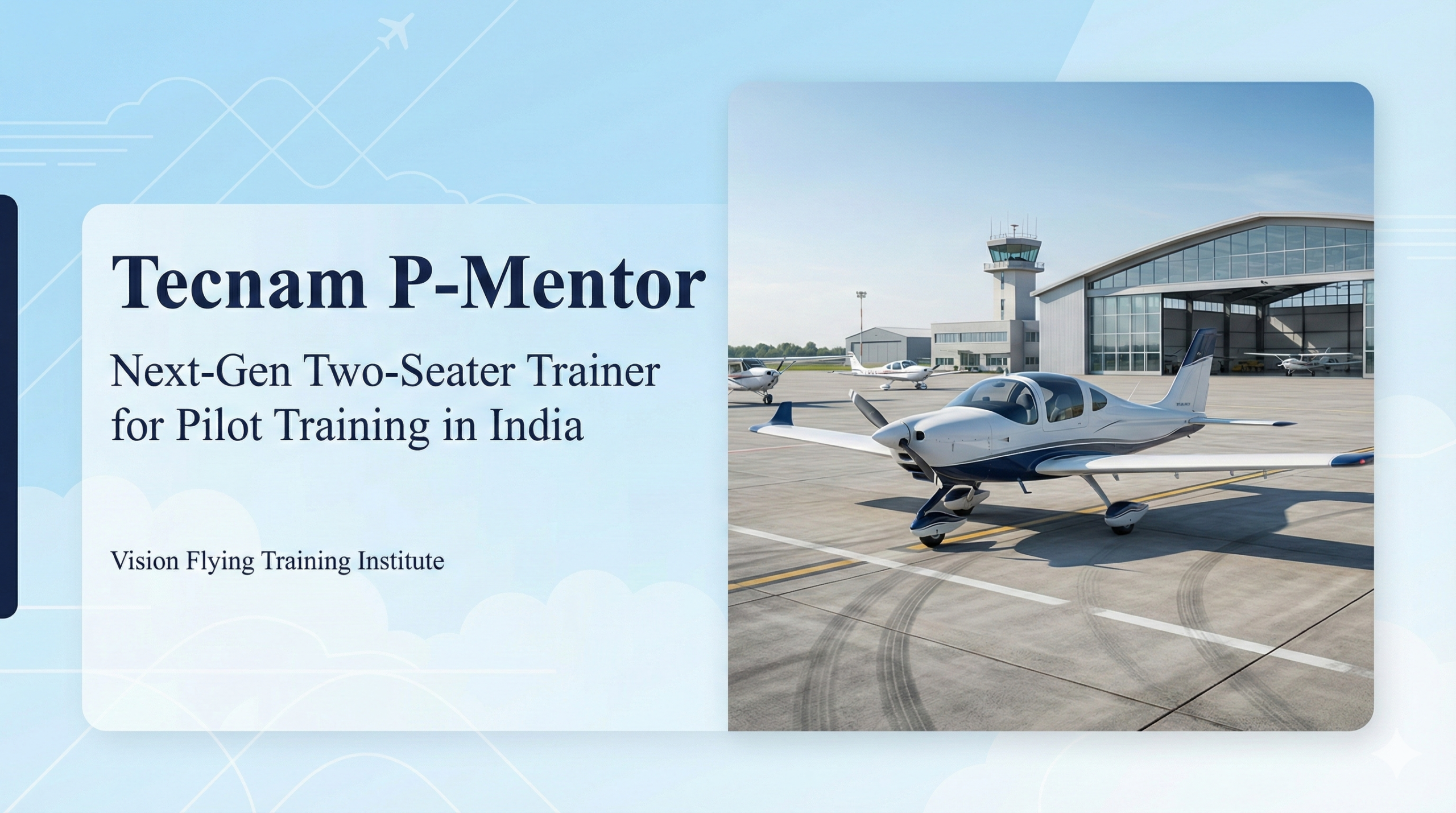
In this blog post, we discuss the Tecnam P-Mentor, one of the most advanced two-seater training aircraft with high-value attributes, a smart cockpit layout, and strong fuel efficiency. This makes it the best choice for Commercial Pilot Licence (CPL) training in India.
Introducing the Tecnam P-Mentor, a high-tech aircraft built for student pilots
The Tecnam P-Mentor is a sleek, Italian-designed two-seat trainer aircraft that was launched in 2022. It is a unique aircraft that is best for training young pilots in India and around the world. It incorporates the latest avionics technology, a fuel-efficient engine, and a safety-oriented design philosophy into one aircraft.
The Tecnam P-Mentor takes student pilots from their very first flying lesson to advanced training such as instrument rating (IR) and even Upset Prevention and Recovery Training (UPRT).
It is no surprise that the best flying institutes for Pilot Training in India and around the world have taken to the P-Mentor in a big way. Vision Flying Training Institute is one of the first flight schools in India to introduce this advanced trainer to its students.
Key Features of the Tecnam P-Mentor for Top Pilot Training in India
The Tecnam P-Mentor is built with features designed to outperform many older trainers in training environments. It’s the kind of airplane that actually makes training feel more structured, safer, and closer to real airline-style flying.
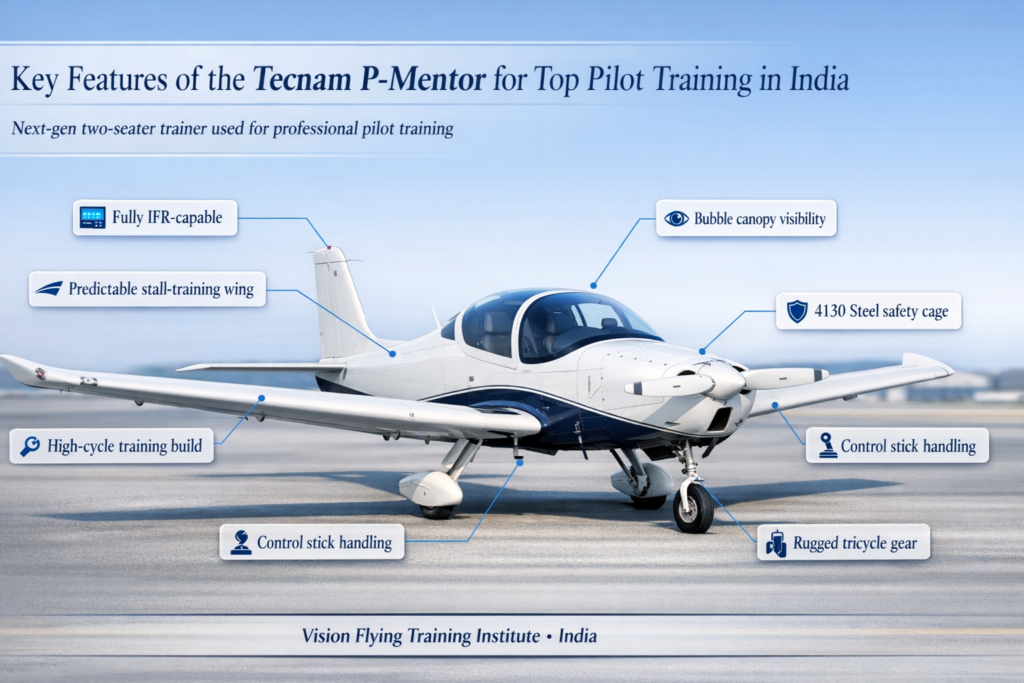
Here are the features that genuinely matter when you are a student pilot in India:
- Fully IFR-capable: The P-Mentor is certified for Instrument Flight Rules (IFR), which means Pilot training at Vision Flying Training Institute goes beyond visual flying and learn real instrument procedures, the kind pilots will actually use later in professional aviation.
- Modern design and build that’s made for high-cycle training: A smart mix of materials, including metal and composites, is used to balance strength and weight. It has a lightweight metal wing structure for durability and a carbon-fiber reinforced leading edge. The cabin is built with a 4130 steel truss frame, like a protective cage. It’s designed for better impact energy absorption. This adds a layer of passive safety that’s honestly reassuring during training.
- Side-by-side seating under a bubble canopy: Student and instructor sit side-by-side, and the bubble canopy gives a wide, open field of view. This makes traffic spotting, runway alignment, and circuit work easier, especially at busy Indian airfields where situational awareness matters a lot.
- Aerodynamic wing built for predictable stall training:
The wing has a tapered planform with a laminar-flow airfoil and slotted flaps covering about 75% of the wing. This improves low-speed handling and makes stall behavior more consistent. This is exactly what you want when you are learning stalls and slow flight. - Control stick instead of a yoke: Instead of the traditional yoke found in many older trainers, the P-Mentor uses a control stick. It helps you develop more precise “stick and rudder” skills and feels closer to how modern aircraft are flown.
- Landing gear made to survive student landings: It has a fixed tricycle landing gear that’s built tough for training cycles (lots of takeoffs and landings). VFTI specifically highlights the aircraft’s strong landing gear and ergonomic controls as well-suited for student pilots.
Tecnam P-Mentor Specifications and Dimensions
The Tecnam P-Mentor is built for training efficiency without compromising performance. It’s an EASA CS-23 certified aircraft with full day/night IFR capability, meaning student pilots can train even for instrument ratings on this platform.
Key specifications of the P-Mentor include:
| Category | Specification | Value |
| Overall dimensions | Wingspan | 9.00 m (29.5 ft) |
| Length | 6.74 m (22.1 ft) | |
| Height | 2.50 m (8.2 ft) | |
| Stabilator span | 2.90 m (9.5 ft) | |
| Wing | Wing area | 11.9 m² (128.1 ft²) |
| Landing gear | Wheel track | 1.84 m (6.04 ft) |
| Wheelbase | 1.62 m (5.31 ft) | |
| Main gear tire | 5.00–5 | |
| Nose gear tire | 5.00–5 | |
| Weights | Maximum take-off weight (MTOW) | 720 kg (1587 lb) |
| Maximum landing weight (MLW) | 720 kg (1587 lb) | |
| Empty weight | 430 kg (948 lb) | |
| Specific loadings | Wing loading | 60.50 kg/m² (12.39 lb/ft²) |
| Power loading | 7.20 kg/hp (15.87 lb/hp) | |
| Fuel | Total fuel capacity | 140 L (37 gal) |
| Usable fuel | 131.6 L (35 gal) | |
| Approved fuel grades | MOGAS (ASTM D4814), MOGAS EN228 (min RON 95), AVGAS 100LL (ASTM D910) | |
| Engine | Manufacturer | Bombardier–Rotax GmbH |
| Model | Rotax 912 iSc 3 Sport | |
| Type Certificate | EASA.E.121 | |
| Engine type | 4 cylinder horizontally-opposed twins with overall displacement of 1352 c.c., mixed cooling, electronic injection, integrated reduction gear with torque damper. | |
| Max take-off power (5 min) | 73.5 kW / 100 hp @ 5800 rpm | |
| Max continuous power | 72.0 kW / 98 hp @ 5500 rpm | |
| Propeller | Manufacturer | MT Propeller |
| Model | MTV-21-A/180-51 | |
| Type Certificate | EASA.P.101 | |
| Blades | 2 (laminated wood composite) | |
| Diameter | 1800 mm (5 ft 10.9 in) | |
| Type | Variable pitch, constant-speed |
The P-Mentor’s numbers show a balance of modern tech and practical design, exactly what a training aircraft needs.
Performance Range of the Tecnam P-Mentor as a Training Aircraft
Do not let its compact frame make you underestimate it.
The P-Mentor delivers solid performance suitable for all training phases, including cross-country flights and advanced maneuvers:
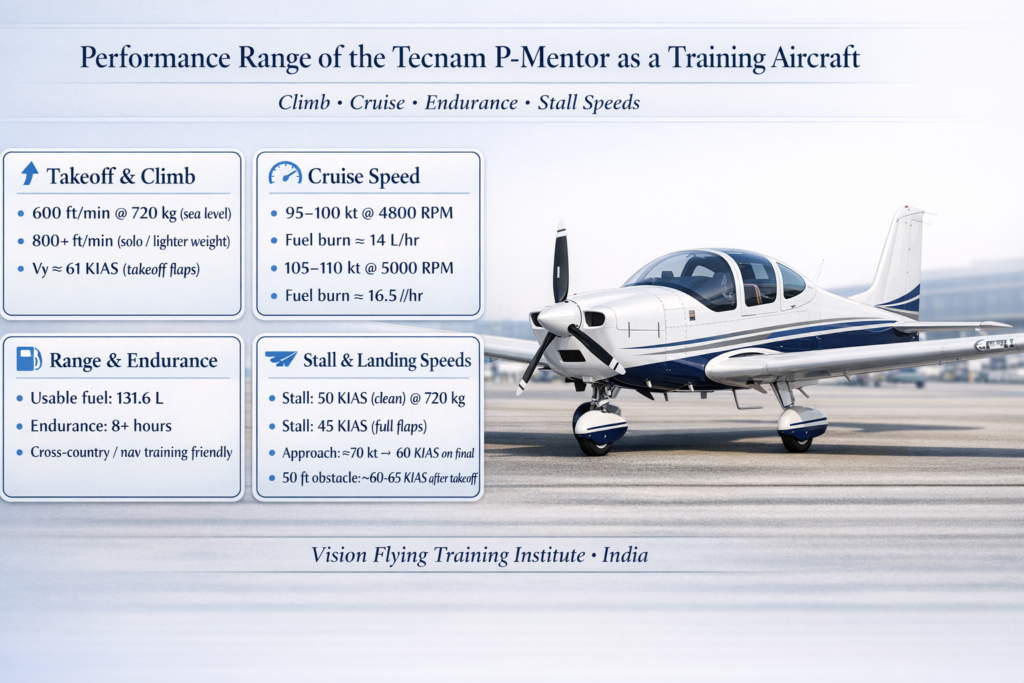
- Takeoff and climb: At maximum weight (720 kg), it climbs at around 600 ft/min at sea level on a standard day. With lighter weight (like solo flying), the climb can go beyond 800 ft/min.
The best climb speed (Vy) is approximately 61 KIAS (knots indicated airspeed) with takeoff flaps, which provides a good climb while maintaining comfortable forward visibility. - Cruise and range: This is where the P-Mentor really feels efficient. At around 4800 RPM (revolutions per minute), it cruises roughly 95-100 knots while burning only about 14 L/hr. At around 5000 RPM, it can do about 105-110 knots for roughly 16.5 L/hr.
With 131.6 L usable fuel, it can stay airborne for 8+ hours, making long cross-country flights and multi-leg nav training easy without constant refuelling. - Stall speeds: The stall speeds are low, which is great for student confidence. At 720 kg, it stalls around 50 KIAS clean and about 45 KIAS with full flaps. That extra margin helps during slow flight, approach practice, and landing training.
- Takeoff and landing feel: Takeoff and landing distances are training-optimized. It typically clears a 50 ft obstacle around 60-65 KIAS after takeoff, and landing approaches are usually flown around 70 knots, slowing to about 60 KIAS on final. With a stall at 45 knots in landing configuration, there’s a solid safety margin for students.
Overall, the P-Mentor gives you a good climb, efficient cruise, and very forgiving low-speed handling. Additionally, it burns significantly less fuel than older trainers, which is a significant advantage during hour-building.
Tecnam P-Mentor Glass Cockpit Avionics and Cockpit Layout
One of the most attractive features of the Tecnam P-Mentor is its Garmin avionics suite. When entering the cockpit of the P-Mentor, pilot trainees see a cockpit environment that is similar to what is found in commercial aircraft and high-end general aviation aircraft, rather than what was found in 1970s-era trainers.
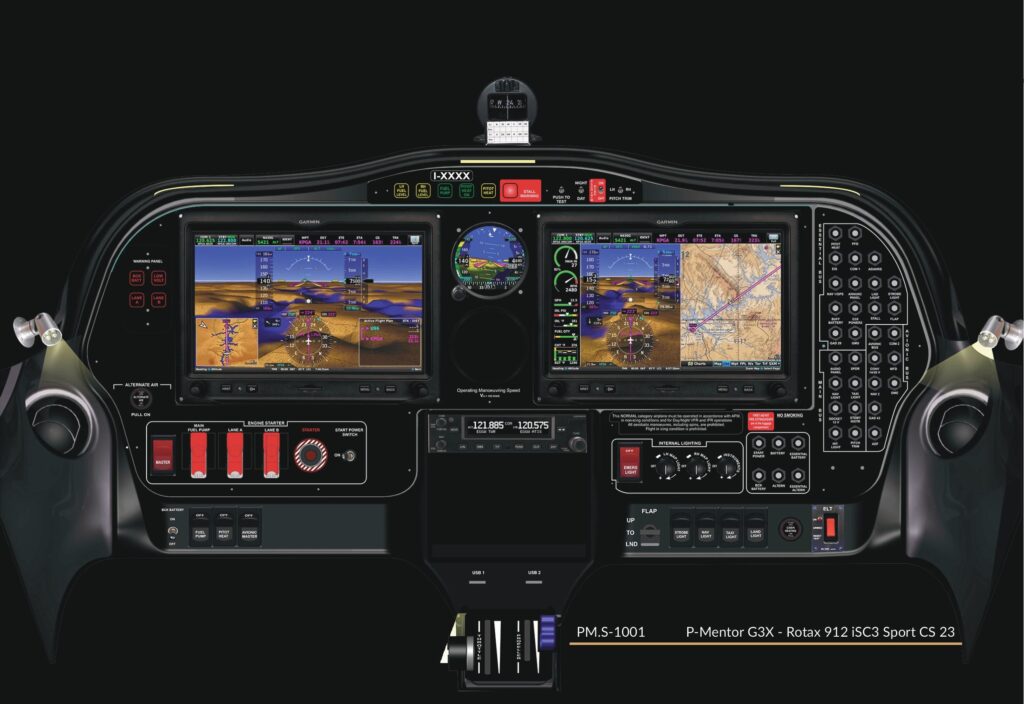
The following are the key features of the cockpit and avionics of the P-Mentor:
GarDual min G3X Touch Dual Displays
- The display is dominated by two large Garmin G3X Touch screens. One is usually the Primary Flight Display (PFD) and the other the Multi-Function Display (MFD).
- You can view attitude, airspeed, altitude, heading, and Horizontal Situation Indicator (HSI) right in front of you, along with your navigation maps and engine information.
- If one screen goes down, the system can revert to a reversionary mode, so you can still view important flight information on the other screen.
Integrated Instrument Flying Setup
The P-Mentor is designed to facilitate Instrument Flight Rules (IFR) training, rather than just visual flight training. The avionics suite may consist of the Garmin GTN 650Xi (a touchscreen Global Positioning System/Navigation/Communication system) and a second radio, such as the Garmin GNC 255A (Navigation/Communication system).
This configuration facilitates the following instrument flight procedures:
- Instrument Landing System (ILS) approaches
- VHF Omnidirectional Range (VOR) navigation
- Global Positioning System (GPS) approaches
- Localizer Performance with Vertical guidance (LPV) approaches using Satellite-Based Augmentation System (SBAS)
It also has a transponder, such as the Garmin GTX345R, which is compatible with Mode S and Automatic Dependent Surveillance-Broadcast (ADS-B Out) for contemporary Air Traffic Control (ATC) systems. Optional components may include Distance Measuring Equipment (DME) and Automatic Direction Finder (ADF) for more comprehensive instrument training exposure.
Autopilot and Flight Director Support
The aircraft is also compatible with the upgraded Garmin GFC 500 digital autopilot system, which is driven by servo motors such as the Garmin GSA 28. The Garmin GMC 507 is the autopilot control panel, with modes such as heading hold, altitude hold, navigation track, and approach.
It is also compatible with Electronic Stability and Protection (ESP), which assists the pilot in keeping the aircraft within safe operating limits. This is particularly useful while training, as trainee pilots may not be adept at mastering the aircraft.
Standby Instrument for Backup
In addition to the primary glass displays, the P-Mentor also includes a Garmin GI 275 Electronic Standby Instrument, which is capable of displaying basic information such as attitudes, altitudes, and airspeeds, and is usually powered by a separate battery source as well. That means if the primary displays encounter a rare failure, you will always have a backup reference source.
Cockpit Layout
The technology is great, but what really helps pilot trainees is the cockpit layout.
In simulation training for pilots, you learn the cockpit workflow step by step, so when you fly the actual aircraft, everything feels in the right place. It then makes day-to-day training easier and faster.
Here are a few things to keep note of:
- Sticks instead of yokes: Both seats have control sticks, which help students master the precise control of the “stick and rudder,” bringing it closer to modern aircraft control philosophies.
- Central power quadrant: The throttle and propeller levers are positioned together in a central console, similar to those found in larger or more advanced aircraft.
- Smart switch placement: Critical items like master power, backup battery, and fuel pump switches are placed logically.
- Easy Access Controls: The fuel selector, flap controls, and key training devices are located in a manner that makes them readily accessible to the student as well as the instructor.
Wide Visibility
The canopy provides wide visibility. Although this is a two-seater, it feels open and practical for training, with cabin heat/defrost and night-friendly lighting. It really makes a difference in circuit training, runway alignment, and traffic scanning.
Fuel Efficiency and Operating Cost Advantages of the P-Mentor for Pilot Training
The Tecnam P-Mentor is extremely economical to operate. It burns roughly 14–15 litres per hour in cruise, which is far lower than many legacy trainers like the Cessna 172 or Piper Archer that often use 30–38 litres per hour.
Its Rotax 912iSc3 engine can also run on automotive petrol (MOGAS) as well as avgas, which can reduce fuel costs further where MOGAS is available. Lower fuel burn and simpler operations mean a lower cost per flying hour, helping flight schools keep training more affordable and consistent.
The P-Mentor is built for high training usage, so maintenance is simpler, and downtime is minimized. Also, the feature of a replaceable wing leading edge, rugged fixed landing gear, and modern fuel-injecting Rotax engine means less wear and tear on training aircraft.
The availability of new parts and manufacturer support means the aircraft typically spends more time flying and less time grounded, helping the student get their pilot training done on time.
This helps trainees start their career sooner and begin earning the salary of a pilot in India. Training delays do the opposite, they push your career and income further away.
Safety Features of the Tecnam P-Mentor for Pilot Trainees in India
Safety is essential in the pilot training aircraft. Tecnam has engineered the P-Mentor with numerous safety features and robust design elements:
- The P-Mentor’s wing design is intended to behave well at low speeds, which means that during practice flights for slow flight and stalls by pilot trainees, this plane will surely give a good warning and stay manageable. It complies with the latest CS-23 regulations for Stall/Spin without any need to resort to any “extraordinary device.”
- The aircraft can be fitted with a whole-aircraft ballistic parachute system. This is unusual for conventional aircraft of this class and adds an extra layer of protection.
- The 4130 steel truss around the cockpit works like a safety frame, giving better protection for people inside, much more than what is provided by some of its older all-Aluminum rivals.
- Student flying means a lot of takeoffs, landings, and occasional firm touchdowns. The P-Mentor’s fixed landing gear and sturdy structure are built to handle that routine without constantly needing fixes.
- The Garmin system, alongside its variants, has features for providing air traffic awareness, air traffic alerts, and air protection, all of which will surely help students cope with their high workload, especially during circuit flying or instrument flying.
Tecnam P-Mentor: DGCA Approved Certifications, IFR Capability, and Compliance
There is no doubt that a tremendous amount of safety-engineering detail goes into this aircraft right from its design. The Tecnam P-Mentor is a fully certified training aircraft that was made in accordance with European Union Aviation Safety Agency (EASA) Certification Specification 23 (CS-23) standards for normal category aircraft.
Moreover, this aircraft was also certified to allow for its usage in instrument flight rules (IFR) training without any restrictions. It is also capable of performing a form of navigation known as performance-based navigation (PBN) and area navigation (RNAV).
Tecnam also explains that the P-Mentor, being an aircraft trainer, is one of the first trainers available on the market that is compliant with the latest CS-23 Amendment 5 standards. In order to do so, the aircraft was required to prove that its stall characteristics are so stable and predictable that an emergency parachute system is not required for safety outcomes. This speaks highly of its stability and its suitability.
Because this European certification framework is similar to that of the United States Federal Aviation Administration (FAA) “Part 23,” the approvals issued by the P-Mentor are applicable and can be validated on a worldwide scale.
It also integrates well with the Indian compliance norms set by the Directorate General of Civil Aviation (DGCA). This aircraft has already cleared the compliance process and is certified for pilot training in India.
Tecnam P-Mentor aircraft are listed in inventory documents published by the DGCA for Flight Training Organisation (FTO). This indicates the aircraft is in operational service under DGCA oversight.
Why Vision Flying Training Institute Uses the Tecnam P-Mentor for Pilot Training in India
Vision Flying Training Institute is a pilot training academy that is committed to delivering the best pilot training in India by innovating and adopting the right technology for our trainees.
The Tecnam P-Mentor is a centerpiece of our training fleet because it aligns with our core mission, i.e., training future airline pilots with modern, safe, and efficient equipment.
Here are some specific reasons and benefits for our pilot students:
- The P-Mentor can take a student from their first flight all the way to instrument rating training and even commercial pilot licence level flying, all on one aircraft.
The aircraft is a secondary concern if you haven’t crafted your pilot journey yet!
Read our blog on How to Become a Commercial Female Pilot After 12th in India.
- The glass cockpit and advanced avionics make it easier for students to get comfortable with digital flight displays and real-world navigation habits early on. It helps students train in a cockpit that feels modern and airline-standard from the very beginning.
- The design of the P-Mentor, from its very conception, has been oriented with training safety in mind. Stable handling inspires confidence in students when undertaking slow flight, landings, and circuit work.
- Flying in India can mean high temperatures, high humidity, or high-density altitude in some regions. The P-Mentor’s Rotax engine actually handles heat well and maintains performance at altitude better than some older engines.
- The DGCA and other regulators increasingly emphasize up-to-date training devices and methods. By using an EASA-certified IFR trainer like the P-Mentor, Vision FTI stays ahead of the curve. The aircraft is already compliant with the latest standards.
The P-Mentor definitely lives up to its name, as it becomes the ‘mentor’ leading the way for the future of pilots into the future of aviation. It brings a new era of training to Vision Flying Training Institute and its students.
Enquire at VFTI for Pilot Training on the Tecnam P-Mentor
We are proud to incorporate an advanced trainer like Tecnam P-Mentor into our holistic Commercial Pilot License course. Pupil pilots at VFTI will be trained on an aircraft that is secure, competent, and with the latest equipment. These trainees are not only to get their pilot’s license but also to excel in the skies as professional aviators.
A call for every Pilot aspirant, join VFTI and train on the latest equipment, under the guidance of expert instructors, with a curriculum that covers everything from DGCA ground exams to advanced flying techniques.
Contact Vision Flying Training Institute today to find out more about our pilot license course. Schedule a visit to see our Tecnam P-Mentor up close or to speak with our pilot mentors.
Your dream of flying commercial jets can start with training in the right airplane and the right flying institute in India.
Call our Admission Desk: +91-9319193602 / +91-9319193605Email: enquiry@vfti.in
Leave a Reply