Tag: pilot training

  • What Is Pilot Training?Complete Guide to PPL and CPL Courses

    What Is Pilot Training?Complete Guide to PPL and CPL Courses

    Pilot training is a structured aviation programme that prepares candidates with the theoretical knowledge, practical flying skills, decision-making ability, and technical understanding required to operate an aircraft safely. 

    In India, pilot training is regulated by the Directorate General of Civil Aviation (DGCA). Students who want to build a professional flying career usually pursue a Commercial Pilot Licence (CPL) course after completing the required academic, medical, theoretical, and flying requirements. 

    This complete guide explains everything about pilot training in India.

    What Is Pilot Training? 

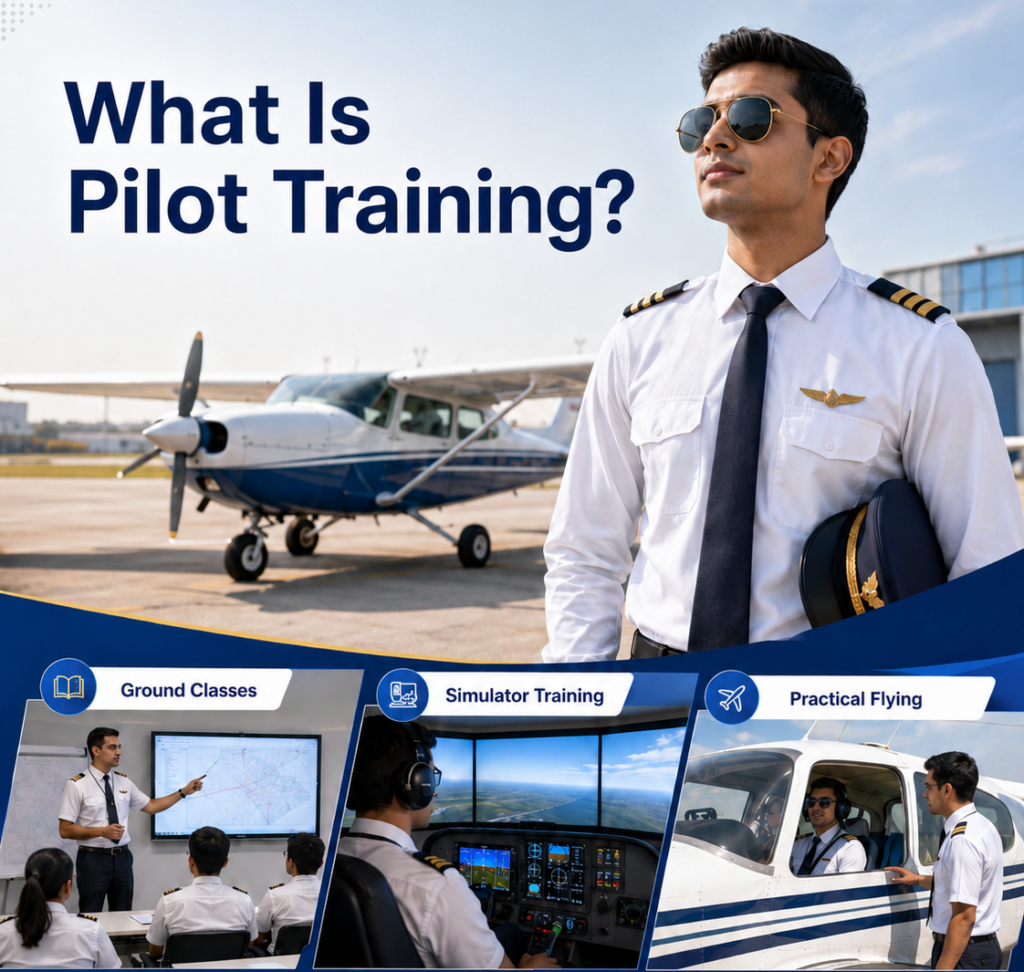
    Pilot training is the process of learning how to safely operate an aircraft through classroom learning, simulator sessions, and practical flying experience.

    A professional pilot must understand much more than just controlling an aircraft. Training develops skills in:

    • Aircraft operations
    • Aviation regulations
    • Navigation
    • Weather understanding
    • Aircraft systems
    • Radio communication
    • Emergency handling
    • Crew coordination
    • Decision-making skills

    A complete pilot training programme combines ground classes and flight training to prepare students for licensing examinations and professional flying careers.

    Students in India complete pilot training through DGCA-approved Flying Training Organisations (FTOs), which provide structured flight training programmes aligned with aviation regulations and licensing requirements. 

    Vision Flying Training Institute (VFTI) is among the top pilot training institutes in India, offering professional pilot training designed to help aspiring aviators build the skills, knowledge, and confidence required for a successful aviation career. 

    Types of Pilot Training Courses in India 

    Students can choose different pilot licences depending on their career goals.

    The two most common pilot training courses are:

    1. Private Pilot Licence (PPL)
    2. Commercial Pilot Licence (CPL)

    PPL (Private Pilot Licence)

    A Private Pilot Licence allows a person to fly aircraft for personal and recreational purposes. A PPL holder cannot work as a commercial airline pilot or earn money by flying passengers.

    PPL is often chosen by individuals who want to experience aviation without pursuing a professional airline career. 

    CPL (Commercial Pilot Licence) 

    A Commercial Pilot Licence is the primary licence required for candidates who want to become professional pilots.

    A CPL allows pilots to work in commercial aviation, subject to meeting airline and operator requirements.

    Commercial pilots may work with:

    • Airlines
    • Charter operators
    • Cargo companies
    • Aviation organisations
    • Flight training institutions (after obtaining required instructor qualifications)

    DGCA-approved CPL programmes at Vision Flying Training Institute (VFTI) are structured to meet the regulatory requirements for obtaining a Commercial Pilot Licence (CPL). 

    The course combines comprehensive ground training, practical flight training, and aviation-focused learning to help aspiring pilots develop the knowledge and skills required to pursue a professional flying career. 

    Difference Between PPL and CPL 

    FeaturePPLCPL
    Full Form Private Pilot Licence Commercial Pilot Licence 
    Main PurposePersonal flying Professional flying career 
    Can Fly CommerciallyNoYes
    Airline CareerNot applicable Required pathway 
    Training LevelBasicAdvanced
    Career ScopeLimitedWider aviation opportunities 

    If your goal is to become an airline pilot in India, CPL training is the correct career pathway. 

    Pilot Training Eligibility Requirements in India

    The eligibility criteria for pilot training depend on the licence type and regulatory requirements.

    CPL Eligibility Requirements 

    Candidates pursuing a Commercial Pilot Licence (CPL) in India must fulfil the following eligibility requirements:

    • Minimum Education: Class 12 or equivalent qualification from a recognised board.
    • Subjects Required: Physics, Mathematics, and English as per DGCA eligibility requirements.
    • Age Requirement: Minimum 17 years of age to begin the CPL training pathway.
    • Medical Fitness: Valid DGCA-approved medical certification is required.
    • Training Organisation: CPL training must be completed through a DGCA-approved Flying Training Organisation (FTO).

    How To Become A Pilot In India After The 12th? 
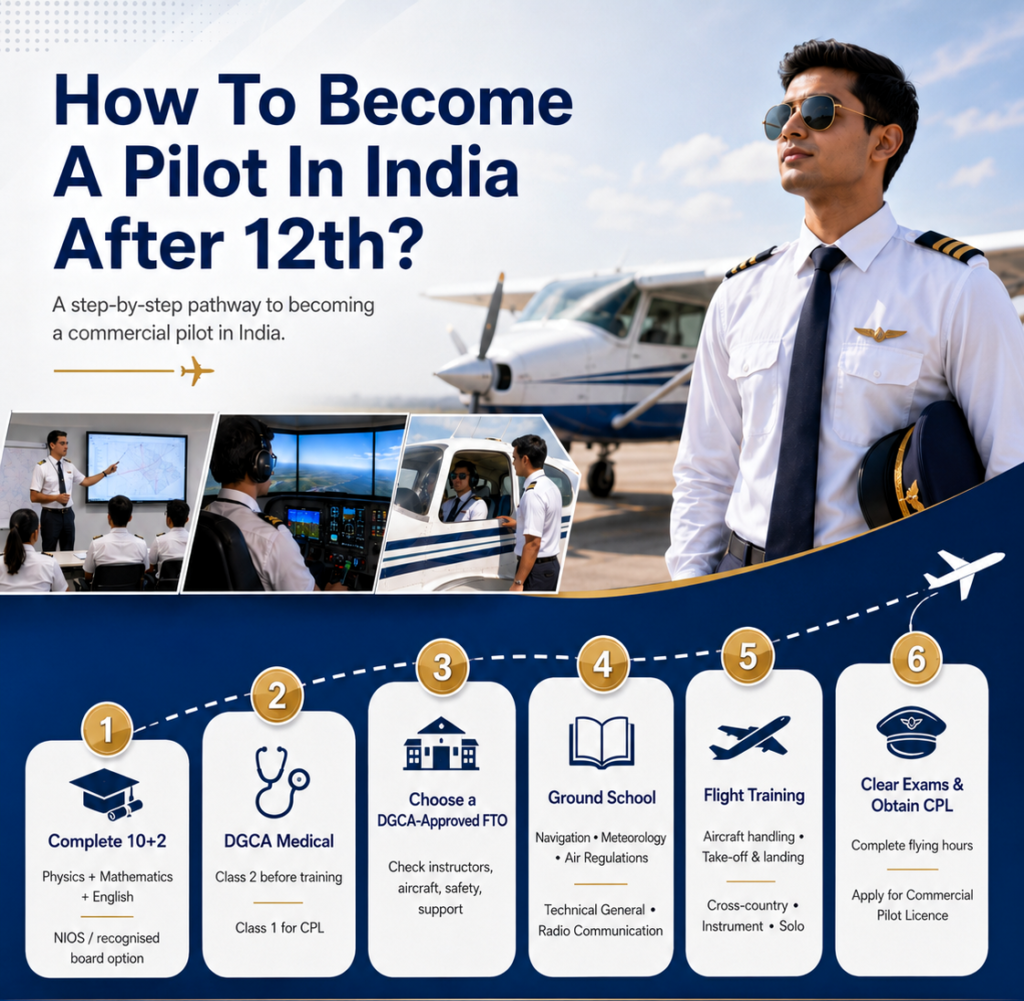
    Many students begin their pilot journey immediately after completing Class 12. 

    Becoming a commercial pilot requires a structured approach that combines academic qualifications, medical fitness, theoretical knowledge, and practical flight experience. The journey from an aviation aspirant to a licensed commercial pilot involves completing DGCA requirements and gaining the necessary skills through professional flight training.

    The general pathway to become a pilot in India includes the following steps:

    Stage 1: Complete 10+2 Education with Physics and Mathematics

    The first step towards becoming a pilot is completing Class 12 education from a recognised board.

    Candidates pursuing a Commercial Pilot Licence (CPL) must generally have Physics and Mathematics as subjects in Class 12 along with English proficiency. 

    A strong foundation in these subjects helps students understand important aviation concepts such as aircraft performance, navigation, aerodynamics, and flight operations.

    Students who do not have Physics and Mathematics in Class 12 may complete these subjects through NIOS (National Institute of Open Schooling) or other recognised education boards. Completing the required subjects through a recognised board helps candidates fulfil the academic eligibility criteria for CPL training.

    Stage 2: DGCA Medical Examination

    The DGCA pilot medical test is a mandatory requirement before beginning professional pilot training.

    Aspiring pilots must complete DGCA Class 2 Medical Examination before starting flight training and DGCA Class 1 Medical Examination for CPL requirements

    Completing medical certification at an early stage helps students confirm their eligibility before investing significant time and resources into pilot training.

    Stage 3: Choose a DGCA-Approved Flying Training Organisation (FTO)

    Selecting the right flying school is one of the most important decisions in a pilot’s career journey.

    Candidates should choose a DGCA-approved Flying Training Organisation (FTO) in aviation that provides structured CPL training according to regulatory standards.

    While selecting a flying institute, students should consider:

    • DGCA approval and training standards
    • Experienced flight instructors
    • Aircraft availability and maintenance standards
    • Safety-focused training environment
    • Quality of ground school preparation
    • Student guidance and career support

    Vision Flying Training Institute (VFTI) is among the top pilot flying training institutes in India, providing structured CPL training with a focus on professional aviation skills, safety, and career preparation.

    Stage 4: Complete Ground School Training

    Before entering the cockpit, students must develop a strong understanding of aviation theory through ground classes.

    CPL ground training covers important subjects, including:

    • Air Navigation
    • Aviation Meteorology
    • Air Regulations
    • Technical General
    • Radio Navigation and Communication

    This theoretical knowledge prepares students for DGCA examinations and helps them understand aircraft systems, flight planning, weather conditions, and operational procedures.

    Stage 5: Complete Flight Training and Build Flying Experience

    After completing the required theoretical training, students begin practical flight training under experienced flight instructors.

    Flight training focuses on developing essential pilot skills, including:

    • Aircraft familiarisation
    • Basic aircraft handling
    • Take-off and landing techniques
    • Circuit flying
    • Cross-country navigation flights
    • Instrument flying
    • Emergency handling procedures
    • Solo flying experience

    At VFTI, students receive structured flight training designed to gradually build confidence, technical ability, and professional flying skills.

    Stage 6: Clear DGCA Examinations and Obtain CPL

    After completing the required flying hours, examinations, and regulatory requirements, candidates can apply for their Commercial Pilot Licence (CPL) from DGCA.

    A CPL allows pilots to pursue professional aviation opportunities. CPL pilot training is the foundation for candidates who aspire to build a long-term career as a professional pilot.

    What Does CPL Training Include?

    A Commercial Pilot Licence (CPL) training programme is designed to develop the theoretical knowledge, technical skills, and practical flying experience required to become a professional pilot. The training is divided into multiple stages, including ground classes, flight training, simulator sessions, and DGCA examinations. 

    1. Ground School Training

    Ground school builds the theoretical foundation required for safe and professional flying. Students learn key aviation subjects such as Air Navigation, Aviation Meteorology, Aircraft Technical Knowledge, Air Regulations, and Radio Communication.

    This knowledge helps aspiring pilots understand aircraft operations, flight planning, weather conditions, and aviation procedures while preparing for DGCA examinations.

    1. Flight Training

    Flight training allows students to apply their theoretical knowledge in real aircraft operations under the guidance of qualified flight instructors. Students learn aircraft handling through practical flying sessions.

    1. Simulator Training

    Simulator training provides a controlled environment where students can practise cockpit procedures, decision-making, and emergency scenarios before experiencing them in actual flight conditions.

    It helps improve situational awareness, confidence, and overall flight safety.

    1. DGCA Examinations

    Students must clear required DGCA examinations before obtaining their licence.

    How Much Does Pilot Training Cost in India? 

    The pilot course fee is a significant investment because it includes aircraft operation, instructor fees, examinations, simulator sessions, and other aviation-related expenses.

    A typical CPL training programme in India may cost approximately ₹35 lakh to ₹60 lakh or more, depending on the flying school, aircraft type, training structure, flying hours, location, and additional requirements such as simulator training, accommodation, and other associated expenses. 
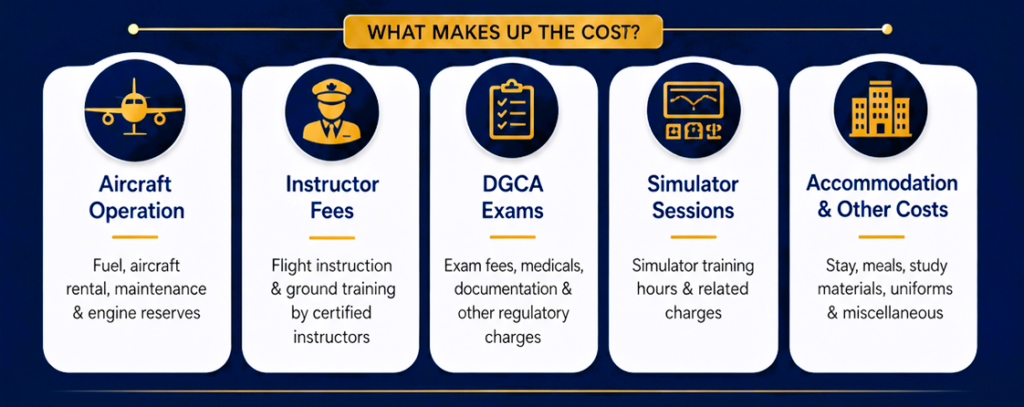
    The exact cost may vary between institutes based on the facilities and services included in the programme. 

    How Long Does It Take To Become A Pilot?

    A Commercial Pilot Licence (CPL) programme in India generally takes around 18 to 24 months to complete when pursued through a structured training programme.

    The actual completion timeline may vary depending on factors such as:

    • Weather conditions affecting flight operations
    • Aircraft availability and maintenance schedules
    • Student performance and learning pace
    • Instructor availability
    • Training consistency and scheduling

    A well-planned training programme with regular flying sessions helps students complete their CPL journey efficiently and progress towards their professional aviation goals.

    Vision Flying Training Institute (VFTI) has its training base in Gujarat, a location known for favourable weather conditions that support consistent flying operations throughout the year. 

    Our institute provides a suitable training environment with the necessary infrastructure, aircraft facilities, and professional guidance to help students complete their flight training effectively and progress towards their CPL goals. 

    Career Opportunities After CPL Training

    After completing a Commercial Pilot Licence (CPL), pilots can explore various career opportunities in the aviation industry, including:

    • Airline First Officer: Join commercial airlines as a First Officer after completing required airline assessments and additional training.
    • Charter Pilot: Fly private and business aircraft with charter operators.
    • Cargo Pilot: Operate cargo aircraft for aviation and logistics companies.
    • Flight Instructor: Train future pilots after obtaining the required instructor qualifications.
    • Aviation Operations: Explore roles in aviation management, flight operations, and related fields.

    Is Pilot Training Worth the Investment in India?

    Since CPL training involves a significant investment, many aspiring pilots and parents want to understand whether pursuing pilot training is a worthwhile career choice.

    Pilot training can be a rewarding investment for students who are passionate about aviation and committed to building a professional flying career. With the growth of the Indian aviation sector and increasing demand for skilled pilots, qualified commercial pilots have opportunities to work with airlines, charter operators, and other aviation organisations.

    Aviation is also considered an attractive career option due to the earning potential of professional pilots. The salary of a pilot can increase significantly with experience, aircraft type, and airline. Experienced pilots, especially those flying larger commercial aircraft, can earn competitive salaries while enjoying a respected and rewarding career.

    However, CPL training is only the beginning of the journey. Choosing the right DGCA-approved flying school, gaining quality flight experience, and developing strong aviation skills play an important role in long-term career success.

    Why Choose Vision Flying Training Institute for Pilot Training in India? 

    Vision Flying Training Institute (VFTI) is a DGCA-approved Flying Training Organisation (FTO) located at Amreli Airport, Gujarat. It is one of the best pilot training colleges in Gujarat, providing aspiring pilots with structured pilot course training in India.

    Students choosing VFTI for pilot training benefit from:

    • DGCA-Approved CPL Training Programme: A structured pathway covering ground school, flight training, and the required flying experience to pursue a Commercial Pilot Licence.
    • Strategic Training Base in Gujarat: VFTI’s airbase at Amreli Airport offers favourable weather conditions, clear skies, and less congested airspace, supporting consistent flying practice throughout the year.
    • Modern Aircraft Fleet: Students receive flight training on modern training aircraft, including Tecnam P2008 JC, Cessna 172 Skyhawk, and Tecnam P-Mentor, equipped with advanced glass cockpit avionics such as Garmin G1000 and G3X Touch systems.
    • Experienced Aviation Instructors: Professional guidance from trained instructors helps students develop essential flying skills.
    • Integrated Learning Approach: VFTI combines classroom learning, practical flying, simulator training, and career preparation to create a complete pilot training experience.
    • Campus-Based Training Environment: Students can focus on their aviation journey with training facilities, boarding, and lodging support available at the Amreli, Gujarat airbase.
    • Career-Oriented Preparation: VFTI provides airline preparation support, including interview guidance, simulator preparation, and career assistance to help students progress towards professional aviation opportunities.

    VFTI provides aspiring pilots with the foundation needed to build a successful career in aviation.

    Conclusion 

    Becoming a pilot is a journey that requires the right training, dedication, and professional guidance. 

    The aviation industry is continuing to grow, creating demand for skilled and well-trained pilots. With the right training pathway and professional guidance, your passion for flying can become a rewarding career as a pilot. 

    Contact Vision Flying Training Institute today and take the first step towards your career in the skies.

    Call: +91 9319193602, +91 9319193605 

    Email: enquiry@vfti.in

    Enquire now and begin your pilot training journey with VFTI.
  • Flight School vs Air Force Pilot Training: Key Differences Explained

    Flight School vs Air Force Pilot Training: Key Differences Explained

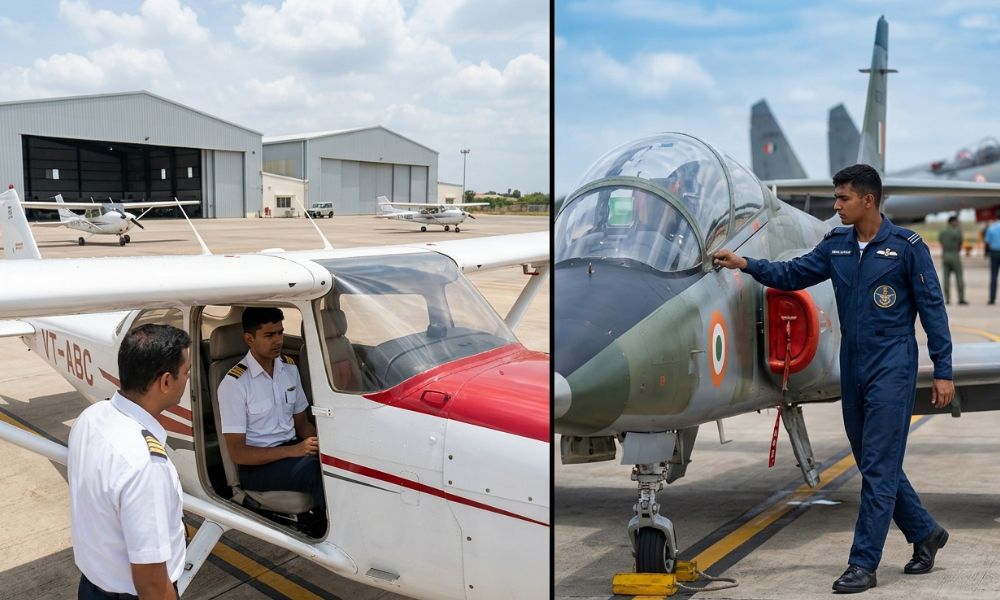
    Pilot training is a dream for many students in India, but there are two fundamentally different paths to the cockpit: a civilian flight school or pilot training through the Indian Air Force. Understanding the key differences helps aspiring pilots determine which route aligns with their career goals, budget, lifestyle and personal interests.

    Civilian flight schools primarily prepare students for careers in commercial aviation – airlines, charter services and private flying. The Indian Air Force trains pilots for military operations and national defence. Both routes command respect, but the training systems, costs, entry requirements and career commitments differ significantly.

    India: Civilian Flight School Overview

    Civilian aviation flight schools train individuals to fly aircraft within a structured regulatory framework. In India, students undergo ground school and the required flying hours at a Flying Training Organisation recognised by the Directorate General of Civil Aviation.

    Training typically covers aircraft handling, navigation, meteorology, aviation law, radio communication, emergency procedures and flight planning. Most students work toward a Commercial Pilot Licence along with additional ratings required for professional aviation. Before selecting any school, it is worth comparing DGCA-approved flying institutes in India to understand what verified, well-structured organisations look like in terms of aircraft availability, instructor quality and course completion standards.

    Civilian training offers one significant advantage: flexibility. Students can compare schools, evaluate costs, assess aircraft availability and choose a location that suits them. They also have more control over the pace at which they complete training.

    Indian Air Force Pilot Training: What Is It?

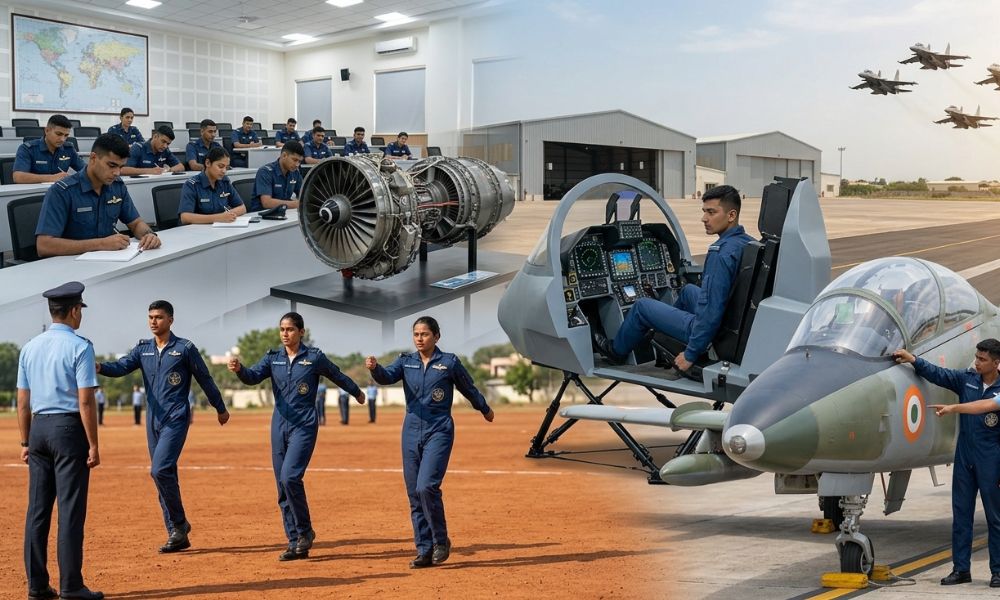
    IAF cadets in classroom training, flight simulator, drill practice, and on the tarmac with a fighter jet

    Indian Air Force pilot training is a military officer programme, not simply a flying curriculum. Candidates selected through the Air Force Common Admission Test and related processes undergo military, academic, physical and flying training as a combined programme.

    The training teaches not only how to fly but also leadership, discipline, resilience, teamwork and decision-making under operational pressure. Air Force pilots may eventually fly advanced military aircraft on active missions. Anyone pursuing this route must have a genuine commitment to military service, not just an interest in flying.

    Entry Requirements and Selection

    Entry requirements represent one of the starkest differences between the two paths.

    Civilian flight school admission follows a comparatively straightforward process. Students must satisfy educational qualifications, age criteria and DGCA medical eligibility requirements before beginning professional training.

    Indian Air Force selection is far more competitive. Candidates are assessed on academic merit, aptitude, medical fitness, physical stamina, psychological profile, leadership qualities and communication skills. A strong academic record alone is insufficient. Candidates must also demonstrate discipline, confidence, problem-solving ability and composure under pressure.

    Cost of Training

    Cost is one of the most significant practical differences between the two paths.

    Civilian pilot training in India involves a substantial personal financial commitment. Students typically pay for aircraft rental, instructor fees, examinations, simulator sessions, medical tests, study materials, accommodation and transport. A clear understanding of pilot course fees and what training actually costs in India is essential before committing to any programme, as the total expenditure is considerably higher than the advertised hourly rate suggests.

    Air Force training operates differently. Selected candidates undergo training as part of their military service and do not pay standard civilian tuition fees. However, this does not mean the path is without cost. Candidates commit to military responsibilities, rigorous discipline, postings and defined service obligations.

    The key distinction:

    • Civilian flight school — students fund their own training and retain control over location and career choices
    • Indian Air Force — training is part of military service, structured and less flexible, oriented toward defence and operational flying.


    Training Style and Environment

    Civilian flight schools are generally more adaptable. Students can schedule flights around budget, weather, instructor availability and aircraft access. The environment is professional but not militarised.

    Air Force training is highly regimented. Trainees follow a structured daily programme combining military drills, physical conditioning, classroom instruction and flying assessments. The training goes beyond aircraft handling — it conditions pilots to make rapid, sound decisions in high-pressure operational environments.

    How Training Intensity Differs

    Civilian students work through theory examinations, navigation exercises, airmanship practice and skills tests. There is typically some flexibility to revisit exercises if additional practice is needed.

    Air Force trainees simultaneously manage academic coursework, physical fitness requirements, simulator training, flying progression and military obligations. The pace is faster and expectations are higher, reflecting the operational demands of military aviation.

    Both paths require genuine discipline, but military training consistently operates under greater pressure and imposes a more demanding lifestyle.

    Aircraft Used During Training

    Civilian students typically begin on light training aircraft, learning the fundamentals of takeoff, landing, navigation, stall recovery, radio communication and emergency procedures. Many progress to multi-engine aircraft and more advanced avionics in later stages.

    Indian Air Force trainees eventually transition to advanced military aircraft with more complex systems, higher performance envelopes and demanding operational procedures. Both civilian and military pilots share the same foundational training principles, however, regardless of the aircraft they ultimately fly.

    Lifestyle Differences

    The lifestyle implications of each path are considerable and often underestimated.

    Civilian pilots have significant freedom over where they work and train. Once qualified, they can pursue employment with airlines, charter operators, flight schools, cargo companies or corporate aviation organisations.

    Air Force pilots have less autonomy over their location and duties. They may be posted to different bases, assigned specific roles or redeployed according to operational requirements.

    Civilian training suits students who want flexibility and a direct route into commercial aviation. The Indian Air Force suits those who want to combine flying with military service and are comfortable with the structure and commitment that entails.

    Career Paths After Civilian Flight School

    Civilian pilots in India typically build experience progressively before becoming eligible for airline positions. Many begin as flight instructors, move into charter or corporate flying and eventually reach the airlines. For students whose primary goal is an airline career, civilian flight training is generally the more direct path.

    That said, completing flight training does not guarantee employment. Airlines evaluate technical knowledge, how many flight hours a candidate has accumulated, medical fitness, communication skills and interview performance before making any offer.

    Career Opportunities After Indian Air Force Training

    Indian Air Force pilots serve in a highly disciplined and technically demanding operational environment. After completing their required service period, many military pilots transition to civilian aviation, bringing strong flying experience and professional credibility.

    However, the Indian Air Force should not be viewed primarily as a pathway to an airline career. The principal commitment is military service, and career decisions are shaped by that obligation throughout the period of service.

    Which Path Is Right for You?

    There is no single correct answer.

    Civilian flight school is typically better suited to students who want a commercial aviation career with flexibility over location, employer and career pace.

    Indian Air Force pilot training is more appropriate for candidates who are drawn to military service, can meet the rigorous selection standards and are prepared for the discipline, postings and long-term service commitments involved.

    Final Thoughts

    The choice between civilian flight school and Indian Air Force pilot training comes down to personal goals, financial circumstances and lifestyle priorities.

    Civilian flight schools offer flexibility and a clear route into commercial aviation, funded at personal expense. Military aviation provides structured professional training and operational flying experience, but comes with stringent selection criteria, disciplined living conditions and defined service obligations.

    For most students targeting an airline career in India, civilian training is the more straightforward path. For those who want to combine flying with military service, the Indian Air Force offers a challenging and fulfilling alternative. Understanding what civilian pilots earn at each stage from CPL through to ATPL can help students assess whether the financial investment in civilian training aligns with their long-term career expectations before making a final decision.

  • Tecnam P Mentor: Features, Cockpit Layout & Fuel Efficiency

    Tecnam P Mentor: Features, Cockpit Layout & Fuel Efficiency

    Airlines in India are not impressed by a pilot’s licence alone. They want airline-ready cadets who can handle modern cockpits, understand systems quickly, and show adaptability to today’s flight decks. It is all that separates a “licensed pilot” from a “hireable pilot”. 

    Your stream does not decide your future in aviation.  A commerce student can also become a Pilot without Physics.

    So what does that have to do with this blog?

    A lot, actually. Because how “ready” you feel as a pilot often depends on two things, where you train and what aircraft you train on. 

    The right flying school and the right trainer can shape how quickly you build real cockpit confidence and not just log hours. 

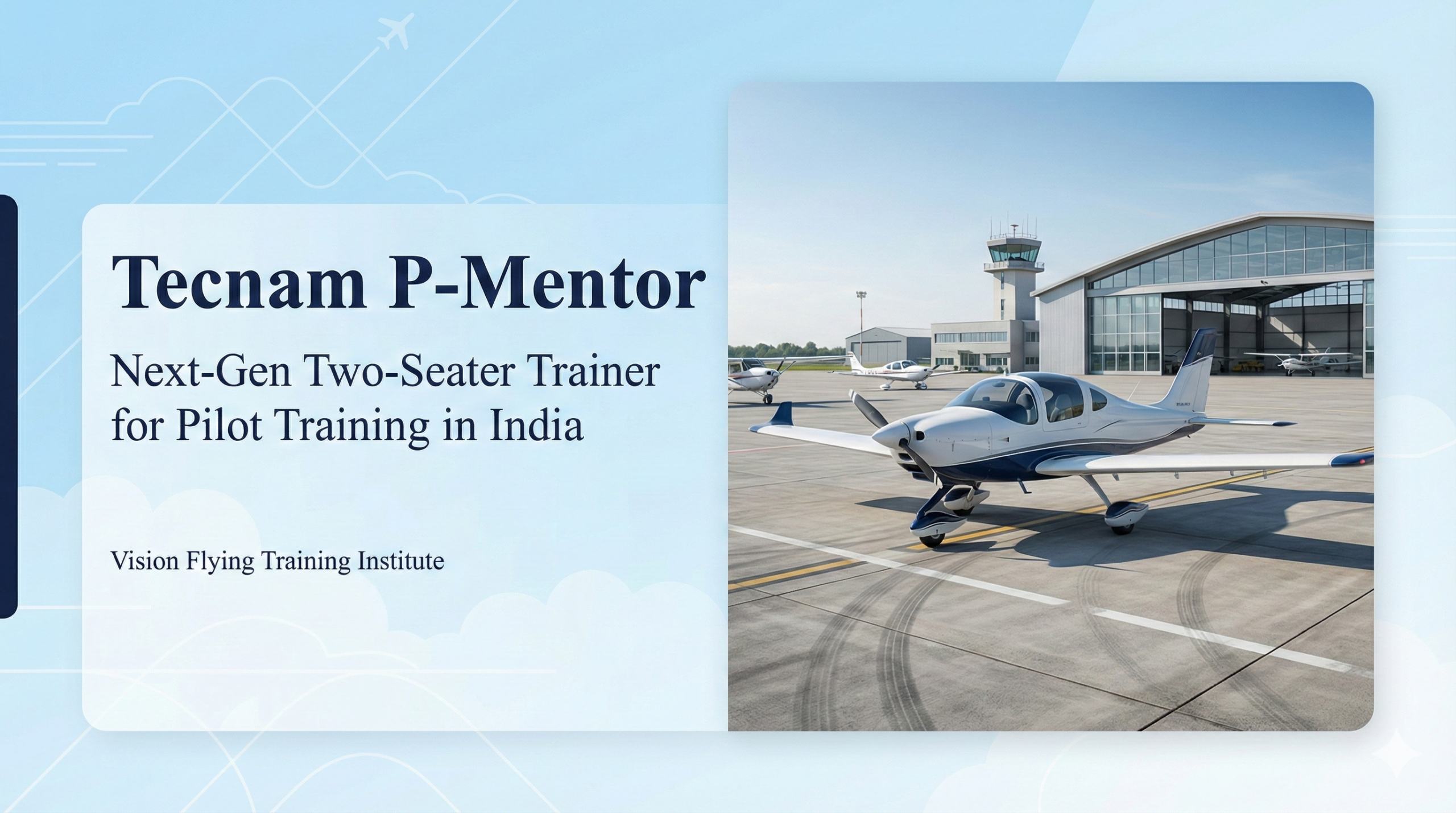
    In this blog post, we discuss the Tecnam P-Mentor, one of the most advanced two-seater training aircraft with high-value attributes, a smart cockpit layout, and strong fuel efficiency. This makes it the best choice for Commercial Pilot Licence (CPL) training in India.

    Introducing the Tecnam P-Mentor, a high-tech aircraft built for student pilots

    The Tecnam P-Mentor is a sleek, Italian-designed two-seat trainer aircraft that was launched in 2022. It is a unique aircraft that is best for training young pilots in India and around the world. It incorporates the latest avionics technology, a fuel-efficient engine, and a safety-oriented design philosophy into one aircraft.

    The Tecnam P-Mentor takes student pilots from their very first flying lesson to advanced training such as instrument rating (IR) and even Upset Prevention and Recovery Training (UPRT). 

    It is no surprise that the best flying institutes for Pilot Training in India and around the world have taken to the P-Mentor in a big way. Vision Flying Training Institute is one of the first flight schools in India to introduce this advanced trainer to its students.

    Key Features of the Tecnam P-Mentor for Top Pilot Training in India

    The Tecnam P-Mentor is built with features designed to outperform many older trainers in training environments. It’s the kind of airplane that actually makes training feel more structured, safer, and closer to real airline-style flying. 

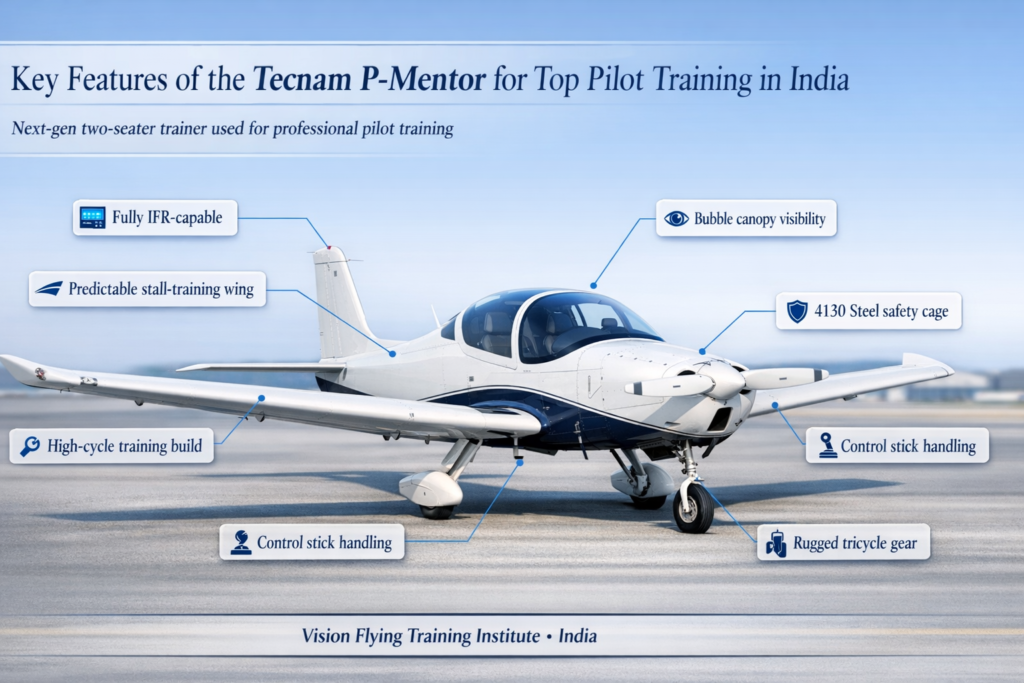
    Key features diagram of Tecnam P-Mentor pilot training aircraft at VFTI


    Here are the features that genuinely matter when you are a student pilot in India:

    • Fully IFR-capable: The P-Mentor is certified for Instrument Flight Rules (IFR), which means Pilot training at Vision Flying Training Institute goes beyond visual flying and learn real instrument procedures, the kind pilots will actually use later in professional aviation.
    • Modern design and build that’s made for high-cycle training: A smart mix of materials, including metal and composites, is used to balance strength and weight. It has a lightweight metal wing structure for durability and a carbon-fiber reinforced leading edge. The cabin is built with a 4130 steel truss frame, like a protective cage. It’s designed for better impact energy absorption. This adds a layer of passive safety that’s honestly reassuring during training.
    • Side-by-side seating under a bubble canopy: Student and instructor sit side-by-side, and the bubble canopy gives a wide, open field of view. This makes traffic spotting, runway alignment, and circuit work easier, especially at busy Indian airfields where situational awareness matters a lot.
    • Aerodynamic wing built for predictable stall training:
      The wing has a tapered planform with a laminar-flow airfoil and slotted flaps covering about 75% of the wing. This improves low-speed handling and makes stall behavior more consistent. This is exactly what you want when you are learning stalls and slow flight.
    • Control stick instead of a yoke: Instead of the traditional yoke found in many older trainers, the P-Mentor uses a control stick. It helps you develop more precise “stick and rudder” skills and feels closer to how modern aircraft are flown.
    • Landing gear made to survive student landings: It has a fixed tricycle landing gear that’s built tough for training cycles (lots of takeoffs and landings). VFTI specifically highlights the aircraft’s strong landing gear and ergonomic controls as well-suited for student pilots.

    Tecnam P-Mentor Specifications and Dimensions

    The Tecnam P-Mentor is built for training efficiency without compromising performance. It’s an EASA CS-23 certified aircraft with full day/night IFR capability, meaning student pilots can train even for instrument ratings on this platform. 

    Key specifications of the P-Mentor include:

    CategorySpecificationValue
    Overall dimensionsWingspan9.00 m (29.5 ft)
    Length6.74 m (22.1 ft)
    Height2.50 m (8.2 ft)
    Stabilator span2.90 m (9.5 ft)
    WingWing area11.9 m² (128.1 ft²)
    Landing gearWheel track1.84 m (6.04 ft)
    Wheelbase1.62 m (5.31 ft)
    Main gear tire5.00–5
    Nose gear tire5.00–5
    WeightsMaximum take-off weight (MTOW)720 kg (1587 lb)
    Maximum landing weight (MLW)720 kg (1587 lb)
    Empty weight430 kg (948 lb)
    Specific loadingsWing loading60.50 kg/m² (12.39 lb/ft²)
    Power loading7.20 kg/hp (15.87 lb/hp)
    FuelTotal fuel capacity140 L (37 gal)
    Usable fuel131.6 L (35 gal)
    Approved fuel gradesMOGAS (ASTM D4814), MOGAS EN228 (min RON 95), AVGAS 100LL (ASTM D910)
    EngineManufacturerBombardier–Rotax GmbH
    ModelRotax 912 iSc 3 Sport
    Type CertificateEASA.E.121
    Engine type4 cylinder horizontally-opposed twins with overall displacement of 1352 c.c., mixed cooling, electronic injection, integrated reduction gear with torque damper.
    Max take-off power (5 min)73.5 kW / 100 hp @ 5800 rpm
    Max continuous power72.0 kW / 98 hp @ 5500 rpm
    PropellerManufacturerMT Propeller
    ModelMTV-21-A/180-51
    Type CertificateEASA.P.101
    Blades2 (laminated wood composite)
    Diameter1800 mm (5 ft 10.9 in)
    TypeVariable pitch, constant-speed

    The P-Mentor’s numbers show a balance of modern tech and practical design, exactly what a training aircraft needs.

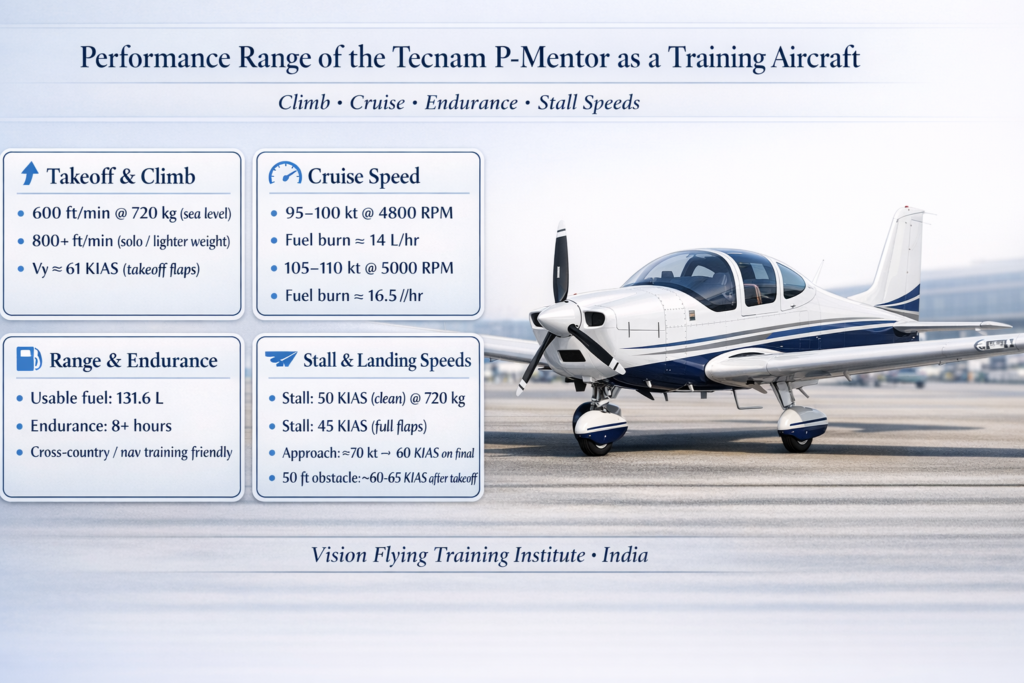
    Performance Range of the Tecnam P-Mentor as a Training Aircraft

    Do not let its compact frame make you underestimate it.

    The P-Mentor delivers solid performance suitable for all training phases, including cross-country flights and advanced maneuvers:

    Performance specifications chart of Tecnam P-Mentor training aircraft

    • Takeoff and climb: At maximum weight (720 kg), it climbs at around 600 ft/min at sea level on a standard day. With lighter weight (like solo flying), the climb can go beyond 800 ft/min. 
      The best climb speed (Vy) is approximately 61 KIAS (knots indicated airspeed) with takeoff flaps, which provides a good climb while maintaining comfortable forward visibility.
    • Cruise and range: This is where the P-Mentor really feels efficient. At around 4800 RPM (revolutions per minute), it cruises roughly 95-100 knots while burning only about 14 L/hr. At around 5000 RPM, it can do about 105-110 knots for roughly 16.5 L/hr. 
      With 131.6 L usable fuel, it can stay airborne for 8+ hours, making long cross-country flights and multi-leg nav training easy without constant refuelling.
    • Stall speeds: The stall speeds are low, which is great for student confidence. At 720 kg, it stalls around 50 KIAS clean and about 45 KIAS with full flaps. That extra margin helps during slow flight, approach practice, and landing training.
    • Takeoff and landing feel: Takeoff and landing distances are training-optimized. It typically clears a 50 ft obstacle around 60-65 KIAS after takeoff, and landing approaches are usually flown around 70 knots, slowing to about 60 KIAS on final. With a stall at 45 knots in landing configuration, there’s a solid safety margin for students.

    Overall, the P-Mentor gives you a good climb, efficient cruise, and very forgiving low-speed handling. Additionally, it burns significantly less fuel than older trainers, which is a significant advantage during hour-building.

    Tecnam P-Mentor Glass Cockpit Avionics and Cockpit Layout

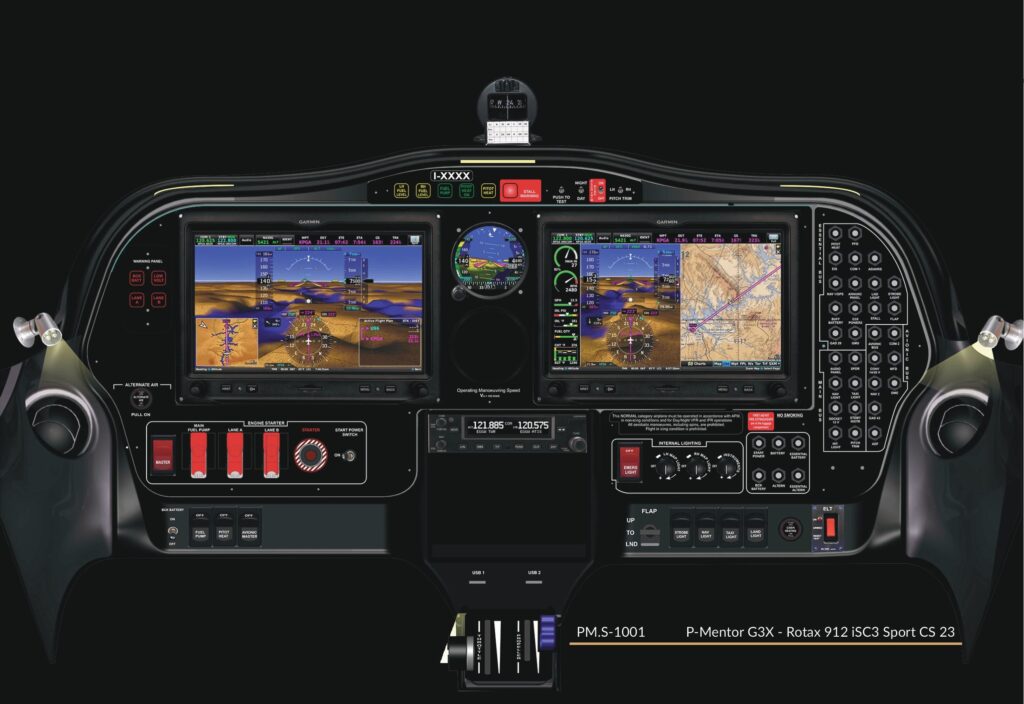
    One of the most attractive features of the Tecnam P-Mentor is its Garmin avionics suite. When entering the cockpit of the P-Mentor, pilot trainees see a cockpit environment that is similar to what is found in commercial aircraft and high-end general aviation aircraft, rather than what was found in 1970s-era trainers. 

    Garmin G3X glass cockpit panel of Tecnam P-Mentor training aircraft


    The following are the key features of the cockpit and avionics of the P-Mentor:

    GarDual min G3X Touch Dual Displays

    • The display is dominated by two large Garmin G3X Touch screens. One is usually the Primary Flight Display (PFD) and the other the Multi-Function Display (MFD).
    • You can view attitude, airspeed, altitude, heading, and Horizontal Situation Indicator (HSI) right in front of you, along with your navigation maps and engine information.
    • If one screen goes down, the system can revert to a reversionary mode, so you can still view important flight information on the other screen.

    Integrated Instrument Flying Setup

    The P-Mentor is designed to facilitate Instrument Flight Rules (IFR) training, rather than just visual flight training. The avionics suite may consist of the Garmin GTN 650Xi (a touchscreen Global Positioning System/Navigation/Communication system) and a second radio, such as the Garmin GNC 255A (Navigation/Communication system).

    This configuration facilitates the following instrument flight procedures:

    • Instrument Landing System (ILS) approaches
    • VHF Omnidirectional Range (VOR) navigation
    • Global Positioning System (GPS) approaches
    • Localizer Performance with Vertical guidance (LPV) approaches using Satellite-Based Augmentation System (SBAS)

    It also has a transponder, such as the Garmin GTX345R, which is compatible with Mode S and Automatic Dependent Surveillance-Broadcast (ADS-B Out) for contemporary Air Traffic Control (ATC) systems. Optional components may include Distance Measuring Equipment (DME) and Automatic Direction Finder (ADF) for more comprehensive instrument training exposure.

    Autopilot and Flight Director Support

    The aircraft is also compatible with the upgraded Garmin GFC 500 digital autopilot system, which is driven by servo motors such as the Garmin GSA 28. The Garmin GMC 507 is the autopilot control panel, with modes such as heading hold, altitude hold, navigation track, and approach. 

    It is also compatible with Electronic Stability and Protection (ESP), which assists the pilot in keeping the aircraft within safe operating limits. This is particularly useful while training, as trainee pilots may not be adept at mastering the aircraft.

    Standby Instrument for Backup

    In addition to the primary glass displays, the P-Mentor also includes a Garmin GI 275 Electronic Standby Instrument, which is capable of displaying basic information such as attitudes, altitudes, and airspeeds, and is usually powered by a separate battery source as well. That means if the primary displays encounter a rare failure, you will always have a backup reference source.

    Cockpit Layout

    The technology is great, but what really helps pilot trainees is the cockpit layout. 

    In simulation training for pilots, you learn the cockpit workflow step by step, so when you fly the actual aircraft, everything feels in the right place. It then makes day-to-day training easier and faster. 

    Here are a few things to keep note of:

    • Sticks instead of yokes: Both seats have control sticks, which help students master the precise control of the “stick and rudder,” bringing it closer to modern aircraft control philosophies.
    • Central power quadrant: The throttle and propeller levers are positioned together in a central console, similar to those found in larger or more advanced aircraft.
    • Smart switch placement: Critical items like master power, backup battery, and fuel pump switches are placed logically.
    • Easy Access Controls: The fuel selector, flap controls, and key training devices are located in a manner that makes them readily accessible to the student as well as the instructor.

    Wide Visibility

    The canopy provides wide visibility. Although this is a two-seater, it feels open and practical for training, with cabin heat/defrost and night-friendly lighting. It really makes a difference in circuit training, runway alignment, and traffic scanning. 

    Fuel Efficiency and Operating Cost Advantages of the P-Mentor for Pilot Training

    The Tecnam P-Mentor is extremely economical to operate. It burns roughly 14–15 litres per hour in cruise, which is far lower than many legacy trainers like the Cessna 172 or Piper Archer that often use 30–38 litres per hour. 

    Its Rotax 912iSc3 engine can also run on automotive petrol (MOGAS) as well as avgas, which can reduce fuel costs further where MOGAS is available. Lower fuel burn and simpler operations mean a lower cost per flying hour, helping flight schools keep training more affordable and consistent.

    The P-Mentor is built for high training usage, so maintenance is simpler, and downtime is minimized. Also, the feature of a replaceable wing leading edge, rugged fixed landing gear, and modern fuel-injecting Rotax engine means less wear and tear on training aircraft. 

    The availability of new parts and manufacturer support means the aircraft typically spends more time flying and less time grounded, helping the student get their pilot training done on time. 

    This helps trainees start their career sooner and begin earning the salary of a pilot in India. Training delays do the opposite, they push your career and income further away.

    Safety Features of the Tecnam P-Mentor for Pilot Trainees in India

    Safety is essential in the pilot training aircraft. Tecnam has engineered the P-Mentor with numerous safety features and robust design elements:

    • The P-Mentor’s wing design is intended to behave well at low speeds, which means that during practice flights for slow flight and stalls by pilot trainees, this plane will surely give a good warning and stay manageable. It complies with the latest CS-23 regulations for Stall/Spin without any need to resort to any “extraordinary device.”
    • The aircraft can be fitted with a whole-aircraft ballistic parachute system. This is unusual for conventional aircraft of this class and adds an extra layer of protection.                        
                                                                                    
    • The 4130 steel truss around the cockpit works like a safety frame, giving better protection for people inside, much more than what is provided by some of its older all-Aluminum rivals.                                                                     
                                           
    • Student flying means a lot of takeoffs, landings, and occasional firm touchdowns. The P-Mentor’s fixed landing gear and sturdy structure are built to handle that routine without constantly needing fixes.                                                            
                                                                          
    • The Garmin system, alongside its variants, has features for providing air traffic awareness, air traffic alerts, and air protection, all of which will surely help students cope with their high workload, especially during circuit flying or instrument flying.

    Tecnam P-Mentor: DGCA Approved Certifications, IFR Capability, and Compliance

    There is no doubt that a tremendous amount of safety-engineering detail goes into this aircraft right from its design. The Tecnam P-Mentor is a fully certified training aircraft that was made in accordance with European Union Aviation Safety Agency (EASA) Certification Specification 23 (CS-23) standards for normal category aircraft. 

    Moreover, this aircraft was also certified to allow for its usage in instrument flight rules (IFR) training without any restrictions. It is also capable of performing a form of navigation known as performance-based navigation (PBN) and area navigation (RNAV).

    Tecnam also explains that the P-Mentor, being an aircraft trainer, is one of the first trainers available on the market that is compliant with the latest CS-23 Amendment 5 standards. In order to do so, the aircraft was required to prove that its stall characteristics are so stable and predictable that an emergency parachute system is not required for safety outcomes. This speaks highly of its stability and its suitability.

    Because this European certification framework is similar to that of the United States Federal Aviation Administration (FAA) “Part 23,” the approvals issued by the P-Mentor are applicable and can be validated on a worldwide scale. 

    It also integrates well with the Indian compliance norms set by the Directorate General of Civil Aviation (DGCA). This aircraft has already cleared the compliance process and is certified for pilot training in India.

    Tecnam P-Mentor aircraft are listed in inventory documents published by the DGCA for Flight Training Organisation (FTO). This indicates the aircraft is in operational service under DGCA oversight.

    Why Vision Flying Training Institute Uses the Tecnam P-Mentor for Pilot Training in India

    Vision Flying Training Institute is a pilot training academy that is committed to delivering the best pilot training in India by innovating and adopting the right technology for our trainees. 

    The Tecnam P-Mentor is a centerpiece of our training fleet because it aligns with our core mission, i.e., training future airline pilots with modern, safe, and efficient equipment. 

    Here are some specific reasons and benefits for our pilot students:

    • The P-Mentor can take a student from their first flight all the way to instrument rating training and even commercial pilot licence level flying, all on one aircraft.

    The aircraft is a secondary concern if you haven’t crafted your pilot journey yet!                               

    Read our blog on How to Become a Commercial Female Pilot After 12th in India. 

    • The glass cockpit and advanced avionics make it easier for students to get comfortable with digital flight displays and real-world navigation habits early on. It helps students train in a cockpit that feels modern and airline-standard from the very beginning.                                      
                                                       
    • The design of the P-Mentor, from its very conception, has been oriented with training safety in mind. Stable handling inspires confidence in students when undertaking slow flight, landings, and circuit work.
    •  Flying in India can mean high temperatures, high humidity, or high-density altitude in some regions. The P-Mentor’s Rotax engine actually handles heat well and maintains performance at altitude better than some older engines.                                                
                          
    • The DGCA and other regulators increasingly emphasize up-to-date training devices and methods. By using an EASA-certified IFR trainer like the P-Mentor, Vision FTI stays ahead of the curve. The aircraft is already compliant with the latest standards.

    The P-Mentor definitely lives up to its name, as it becomes the ‘mentor’ leading the way for the future of pilots into the future of aviation. It brings a new era of training to Vision Flying Training Institute and its students.

    Enquire at VFTI for Pilot Training on the Tecnam P-Mentor

    We are proud to incorporate an advanced trainer like Tecnam P-Mentor into our holistic Commercial Pilot License course. Pupil pilots at VFTI will be trained on an aircraft that is secure, competent, and with the latest equipment. These trainees are not only to get their pilot’s license but also to excel in the skies as professional aviators.     

    A call for every Pilot aspirant, join VFTI and train on the latest equipment, under the guidance of expert instructors, with a curriculum that covers everything from DGCA ground exams to advanced flying techniques.   

    Contact Vision Flying Training Institute today to find out more about our pilot license course. Schedule a visit to see our Tecnam P-Mentor up close or to speak with our pilot mentors. 

    Your dream of flying commercial jets can start with training in the right airplane and the right flying institute in India.

    Download our 2026 Brochure

    Call our Admission Desk: +91-9319193602 / +91-9319193605Email: enquiry@vfti.in