The “best” flying institute in India is not the one with the loudest marketing. It’s the one that gets you to your Commercial Pilot Licence (CPL) on time, within budget, and with strong safety standards.
Coming here means you are doing the smartest thing a future pilot can do: researching properly before putting ₹40 to ₹55+ lakhs into CPL training.
The choice often matters even more for female pilot aspirants, because the right environment brings better support, mentorship, confidence, and a training pace that does not keep you stuck for months.
Check out our latest blog, “How to Become a Commercial Female Pilot After 12th in India.” It walks you through everything, step by step, so you know exactly what to do next.
That is why we looked at aircraft availability, weather patterns, training consistency, ground school support, safety and compliance culture, student assistance, and student feedback, and then ranked the top DGCA-approved flying schools in India.
Why the Right Flying Academy Matters for Commercial Pilot Licence (CPL) Training in India?
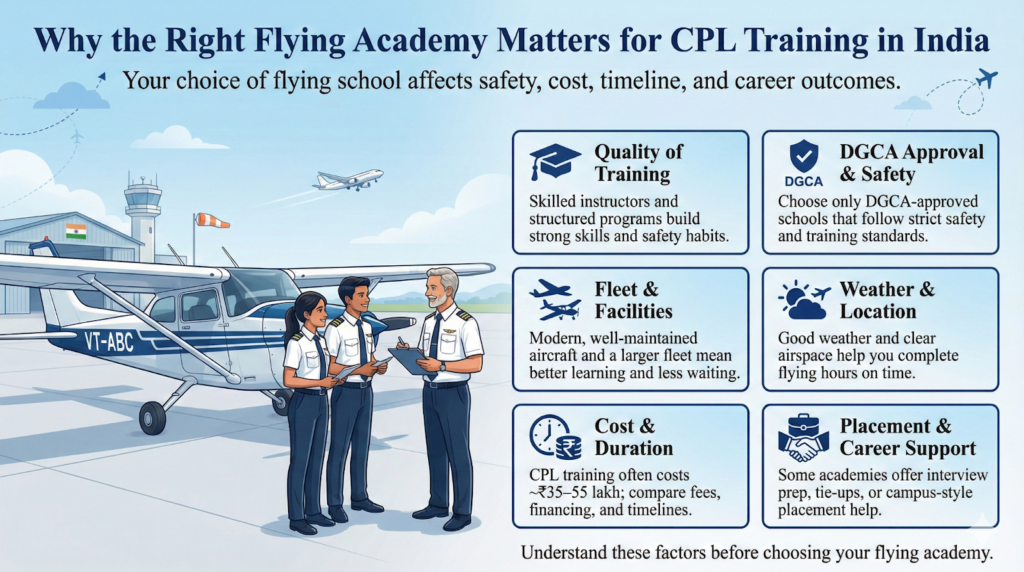
Becoming a pilot is a significant investment of time and money. Here are a few factors that make picking the right flying institute so important:
- Quality of Training: A well-structured program with skilled instructors and modern aircraft helps you build strong flying skills and safety habits from day one. Poor training can leave you uncertain and underprepared.
- DGCA Approval & Safety: In India, flying schools must be approved by the Directorate General of Civil Aviation (DGCA). An approved school follows strict safety and training standards.
- Fleet and Facilities: The number and type of aircraft available matter. Modern glass cockpit trainers and well-maintained aircraft can make learning better. A larger fleet also means less waiting for your turn to fly, helping you log hours faster.
- Weather & Location: Some academies have bases with favorable weather and unrestricted airspace, allowing near year-round flying. Good weather, like in parts of Gujarat or Madhya Pradesh, means you can complete your training on schedule without long monsoon delays.
- Cost and Duration: Commercial Pilot License (CPL) programs in India typically cost anywhere from ₹35 lakh to ₹55 lakh, approximately, for 200 hours of flying.
Government institutes tend to have fixed lower fees but tougher entry, while private academies may be costlier and offer financing options.
- Placement Support: After getting your CPL, landing an airline job is not guaranteed by any Pilot Training school. However, some institutes have career support, e.g., airline interview preparation, campus placements, or tie-ups with airline cadet programs.
Keeping these factors in mind, let us look at the top flying training institutes in India.
Top 10 Best Flying Institutes in India
1. Vision Flying Training Institute (VFTI) – Amreli, Gujarat:
Vision Flying Training Institute is among India’s top flying schools. It brings a modern approach to pilot training. Established in 2024, VFTI quickly gained DGCA approval and is part of the Vision Group of Institutions, which has over two decades of experience in education.
The institute’s flying base is in Amreli, Gujarat, a location known for clear skies and 365-day flying weather. This means minimal training disruptions due to bad weather. The choice of Amreli gives students access to relatively uncongested airspace and excellent flying conditions year-round.
VFTI offers training for both Commercial Pilot License (CPL) and Private Pilot License (PPL) programs, as well as license conversion training. All pilot training courses are DGCA-approved, and the CPL program includes the standard 200 hours of flying training with instrument flying, night flying, and multi-engine exposure as required by DGCA norms
One of VFTI’s biggest strengths is its modern aircraft fleet. Unlike many older schools that rely on decades-old planes, VFTI has invested in new-generation trainers. Their fleet includes Tecnam P2008 JC light sport aircraft, Tecnam P2006T Multi-Engine Simulator, and the advanced Tecnam P-Mentor, along with the reliable Cessna 172 Skyhawk.
Apart from our advanced fleet, VFTI has a DGCA-certified, CAR-145 approved in-house Maintenance, Repair and Overhaul (MRO) facility that keeps aircraft in top condition, reduces downtime, and helps you complete your CPL training on time. Our MRO services include line and base maintenance, scheduled and unscheduled inspections, structural repairs and modifications, component replacement and servicing, and complete airworthiness support.
VFTI features highly experienced flight instructors, some with backgrounds in the Air Force or airlines, so students learn under mentors who have flown in real-world environments. The student-to-instructor ratio is kept low, meaning you get more personalized one-on-one guidance.
Further, they provide guidance for airline placements, conduct mock interviews and simulator checks for airline selection, and have industry tie-ups to stay updated on hiring requirements.
When you have not studied Physics and Maths before, the flying school you choose matters even more, because you need the right support, not just flying hours. At VFTI, we guide commerce-background aspirants properly, from the basics to the CPL pathway. You can also check our full guide: “How a Commerce Student Can Become a Pilot Without Physics.”
VFTI is a DGCA-approved flying institute that can turn you into a competent commercial pilot on a fast timeline. VFTI, the pilot training institute, should be at the top of your list.
2. Indira Gandhi Rashtriya Uran Akademi (IGRUA) – Amethi, Uttar Pradesh:
IGRUA is often the name that comes up in discussions of the best pilot training institutes in India. Established in 1985 by the Government of India, IGRUA has a storied legacy and is sometimes referred to as the “IIT/IIM of Aviation”.
It is a public central flying school under the Ministry of Civil Aviation. IGRUA is based at Fursatganj Airfield, Amethi, UP. It was the country’s first national aviation academy. Over the decades, IGRUA has built a reputation for strict, high-quality training and disciplined operations.
IGRUA conducts an Ab-initio to CPL course, which can include an integrated three-year B.Sc. Aviation degree, in collaboration with a university. The training is comprehensive. IGRUA also historically offered a commercial helicopter pilot license course and other workshops.
IGRUA employs a mix of ex-Indian Air Force and senior civilian instructors. IGRUA cadets are known to have very strong theoretical knowledge and disciplined flying skills.
The aircraft fleet at IGRUA is large and modern: currently about 13 active training aircraft, primarily Diamond DA40 single-engine trainers and a couple of Diamond DA42 twin-engine aircraft. They also have two DA40 simulators for instrument training.
However, one downside noted by recent cadets is long training duration due to high student numbers and finite aircraft; some batches have taken 3-4 years to complete CPL. This backlog issue means you might spend a lot of time waiting for sorties or for your turn on the twin-engine, etc. It’s something to consider if timing is critical for you.
3. National Flying Training Institute (CAE Gondia) – Gondia, Maharashtra:
National Flying Training Institute (NFTI) in Gondia is popularly known as CAE Gondia. It is a premier private flying training academy that brings international expertise to India. It’s a joint venture between CAE Inc. (Canada), a world leader in aviation training, and the Airports Authority of India. Established in 2007, NFTI was one of the first privately-run academies to set up on a large scale to meet the growing demand for pilots.
CAE Gondia offers an Integrated CPL program that covers your Commercial Pilot License with Instrument Rating and Multi-Engine Rating in about 19 months of training. The curriculum and procedures here are aligned with ICAO and DGCA standards.
NFTI Gondia operates from Birsi Airport, Gondia, a training airfield in eastern Maharashtra. The location is relatively quiet with minimal commercial air traffic, which is best for training flights. The training fleet is modern and similar to IGRUA’s: about 12 single-engine Diamond DA40 aircraft and 2 twin-engine Diamond DA42 aircraft for multi-engine training. These aircraft have glass cockpits (Garmin G1000 avionics), preparing students for airline technology.
NFTI is undeniably one of the best flying training institutes in India, blending the local DGCA syllabus with international best practices.
4. Chimes Aviation Academy (CAA) – Dhana/Sagar, Madhya Pradesh:
Chimes Aviation Academy has rapidly grown into one of India’s leading flying schools. Founded in 2008 at Dhana airfield near Sagar, MP, Chimes is a private academy known for its modern approach. In fact, Chimes Aviation Academy was ranked as the top FTO in India in the DGCA’s inaugural 2025 rankings, being listed first among the Category ‘B’ schools.
One of Chimes’ biggest bragging points is its large fleet of training aircraft. CAA currently operates 24+ aircraft, including Cessna 172 single-engine planes and Diamond DA42 twin-engine aircraft, all equipped with Garmin G1000 glass cockpits. They have even added new Piper single-engine aircraft and Tecnam trainers recently, expanding the fleet. This is India’s largest civilian training fleet.
CAA offers the flagship Cadet Pilot Program in partnership with IndiGo Airlines. They also conduct Assistant Flight Instructor (AFI) / Flight Instructor (FI) courses, license conversions, and other add-ons.
5. Madhya Pradesh Flying Club (MPFC) – Indore & Bhopal, MP:
One of the oldest flying clubs, dating back to the 1950s. MPFC is state-run and has trained many pilots over the years. It operates from two cities Indore and Bhopal. The academy offers CPL, PPL, and instrument rating.
Being a club, the fleet is small (Cessna 152/172) and training can be slower. Still, its legacy and experienced instructors make it notable.
6. Orient Flights Aviation Academy (OFAA) – Mysore, Karnataka:
OFAA is a private flight academy with around 10 years of experience. It operates from Mysuru Airport. It provides CPL, PPL, and has had cadet program partnerships in the past.
Its fleet includes Cessna 172s and a DA42 Twin Star for multi-engine, making training strong and comfortable in Mysuru’s calm environment.
7. Flytech Aviation Academy – Hyderabad (Telangana):
A well-known private academy, Flytech has one of the largest fleets in India. They have operated 10+ aircraft including Cessnas and Piper Seneca for multi-engine. They have been in operation since the 1990s and have a large number of alumni.
Flytech’s appeal is that they have their own airfield in Telangana and offer comprehensive training including aircraft maintenance engineering courses. However, DGCA’s ranking placed Flytech in Category C, implying some areas for improvement.
8. Bombay Flying Club (BFC) – Mumbai, Maharashtra:
The oldest flying club in India, established in 1928. BFC trained India’s first pilots and is historically significant. It operates out of Mumbai’s Juhu Aerodrome and also Dhule for additional flying.
BFC offers CPL, PPL, and aircraft maintenance courses. They have a fleet of Cessna 172s and a couple of multi-engine planes. The advantage of BFC is its strong alumni network and location in Mumbai.
However, being a club in a congested city, aviation students sometimes face scheduling challenges and delays. In the 2025 DGCA rankings, BFC unfortunately fell into Category C, indicating room to upgrade safety and training performance.
Still, for Mumbai-based students or those wanting a legacy name, BFC is a consideration.
9. Ahmedabad Aviation & Aeronautics Ltd (AAA) – Ahmedabad, Gujarat:
Ahmedabad Aviation & Aeronautics Ltd is a private flying school operating at Ahmedabad airport since the 1990s. It offers CPL and PPL training. AAA was a go-to institute before VFTI and Blue Ray Aviation emerged in Gujarat.
AAA has a fleet of Cessna 172 and Piper Seneca (multi-engine). Its urban location is a double-edged sword: great city amenities, but busier airspace can limit daily flying hours.
AAA provides a solid training but with older infrastructure, something new entrants like VFTI aim to improve upon.
10. Top Crew Aviation (TCA) – Delhi (HQ) / Various bases
Top Crew Aviation is a new player that’s been gaining attention recently. It was founded in late 2020s. TCA offers CPL, PPL, and ATPL theory classes, and they have been innovative in providing scholarships. They use a mix of partner flying schools for actual flight training and have their own simulators.
TCA’s model is unique: they help students with financing and then guide them through training either domestically or partly abroad. For example, they had programs to do flying in South Africa or Serbia for cost savings.
TCA’s focus on placement assistance and airline interview prep is a strong selling point. As a newer institute, their success will depend on student outcomes, but they represent a trend of modern, student-centric training.
When budget is a limiting factor, it might be worth exploring such options where merit-based scholarships could reduce your cost.
There are other respectable academies like Gujarat Flying Club (Vadodara), GATI (Government Aviation Training Institute, Bhubaneshwar), Haryana Institute of Civil Aviation (at Karnal, Hisar, Pinjore), Rajiv Gandhi Academy for Aviation Technology (Trivandrum, Kerala), Redbird Aviation (a private FTO with bases in Maharashtra, Karnataka, Assam), and Falcon Aviation Academy (UP and MP), among others. Each has its own pros and cons. When comparing, always check the latest reviews on their fleet serviceability, instructor availability, and recent safety record.
Before choosing a flying school, it’s essential to understand the total investment and expected training timeline. For a complete breakdown, read our detailed guide on Pilot Course Fees & Duration, where we have covered everything related to this.
Why VFTI is the Best Flying Institute in India
It’s fair to ask why VFTI tops the list over giants like IGRUA. The reason is practical, not promotional: training efficiency.
VFTI wins on two critical fronts:
The Weather Factor: VFTI is in Amreli. It does not have the “Delhi Fog” that grounds planes for weeks in winter, nor the torrential Mumbai monsoons. You fly almost every single day.
The Tech Factor: Training on a Tecnam P2008 with a Glass Cockpit is just necessary. Modern Airbuses do not have analog dials. VFTI trains you to scan digital screens, manage energy, and use autopilots skills that make your airline Type Rating much easier.
Conclusion
Becoming a pilot is an investment of your time and money. You cannot afford to spend that at a pilot training school where you will sit on the ground waiting for spare parts or better weather.
You need a school that treats your training with the same professional urgency that you have for your career.
The “best” flying training institute in India ultimately depends on your priorities, be it advanced training, legacy reputation, cost, or speed.
Vision Flying Training Institute (VFTI) is a well-thought-out choice for students who want modern infrastructure, personalized training, and a faster, more structured path to their CPL.
Schedule a call with VFTI today!
Call our Admission Desk: +91-9319193602 / +91-9319193605
Email: enquiry@vfti.in
Leave a Reply