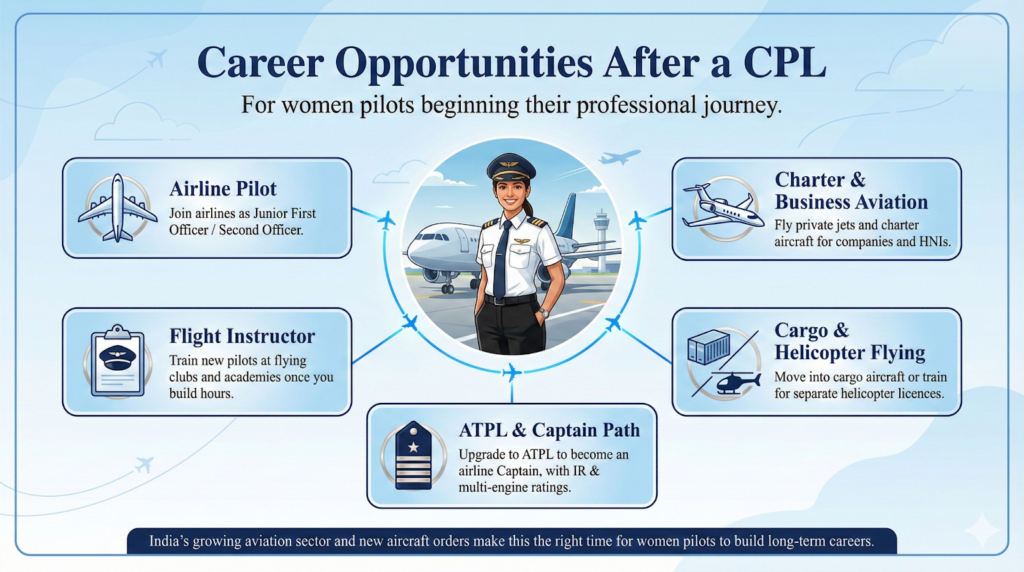
Tag: vfti

  • Tecnam P Mentor: Features, Cockpit Layout & Fuel Efficiency

    Tecnam P Mentor: Features, Cockpit Layout & Fuel Efficiency

    Airlines in India are not impressed by a pilot’s licence alone. They want airline-ready cadets who can handle modern cockpits, understand systems quickly, and show adaptability to today’s flight decks. It is all that separates a “licensed pilot” from a “hireable pilot”. 

    Your stream does not decide your future in aviation.  A commerce student can also become a Pilot without Physics.

    So what does that have to do with this blog?

    A lot, actually. Because how “ready” you feel as a pilot often depends on two things, where you train and what aircraft you train on

    The right flying school and the right trainer can shape how quickly you build real cockpit confidence and not just log hours. 

    In this blog post, we discuss the Tecnam P-Mentor, one of the most advanced two-seater training aircraft with high-value attributes, a smart cockpit layout, and strong fuel efficiency. This makes it the best choice for Commercial Pilot Licence (CPL) training in India.

    Introducing the Tecnam P-Mentor, a high-tech aircraft built for student pilots

    The Tecnam P-Mentor is a sleek, Italian-designed two-seat trainer aircraft that was launched in 2022. It is a unique aircraft that is best for training young pilots in India and around the world. It incorporates the latest avionics technology, a fuel-efficient engine, and a safety-oriented design philosophy into one aircraft.

    The Tecnam P-Mentor takes student pilots from their very first flying lesson to advanced training such as instrument rating (IR) and even Upset Prevention and Recovery Training (UPRT). 

    It is no surprise that the best flying institutes for Pilot Training in India and around the world have taken to the P-Mentor in a big way. Vision Flying Training Institute is one of the first flight schools in India to introduce this advanced trainer to its students.

    Key Features of the Tecnam P-Mentor for Top Pilot Training in India

    The Tecnam P-Mentor is built with features designed to outperform many older trainers in training environments. It’s the kind of airplane that actually makes training feel more structured, safer, and closer to real airline-style flying. 
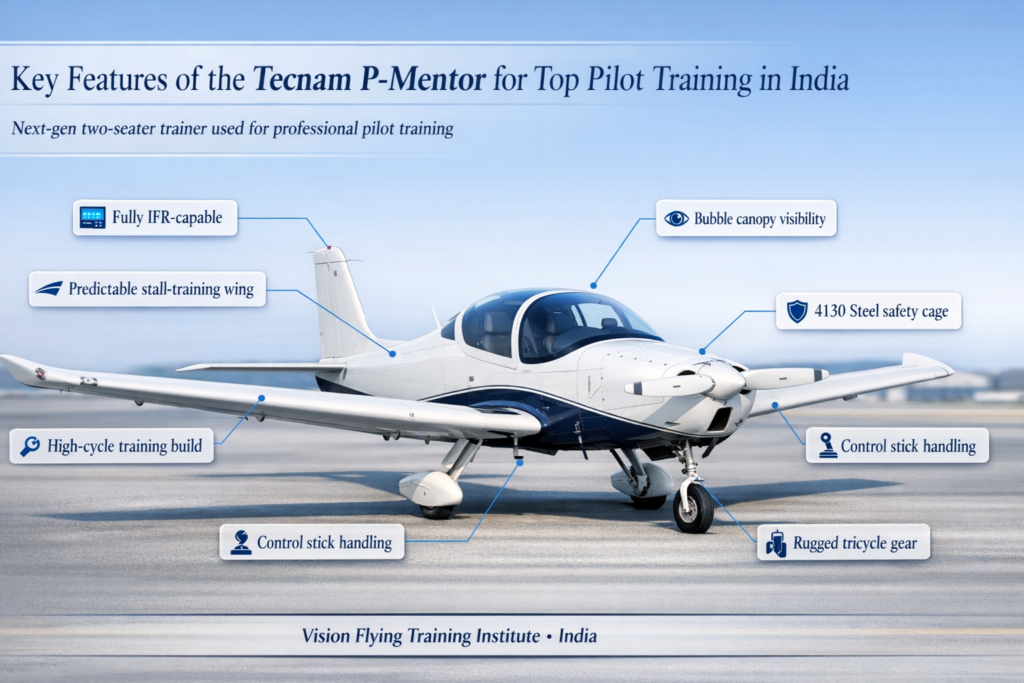
    Key features diagram of Tecnam P-Mentor pilot training aircraft at VFTI


    Here are the features that genuinely matter when you are a student pilot in India:

    • Fully IFR-capable: The P-Mentor is certified for Instrument Flight Rules (IFR), which means Pilot training at Vision Flying Training Institute goes beyond visual flying and learn real instrument procedures, the kind pilots will actually use later in professional aviation.
    • Modern design and build that’s made for high-cycle training: A smart mix of materials, including metal and composites, is used to balance strength and weight. It has a lightweight metal wing structure for durability and a carbon-fiber reinforced leading edge. The cabin is built with a 4130 steel truss frame, like a protective cage. It’s designed for better impact energy absorption. This adds a layer of passive safety that’s honestly reassuring during training.
    • Side-by-side seating under a bubble canopy: Student and instructor sit side-by-side, and the bubble canopy gives a wide, open field of view. This makes traffic spotting, runway alignment, and circuit work easier, especially at busy Indian airfields where situational awareness matters a lot.
    • Aerodynamic wing built for predictable stall training:
      The wing has a tapered planform with a laminar-flow airfoil and slotted flaps covering about 75% of the wing. This improves low-speed handling and makes stall behavior more consistent. This is exactly what you want when you are learning stalls and slow flight.
    • Control stick instead of a yoke: Instead of the traditional yoke found in many older trainers, the P-Mentor uses a control stick. It helps you develop more precise “stick and rudder” skills and feels closer to how modern aircraft are flown.
    • Landing gear made to survive student landings: It has a fixed tricycle landing gear that’s built tough for training cycles (lots of takeoffs and landings). VFTI specifically highlights the aircraft’s strong landing gear and ergonomic controls as well-suited for student pilots.

    Tecnam P-Mentor Specifications and Dimensions

    The Tecnam P-Mentor is built for training efficiency without compromising performance. It’s an EASA CS-23 certified aircraft with full day/night IFR capability, meaning student pilots can train even for instrument ratings on this platform. 

    Key specifications of the P-Mentor include:

    CategorySpecificationValue
    Overall dimensionsWingspan9.00 m (29.5 ft)
    Length6.74 m (22.1 ft)
    Height2.50 m (8.2 ft)
    Stabilator span2.90 m (9.5 ft)
    WingWing area11.9 m² (128.1 ft²)
    Landing gearWheel track1.84 m (6.04 ft)
    Wheelbase1.62 m (5.31 ft)
    Main gear tire5.00–5
    Nose gear tire5.00–5
    WeightsMaximum take-off weight (MTOW)720 kg (1587 lb)
    Maximum landing weight (MLW)720 kg (1587 lb)
    Empty weight430 kg (948 lb)
    Specific loadingsWing loading60.50 kg/m² (12.39 lb/ft²)
    Power loading7.20 kg/hp (15.87 lb/hp)
    FuelTotal fuel capacity140 L (37 gal)
    Usable fuel131.6 L (35 gal)
    Approved fuel gradesMOGAS (ASTM D4814), MOGAS EN228 (min RON 95), AVGAS 100LL (ASTM D910)
    EngineManufacturerBombardier–Rotax GmbH
    ModelRotax 912 iSc 3 Sport
    Type CertificateEASA.E.121
    Engine type4 cylinder horizontally-opposed twins with overall displacement of 1352 c.c., mixed cooling, electronic injection, integrated reduction gear with torque damper.
    Max take-off power (5 min)73.5 kW / 100 hp @ 5800 rpm
    Max continuous power72.0 kW / 98 hp @ 5500 rpm
    PropellerManufacturerMT Propeller
    ModelMTV-21-A/180-51
    Type CertificateEASA.P.101
    Blades2 (laminated wood composite)
    Diameter1800 mm (5 ft 10.9 in)
    TypeVariable pitch, constant-speed

    The P-Mentor’s numbers show a balance of modern tech and practical design, exactly what a training aircraft needs.

    Performance Range of the Tecnam P-Mentor as a Training Aircraft

    Do not let its compact frame make you underestimate it.

    The P-Mentor delivers solid performance suitable for all training phases, including cross-country flights and advanced maneuvers:
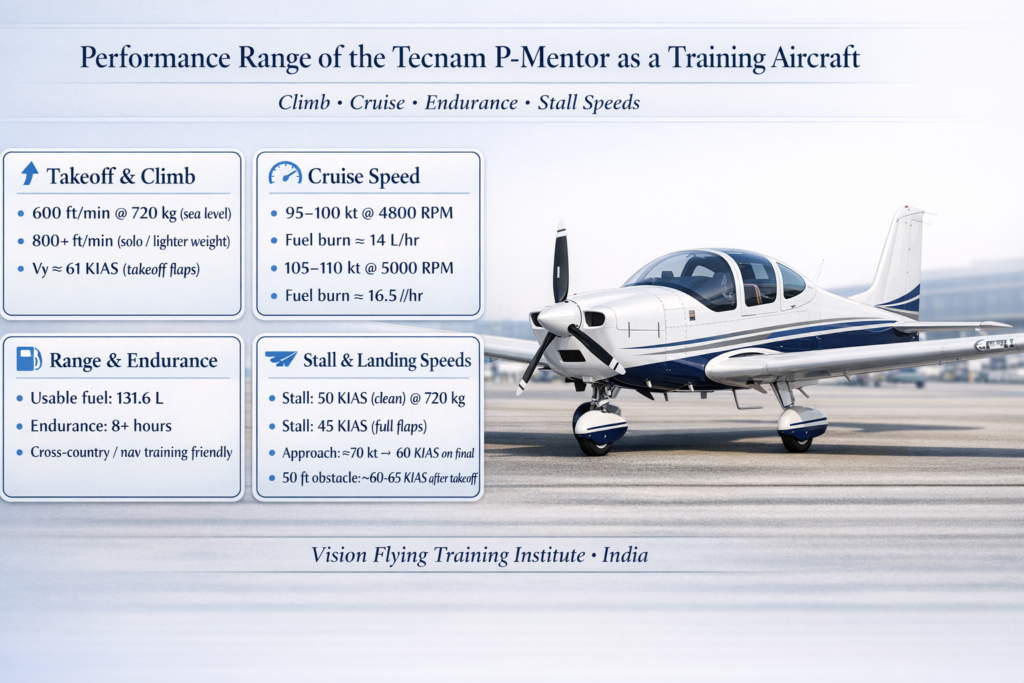
    Performance specifications chart of Tecnam P-Mentor training aircraft

    • Takeoff and climb: At maximum weight (720 kg), it climbs at around 600 ft/min at sea level on a standard day. With lighter weight (like solo flying), the climb can go beyond 800 ft/min
      The best climb speed (Vy) is approximately 61 KIAS (knots indicated airspeed) with takeoff flaps, which provides a good climb while maintaining comfortable forward visibility.
    • Cruise and range: This is where the P-Mentor really feels efficient. At around 4800 RPM (revolutions per minute), it cruises roughly 95-100 knots while burning only about 14 L/hr. At around 5000 RPM, it can do about 105-110 knots for roughly 16.5 L/hr
      With 131.6 L usable fuel, it can stay airborne for 8+ hours, making long cross-country flights and multi-leg nav training easy without constant refuelling.
    • Stall speeds: The stall speeds are low, which is great for student confidence. At 720 kg, it stalls around 50 KIAS clean and about 45 KIAS with full flaps. That extra margin helps during slow flight, approach practice, and landing training.
    • Takeoff and landing feel: Takeoff and landing distances are training-optimized. It typically clears a 50 ft obstacle around 60-65 KIAS after takeoff, and landing approaches are usually flown around 70 knots, slowing to about 60 KIAS on final. With a stall at 45 knots in landing configuration, there’s a solid safety margin for students.

    Overall, the P-Mentor gives you a good climb, efficient cruise, and very forgiving low-speed handling. Additionally, it burns significantly less fuel than older trainers, which is a significant advantage during hour-building.

    Tecnam P-Mentor Glass Cockpit Avionics and Cockpit Layout

    One of the most attractive features of the Tecnam P-Mentor is its Garmin avionics suite. When entering the cockpit of the P-Mentor, pilot trainees see a cockpit environment that is similar to what is found in commercial aircraft and high-end general aviation aircraft, rather than what was found in 1970s-era trainers. 
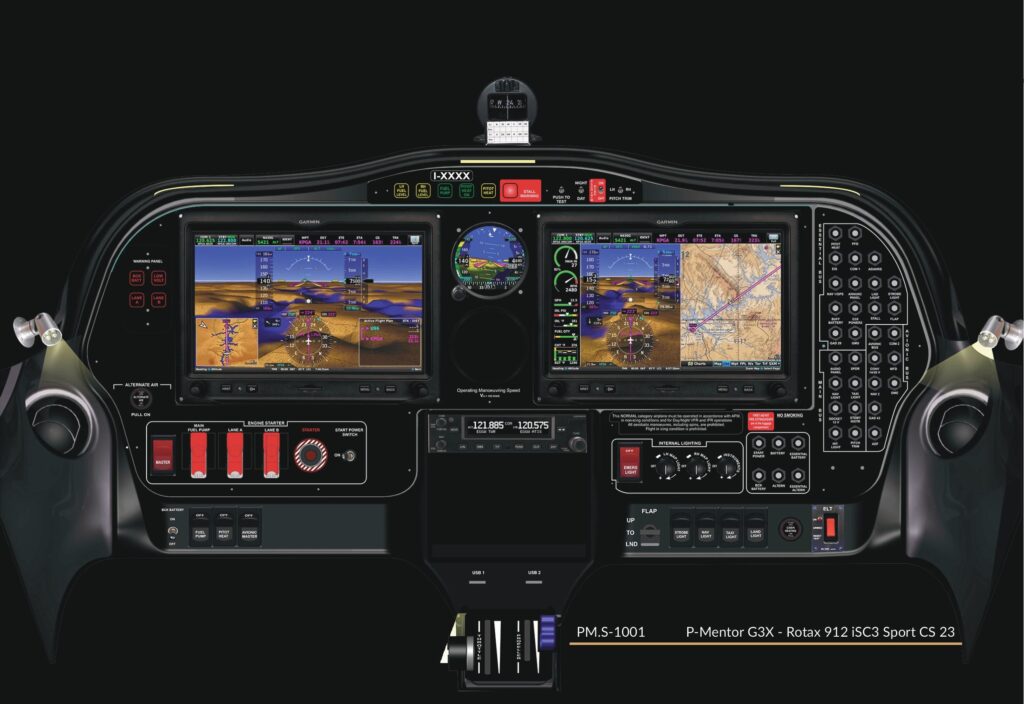
    Garmin G3X glass cockpit panel of Tecnam P-Mentor training aircraft


    The following are the key features of the cockpit and avionics of the P-Mentor:

    GarDual min G3X Touch Dual Displays

    • The display is dominated by two large Garmin G3X Touch screens. One is usually the Primary Flight Display (PFD) and the other the Multi-Function Display (MFD).
    • You can view attitude, airspeed, altitude, heading, and Horizontal Situation Indicator (HSI) right in front of you, along with your navigation maps and engine information.
    • If one screen goes down, the system can revert to a reversionary mode, so you can still view important flight information on the other screen.

    Integrated Instrument Flying Setup

    The P-Mentor is designed to facilitate Instrument Flight Rules (IFR) training, rather than just visual flight training. The avionics suite may consist of the Garmin GTN 650Xi (a touchscreen Global Positioning System/Navigation/Communication system) and a second radio, such as the Garmin GNC 255A (Navigation/Communication system).

    This configuration facilitates the following instrument flight procedures:

    • Instrument Landing System (ILS) approaches
    • VHF Omnidirectional Range (VOR) navigation
    • Global Positioning System (GPS) approaches
    • Localizer Performance with Vertical guidance (LPV) approaches using Satellite-Based Augmentation System (SBAS)

    It also has a transponder, such as the Garmin GTX345R, which is compatible with Mode S and Automatic Dependent Surveillance-Broadcast (ADS-B Out) for contemporary Air Traffic Control (ATC) systems. Optional components may include Distance Measuring Equipment (DME) and Automatic Direction Finder (ADF) for more comprehensive instrument training exposure.

    Autopilot and Flight Director Support

    The aircraft is also compatible with the upgraded Garmin GFC 500 digital autopilot system, which is driven by servo motors such as the Garmin GSA 28. The Garmin GMC 507 is the autopilot control panel, with modes such as heading hold, altitude hold, navigation track, and approach. 

    It is also compatible with Electronic Stability and Protection (ESP), which assists the pilot in keeping the aircraft within safe operating limits. This is particularly useful while training, as trainee pilots may not be adept at mastering the aircraft.

    Standby Instrument for Backup

    In addition to the primary glass displays, the P-Mentor also includes a Garmin GI 275 Electronic Standby Instrument, which is capable of displaying basic information such as attitudes, altitudes, and airspeeds, and is usually powered by a separate battery source as well. That means if the primary displays encounter a rare failure, you will always have a backup reference source.

    Cockpit Layout

    The technology is great, but what really helps pilot trainees is the cockpit layout. 

    In simulation training for pilots, you learn the cockpit workflow step by step, so when you fly the actual aircraft, everything feels in the right place. It then makes day-to-day training easier and faster. 

    Here are a few things to keep note of:

    • Sticks instead of yokes: Both seats have control sticks, which help students master the precise control of the “stick and rudder,” bringing it closer to modern aircraft control philosophies.
    • Central power quadrant: The throttle and propeller levers are positioned together in a central console, similar to those found in larger or more advanced aircraft.
    • Smart switch placement: Critical items like master power, backup battery, and fuel pump switches are placed logically.
    • Easy Access Controls: The fuel selector, flap controls, and key training devices are located in a manner that makes them readily accessible to the student as well as the instructor.

    Wide Visibility

    The canopy provides wide visibility. Although this is a two-seater, it feels open and practical for training, with cabin heat/defrost and night-friendly lighting. It really makes a difference in circuit training, runway alignment, and traffic scanning. 

    Fuel Efficiency and Operating Cost Advantages of the P-Mentor for Pilot Training

    The Tecnam P-Mentor is extremely economical to operate. It burns roughly 14–15 litres per hour in cruise, which is far lower than many legacy trainers like the Cessna 172 or Piper Archer that often use 30–38 litres per hour

    Its Rotax 912iSc3 engine can also run on automotive petrol (MOGAS) as well as avgas, which can reduce fuel costs further where MOGAS is available. Lower fuel burn and simpler operations mean a lower cost per flying hour, helping flight schools keep training more affordable and consistent.

    The P-Mentor is built for high training usage, so maintenance is simpler, and downtime is minimized. Also, the feature of a replaceable wing leading edge, rugged fixed landing gear, and modern fuel-injecting Rotax engine means less wear and tear on training aircraft. 

    The availability of new parts and manufacturer support means the aircraft typically spends more time flying and less time grounded, helping the student get their pilot training done on time. 

    This helps trainees start their career sooner and begin earning the salary of a pilot in India. Training delays do the opposite, they push your career and income further away.

    Safety Features of the Tecnam P-Mentor for Pilot Trainees in India

    Safety is essential in the pilot training aircraft. Tecnam has engineered the P-Mentor with numerous safety features and robust design elements:

    • The P-Mentor’s wing design is intended to behave well at low speeds, which means that during practice flights for slow flight and stalls by pilot trainees, this plane will surely give a good warning and stay manageable. It complies with the latest CS-23 regulations for Stall/Spin without any need to resort to any “extraordinary device.”
    • The aircraft can be fitted with a whole-aircraft ballistic parachute system. This is unusual for conventional aircraft of this class and adds an extra layer of protection.                        
                                                                                    
    • The 4130 steel truss around the cockpit works like a safety frame, giving better protection for people inside, much more than what is provided by some of its older all-Aluminum rivals.                                                                     
                                           
    • Student flying means a lot of takeoffs, landings, and occasional firm touchdowns. The P-Mentor’s fixed landing gear and sturdy structure are built to handle that routine without constantly needing fixes.                                                            
                                                                          
    • The Garmin system, alongside its variants, has features for providing air traffic awareness, air traffic alerts, and air protection, all of which will surely help students cope with their high workload, especially during circuit flying or instrument flying.

    Tecnam P-Mentor: DGCA Approved Certifications, IFR Capability, and Compliance

    There is no doubt that a tremendous amount of safety-engineering detail goes into this aircraft right from its design. The Tecnam P-Mentor is a fully certified training aircraft that was made in accordance with European Union Aviation Safety Agency (EASA) Certification Specification 23 (CS-23) standards for normal category aircraft. 

    Moreover, this aircraft was also certified to allow for its usage in instrument flight rules (IFR) training without any restrictions. It is also capable of performing a form of navigation known as performance-based navigation (PBN) and area navigation (RNAV).

    Tecnam also explains that the P-Mentor, being an aircraft trainer, is one of the first trainers available on the market that is compliant with the latest CS-23 Amendment 5 standards. In order to do so, the aircraft was required to prove that its stall characteristics are so stable and predictable that an emergency parachute system is not required for safety outcomes. This speaks highly of its stability and its suitability.

    Because this European certification framework is similar to that of the United States Federal Aviation Administration (FAA) “Part 23,” the approvals issued by the P-Mentor are applicable and can be validated on a worldwide scale. 

    It also integrates well with the Indian compliance norms set by the Directorate General of Civil Aviation (DGCA). This aircraft has already cleared the compliance process and is certified for pilot training in India.

    Tecnam P-Mentor aircraft are listed in inventory documents published by the DGCA for Flight Training Organisation (FTO). This indicates the aircraft is in operational service under DGCA oversight.

    Why Vision Flying Training Institute Uses the Tecnam P-Mentor for Pilot Training in India

    Vision Flying Training Institute is a pilot training academy that is committed to delivering the best pilot training in India by innovating and adopting the right technology for our trainees. 

    The Tecnam P-Mentor is a centerpiece of our training fleet because it aligns with our core mission, i.e., training future airline pilots with modern, safe, and efficient equipment. 

    Here are some specific reasons and benefits for our pilot students:

    • The P-Mentor can take a student from their first flight all the way to instrument rating training and even commercial pilot licence level flying, all on one aircraft.

    The aircraft is a secondary concern if you haven’t crafted your pilot journey yet!                               

    Read our blog on How to Become a Commercial Female Pilot After 12th in India

    • The glass cockpit and advanced avionics make it easier for students to get comfortable with digital flight displays and real-world navigation habits early on. It helps students train in a cockpit that feels modern and airline-standard from the very beginning.                                      
                                                       
    • The design of the P-Mentor, from its very conception, has been oriented with training safety in mind. Stable handling inspires confidence in students when undertaking slow flight, landings, and circuit work.
    •  Flying in India can mean high temperatures, high humidity, or high-density altitude in some regions. The P-Mentor’s Rotax engine actually handles heat well and maintains performance at altitude better than some older engines.                                                
                          
    • The DGCA and other regulators increasingly emphasize up-to-date training devices and methods. By using an EASA-certified IFR trainer like the P-Mentor, Vision FTI stays ahead of the curve. The aircraft is already compliant with the latest standards.

    The P-Mentor definitely lives up to its name, as it becomes the ‘mentor’ leading the way for the future of pilots into the future of aviation. It brings a new era of training to Vision Flying Training Institute and its students.

    Enquire at VFTI for Pilot Training on the Tecnam P-Mentor

    We are proud to incorporate an advanced trainer like Tecnam P-Mentor into our holistic Commercial Pilot License course. Pupil pilots at VFTI will be trained on an aircraft that is secure, competent, and with the latest equipment. These trainees are not only to get their pilot’s license but also to excel in the skies as professional aviators.     

    A call for every Pilot aspirant, join VFTI and train on the latest equipment, under the guidance of expert instructors, with a curriculum that covers everything from DGCA ground exams to advanced flying techniques.   

    Contact Vision Flying Training Institute today to find out more about our pilot license course. Schedule a visit to see our Tecnam P-Mentor up close or to speak with our pilot mentors. 

    Your dream of flying commercial jets can start with training in the right airplane and the right flying institute in India.

    Download our 2026 Brochure

    Call our Admission Desk: +91-9319193602 / +91-9319193605Email: enquiry@vfti.in
  • Simulation Training for Pilots: Benefits, Cost, & Real-World Accuracy

    Simulation Training for Pilots: Benefits, Cost, & Real-World Accuracy

    Simulation training has become a foundational element of modern pilot education rather than a supplementary tool. Across student pilot programs, commercial pilot license training, and airline preparation, simulators are used to develop cockpit discipline, procedural accuracy, and decision-making skills before pilots operate real aircraft.

    For aspirants evaluating professional training options, choosing a DGCA-approved flight training institute in India such as VFTI (Vision Flying Training Institute) plays a critical role in how effectively simulation training is integrated into real-world flying. This article explains what simulation training involves, its practical benefits, cost considerations, and how accurately it reflects real-world flying conditions.

    What Is Simulation Training for Pilots?

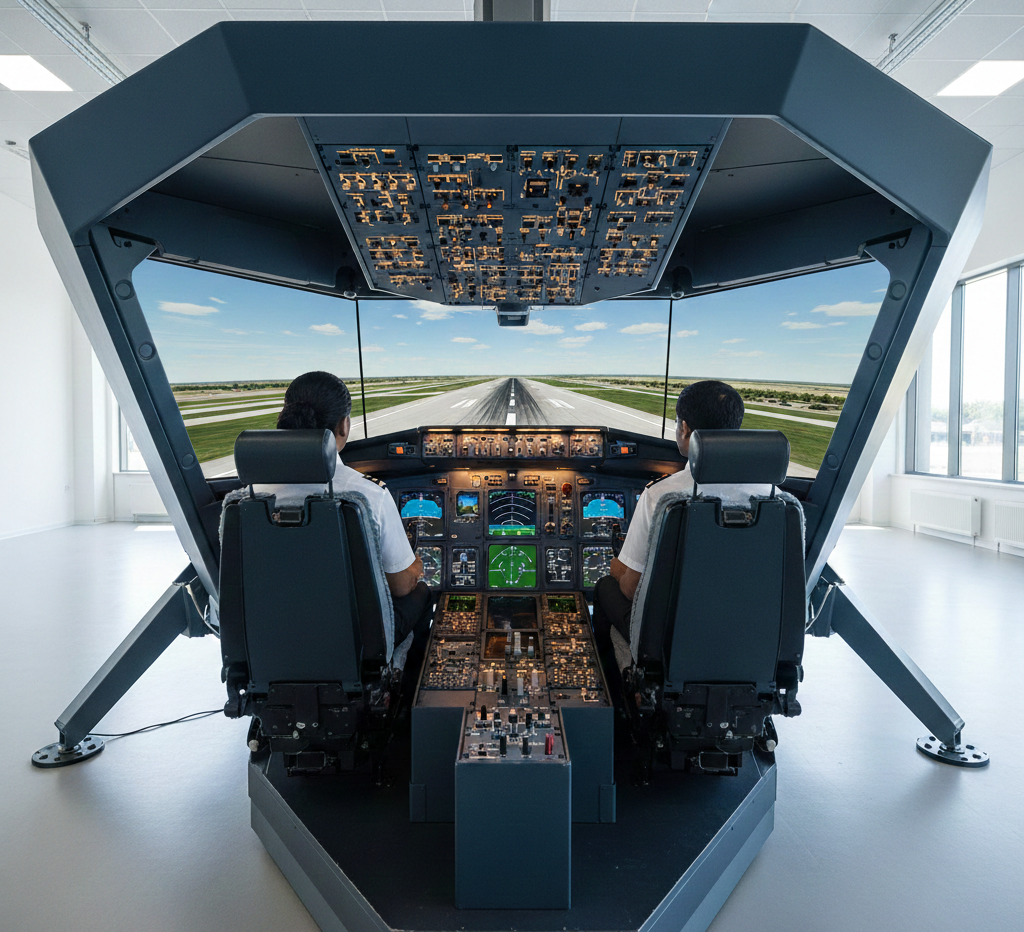
    Full-motion flight simulator used for commercial pilot and airline training

    Simulation training for pilots uses certified flight simulation devices to replicate aircraft systems, cockpit layouts, flight dynamics, and operational environments. These devices allow pilots to practice normal operations, instrument procedures, and abnormal or emergency scenarios in a controlled, repeatable setting.

    Simulation training is especially relevant for aspirants who are exploring becoming a pilot without Physics and want to understand cockpit procedures before flying real aircraft. Once eligibility requirements are met, simulators help candidates build cockpit familiarity, checklist discipline, and situational awareness early in their training.

    Types of Flight Simulators Used in Pilot Training

    Comparison of flight simulator training and real aircraft cockpit during runway operations

    Basic Flight Training Devices

    Basic training devices are commonly used during the initial stages of pilot training. They help students become familiar with cockpit layout, radio communication flow, checklist usage, and basic instrument scanning. While they do not replicate full aircraft physics, they are effective for building procedural confidence and reducing early training anxiety.

    FNPT and Advanced Training Simulators

    Flight and Navigation Procedure Trainers (FNPT) are used extensively during CPL and other training courses and instrument rating phases. These simulators replicate aircraft systems with higher accuracy, allowing pilots to practice IFR procedures, navigation, and abnormal situations. Approved FNPT devices are accepted by aviation authorities for logging specific portions of training time.

    Full Flight Simulators

    Full Flight Simulators offer the highest level of realism. They feature exact cockpit replicas, motion platforms, and high-resolution visual systems. These simulators are primarily used for airline training and type ratings, where procedural accuracy, crew coordination, and decision-making under pressure are critical.

    Key Benefits of Simulation Training for Pilots

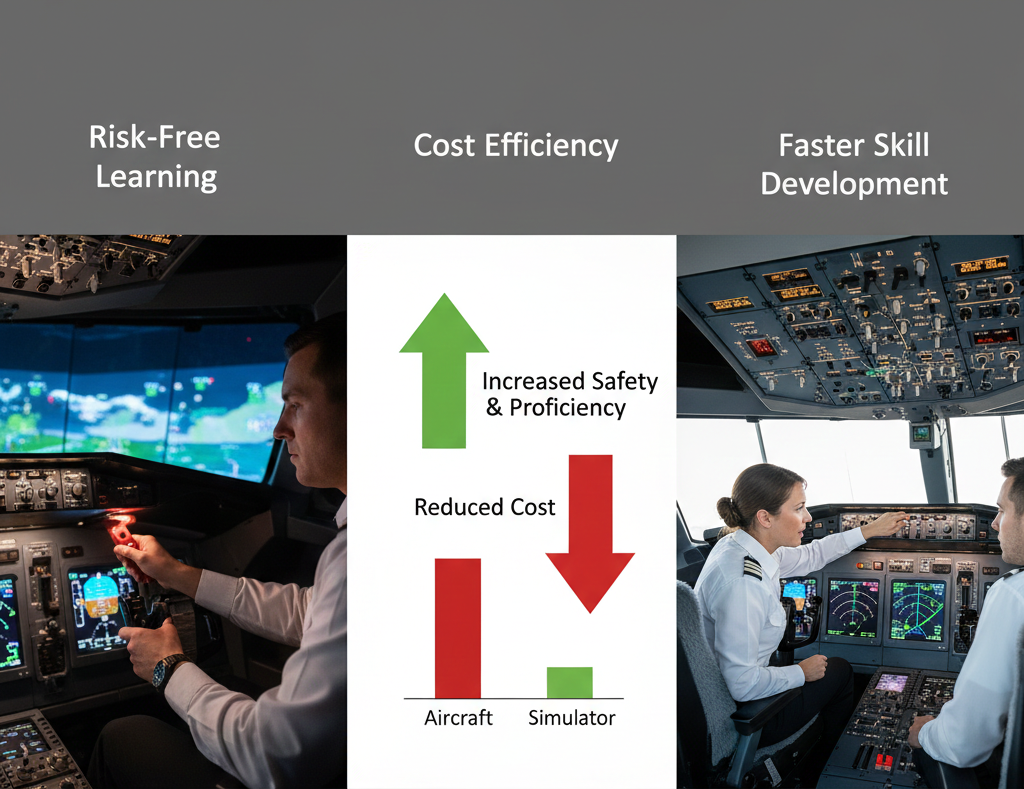
    Benefits of pilot simulation training including cost efficiency, safety, and faster skill development

    Simulation training offers advantages that are difficult or impractical to achieve consistently in real aircraft, particularly during early skill development and advanced procedural training.

    Risk-Free Learning Environment

    One of the most significant benefits of simulators is the ability to practice critical scenarios without physical risk. Engine failures, system malfunctions, severe weather encounters, and emergency descents can be trained repeatedly in a controlled environment.

    This risk-free exposure is particularly beneficial for students entering aviation through alternative eligibility routes, including commerce-background students and beginners, as it allows them to build confidence before facing real-world operational pressure.

    Cost Efficiency Compared to Aircraft Flying

    Operating real aircraft involves fuel costs, maintenance, airport charges, and aircraft availability constraints. Simulators eliminate many of these expenses, allowing flight schools to deliver structured training at a lower cost per hour.

    When evaluated alongside long-term career outcomes such as pilot salary in India, simulator-based learning helps reduce unnecessary repetition of expensive flight hours while maintaining training quality.

    Faster Skill Development and Error Correction

    Simulators allow instructors to pause sessions, repeat specific maneuvers, and correct errors immediately. This targeted training approach accelerates learning, particularly during instrument flying and procedural training, where repeating scenarios in real aircraft may not always be practical due to weather or operational limitations.

    Exposure to Realistic Operational Scenarios

    Pilots can train for conditions they may rarely encounter during routine flying, such as extreme weather, congested airspace, or complex system failures. This exposure improves situational awareness and prepares pilots for airline-style operational environments.

    Understanding how effectively a school integrates such simulator-based scenarios is one of the key benchmarks when evaluating the best flying institutes in India.

    How Accurate Is Simulation Training Compared to Real Flying?

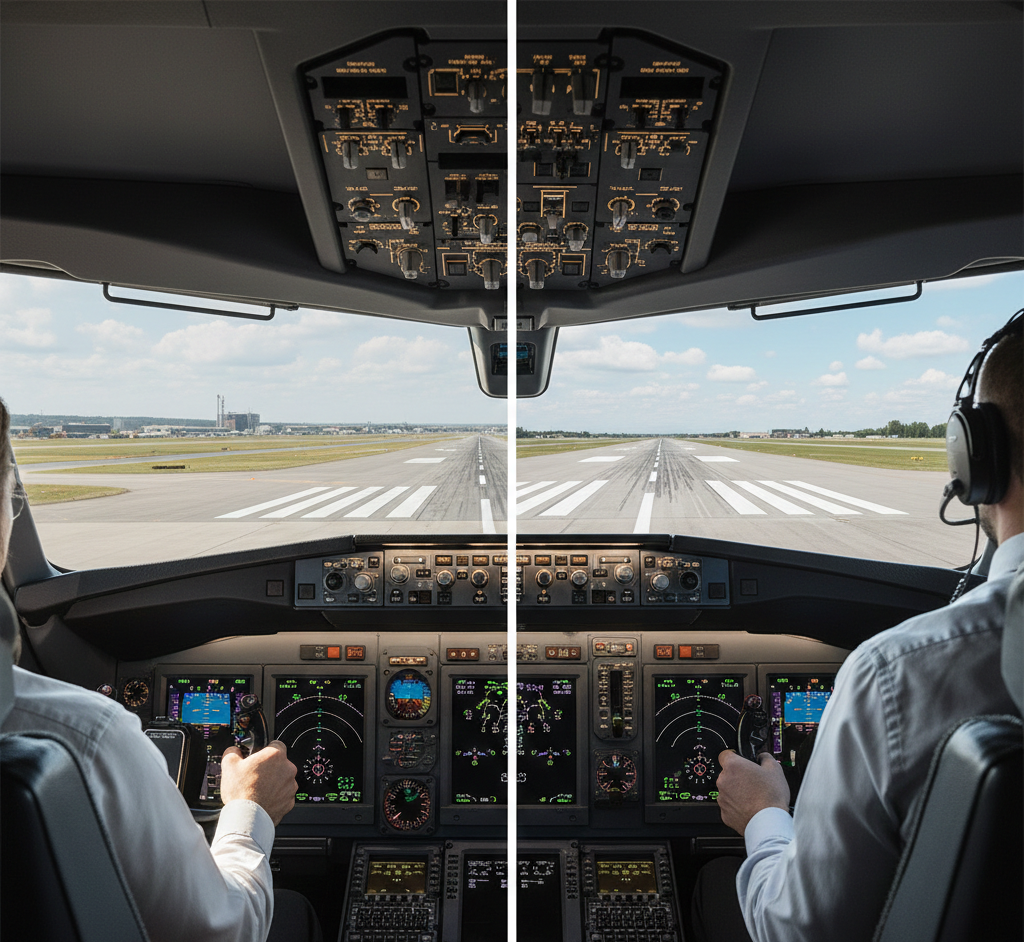
    Comparison of flight simulator training and real aircraft cockpit during runway operations

    Modern certified simulators are developed using real aircraft performance data and manufacturer-approved system logic. Cockpit layouts, avionics behavior, and procedural workflows closely match real aircraft operations.

    While simulators replicate procedural and systems-based flying with high accuracy, certain physical sensations such as prolonged G-forces and subtle aerodynamic feedback are approximated rather than fully duplicated. For this reason, simulation training is designed to complement real flying, not replace it entirely.

    How do realistic flight simulators enhance pilot training?

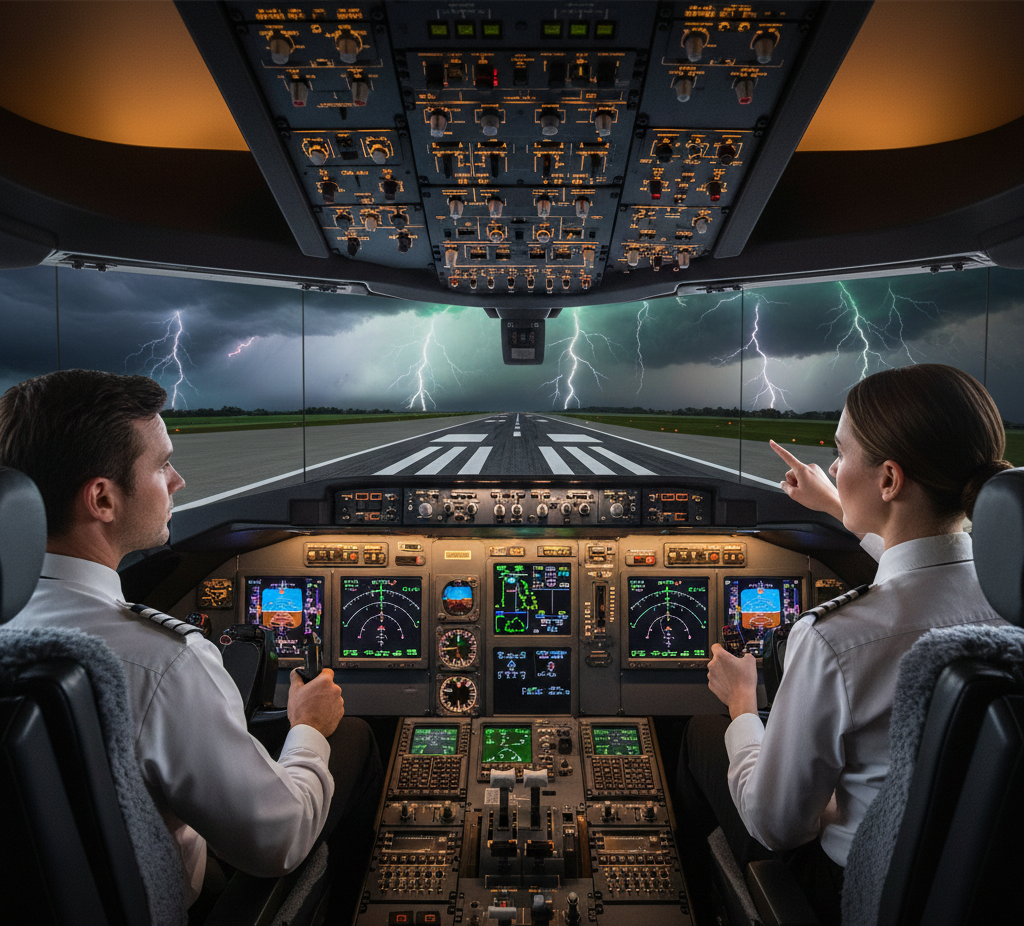
    Flight simulator training showing pilots practicing emergency landing in severe weather conditions

    Realistic flight simulators transform pilot training through immersive scenario-based learning that would be impossible or dangerous in actual aircraft. Modern simulators recreate complex weather conditions, system failures, and emergency situations with precise accuracy, allowing pilots to experience and master challenging scenarios repeatedly without safety risks.

    The flight training hours reduction achieved through high-fidelity simulation is particularly significant for advanced maneuvers and emergency procedures. Research demonstrates that simulator training effectively transfers skills to real-world flying while reducing the time needed for proficiency development.

    These systems excel at standardizing training experiences across different instructors and locations, ensuring consistent skill development. The ability to pause, replay, and analyze specific moments enhances learning effectiveness compared to traditional flight training methods.

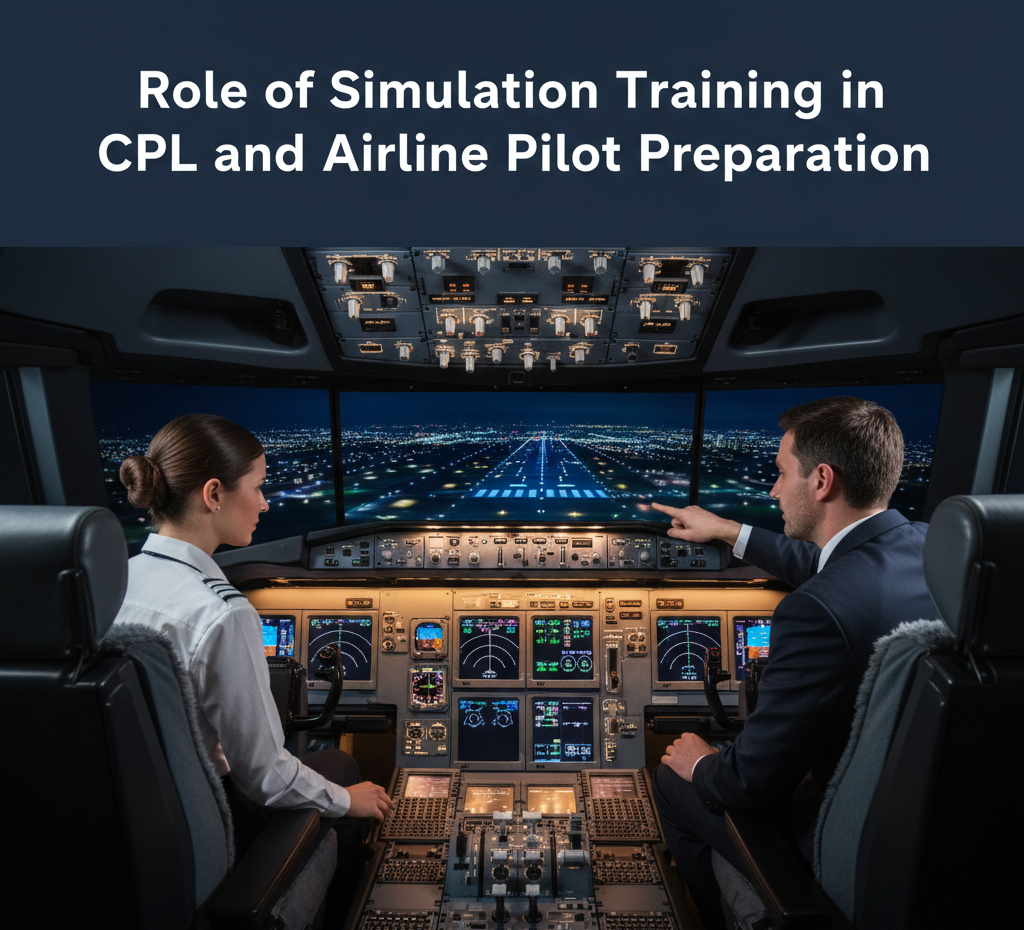
    Role of Simulation Training in CPL and Airline Pilot Preparation

    Commercial pilot and instructor practicing night landing procedures inside a full-flight simulator for airline pilot preparation

    Simulation training plays a strategic role in commercial pilot license programs by preparing students for structured, airline-style operations. For women aspirants and students beginning aviation training after Class 12, simulators provide a controlled environment to build confidence before transitioning to complex aircraft operations.

    This structured approach is particularly supportive for aspirants pursuing female pilot training in India, where early confidence, procedural accuracy, and decision-making skills are essential.

    Airlines rely heavily on simulation training for type ratings, recurrent checks, and emergency preparedness. Pilots with strong simulator exposure adapt faster to airline SOPs and cockpit discipline.

    Cost of Simulation Training for Pilots

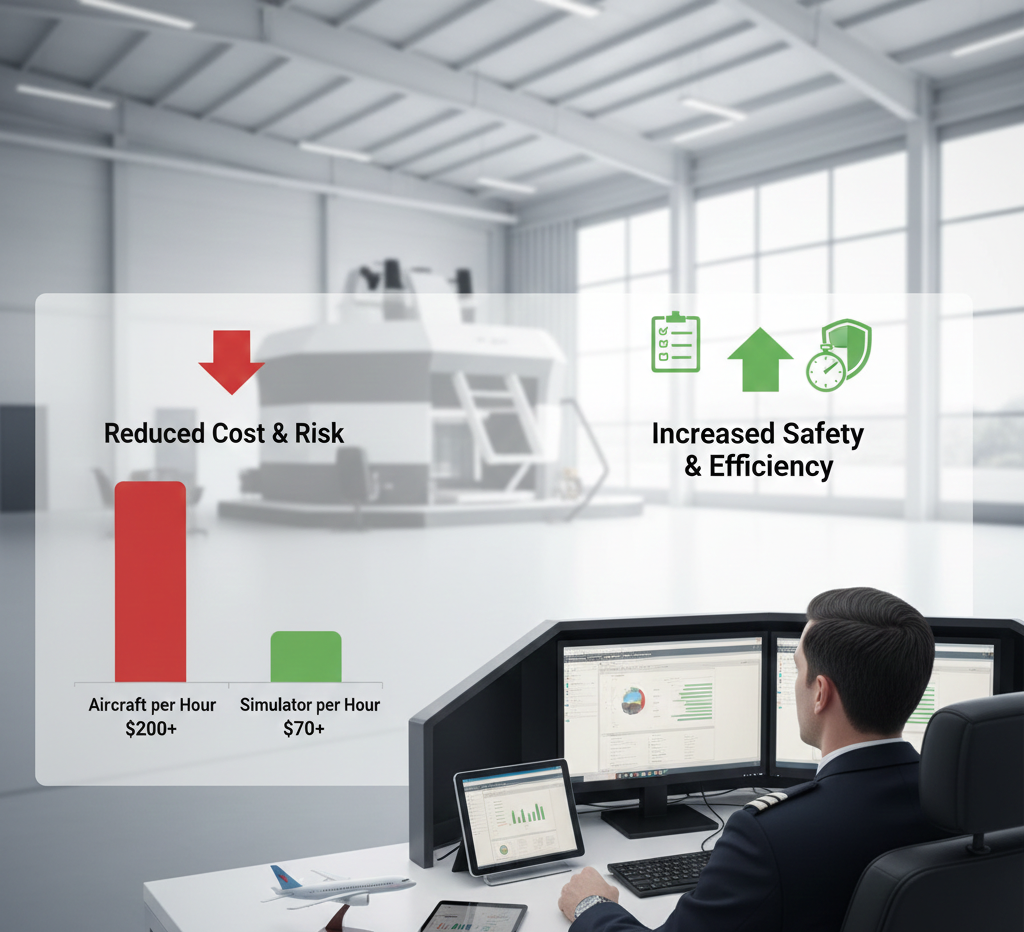
    Flight simulator training setup showing reduced cost per hour compared to real aircraft flying and improved safety efficiency

    Flight simulation benefits extend far beyond skill development into substantial economic advantages for aviation training programs. Traditional flight training costs average $150-200 per hour for aircraft operation, fuel, and instructor fees, while high-fidelity simulators operate at approximately $50-75 per hour despite their multi-million dollar initial investment.

    The economics become compelling when considering training volume and safety factors. Simulator-based training programs demonstrate significant cost reductions through eliminated fuel consumption, reduced aircraft maintenance, and minimized weather-related delays that plague traditional flight instruction.

    Training organizations report 40-60% cost savings when incorporating simulation into their curricula, particularly for complex emergency procedures that would be prohibitively expensive or dangerous to practice in actual aircraft. These financial advantages position simulation training as an economically sustainable solution for addressing the aviation industry’s growing pilot shortage while maintaining rigorous safety standards.

    Comparison Table: Simulation Training vs. Traditional Training

    Training AspectSimulation TrainingTraditional Aircraft Training
    Cost per Hour$150-400$800-2,500+
    Safety RiskZero accident riskInherent flight hazards
    Weather DependencyAlways availableLimited by conditions
    Emergency TrainingUnlimited scenario repetitionRestricted by safety constraints
    Fuel CostsNone$200-500+ per hour
    Instructor AvailabilityFlexible schedulingAircraft-dependent timing
    Maintenance ImpactNo aircraft wearIncreases maintenance needs

    Training effectiveness varies significantly between approaches. While simulation excels at emergency procedure training and cost management, real-world pilot training remains essential for developing actual flight sensations and environmental awareness that simulators cannot fully replicate.

    How to Choose the Right Flight School for Simulation Training

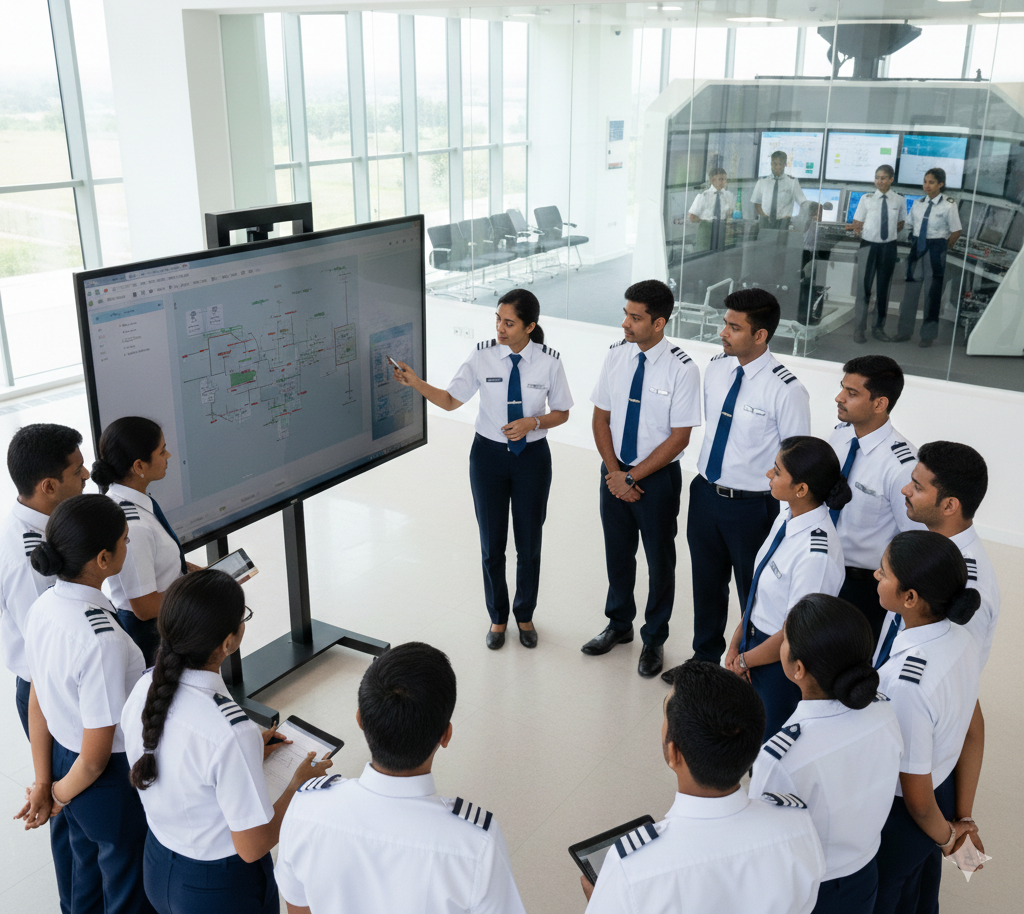
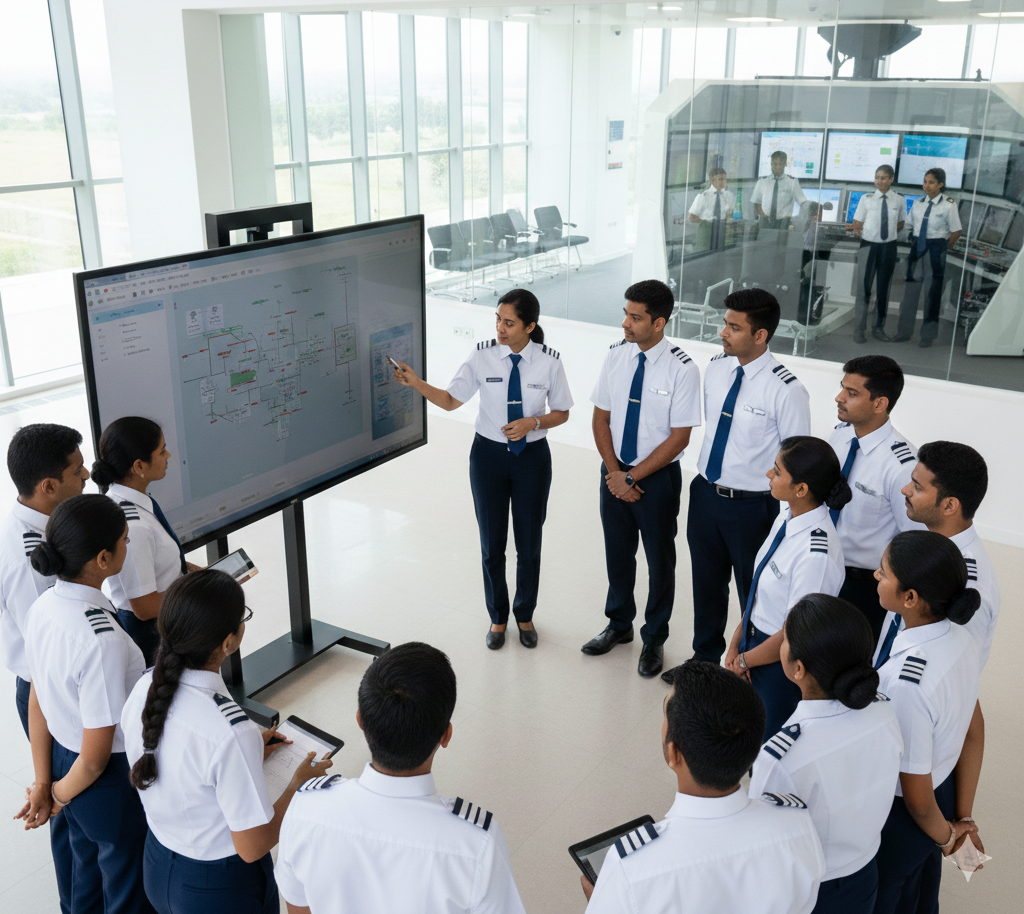
    Pilot trainees receiving simulation training briefing using a digital flight systems display at an aviation training academy

    Selecting the right flight school requires careful evaluation of simulator quality and curriculum integration. Approved devices, experienced instructors, and structured lesson planning are essential indicators of training quality.

    Students should ensure simulator hours are used to enhance learning rather than replace essential real-flight exposure. Well-integrated simulator programs produce pilots who are operationally prepared and technically confident.

    Conclusion


    Simulation training offers clear value when integrated correctly into pilot education. It improves safety, reduces unnecessary training costs, and prepares students for real-world operational demands.

    When combined with structured aircraft flying, simulation training significantly enhances pilot readiness, employability, and long-term professional credibility.


    Frequently Asked Questions

    Why are some flight instructors against simulator training?

    Some instructors worry that simulators cannot fully replicate real aircraft sensations like vibration, G-forces, and weather effects. They also fear students may develop habits that don’t transfer perfectly to real flight. This skepticism often comes from traditional training backgrounds rather than flaws in modern simulation technology.

    Do pilots gain real-life experience from flight simulators?

    Yes, pilots gain real operational experience from simulators, especially in procedures, decision-making, and emergency handling. Simulators are highly effective for instrument flying and abnormal scenarios. However, they do not fully replace real aircraft experience due to limited physical feedback.

    Why are flight simulators not as effective as real flight experience?

    Flight simulators cannot fully reproduce physical sensations such as G-forces, vibration, spatial disorientation, and real-world stress. These elements are critical for developing instinctive flying skills. This is why simulator training is most effective when combined with actual flight hours.

    What are the advantages of using flight simulators for pilot training?

    Flight simulators improve safety, reduce training costs, and allow pilots to practice emergencies repeatedly without risk. They provide consistent, controlled environments ideal for learning procedures and decision-making skills.

    What are the disadvantages of flight simulators in pilot training?

    Simulators lack full sensory realism and cannot replicate real-flight stress, weather unpredictability, or physical aircraft feedback. This limits their ability to fully replace hands-on flying experience.

    Are flight simulators a replacement for real flight training?

    No. Flight simulators are a training supplement, not a replacement. They enhance learning efficiency but must be combined with real aircraft flying for complete pilot skill development.

    Why do modern pilot training programs still rely heavily on simulators?

    Because simulators allow safe, cost-effective training for complex and emergency scenarios that are impractical or unsafe to practice in real aircraft.

    Is simulator training mandatory for becoming a pilot?

    Simulator training is required for specific licenses, instrument ratings, and airline programs, though it may not be mandatory at every training stage.

    Can simulator hours replace real flight hours?

    Simulator hours can replace a limited portion of flight hours depending on regulatory approval, but they cannot fully substitute real aircraft flying.

    Do airlines accept simulator-based training?

    Yes. Airlines rely extensively on full flight simulators for type ratings, recurrent checks, and emergency training.

    Is simulator training useful for beginners?

    Yes. Simulators help beginners develop cockpit familiarity, procedural understanding, and confidence before transitioning to real aircraft.

    Download our 2026 Brochure

    Call our Admission Desk: +91-9319193602 / +91-9319193605

    Email: enquiry@vfti.in
  • Pilot Salary in India 2026: CPL vs ATPL, Airlines, Experience & Aircraft

    Pilot Salary in India 2026: CPL vs ATPL, Airlines, Experience & Aircraft

    When you see a pilot walking through an airport terminal, one thought probably crosses your mind: “How much do they make?” 

    And if you are an aspiring pilot, chances are you have already searched on Google, “What is the salary of pilots in India?”

    Becoming a pilot in India is one of the most financially rewarding careers in the country, but earnings can vary widely depending on experience, aircraft type, route, and employer. 

    In this comprehensive guide, we will break down how much pilots earn at different stages, what factors influence their pay, and how a pilot’s salary grows over time. 

    Let’s take off on the journey from a fresh pilot to a senior captain and see what the paycheck looks like at each stage of a flying career in India.

    What Factors Determine a Pilot’s Salary in India?

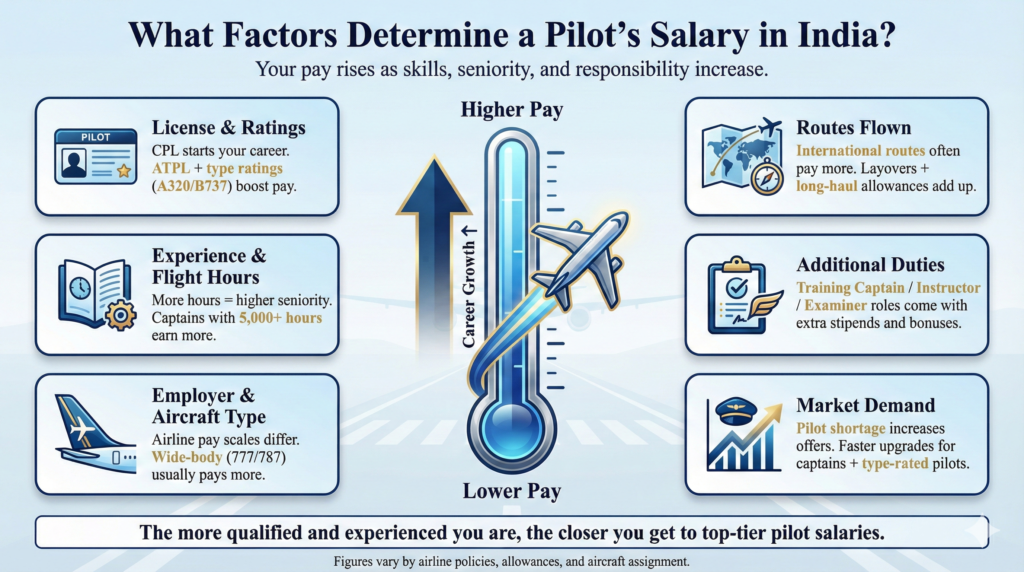
    Factors affecting pilot salary in India


    Several key factors affect how much a pilot earns in India:

    License & Ratings: The type of license matters. A Commercial Pilot License (CPL) is needed to start flying commercial aircraft, but an Airline Transport Pilot License (ATPL) is required to become a Captain. Pilots with advanced type ratings (certifications for specific jets like A320 or B737) often command higher pay.

    Even for those curious whether a Commerce Student Can Become a Pilot Without Physics, the path may look a little different, but licenses and ratings are still same and decide your career growth and earning potential.

    Experience & Flight Hours: Seniority and hours flown impact salary. A First Officer with a few hundred hours earns much less than a Captain with 5,000+ hours. As you log more flight hours and years, your income keeps moving up.

    Employer & Aircraft Type: Which airline you work for makes a difference. Low-cost carriers, e.g., IndiGo, SpiceJet, tend to have lower pay scales, whereas full-service airlines, like Air India or Vistara, and especially foreign airlines like Emirates or Singapore Airlines, pay more and offer richer allowances. Wide-body jet pilots, flying 777s, 787s, etc., earn more than those flying smaller aircraft.

    Routes Flown: Domestic vs. International matters. Domestic pilots have good salaries but typically lower than long-haul international pilots, who get extra pay for overseas layovers, time-zone crossings, and generally fly larger aircraft.

    Additional Duties: Pilots who take on special roles, such as Training Captains, Simulator Instructors, or Examiner roles, receive extra stipends. These leadership or training duties on top of flying come with additional pay bonuses.

    Market Demand: Like any industry, supply and demand influence pay. Right now, there’s a global pilot shortage, so airlines are competing for talent. This means faster promotions and higher salary offers, especially for captains and certain aircraft type-rated pilots.

    The more qualified and experienced you are, the higher your earnings. A young First Officer might start on the lower end, but with each year and every skill you add, you reach closer to those top-tier salaries.

    Career Progression and Salary Growth for Pilots in India

    One of the exciting aspects of a pilot’s career is how quickly the salary grows with experience. The first few years might feel slow, but as you gain seniority, your earnings can literally take off.

    The pilot career path works like a standard roadmap. After 12th, you train, get your CPL, and step into a flying job. The rules and salary structure apply equally to everyone, including aspiring commercial female pilots after 12th


    Here’s a typical journey in terms of years and salary milestones:

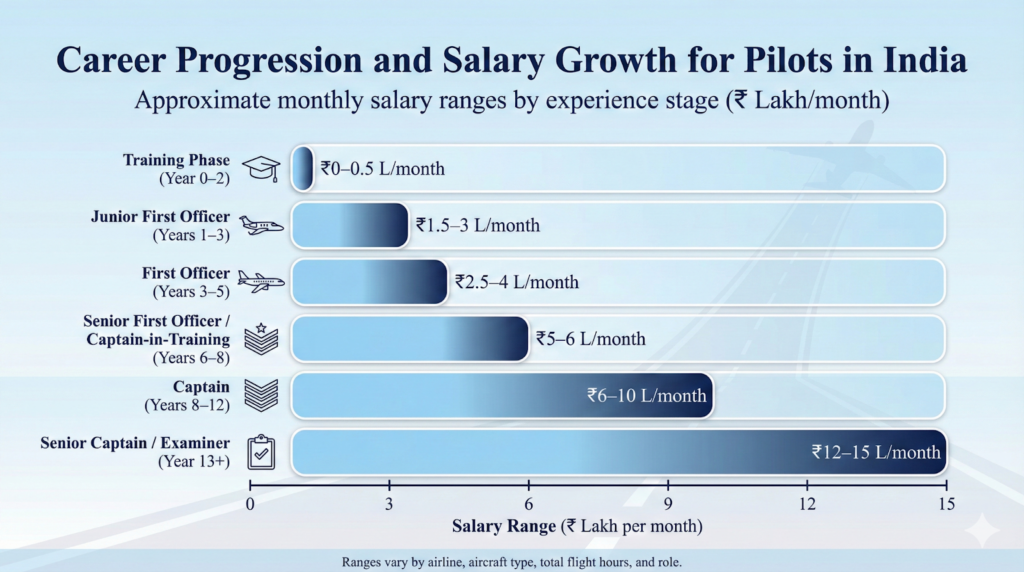
    Pilot career progression and salary growth in India

    Training Phase (Year 0-2): This includes 12-18 months in flight school for CPL, plus possibly some time instructing or struggling to get that first airline break.

    Choosing a DGCA-approved institute such as Vision Flying Training Institute (VFTI), as one of the best flying institutes for pilot training in India, can play a major role in building strong fundamentals and improving airline placement prospects later. Income during training is nil, and initial jobs, like an instructor or junior trainee pilot, might pay ₹30,000–₹50,000 per month at best. Essentially, you invest time and money now for future rewards. 

    Junior First Officer (Years 1-3): Once hired by an airline as a Junior First Officer, you start earning around ₹1.5–3 L/Month as a newcomer. This period is about learning on the job and accumulating hours. Salary is moderate, but after the training period, it feels great to get paid to fly!

    First Officer (Years 3-5): After a couple of years, you become a full First Officer. Your pay now might be in the range of ₹2.5–4 L/Month. You may also start getting additional bonuses for hitting certain flight hour targets and experience increments annually.

    Senior First Officer / Captain-in-Training (Years 6-8): In many airlines, by around year 6-8, you either upgrade to Senior First Officer or enter Captain training. Salaries here approach ₹5-6 L/Month.

    Captain (Years 8-12): Typically, within 8-10 years of starting, pilots achieve Captaincy. Now the salary jumps often ₹6–10 L/Month for a Captain in India. Annual pay can cross ₹1 crore for senior narrow-body Captains. This is the reward for all those years of building experience.

    Senior Captain / Examiner (Year 13+): Beyond a decade, many captains take on roles like Check Captain, Training Captain, or Examiner. These are veteran pilots who assess others. Their pay can cross ₹12–15 L/Month in India and much more abroad. This is the point where you’re in the highest salary band, sometimes in supervisory roles, with maximum perks and a lot of professional respect.

    Becoming a captain is not the end; many pilots go beyond, becoming senior instructors, management pilots, or even starting their own aviation businesses (charter companies, flight schools, consultancies). Those paths can lead to additional income streams on top of flying.

    Commercial Airline Pilot Salary in India 

    Most aspiring pilots aim to fly for commercial airlines. Commercial pilots (airline pilots) start their careers as First Officers (co-pilots) and can progress to Captains and Senior Captains (typically after obtaining an Airline Transport Pilot License (ATPL) for captaincy). 

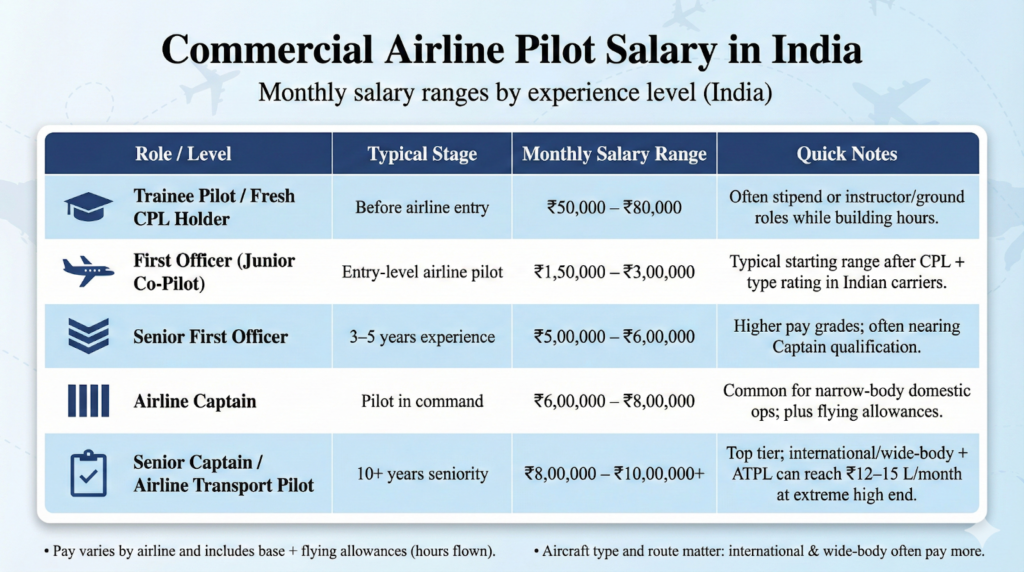
    Here’s an overview of monthly salary ranges at different experience levels for airline pilots in India:

    Commercial airline pilot salary growth in India
    • Trainee Pilot / Fresh CPL Holder: ₹50,000 – ₹80,000 per month. This is often a stipend or instructor pay for fresh pilots who haven’t joined an airline yet. Many new Commercial Pilot License (CPL) holders initially work as junior flight instructors or in ground roles, earning a modest income while building hours. Once they get hired by an airline as a First Officer, their pay increases significantly.
    • First Officer (Junior Co-Pilot): ₹1,50,000 – ₹3,00,000 per month. This is the typical starting salary range for a new airline pilot in India. After finishing CPL training and type rating, starting salaries in Indian carriers usually fall in this range. 
    • Senior First Officer: ₹5,00,000 – ₹6,00,000 per month. After a few years (usually 3–5 years) of experience and hundreds of flight hours, First Officers get promoted or earn higher pay grades. Senior First Officers who are close to qualifying as Captains can earn around 5–6 lakhs monthly. Experience and expertise start reflecting in this pay range.
    • Airline Captain: ₹6,00,000 – ₹8,00,000 per month. Captains, the pilots in command, have substantially higher salaries. In India, a narrow-body aircraft Captain (e.g., flying an Airbus A320 or Boeing 737 on domestic routes) often earns between 6 and 8 lakhs a month. This translates to roughly ₹60–96 lakh per annum. Captains also get additional flying allowances, and their pay depends on factors like total flight hours and the airline’s pay structure.
    • Senior Captain / Airline Transport Pilot: ₹8,00,000 – ₹10,00,000+ per month. Experienced captains with many years of service (10+ years) and high seniority can make upwards of ₹8 lakh monthly, crossing into eight-figure annual salaries. In leading airlines, senior captains commanding international flights or wide-body jets (e.g., Boeing 787s) may earn over ₹1 crore per year, i.e., ₹12–15 lakh per month at the extreme high end. Such top-tier salaries are typically for pilots with an ATPL, thousands of flight hours, and often training roles.

    These figures are averages and can vary by airline. Most airlines in India pay a combination of a base salary and flying allowances (hourly pay for hours flown). Thus, a pilot’s take-home pay can fluctuate based on how many hours they fly in a month. 

    Additionally, factors like the type of aircraft and route (domestic vs international) influence the pay, international and wide-body operations tend to pay more due to longer hours and higher responsibility.

    Annual Salary of a Commercial Pilot in India

    Salary of Commercial Airline Pilots in India for Domestic and International Flights

    A commercial airline pilot’s salary in India changes a lot depending on where they fly. Domestic routes usually mean shorter sectors, more daily rotations, and standard allowances. 

    International flying often means longer duty hours, more night flying, and layovers in other countries. Many international operations are also on wide-body aircraft, like Boeing 777/787 or Airbus A330/A350, which generally come with a better pay package.

    This does not mean every pilot can jump to international flying early. Many airlines assign international routes based on:

    • Seniority
    • Fleet type
    • Base location
    • Operational requirements
    • Experience and performance

    Work Differences Between Domestic and International Flights That Affect the Salary of Commercial Airline Pilots

    FactorDomestic FlightsInternational Flights
    Sector lengthShortMedium to long
    AircraftMostly narrow-bodyOften wide-body
    Layover payLow/limitedHigher and frequent
    Monthly income potentialStrongUsually higher
    Who gets it firstNewer pilots often start hereTypically higher seniority


    Most pilots start out on domestic routes as First Officers. As you build flight hours and seniority, you are more likely to move into international flying, where the top salary ranges usually begin.

    Pilot’s Salary at Top Indian Airlines

    Salaries can differ significantly from one airline to another. Below is a comparison of pilot salaries at some leading Indian airlines for First Officers and Captains:

    AirlineFirst Officer (Monthly)Captain (Monthly)
    Air India₹2.5 – 3.5 lakh₹7 – 10 lakh (senior/wide-body up to ₹15L)
    IndiGo₹2 – 3 lakh₹6 – 9 lakh (senior up to ₹11L)
    Vistara₹2 – 3 lakh₹5.5 – 8 lakh
    SpiceJet₹1.5 – 2 lakh₹4.5 – 6.5 lakh
    Akasa Air₹1.8 – 2.5 lakh₹5 – 7.5 lakh

    As shown in the table above, Air India and IndiGo tend to offer the highest salaries for pilots among Indian carriers. 

    The key takeaway is that the larger the airline and the bigger the aircraft, the higher the pilot’s salary in India.

    Cargo Pilot Salary in India

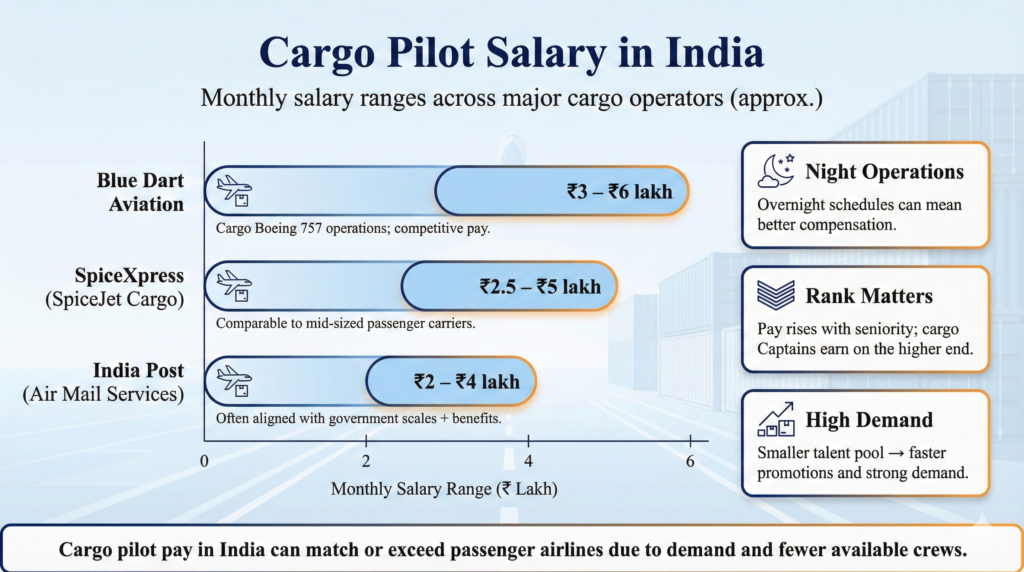
    Cargo pilots operate freight aircraft for logistics airlines. In India, cargo pilot salaries are on par with, and sometimes even higher than, those of passenger airline pilots due to the growing demand and relatively smaller talent pool. Cargo operations often happen on overnight schedules, and airlines compensate accordingly.

    Here are a few examples of cargo pilot pay:

    Blue Dart Aviation: ~₹3 – 6 lakhs per month for pilots. Blue Dart, which operates cargo Boeing 757s, offers competitive salaries to attract experienced crews.

    SpiceXpress (SpiceJet’s Cargo wing): ~₹2.5 – 5 lakhs per month. SpiceXpress pays in a range comparable to mid-sized passenger carriers.

    India Post (Air Mail Services): ~₹2 – 4 lakhs per month for pilots flying postal cargo routes. These tend to be slightly lower, aligning with government pay scales but with decent benefits.

    Cargo pilots typically earn based on their rank, similar to other airlines. Experienced cargo Captains can be on the higher end, especially if they have specialized skills. 

    An advantage in cargo flying is that there are fewer overall pilots in this sector, so demand for skilled cargo pilots is high, potentially leading to better pay or faster promotions in certain cases. 

    Charter and Private Jet Pilot Salary in India

    Another career path is flying private charters or business jets. Charter pilots fly VIP clients, corporate executives, or operate air-taxi services and ambulance flights. 

    Charter and private jet pilot salary in India


    In India, the charter aviation market is smaller than the commercial airlines, but it’s growing. Salaries for charter (corporate) pilots vary widely based on the type of aircraft and clientele:

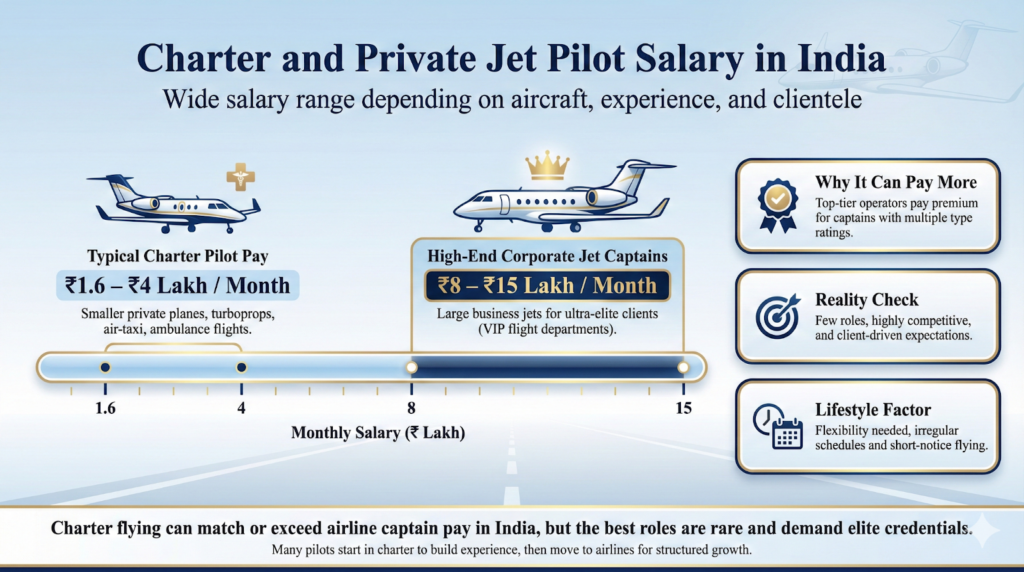
    Typical Charter Pilot Pay: Around ₹1.6 – 4 lakh per month for most charter pilots flying smaller private planes or turboprops. This is comparable to a first officer or junior captain in a commercial airline.

    High-End Corporate Jet Captains: ₹8 – 15 lakh per month for very experienced pilots flying large business jets for ultra-elite clients. 

    Top-tier charter companies or corporate flight departments, e.g., those operating Gulfstream or Bombardier long-range jets for VIPs, pay premium salaries to captains with extensive experience and multiple type ratings. These elite charter pilots can earn as much or even more than an airline captain in India, but such positions are few and highly competitive.

    However, these jobs demand excellent credentials, flexibility, and sometimes irregular schedules to cater to client needs. 

    Many pilots start in charter flying to gain experience, and some later transition to airline jobs for more structured career growth. 

    Indian Air Force Military Pilots

    Fighter pilots and transport pilots in the Indian Air Force (IAF) have a different pay structure governed by government pay scales. While you cannot directly compare military and civil salaries, here’s an overview:

    Indian Air Force pilot salary by rank

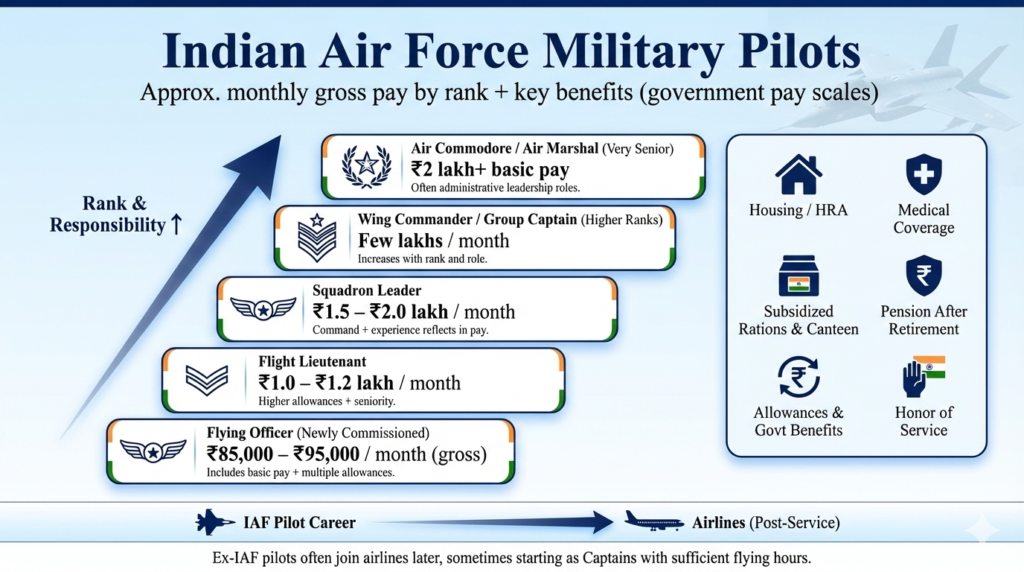
    A newly commissioned Flying Officer (the starting rank for IAF pilots) earns roughly ₹85,000 – ₹95,000 per month (gross) as of 2025. This includes basic pay and a slew of military allowances.

    A Flight Lieutenant might get around ₹1-1.2 lakh/month, a Squadron Leader can cross ₹1.5-2 lakh/month, and higher ranks (Wing Commander, Group Captain, etc.) earn in the few lakhs per month range. 

    The Air Force pay tops out with very senior officers (e.g., a full Air Commodore or Air Marshal) whose basic pay can be ₹2 lakh+, but those are administrative roles by then.

    Along with salary, IAF pilots get free housing or housing allowance, comprehensive medical coverage, subsidized rations and canteen facilities, pension after retirement, and other benefits. These perks mean that even if the take-home salary is lower than a commercial pilot’s, the overall package plus the honor of serving the nation can be extremely rewarding.

    It’s not uncommon for ex-IAF pilots to join airlines later. They often start as captains in airlines if they have enough flying hours, thereby significantly increasing their pay in the second phase of their career.

    Commercial airline pilots earn the most in pure salary terms, especially at the senior levels. Charter pilots and instructors earn decent pay with certain lifestyle benefits. Military pilots trade a bit of pay for prestige and long-term benefits.

    It ultimately comes down to what kind of flying career you want.

    Perks and Benefits of Being a Pilot

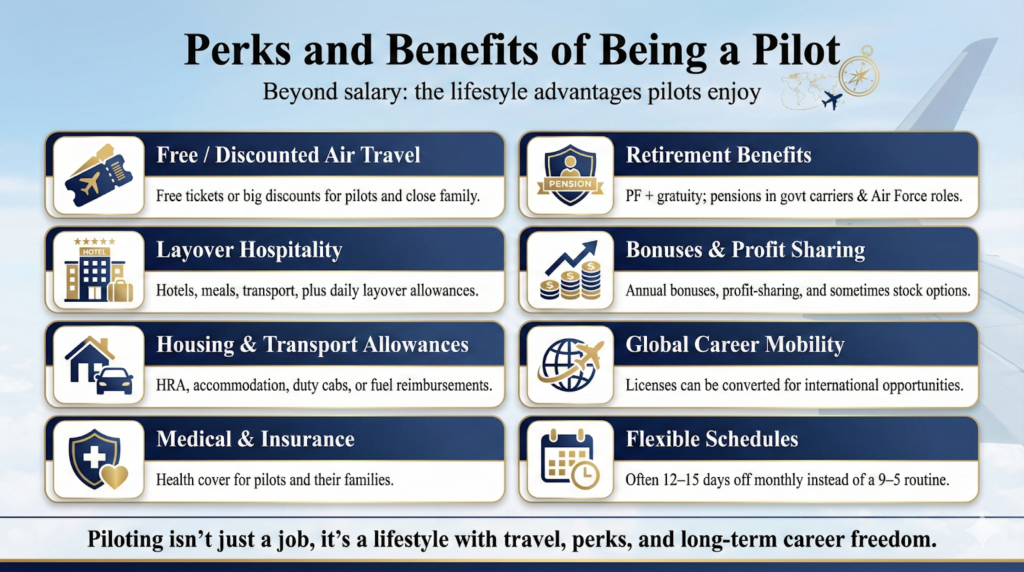
    Salary is just one part of a pilot’s compensation. The lifestyle and benefits coming with a pilot’s job are a big draw as well. Here are some perks Indian pilots enjoy:

    Perks and benefits of being a pilot in India
    • Free or Discounted Air Travel: Most airlines offer free flight tickets or big discounts to pilots and their immediate family for personal travel. 
    • Layover Hospitality: When you fly outstation, the airline covers 5-star hotel stays, meals, and transport for layovers. You earn daily allowances during international layovers to cover food and incidentals.
    • Housing & Transport Allowances: Many airlines provide a housing allowance or even accommodation for pilots in the base city. Some have pick-up/drop-off cab services for duty or reimburse fuel if you drive. These benefits mean your living expenses can be greatly reduced.
    • Medical and Insurance: Pilots receive health insurance for themselves and their families. 
    • Retirement Benefits: In India, government carriers and the Air Force provide pensions. Private airlines don’t give formal pensions, but do contribute to the Provident Fund (PF) and gratuity. Defence pilots notably get a lifetime pension and healthcare.
    • Bonuses and Profit Sharing: Airlines may give annual performance bonuses or profit-sharing when the company does well. Senior pilots in management roles can also get stock options in some cases.
    • Global Career Mobility: A pilot’s skills are globally recognized. You can convert licenses and work abroad more easily than in most professions.
    • Flexible Schedules: Pilots don’t work a 9–5 desk job. In many airlines, you might fly for 15–18 days and have 12–15 days off per month. This allows blocks of free time to pursue other interests or spend time with family.

    All these benefits significantly add to the value of a pilot’s salary. Pilots often remark that while the money is great, it’s the lifestyle that really makes it worth it.

    Pilot Salary in India vs Other Countries

    While Indian pilots are well-paid relative to local standards, global pilot salaries in regions like North America, Europe, and the Middle East are higher in absolute terms. 

    Here is a quick comparison of average monthly pilot pay for airlines in different regions:

    RegionAverage Monthly Airline Pilot PayNotes
    India₹2.5L to ₹10–12LRange from Junior First Officer to experienced Captain
    USA$12k–$18k (≈ ₹10L–₹15L)Senior captains at major airlines can cross ₹2 crore/year
    Middle East (UAE, Qatar)AED 40k–75k or QAR 45k–70k (≈ ₹9L–₹16L)Often tax-free, and housing is commonly provided
    Europe (EU)€8k–€15k (≈ ₹7L–₹13L)High pay, but higher taxes and higher cost of living
    East / Southeast Asia (Singapore, etc.)SGD 18k–25k (≈ ₹10L–₹14L)China has offered very high pay in some cases (up to $25k/month for foreign captains)
    Australia / Canada₹8L–₹12LSimilar salary band to Europe on average

    Many Indian pilots choose to gain experience here, then move to Gulf or Asian carriers for high-paying salaries.

    Conclusion

    The journey from student pilot to senior captain is challenging but hugely rewarding,  both financially and in personal growth. In India, pilot salaries can literally shoot through the roof as you gain experience.

    Now is a great time to start your Pilot training journey. Airlines are expanding, and the demand for skilled pilots is high. The first step is getting quality training and guidance at Vision Flying Training Institute (VFTI), one of the best flying institutes for pilot training in India.

    Whether you are an aspiring commercial female pilot after 12th or a commerce student looking for how to become a pilot without Physics.

    VFTI can help you earn your wings with its expert instructors, top-notch flight training, and career mentorship. With the right training, you could be in the pilot’s seat of a commercial airliner in a few years and earn the impressive pilot salaries we discussed above.

    Our graduates have gone on to fly with leading airlines in India and abroad. We can help you navigate DGCA exams, choose the right type-rating, and even prepare for airline interviews.

    Contact Vision Flying Training Institute to learn more about our pilot training courses and admission process.

    Frequently Asked Questions

    1. What is the salary of a pilot in India per month?

    In India, airline pilots typically earn ₹1.5 lakh to ₹12 lakh per month. Freshers start lower, while captains and senior captains earn the highest.

    1. Salary of a pilot in Air India per month

    A pilot at Air India generally earns around ₹2.5 lakh to ₹15 lakh per month, depending on role and aircraft type. International and wide-body captains sit on the higher end.

    1. What is the salary of an international pilot in India per month?

    International route pilots in India usually earn ₹3 lakh to ₹15 lakh per month. Pay is higher due to long-haul flying, layover allowance, and international sector pay.

    1. What is the salary of a pilot in India per month for freshers?

    Pilot salary in India for freshers is usually ₹1.5 lakh to ₹3 lakh per month once they join an airline as a First Officer. 

    1. Salary of a pilot in IndiGo per month

    At IndiGo, pilots typically earn ₹2 lakh to ₹11 lakh per month, depending on rank. First Officers are on the lower range and Captains on the higher range.

    1. What is the salary of a pilot in India after 10 years?

    After 10 years, a pilot in India commonly earns ₹10 lakh to ₹12 lakh+ per month, especially if they’ve upgraded to Captain or Senior Captain.

    1. What is the salary of a commercial pilot in India per month?

    A commercial airline pilot in India generally earns ₹1.5 lakh to ₹12 lakh per month, depending on whether they are a First Officer, Captain, or Senior Captain.

    1. The highest salary of a pilot in India per month

    The highest pilot salary in India can reach ₹12 lakh to ₹18 lakh+ per month for senior wide-body captains, training captains, or examiners, depending on the airline and role.

  • Top 10 Flying Institutes in India (2026) – DGCA Approved Pilot Training

    Top 10 Flying Institutes in India (2026) – DGCA Approved Pilot Training

    The “best” flying institute in India is not the one with the loudest marketing. It’s the one that gets you to your Commercial Pilot Licence (CPL) on time, within budget, and with strong safety standards. 

    Coming here means you are doing the smartest thing a future pilot can do: researching properly before putting ₹40 to ₹55+ lakhs into CPL training. 

    The choice often matters even more for female pilot aspirants, because the right environment brings better support, mentorship, confidence, and a training pace that does not keep you stuck for months. 

    Check out our latest blog, “How to Become a Commercial Female Pilot After 12th in India.” It walks you through everything, step by step, so you know exactly what to do next.

    That is why we looked at aircraft availability, weather patterns, training consistency, ground school support, safety and compliance culture, student assistance, and student feedback, and then ranked the top DGCA-approved flying schools in India.

    Why the Right Flying Academy Matters for Commercial Pilot Licence (CPL) Training in India?

    Infographic explaining key factors to choose the right flying academy for CPL training in India, including DGCA approval, training quality, fleet, cost, weather, and placement support.

    Becoming a pilot is a significant investment of time and money. Here are a few factors that make picking the right flying institute so important:

    • Quality of Training: A well-structured program with skilled instructors and modern aircraft helps you build strong flying skills and safety habits from day one. Poor training can leave you uncertain and underprepared.
    • DGCA Approval & Safety: In India, flying schools must be approved by the Directorate General of Civil Aviation (DGCA). An approved school follows strict safety and training standards.
    • Fleet and Facilities: The number and type of aircraft available matter. Modern glass cockpit trainers and well-maintained aircraft can make learning better. A larger fleet also means less waiting for your turn to fly, helping you log hours faster.
    • Weather & Location: Some academies have bases with favorable weather and unrestricted airspace, allowing near year-round flying. Good weather, like in parts of Gujarat or Madhya Pradesh, means you can complete your training on schedule without long monsoon delays.
    • Cost and Duration: Commercial Pilot License (CPL) programs in India typically cost anywhere from ₹35 lakh to ₹55 lakh, approximately, for 200 hours of flying. 

    Government institutes tend to have fixed lower fees but tougher entry, while private academies may be costlier and offer financing options.

    • Placement Support: After getting your CPL, landing an airline job is not guaranteed by any Pilot Training school. However, some institutes have career support, e.g., airline interview preparation, campus placements, or tie-ups with airline cadet programs.

    Keeping these factors in mind, let us look at the top flying training institutes in India.

    Top 10 Best Flying Institutes in India

    1. Vision Flying Training Institute (VFTI) – Amreli, Gujarat:

    Vision Flying Training Institute is among India’s top flying schools. It brings a modern approach to pilot training. Established in 2024, VFTI quickly gained DGCA approval and is part of the Vision Group of Institutions, which has over two decades of experience in education.

    The institute’s flying base is in Amreli, Gujarat, a location known for clear skies and 365-day flying weather. This means minimal training disruptions due to bad weather. The choice of Amreli gives students access to relatively uncongested airspace and excellent flying conditions year-round. 

    VFTI offers training for both Commercial Pilot License (CPL) and Private Pilot License (PPL) programs, as well as license conversion training. All pilot training courses are DGCA-approved, and the CPL program includes the standard 200 hours of flying training with instrument flying, night flying, and multi-engine exposure as required by DGCA norms

    One of VFTI’s biggest strengths is its modern aircraft fleet. Unlike many older schools that rely on decades-old planes, VFTI has invested in new-generation trainers. Their fleet includes Tecnam P2008 JC light sport aircraft, Tecnam P2006T Multi-Engine Simulator, and the advanced Tecnam P-Mentor, along with the reliable Cessna 172 Skyhawk

    Apart from our advanced fleet, VFTI has a DGCA-certified, CAR-145 approved in-house Maintenance, Repair and Overhaul (MRO) facility that keeps aircraft in top condition, reduces downtime, and helps you complete your CPL training on time. Our MRO services include line and base maintenance, scheduled and unscheduled inspections, structural repairs and modifications, component replacement and servicing, and complete airworthiness support. 

    VFTI features highly experienced flight instructors, some with backgrounds in the Air Force or airlines, so students learn under mentors who have flown in real-world environments. The student-to-instructor ratio is kept low, meaning you get more personalized one-on-one guidance.

    Further, they provide guidance for airline placements, conduct mock interviews and simulator checks for airline selection, and have industry tie-ups to stay updated on hiring requirements. 

    When you have not studied Physics and Maths before, the flying school you choose matters even more, because you need the right support, not just flying hours. At VFTI, we guide commerce-background aspirants properly, from the basics to the CPL pathway. You can also check our full guide: How a Commerce Student Can Become a Pilot Without Physics.”

    VFTI is a DGCA-approved flying institute that can turn you into a competent commercial pilot on a fast timeline. VFTI, the pilot training institute, should be at the top of your list.

    2. Indira Gandhi Rashtriya Uran Akademi (IGRUA) – Amethi, Uttar Pradesh:

    IGRUA is often the name that comes up in discussions of the best pilot training institutes in India. Established in 1985 by the Government of India, IGRUA has a storied legacy and is sometimes referred to as the “IIT/IIM of Aviation”

    It is a public central flying school under the Ministry of Civil Aviation. IGRUA is based at Fursatganj Airfield, Amethi, UP. It was the country’s first national aviation academy. Over the decades, IGRUA has built a reputation for strict, high-quality training and disciplined operations.

    IGRUA conducts an Ab-initio to CPL course, which can include an integrated three-year B.Sc. Aviation degree, in collaboration with a university. The training is comprehensive. IGRUA also historically offered a commercial helicopter pilot license course and other workshops. 

    IGRUA employs a mix of ex-Indian Air Force and senior civilian instructors. IGRUA cadets are known to have very strong theoretical knowledge and disciplined flying skills. 

    The aircraft fleet at IGRUA is large and modern: currently about 13 active training aircraft, primarily Diamond DA40 single-engine trainers and a couple of Diamond DA42 twin-engine aircraft. They also have two DA40 simulators for instrument training. 

    However, one downside noted by recent cadets is long training duration due to high student numbers and finite aircraft; some batches have taken 3-4 years to complete CPL. This backlog issue means you might spend a lot of time waiting for sorties or for your turn on the twin-engine, etc. It’s something to consider if timing is critical for you. 

    3. National Flying Training Institute (CAE Gondia) – Gondia, Maharashtra:

    National Flying Training Institute (NFTI) in Gondia is popularly known as CAE Gondia. It is a premier private flying training academy that brings international expertise to India. It’s a joint venture between CAE Inc. (Canada), a world leader in aviation training, and the Airports Authority of India. Established in 2007, NFTI was one of the first privately-run academies to set up on a large scale to meet the growing demand for pilots. 

    CAE Gondia offers an Integrated CPL program that covers your Commercial Pilot License with Instrument Rating and Multi-Engine Rating in about 19 months of training. The curriculum and procedures here are aligned with ICAO and DGCA standards.

    NFTI Gondia operates from Birsi Airport, Gondia, a training airfield in eastern Maharashtra. The location is relatively quiet with minimal commercial air traffic, which is best for training flights. The training fleet is modern and similar to IGRUA’s: about 12 single-engine Diamond DA40 aircraft and 2 twin-engine Diamond DA42 aircraft for multi-engine training. These aircraft have glass cockpits (Garmin G1000 avionics), preparing students for airline technology. 

    NFTI is undeniably one of the best flying training institutes in India, blending the local DGCA syllabus with international best practices.

    4. Chimes Aviation Academy (CAA) – Dhana/Sagar, Madhya Pradesh:

    Chimes Aviation Academy has rapidly grown into one of India’s leading flying schools. Founded in 2008 at Dhana airfield near Sagar, MP, Chimes is a private academy known for its modern approach. In fact, Chimes Aviation Academy was ranked as the top FTO in India in the DGCA’s inaugural 2025 rankings, being listed first among the Category ‘B’ schools.

    One of Chimes’ biggest bragging points is its large fleet of training aircraft. CAA currently operates 24+ aircraft, including Cessna 172 single-engine planes and Diamond DA42 twin-engine aircraft, all equipped with Garmin G1000 glass cockpits. They have even added new Piper single-engine aircraft and Tecnam trainers recently, expanding the fleet. This is India’s largest civilian training fleet.

    CAA offers the flagship Cadet Pilot Program in partnership with IndiGo Airlines. They also conduct Assistant Flight Instructor (AFI) / Flight Instructor (FI) courses, license conversions, and other add-ons.

    5. Madhya Pradesh Flying Club (MPFC) – Indore & Bhopal, MP:

    One of the oldest flying clubs, dating back to the 1950s. MPFC is state-run and has trained many pilots over the years. It operates from two cities Indore and Bhopal. The academy offers CPL, PPL, and instrument rating. 

    Being a club, the fleet is small (Cessna 152/172) and training can be slower. Still, its legacy and experienced instructors make it notable.

    6. Orient Flights Aviation Academy (OFAA) – Mysore, Karnataka:

    OFAA is a private flight academy with around 10 years of experience. It operates from Mysuru Airport. It provides CPL, PPL, and has had cadet program partnerships in the past.

    Its fleet includes Cessna 172s and a DA42 Twin Star for multi-engine, making training strong and comfortable in Mysuru’s calm environment.

    7. Flytech Aviation Academy – Hyderabad (Telangana):

    A well-known private academy, Flytech has one of the largest fleets in India. They have operated 10+ aircraft including Cessnas and Piper Seneca for multi-engine. They have been in operation since the 1990s and have a large number of alumni. 

    Flytech’s appeal is that they have their own airfield in Telangana and offer comprehensive training including aircraft maintenance engineering courses. However, DGCA’s ranking placed Flytech in Category C, implying some areas for improvement.

    8. Bombay Flying Club (BFC) – Mumbai, Maharashtra:

    The oldest flying club in India, established in 1928. BFC trained India’s first pilots and is historically significant. It operates out of Mumbai’s Juhu Aerodrome and also Dhule for additional flying. 

    BFC offers CPL, PPL, and aircraft maintenance courses. They have a fleet of Cessna 172s and a couple of multi-engine planes. The advantage of BFC is its strong alumni network and location in Mumbai. 

    However, being a club in a congested city, aviation students sometimes face scheduling challenges and delays. In the 2025 DGCA rankings, BFC unfortunately fell into Category C, indicating room to upgrade safety and training performance. 

    Still, for Mumbai-based students or those wanting a legacy name, BFC is a consideration.

    9. Ahmedabad Aviation & Aeronautics Ltd (AAA) – Ahmedabad, Gujarat:

    Ahmedabad Aviation & Aeronautics Ltd is a private flying school operating at Ahmedabad airport since the 1990s. It offers CPL and PPL training. AAA was a go-to institute before VFTI and Blue Ray Aviation emerged in Gujarat. 

    AAA has a fleet of Cessna 172 and Piper Seneca (multi-engine). Its urban location is a double-edged sword: great city amenities, but busier airspace can limit daily flying hours.

    AAA provides a solid training but with older infrastructure, something new entrants like VFTI aim to improve upon.

    10. Top Crew Aviation (TCA) – Delhi (HQ) / Various bases

    Top Crew Aviation is a new player that’s been gaining attention recently. It was founded in late 2020s. TCA offers CPL, PPL, and ATPL theory classes, and they have been innovative in providing scholarships. They use a mix of partner flying schools for actual flight training and have their own simulators. 

    TCA’s model is unique: they help students with financing and then guide them through training either domestically or partly abroad. For example, they had programs to do flying in South Africa or Serbia for cost savings. 

    TCA’s focus on placement assistance and airline interview prep is a strong selling point. As a newer institute, their success will depend on student outcomes, but they represent a trend of modern, student-centric training. 

    When budget is a limiting factor, it might be worth exploring such options where merit-based scholarships could reduce your cost.

    There are other respectable academies like Gujarat Flying Club (Vadodara), GATI (Government Aviation Training Institute, Bhubaneshwar), Haryana Institute of Civil Aviation (at Karnal, Hisar, Pinjore), Rajiv Gandhi Academy for Aviation Technology (Trivandrum, Kerala), Redbird Aviation (a private FTO with bases in Maharashtra, Karnataka, Assam), and Falcon Aviation Academy (UP and MP), among others. Each has its own pros and cons. When comparing, always check the latest reviews on their fleet serviceability, instructor availability, and recent safety record.

    Before choosing a flying school, it’s essential to understand the total investment and expected training timeline. For a complete breakdown, read our detailed guide on Pilot Course Fees & Duration, where we have covered everything related to this.

    Why VFTI is the Best Flying Institute in India

    It’s fair to ask why VFTI tops the list over giants like IGRUA. The reason is practical, not promotional: training efficiency.

    VFTI wins on two critical fronts:

    The Weather Factor: VFTI is in Amreli. It does not have the “Delhi Fog” that grounds planes for weeks in winter, nor the torrential Mumbai monsoons. You fly almost every single day.

    The Tech Factor: Training on a Tecnam P2008 with a Glass Cockpit is just necessary. Modern Airbuses do not have analog dials. VFTI trains you to scan digital screens, manage energy, and use autopilots skills that make your airline Type Rating much easier.

    Conclusion

    Becoming a pilot is an investment of your time and money. You cannot afford to spend that at a pilot training school where you will sit on the ground waiting for spare parts or better weather.

    You need a school that treats your training with the same professional urgency that you have for your career.

    The “best” flying training institute in India ultimately depends on your priorities, be it advanced training, legacy reputation, cost, or speed.

    Vision Flying Training Institute (VFTI) is a well-thought-out choice for students who want modern infrastructure, personalized training, and a faster, more structured path to their CPL.

    Schedule a call with VFTI today!

    Download our 2026 Brochure

    Call our Admission Desk: +91-9319193602 / +91-9319193605

    Email: enquiry@vfti.in
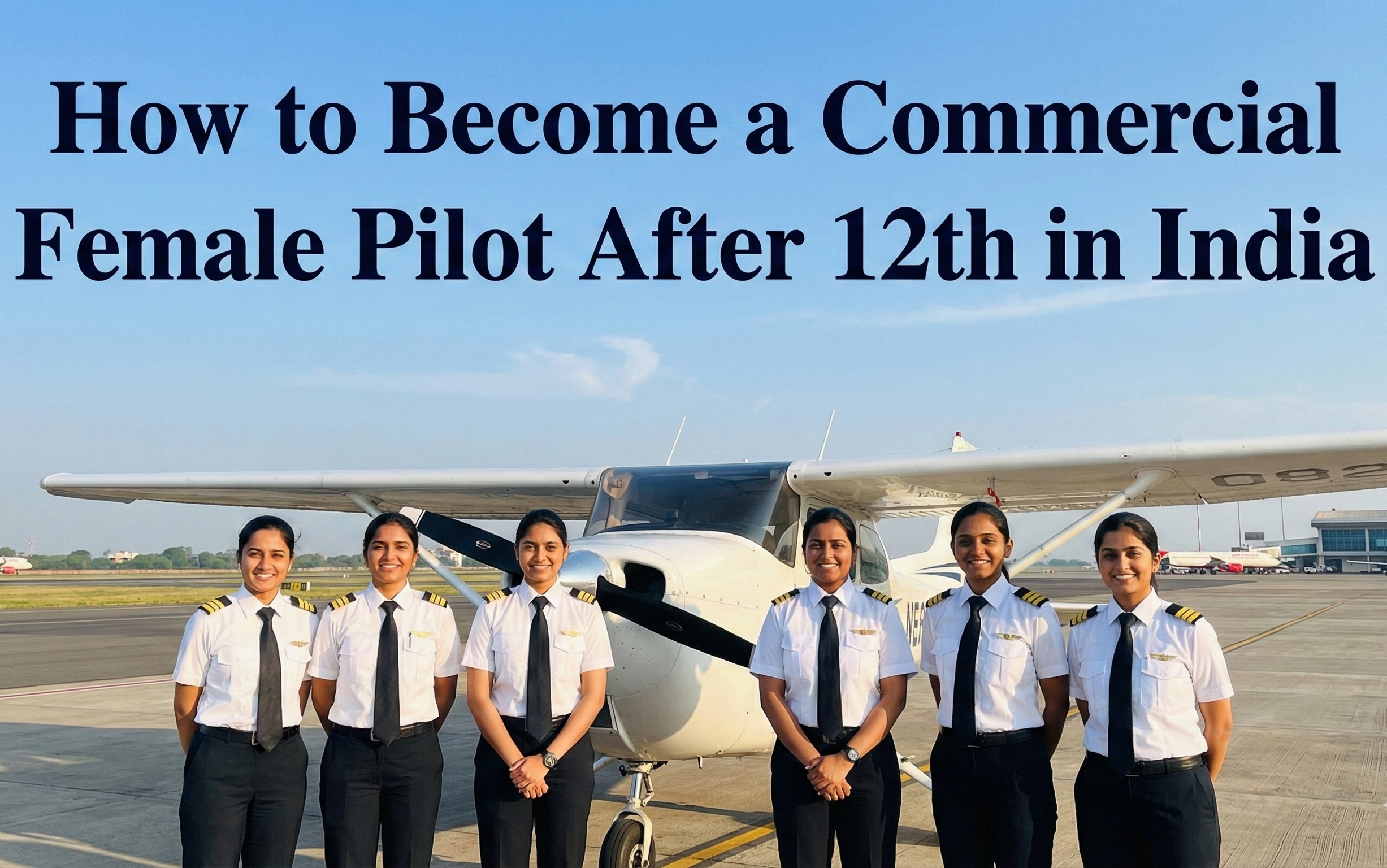
  • How to Become a Commercial Female Pilot After 12th (2026 Guide)

    How to Become a Commercial Female Pilot After 12th (2026 Guide)

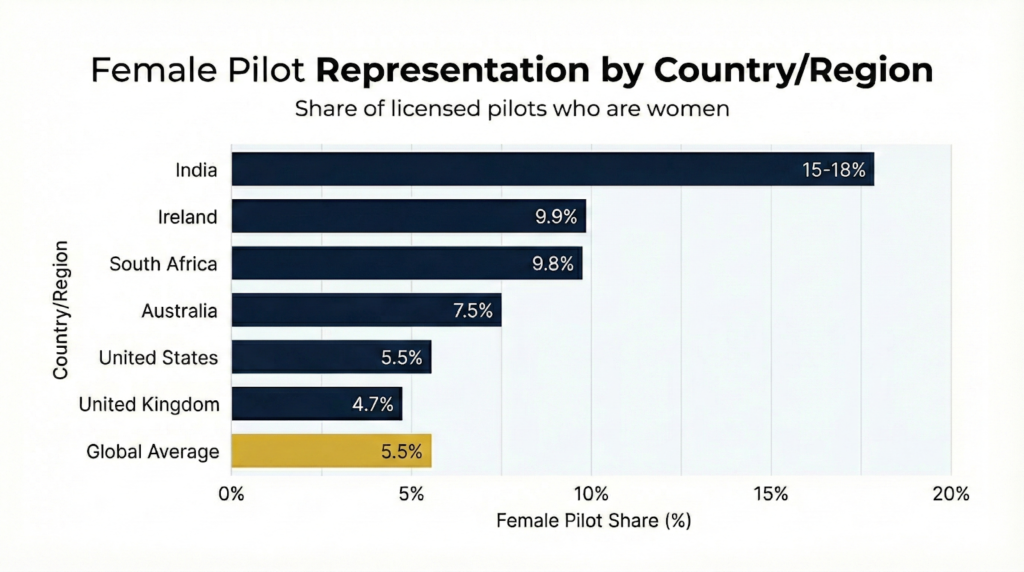
    India has the highest proportion of female commercial pilots in the world. Women make up approximately 15% of India’s pilot workforce, compared to about 5% in the United States.

    When you enter an airport briefing room, you won’t be the “only girl” there. You will be joining a workforce where women like Captain Zoya Agarwal, who flew over the North Pole have already normalized the idea that the cockpit belongs to anyone with skill. 

    Now, let us move past the inspiration and get to the hard work. 

    Becoming a pilot takes more than just being enthusiastic about aviation. It demands a strong grip on Physics and Mathematics, plus a clear understanding of different pilot licenses. It also demands consistent discipline, training at a top flying school, Vision Flying Training Institute (VFTI), and the ability to perform confidently in high-stress situations.

    This blog is a practical roadmap for every female pilot aspirant. With institutes like Vision Flying Training Institute (VFTI), your path to becoming a pilot becomes clearer, more structured, and genuinely achievable.

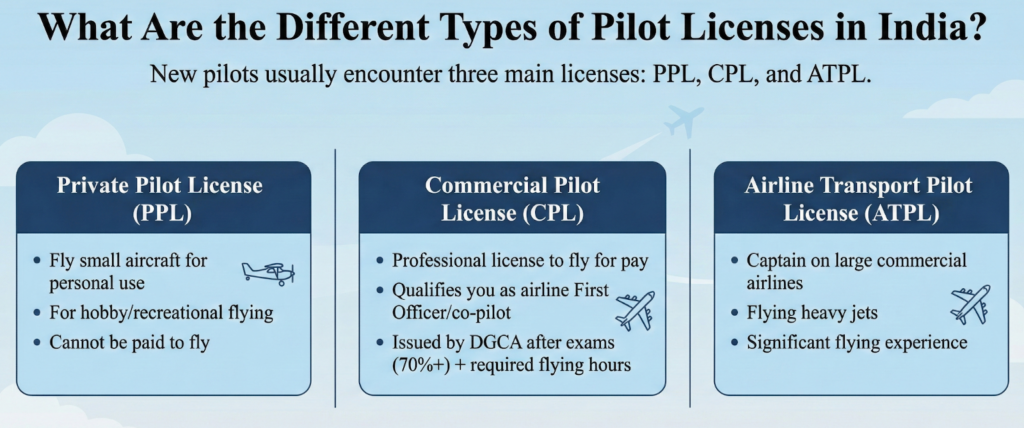
    What Are the Different Types of Pilot Licenses in India?

    When starting out, you will hear terms like PPL, CPL, and ATPL. As a beginner, it can be difficult to understand what they mean and which one you need for a full-fledged career in aviation. We have explained each pilot license below.

    • Private Pilot License (PPL) 

    A PPL allows you to fly small aircraft for personal hobby or sport, but not for commercial work. It’s often a first step for enthusiasts, you learn to fly and carry passengers, but you cannot earn a salary with a PPL.

    • Commercial Pilot License (CPL)

    The CPL is the professional license. With a CPL, you are allowed to fly aircraft and get paid as a first officer or co-pilot with an airline. This is the license every female pilot aspirant needs to become a commercial pilot in India. 

    The Directorate General of Civil Aviation (DGCA) issues the CPL once you meet all requirements, including passing exams with 70% and logging required flying hours.

    • Airline Transport Pilot License (ATPL)

    The ATPL is the highest level of pilot certification. It’s what you eventually obtain to become a Captain of an airliner or to fly large transport aircraft. 

    In India, you need to be at least 21 years old and have about 1,500 hours of flight experience among other criteria to get an ATPL. 

    Typically, female pilots first earn a CPL, then build experience and clear additional exams to achieve an ATPL.

    After Class 12, every female pilot aspirant’s immediate goal should be to obtain a CPL. The CPL will launch your career as a commercial pilot, after which you can work toward an ATPL as you gain experience.

    Eligibility Criteria After 12th for Commercial Pilot Training for Women in India

    Before you can start pilot training, you must meet certain eligibility requirements set by the DGCA and flying schools:

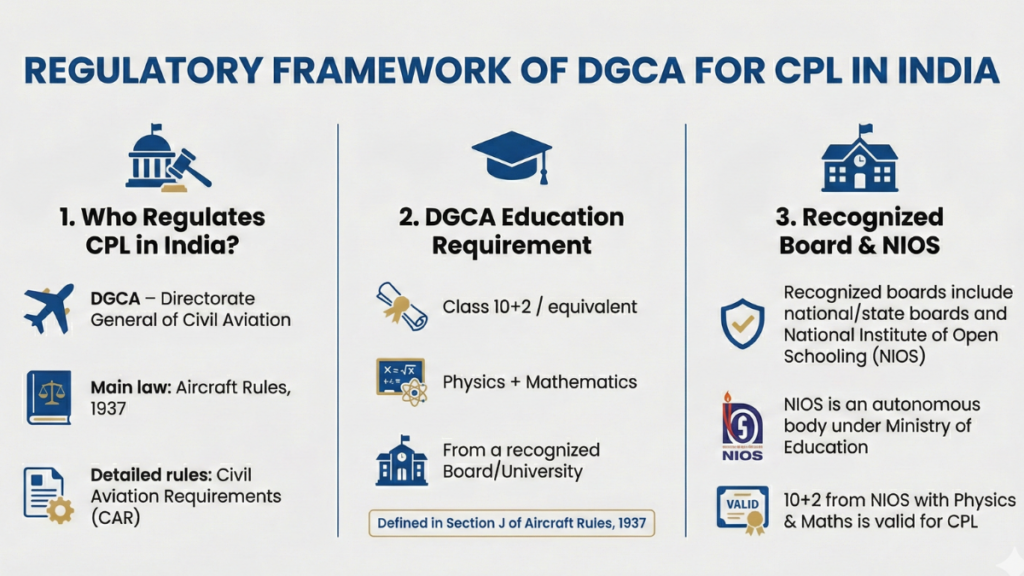
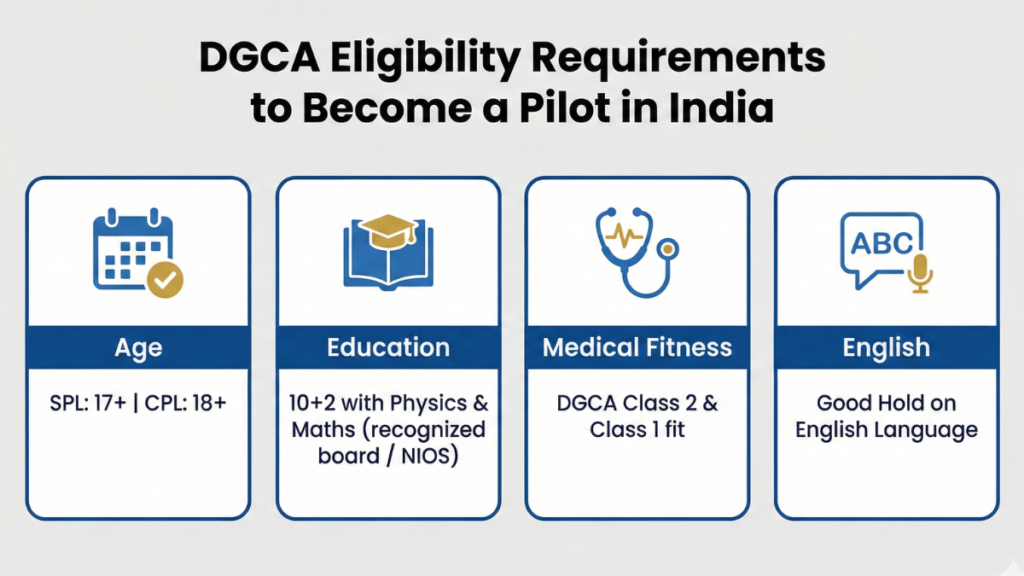
    • Educational Qualifications: You must have completed 10+2 (Class XII) with Physics and Mathematics as core subjects. Good flying schools such as Vision Flying Training Institute typically require a minimum of 50–60% marks in these subjects. 

    If you did not have Physics or Math in 12th (for example, you were a Commerce or Arts student), you can qualify by passing these subjects via NIOS (National Institute of Open Schooling) or a recognised equivalent.

    You can also read our detailed blog for complete guidance on “How a Commerce Student Can Become a Pilot Without Physics”.

    English proficiency is also important, as all training and communication are in English.

    • Age Requirement: The minimum age to start pilot training is 17 years, and you must be 18 years old to receive a Commercial Pilot License. There is no upper age limit to train, but airlines typically retire pilots by age 65.
    • Medical Fitness: You must obtain a DGCA Class 2 Medical certificate to begin your flying training. This involves an examination by a DGCA-approved medical examiner to check your eyesight, hearing, cardiovascular fitness, and overall health. 

    Once you start training or approach your first solo flight, you will also need to get a Class 1 Medical certificate, which is required for acting as a commercial pilot.

    • Nationality: You should be an Indian citizen for flying in India. Foreign nationals have separate procedures.
    • Background Check: Expect to provide a police clearance or background check when applying for licenses, as aviation authorities make sure candidates have no disqualifying history.

    The path is open regardless of gender. In fact, being a female pilot in India can be an advantage given the industry’s supportive stance on diversity

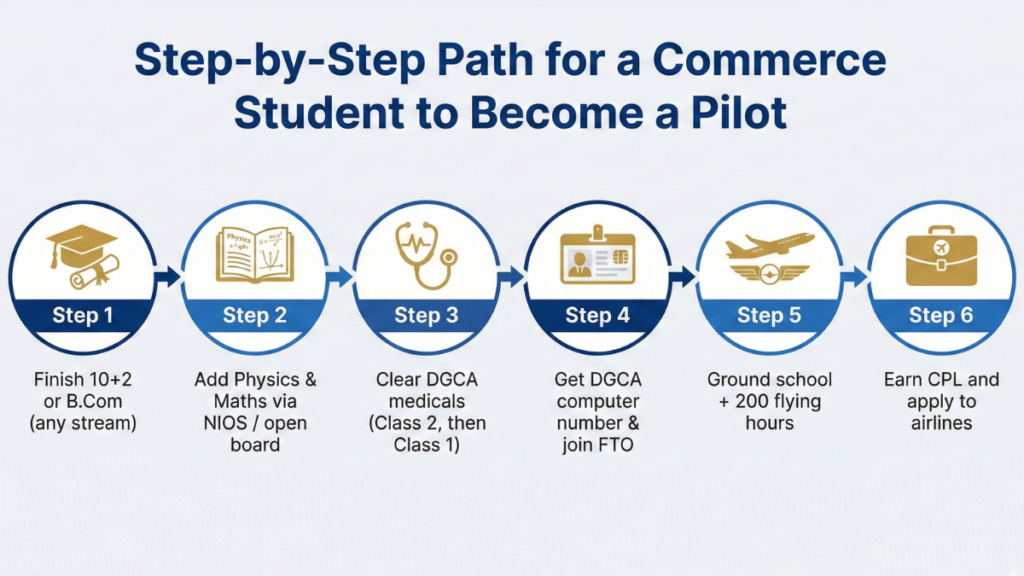
    Process for Females to Obtain a Commercial Pilot License (CPL) After Class 12

    Becoming a commercial pilot involves several stages. Below is a step-by-step roadmap to go from 12th pass to licensed CPL holder:

    1. Finish 10+2 with Required Subjects: Make sure you have Physics and Math in Class XII or complete them via NIOS if needed. Without these, you cannot get a CPL.
    2. Apply for a DGCA Computer Number: This is an ID issued by DGCA that registers you as a candidate for pilot exams. You apply through the DGCA Pariksha portal online. It’s basically your exam registration number for all DGCA theory exams.
    3. Obtain Your Class 2 Medical Certificate: Find a DGCA-approved medical examiner and get your Class II Medical done early. Once you pass, you will receive a file number. With that, apply for a Class 1 Medical appointment. You can even begin ground classes while your Class 1 is in process. You will need Class 1 before you can exercise the privileges of a CPL.
    4. Enroll in a DGCA-Approved Flying School: It’s crucial to train at a DGCA-approved Flying Training Organization (FTO). Schools like Vision Flying Training Institute (VFTI) are approved FTOs, meaning DGCA recognizes their training. Enroll in a Commercial Pilot License course.
    5. Ground School and DGCA Exams: Ground school is where you learn the theoretical subjects required for pilots. These include Air Regulations, Aviation Meteorology, Air Navigation, Technical General, Technical Specific (aircraft and engines), and Radio Telephony. The DGCA exams are held quarterly. You need at least 70% to pass each subject.
    6. Flight Training (200 Hours): Alongside or after passing your written exams, you will undergo flight training with instructor pilots. DGCA mandates a minimum of 200 hours of flight time for a CPL. Those 200 hours will include:
    • 100 hours as Pilot-in-Command (solo flying) where you are the sole occupant controlling the aircraft.
    • 50 hours of cross-country flying to multiple airports independently as the pilot.
    • 40 hours of instrument flying to learn how to fly in low visibility, with up to 20 hours allowed on an approved simulator.
    • 10 hours of night flying to get comfortable with night take-offs and landings.
    • 10 hours on multi-engine aircraft. This is required to fly planes with more than one engine and is highly recommended for airline aspirants.
    1. You will start with dual flights with an instructor, progress to solo flights once proficient, do navigation sorties, and gradually fulfill each of these requirements. This phase typically takes 12–18 months depending on weather and aircraft availability. At VFTI’s base in Gujarat, one big advantage is 365 days of flyable weather and uncongested airspace, which helps students log hours consistently without long delays.
    2. Clear the Flying Skill Tests: When you complete your flying hours and pass the written exams, you will undergo practical skill tests. DGCA examiners will test you on general flying skills, instrument flying, and navigation in an aircraft. These checks make sure you can safely handle the aircraft and procedures.
    3. License Issuance: Submit all required documents such as logbook, exam results, medicals, etc. to DGCA for license issuance. Within a few weeks, you will receive your Commercial Pilot License.
    4. Type Rating and Further Training: A Type Rating is specialized training for the specific aircraft e.g., Boeing 737 or Airbus A320 that you will fly in an airline job. After CPL, many pilots enroll in type rating courses. Meanwhile, you can also build experience by working as a junior pilot or flight instructor. 
    5. Upgrade to ATPL: Once you accumulate 1,500+ hours and meet the required flying experience criteria, you can apply for an ATPL. When you meet all the requirements, DGCA will grant you an ATPL. 

    However, this step comes later in your career. Many pilots earn their ATPL in their late 20s or 30s when they are ready to command an aircraft.

    Many before you have followed these steps successfully. With determination, you can too!

    Government Schemes & Scholarships for Women Pilot Aspirants in India

    There are government-backed schemes and scholarships that can help women pilot aspirants in India fund their journey.

    1. AICTE Saksham Scholarship: Specifically for specially-abled students, but often has broader technical education overlaps.
    2. Women in Aviation International (WAI) Scholarships: WAI offers substantial scholarships annually. The application cycle usually opens in mid-2025 for the 2026 awards.
    3. State Government Schemes: States like Bihar, Maharashtra, and Karnataka often have scholarship schemes for SC/ST/OBC students pursuing technical courses like CPL.
    4. DGCA, IGRUA, and private academies occasionally offer merit-based financial aid.
    5. Bank Loans: Since pilot training is a vocational professional course, most nationalized banks offer education loans for DGCA-approved institutes

    Advantages of Being a Female Pilot in India

    Choosing to become a pilot is a bold and exciting move for anyone, especially as a woman in India. Here are some benefits and encouraging facts for female pilots in India:

    1. Airlines in India are expanding rapidly, creating a high demand for pilots. IndiGo, Air India, and others are expected to hire thousands of pilots in the coming years. This demand means that if you train well and perform consistently, you have a strong chance of landing a great job.
    2. Both government bodies and private organizations are encouraging female aviators. The Indian Air Force started inducting women as pilots decades ago, and today women even fly fighter jets. State governments like Haryana have, at times, subsidized pilot training for female cadets, and some companies have also offered full scholarships to women for pilot training.
    3. India has no shortage of inspiring female pilot role models, such as Captain Nivedita Bhasin, who became the world’s youngest female airline captain in 1989. Many are active on social media or training organizations and are ready to mentor the next generation.

    With passion and perseverance, becoming a female pilot in India can be a highly rewarding career both financially and personally.

    Career Opportunities for Female Pilots After Getting a CPL

    The moment you complete your CPL, you become eligible for a variety of pilot career routes.

    Airline Pilot: This is the most popular route. With a CPL, you can join an airline as a Junior First Officer or Second Officer.

    Charter and Business Aviation: With a CPL, you can also fly private charter aircraft or business jets. Many companies, high-net-worth individuals, and charter operators hire pilots to fly aircraft such as Cessna Citations and Bombardier Challengers. These roles can be quite lucrative and may offer more flexible schedules than airline jobs.

    Flight Instructor: Some CPL holders choose to become instructors at flying clubs or academies. As a young female instructor, you can become a role model for other girls entering the field. Once you cross around 750 hours and meet DGCA criteria, you can qualify as a Grade I or Grade II instructor.

    Cargo and Helicopter Pilot: With further training or conversion, pilots can fly cargo aircraft or train for helicopter licences. Since helicopters require a separate licence, this is a great option if rotorcraft interest you.

    Airline Transport Pilot Licence (ATPL) and Beyond: Over time, you will take the ATPL exams and upgrade your licence. An ATPL is needed to captain commercial flights. Many pilots also pursue an Instrument Rating and Multi-Engine Rating to expand the types of aircraft they can fly and the conditions they can operate in. Some even go abroad for advanced training or pursue certifications such as a Federal Aviation Administration (FAA) licence if they plan to work internationally.

    Career growth in aviation is significant. India, especially, is full of opportunities now. With new airlines launching and existing carriers ordering hundreds of aircraft, the future looks very promising for aspiring pilots.

    Conclusion

    The Indian aviation market is booming. But airlines do not just want license holders; they want skilled female aviators. 

    Vision Flying Training Institute does not just sell you flying hours. We train you to survive and grow in the airline world. 

    We respect the investment your family is making, and we match it with transparency and training rigour.        

    Visit us at Amreli or our Delhi office. Talk to our instructors. 

    Download our 2026 Brochure

    Call our Admission Desk: +91-9319193602 / +91-9319193605

    Email: enquiry@vfti.in
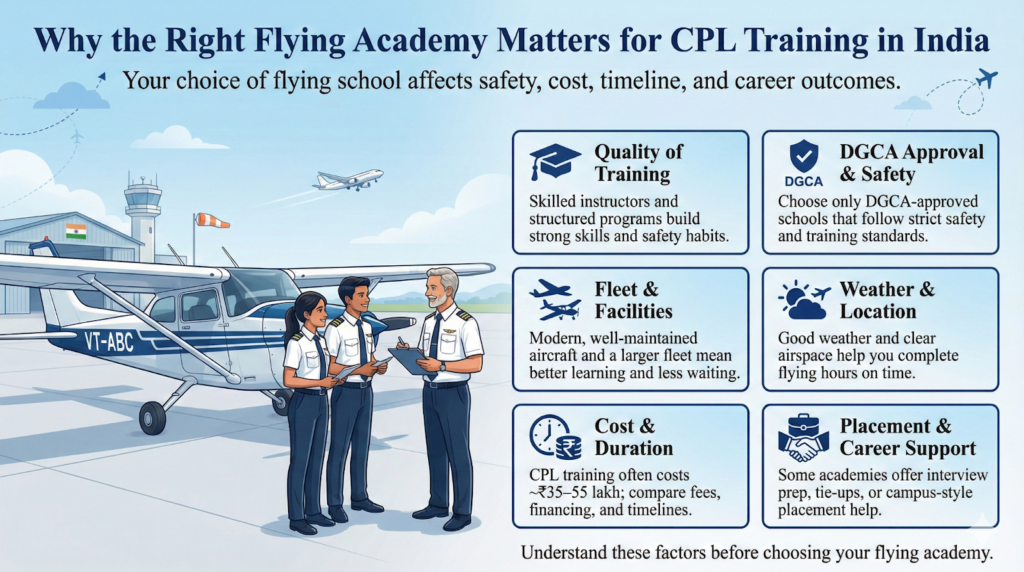
  • How Commerce Students Can Become Pilots in India (Without Physics)

    How Commerce Students Can Become Pilots in India (Without Physics)

    A common myth circulates in Indian households: “If you want to be a pilot, you must take Science in 12th grade.”  

    We are here to tell you that they are wrong. A commerce student can become a pilot in India.

    Historically, the profession of a Commercial Pilot was viewed through a exclusionary lens. It was perceived as the exclusive domain of “Science Stream” students, especially those who had mastered the rigors of Physics, Chemistry, and Mathematics in their higher secondary education.

    However, the actual guidelines from Directorate General of Civil Aviation (DGCA) does not match what many people assume. The academic pathways to the cockpit are far more flexible than many Indian parent or career counselor realises. 

    In this guide, we will explain how a Commerce student can become a pilot in India. We will also show how Vision Flying Training Institute (VFTI), the best flying institute in India, helps you prepare for your DGCA exams and earn your Commercial Pilot License (CPL).

    Regulatory Framework of the Directorate General of Civil Aviation for the Commercial Pilot Licence in India

    VFTI features including DGCA approval, modern aircraft fleet, and CPL training support

    Before understanding how a Commerce student can become a pilot, one must first go through the legal texts that govern Indian civil aviation. The main governing document is the Aircraft Rules, 1937. This is supported by the Civil Aviation Requirements (CAR).

    The Specificity of Educational Requirements:

    recognisedThe requirements for the issuance of a Commercial Pilot License (CPL) are detailed in Section J of the Aircraft Rules, 1937. An applicant must have passed Class 10+2 or an equivalent examination with Physics and Mathematics, from a recognized Board/University. 

    The Legitimacy of National Institute of Open Schooling (NIOS):

    The second critical component is the term “recognised Board.” The National Institute of Open Schooling (NIOS) is an autonomous institution under the Ministry of Education, Government of India. It was established precisely to provide flexibility in education.

    Table 1: Comparative Validity of Boards for DGCA Licensing

    FeatureCBSE / ICSE / State BoardsNational Institute of Open Schooling (NIOS)
    Legal StatusRecognized by Ministry of EducationRecognized by Ministry of Education
    DGCA AcceptanceFully AcceptedFully Accepted
    Subject FlexibilityRigid Streams (Science/Commerce/Arts)Pick Individual Subjects
    Exam ScheduleFixed (March/April)On-Demand (Year-round) 
    Primary Use CaseFoundational EducationBridging & Up-skilling

    The marks sheet from NIOS containing Physics and Mathematics is not distinguishable in law from the marks sheet of CBSE for the issuance of a pilot license. It is a designed feature of the Indian educational framework to allow career shifts without repeating entire academic years.

    DGCA Eligibility Requirements to Become a Pilot in India

    DGCA regulatory framework for commercial pilot license education and recognized boards in India

    You need to fulfill some requirements specified by the DGCA in order to become a Commercial Pilot in India.

    The eligibility criteria for a Commercial Pilot License (CPL) are:

    Age: Must be at least 17 years old to start flight training for a Student Pilot License (SPL), and 18 years old to get a CPL issued.

    Educational Qualification: Need to have 10+2 (Class XII) with Physics and Mathematics, or an equivalent qualification recognized by any board. 

    This is the key requirement where commerce students need to pay attention. If you have completed 12th in commerce (or arts) without Physics/Math, you can still fulfill this requirement by passing those subjects through an approved board like NIOS or a state open school.

    Medical Fitness: Must be declared fit by DGCA-approved doctors (Class 2 and Class 1 Medicals).

    English Proficiency: Since all pilot training exams, cockpit communications, and Air Traffic Control instructions are in English, you need a good command of English. 

    The eligibility criteria for a Private Pilot License (PPL), which is a license for personal/recreational flying are different and actually less strict on the academic side. In fact, to do a PPL in India you only need to be 10th pass (Class X) and 17 years old, with a DGCA Class 2 medical.

    This means a PPL could be pursued even without Physics/Math at 12th. However, a PPL only allows you to fly private aircraft for non-commercial purposes. You cannot get a paid flying job with just a PPL. So, if your goal is an airline or commercial flying career, you will eventually need to meet the CPL requirements.

    Step-by-Step Path for a Commerce Student to Become a Pilot

    Step-by-step process for commerce students to become a commercial pilot in India

    Now let’s put it all together. Here is a step-by-step roadmap for a commerce student (12th pass or even a graduate) to become a licensed pilot:

    Step 1: Finish High School in any stream. Whether you have just cleared your 12th in Commerce or already have a B.Com degree, you are eligible. The DGCA simply requires a 10+2 passing certificate to get the ball rolling.

    Step 2: Bridge the Gap with NIOS. Since you did not take Physics and Math, you will sit for these two subjects via the National Institute of Open Schooling (NIOS). It’s a recognized, flexible way to meet DGCA requirements without repeating high school.

    Step 3: Clear Your Medicals Early. Before investing in training, be sure you are fit to fly. Start with a Class 2 Medical (initial checkup), followed by a Class 1 Medical. At Vision Flying Training Institute (VFTI), we always suggest doing this early so you can fly with peace of mind.

    Step 4: Secure Your Computer Number & Join an Flying Training Organization (FTO). Your “Computer Number” is your official DGCA ID. Once you have that and your medicals, you can enroll in a Flying Training Organization (FTO). We help you navigate the paperwork so you can focus on the flying training course.

    Step 5: Master the Ground School & Flight Hours. You will balance theory (Navigation, Meteorology, and Regulations) with 200 hours of actual flying. Do not worry about the “Science” aspect, our instructors at VFTI translate complex concepts into practical pilot knowledge.

    Step 6: Earn Your CPL and Take Off. Once you pass your DGCA exams and complete your flying hours, you will receive your Commercial Pilot License (CPL). 

    From here, you are ready to apply to major airlines or charter companies and start your career.

    Vision Flying Training Institute (VFTI) is an “infrastructure-first” institute. We have helped many commerce students rewrite their journey from balancing ledgers to flying aircraft thousands of feet above the ground. When you have the passion, the discipline, and the dream to wear the white uniform, your school stream will never hold you back.

    The Cost of Becoming a Pilot in India

    Cost breakdown of becoming a pilot in India including ground school, flight hours, simulator, and medical exams.

    Pilot training is an investment. While the cost is significant, the starting pilot salary for a First Officer in Indian airlines (like Indigo, Air India, or SpiceJet) ranges from ₹2 Lakhs to ₹5 Lakhs per month, making it one of the most financially rewarding careers in the country.

    The following table provides a comprehensive breakdown of the various cost components.

    Table 2: The “Commerce-to-Pilot” Cost Structure

    Cost ComponentApproximate Cost (INR)
    NIOS Registration & Exams₹5,000 – ₹15,000
    DGCA Class 2 Medical₹5,000 – ₹8,000
    DGCA Computer Number & Exams₹15,000 – ₹20,000
    CPL Ground School (VFTI)₹1,50,000 – ₹2,50,000
    Flying Training (200 Hrs at VFTI)₹35,00,000 – ₹45,00,000
    Accommodation & Living (Amreli)₹2,00,000 – ₹3,00,000
    DGCA Class 1 Medical₹5,000 – ₹10,000
    TOTAL ESTIMATED COST₹40 Lakh – ₹55 Lakh

    What Makes Vision Flying Training Institute the Best for Pilot Training?

    Guide on how a commerce student can become a pilot without physics through NIOS and DGCA pathway

    Your choice of training institute for becoming a pilot is important, as it will shape your learning experience and career opportunities.

    The best option for aspiring pilots, especially those from commerce or non-science backgrounds is Vision Flying Training Institute (VFTI) . Here’s why:

    • DGCA-Approved and Highly Rated: We are a fully authorized Flying Training Organization (FTO). Every hour you log and every exam you pass here is 100% recognized by the DGCA and international airlines.
    • A “One-Stop” CPL Program We handle everything, from helping you clear NIOS for Physics and Math to finishing your 200 flying hours. You focus on the sky; we handle the paperwork.
    • Modern Fleet & Glass Cockpits Forget outdated planes. You will train on the Cessna 172 Skyhawk and the next-gen Tecnam P-Mentor, featuring the same “Glass Cockpit” technology used in modern Airbus and Boeing jets.
    • Fly 365 Days a Year Based in Amreli, Gujarat, we enjoy near-perfect flying weather year-round. While other schools are grounded by monsoons or winter fog, our students finish their 200 hours months ahead of schedule.
    • Safety First (In-House Maintenance) We don’t outsource our safety. VFTI has its own DGCA-certified maintenance facility (MRO) on-site, ensuring every aircraft is in peak condition before you ever turn the key.
    • Industry-Veteran Mentors Our instructors are not just teachers; they are seasoned captains. We maintain small batch sizes to  make sure Commerce students get the personalized attention needed to master technical aviation subjects.
    • Placement & Career Support Our job is not done when you get your license. We provide interview prep, airline entrance coaching, and career counseling to help you transition from our tarmac to an airline cockpit.

    The transition from a Commerce background to a professional pilot is a path well-traveled at VFTI. We have the tools, the weather, and the expertise to help you earn your wings efficiently and safely.

    Frequently Asked Questions

    Q1. Can I become a pilot after BCom without having Physics in 12th?

    Yes, but you must first clear Physics and Mathematics from NIOS or another recognized open board. Once you have these subject certifications, your BCom degree combined with 10+2 (now including Physics and Maths) meets all DGCA requirements.

    Q2. Is the NIOS marksheet valid for airline jobs?

    Yes. All major airlines, including Indigo, Air India, and Vistara, recognize NIOS marksheets as long as they are verified and meet the DGCA requirements.

    Q3. How long does it take for a Commerce student to become a pilot?

    The timeline is roughly 18 to 24 months. This includes 4-6 months for ground school and exams, and 12-14 months for flying training (CPL).

    Q4. Can I fly if I wear glasses?

    Yes. As long as your vision is corrected to 6/6 with glasses and you have no underlying ocular diseases, you can pass the Class 1 Medical.

    Q5. Is the DGCA exam difficult for Commerce students?

    It requires hard work, but it is not impossible. With the right coaching at VFTI, the “Maths and Physics” involved are purely functional. You won’t be doing theoretical calculus; you will be calculating fuel burn, wind correction angles, and pressure altitudes.

    Conclusion

    The physics can be learned. The passion must be innate.                                                     

    Being a Commerce student is not a barrier; it is simply a different starting point. The sky does not ask what subjects you took in 12th grade, it only cares about your ability to handle an aircraft and your dedication to safety.      

    Visit VFTI to learn more about their CPL training programs, or check the NIOS website for registration windows. Connect with VFTI’s admission counselors to understand how they can guide you through this journey.
             

    Don’t let another year fly by. Contact us today for a free counselling session.