When aspiring pilots begin their aviation journey, one question appears almost immediately:
“What is the difference between a First Officer and a Captain?”
Many students entering commercial pilot training course know that both positions involve flying aircraft, but they often do not understand how these roles differ in terms of responsibility, authority, experience, and salary.
A First Officer and a Captain are not two separate careers. They are two important stages of the same professional pilot journey.
Almost every airline Captain begins their career as a First Officer. After gaining flying experience, completing required training, demonstrating strong decision-making abilities, and meeting airline requirements, a First Officer can progress to the position of Captain.
This career progression is important to understand because becoming an airline pilot requires years of training, experience, and continuous professional growth. The path starts with obtaining a Commercial Pilot Licence (CPL), gaining professional flying experience, joining an airline as a First Officer, and eventually upgrading to Captain.
In this guide, we will compare:
- First Officer vs Captain responsibilities
- First Officer vs Captain salary in India
- Pilot Career growth timeline
- Skills Pilots need for each role
- How pilots move from First Officer to Captain
First Officer vs Captain: Side-by-Side Comparison
| Factor | First Officer | Captain |
| Other Name | Co-Pilot | Pilot-in-Command (PIC) |
| Position | Second-in-command of the aircraft | Commander of the aircraft |
| Cockpit Seat | Right-hand seat | Left-hand seat |
| Experience Level | Early to mid-career pilot | Senior experienced pilot |
| Main Role | Supports the Captain and operates the aircraft | Has final responsibility for flight safety |
| Decision Authority | Provides input and supports decisions | Makes final operational decisions |
| Licence Requirement | Commercial Pilot Licence (CPL) and airline requirements | Airline experience and Airline Transport Pilot Licence (ATPL) requirements |
| Salary | Lower compared to Captain | Highest pilot salary level |
| Career Stage | Starting stage of airline career | Advanced stage of pilot career |
Who is a First Officer?
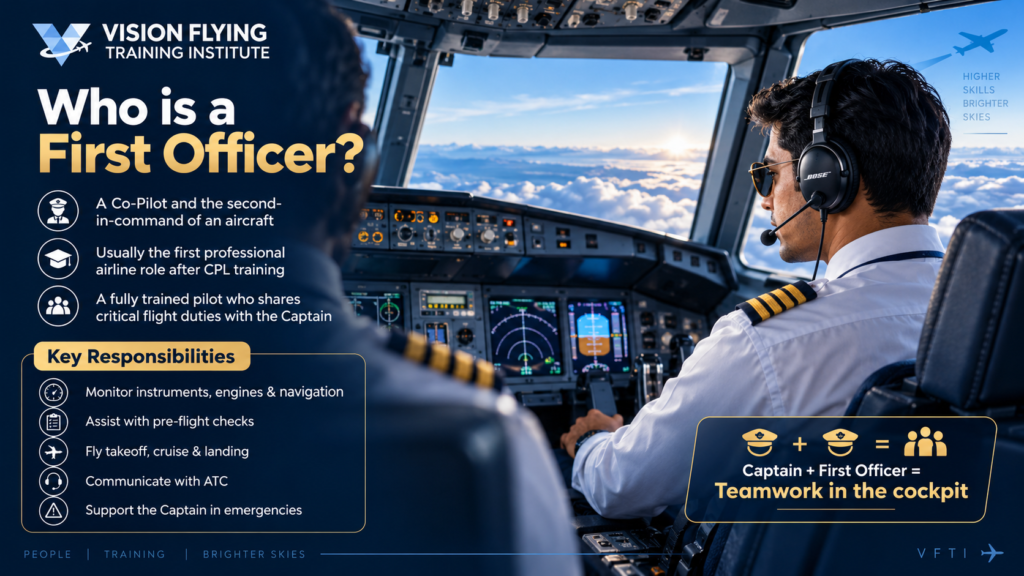
A First Officer, commonly called a Co-Pilot, is the second-in-command of an aircraft.
The First Officer role is usually the first professional airline position for pilots who have completed their Commercial Pilot Licence (CPL) training program and successfully met airline hiring criteria.
Although the Captain is the final authority onboard, a First Officer is not an assistant. A First Officer is a fully trained professional pilot who can operate the aircraft and perform critical flight duties.
Modern airline operations depend heavily on teamwork between the Captain and First Officer. Both pilots share flight responsibilities, monitor aircraft systems, communicate with Air Traffic Control (ATC), and follow strict aviation procedures.
Responsibilities of a First Officer
A First Officer works closely with the Captain to manage flight operations and maintain safe aircraft operations. The key responsibilities of a First Officer include:
- Monitoring flight operations by keeping track of aircraft instruments, engine performance, navigation systems, weather conditions, and flight parameters to identify and respond to any changes during the flight.
- Completing pre-flight checks by assisting the Captain with aircraft inspections, flight plan reviews, weather assessment, fuel calculations, and other required safety procedures before departure.
- Flying different stages of the journey, including takeoff, cruise, and landing, while following airline procedures and coordinating with the Captain.
- Communicating with Air Traffic Control (ATC) to exchange important flight information and maintain smooth coordination during all phases of the flight.
- Supporting the Captain during emergencies or unexpected situations by analysing available information, following checklists, monitoring aircraft systems, and contributing to safe decision-making.
Who is an Airline Captain?
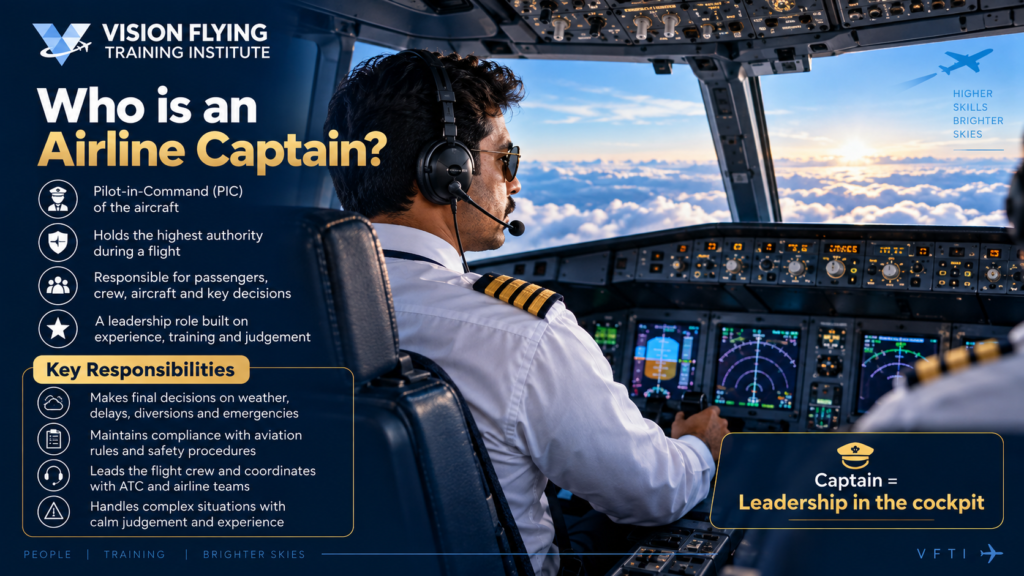
An airline Captain is the Pilot-in-Command (PIC) of the aircraft.
The Captain holds the highest level of authority during a flight and is ultimately responsible for the safety of passengers, crew members, aircraft, and operational decisions.
Becoming a Captain is one of the biggest achievements in a commercial pilot’s career because it represents years of experience, training, and professional development.
A Captain is not only an experienced pilot but also a leader responsible for managing the cockpit environment.
Responsibilities of an Airline Captain
An Airline Captain is the Pilot-in-Command (PIC) and holds the highest level of authority during a flight. The Captain’s key responsibilities include:
- Making final operational decisions related to weather conditions, flight safety, route changes, delays, diversions, and emergencies. For example, if weather conditions become unsafe, the Captain decides whether to continue the flight, delay departure, divert, or return to the airport.
- Maintaining compliance with aviation regulations and safety procedures by making sure all flight operations follow airline policies, regulatory requirements, and standard operating procedures.
- Leading the flight crew by coordinating with First Officers, cabin crew, Air Traffic Controllers, airline operations teams, and ground staff to maintain effective communication throughout the journey.
- Handling complex and unexpected situations such as severe weather, technical issues, operational challenges, and medical emergencies by using experience, training, and decision-making skills to manage situations calmly.
Difference in the Authority of a First Officer and a Captain
One of the biggest differences between these roles is decision-making authority.
A First Officer contributes to decisions, but the Captain has the final responsibility.
An aircraft cockpit relies on teamwork, with both pilots contributing their skills and experience to operate the flight safely.
- The First Officer supports flight operations, monitors aircraft systems, and works alongside the Captain in managing the flight.
- The Captain leads the cockpit crew, makes final operational decisions, and takes overall responsibility for the aircraft and everyone onboard.
However, aviation follows a principle called Crew Resource Management (CRM), where both pilots are encouraged to communicate openly and contribute their expertise.
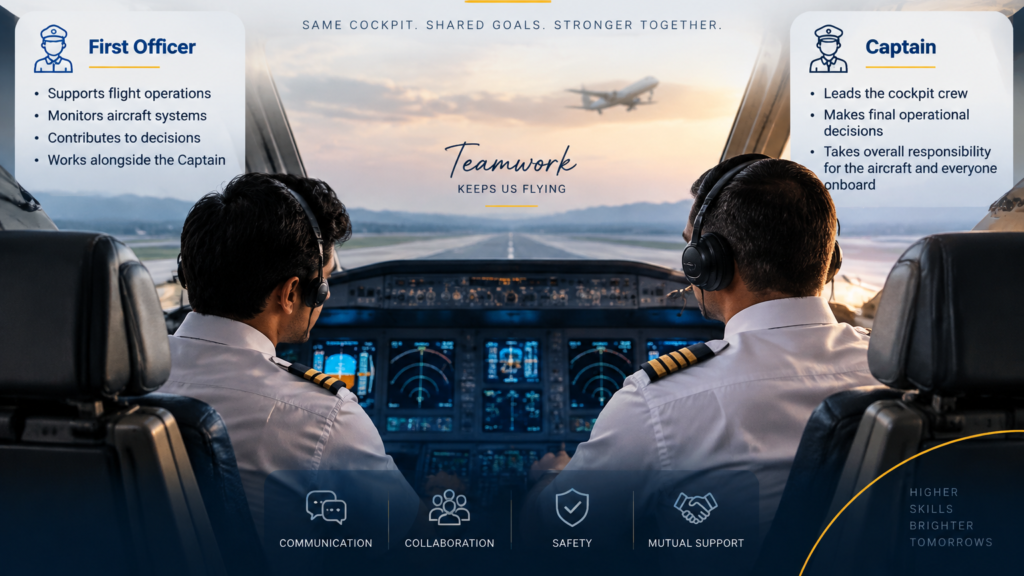
Safety in aviation is not based on one person making decisions alone. It depends on teamwork, communication, and mutual support.
First Officer vs Captain Salary in India
Salary of a pilot in India is one of the most searched topics among aviation students.
However, there is no fixed salary for all pilots because earnings depend on several factors, including:
- Airline company
- Aircraft type
- Flying hours
- Experience level
- Domestic or international operations
- Seniority
- Allowances and benefits
A pilot flying a narrow-body aircraft for domestic operations may have a different salary structure compared to a pilot operating international wide-body aircraft.
Average First Officer Salary in India
A First Officer’s salary generally increases with experience.
| Experience Level | Approximate Monthly Salary |
| Newly Joined First Officer | ₹1.5 lakh – ₹3 lakh/month |
| Experienced First Officer | ₹3 lakh – ₹5 lakh/month |
| Senior First Officer | ₹4 lakh – ₹6 lakh+/month |
Average Captain Salary in India
Captains earn higher salaries because they have:
- Greater responsibility
- More flight experience
- Command authority
- Additional training requirements
| Captain Level | Approximate Monthly Salary |
| Junior Captain | ₹6 lakh – ₹8 lakh/month |
| Experienced Captain | ₹8 lakh – ₹12 lakh/month |
| Senior/Wide-body Captain | ₹12 lakh+/month |
These figures are approximate and may change depending on airline policies, aircraft category, experience, and other compensation factors.
Why Does a Captain Earn More Than a First Officer?
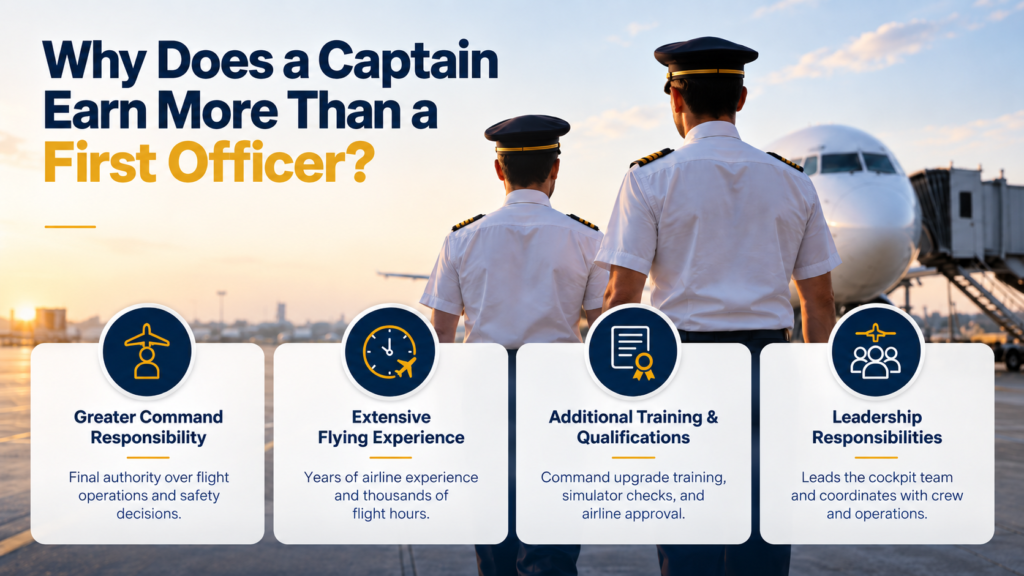
The difference in salary between a Captain and a First Officer comes from the level of responsibility, experience, and authority associated with each role.
- Greater Command Responsibility
A Captain is the Pilot-in-Command (PIC) and has the final authority over flight operations. The Captain makes critical decisions related to flight safety, weather conditions, route changes, and emergency situations.
- Extensive Flying Experience
Most Captains have several years of airline experience and thousands of flight hours. This experience helps them handle complex operational situations and make informed decisions.
- Additional Training and Qualifications
Before becoming a Captain, pilots must complete additional training, simulator assessments, and meet airline requirements for command upgrade.
- Leadership Responsibilities
A Captain leads the cockpit team and coordinates with First Officers, cabin crew, air traffic controllers, and ground teams to manage flight operations effectively.
How Does a First Officer Become a Captain?
Becoming an airline Captain is not an overnight achievement. It is the result of years of training, flying experience, professional development, and consistent performance.
Most pilots in India follow this career path:
Student Pilot → CPL Holder → Airline First Officer → Senior First Officer → ATPL Holder (Meeting Command Requirements) → Airline Captain
Each stage develops different skills required to operate commercial aircraft safely.
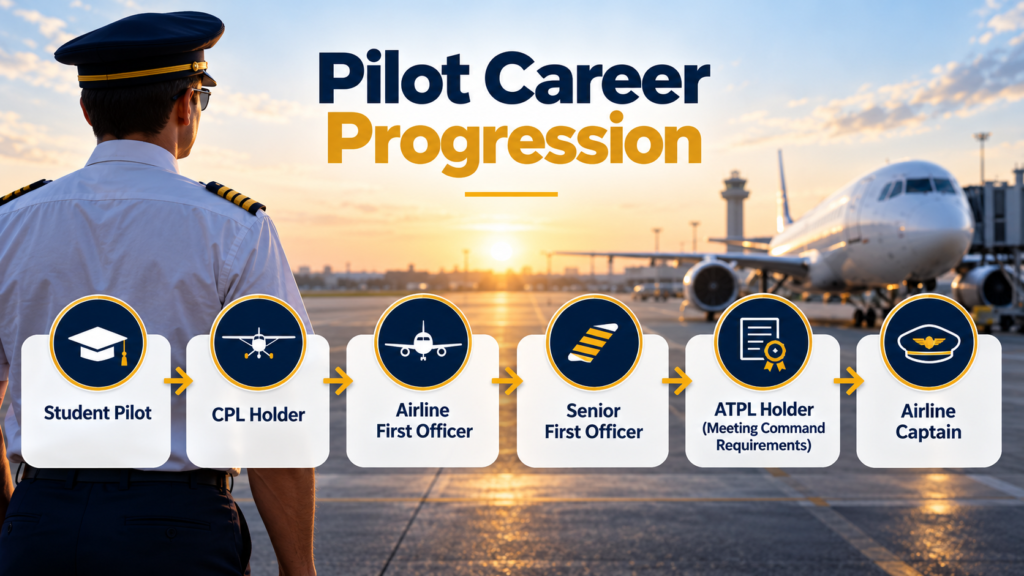
Pilot Career Path Towards Becoming an Airline Captain
Stage 1: Student Pilot
Every airline pilot begins their journey as a student pilot.
Understanding how to apply for pilot training in India is the first step for aspiring aviators who want to begin their journey as a Student Pilot.
During this stage, aspiring pilots learn the fundamentals of aviation through ground school and flight training.
After completing the required pilot training, examinations, flying hours, and medical requirements, students can progress toward obtaining their Commercial Pilot Licence (CPL).
Stage 2: Commercial Pilot Licence (CPL) Holder
A Commercial Pilot Licence (CPL) is the first major professional qualification required to begin a career as a commercial pilot.
After obtaining a CPL, pilots can apply for airline opportunities and continue preparing for professional operations.
At this stage, many pilots focus on:
- Completing aircraft type rating training
- Preparing for airline selection processes
- Improving aviation communication skills
- Building professional flying experience
A Commercial Pilot Licence provides the foundation for entering airline operations, but pilots must continue gaining experience before progressing to higher ranks.
Stage 3: First Officer (Entry-Level Airline Pilot)
After meeting airline hiring requirements and completing required training, pilots usually begin their airline career as First Officers.
A First Officer spends several years gaining experience before becoming eligible for command.
Stage 4: Senior First Officer
With additional flight experience and time in airline operations, pilots may progress to the role of Senior First Officer.
A Senior First Officer usually has:
- More flying experience
- Better aircraft knowledge
- Stronger operational understanding
- Greater confidence in handling complex situations
This stage prepares pilots for the responsibilities associated with aircraft command.
Stage 5: ATPL Qualification
The Airline Transport Pilot Licence (ATPL) is the highest level of pilot licence and an important qualification in the journey toward becoming an airline Captain.
Pilots generally work toward meeting ATPL requirements while gaining experience as airline First Officers.
To obtain an ATPL in India, pilots must meet DGCA requirements, which include:
- Holding a valid Commercial Pilot Licence (CPL)
- Completing the required flight experience
- Passing required examinations
- Meeting medical fitness standards
- Fulfilling regulatory requirements
The ATPL demonstrates that a pilot has developed the knowledge and experience required for advanced airline operations.
Stage 6: Airline Captain
After gaining sufficient experience, meeting airline requirements, completing command training, and fulfilling ATPL requirements, a pilot can progress to the position of Airline Captain.
Before upgrading a pilot to Captain, airlines assess factors such as:
- Flying experience
- Aircraft knowledge
- Simulator performance
- Decision-making ability
- Leadership skills
- Safety record
- Professional conduct
How Many Years Does It Take to Become a Captain?
There is no fixed timeline because every pilot’s journey is different.
The time required depends on:
- Airline growth
- Aircraft availability
- Pilot demand
- Flying opportunities
- Performance
- Regulatory requirements
Generally, many pilots may take approximately 6–8 years after joining an airline to upgrade from First Officer to Captain.
A possible career timeline:
| Career Stage | Approximate Duration |
| Flight Training | 1.5–2 years |
| CPL Completion | Depends on training progress |
| First Officer | Initial airline position |
| Senior First Officer | Around 3–5 years depending on airline |
| Captain Upgrade | Around 6–8 years depending on opportunities |
Some pilots may upgrade faster, while others may take longer depending on market conditions and airline policies.
First Officer vs Captain: Work Life and Responsibilities Compared
Commercial Pilot’s Salary is important, but aviation students should also understand the lifestyle difference between these two positions.
| Category | First Officer | Captain |
| Responsibility | Supports flight operations | Final responsibility for flight safety |
| Decision Pressure | Moderate | High |
| Leadership Role | Developing leadership skills | Leads cockpit operations |
| Experience Required | Early career | Extensive experience |
| Learning Focus | Building expertise | Applying expertise and mentoring others |
| Career Stage | Growth phase | Leadership phase |
Can a First Officer Earn the Same Salary as a Captain?
Generally, a First Officer earns less than a Captain because the Captain has greater responsibility and experience.
However, the salary gap may become smaller in certain situations, but reaching Captain rank usually provides the highest long-term earning potential in an airline pilot career.
Is Becoming an Airline Captain the Highest Position for a Pilot?
Becoming an Airline Captain is a major achievement in a pilot’s career. However, aviation careers do not end after reaching the Captain position. Experienced pilots can explore several high-paying job opportunities within the aviation industry.
Some career paths available to experienced pilots include:
Training Captain
Training Captains play an important role in developing the next generation of airline pilots. They use their operational experience to train and evaluate pilots through:
- Simulator training sessions
- Flight assessments
- Mentoring and guidance
Flight Instructor
Experienced pilots can choose to become Flight Instructors and share their knowledge with student pilots.
Aviation Examiner
Senior pilots with extensive experience may become authorised examiners who assess pilot performance and skills during training and proficiency checks.
Flight Operations Management
Some pilots move into aviation leadership and management roles where they contribute to areas such as:
- Airline operations
- Flight safety management
- Crew planning
- Operational strategy
Build Your Foundation for a Successful Pilot Career with Vision Flying Training Institute
Vision Flying Training Institute (VFTI) is one of the top DGCA-approved flying institutes in India. It provides aspiring pilots with the training, guidance, and support required to build a successful aviation career.
The institute helps students develop the knowledge, skills, and confidence required for professional flying through:
- Comprehensive aviation training
- Experienced guidance
- Industry-focused learning approach
- Career-oriented pilot preparation
A successful aviation career starts with the right training, commitment, and a willingness to keep learning and improving. Every airline Captain began their journey as a student pilot, gradually building knowledge, skills, and experience through proper training and practice.
With the right guidance and a strong foundation, aspiring pilots can take meaningful steps toward achieving their goal of becoming professional airline pilots.
Conclusion
The difference between a First Officer and a Captain is not limited to salary or rank. It reflects two important stages in a pilot’s professional journey.
A First Officer gains valuable flight experience, strengthens technical skills, and learns the complexities of airline operations. A Captain uses that experience to lead the cockpit team, make critical decisions, and take responsibility for safe flight operations.
Becoming an airline Captain requires dedication, patience, and continuous learning. With the right training and guidance, aspiring pilots in India can progress from a CPL student toward achieving their goal of becoming an airline Captain.
The left seat of the cockpit is not achieved overnight. It is earned through years of training, experience, discipline, and commitment to aviation.
Frequently Asked Questions (FAQs)
- What is the difference between a First Officer and a Captain?
A First Officer is the second-in-command pilot who supports flight operations, while a Captain is the Pilot-in-Command responsible for final decisions and overall aircraft safety.
- Who earns more, a First Officer or a Captain?
A Captain generally earns more than a First Officer because of greater responsibility, experience, and command authority.
- How much does a First Officer earn in India?
A First Officer in India may earn approximately ₹1.5 lakh to ₹6 lakh per month depending on airline, experience, aircraft type, and compensation structure.
- How much does an airline Captain earn in India?
An airline Captain in India may earn approximately ₹6 lakh to ₹12 lakh or more per month depending on experience, airline, aircraft type, and route operations.
- How long does it take to become an airline Captain?
Most pilots require several years of airline experience before becoming Captains. The timeline commonly ranges from around 6–8 years but varies based on airline requirements and opportunities.
- Can a CPL holder become an airline Captain?
Yes. A CPL holder can begin an airline career as a First Officer and progress toward Captain after gaining experience, completing required training, and meeting airline and regulatory requirements.