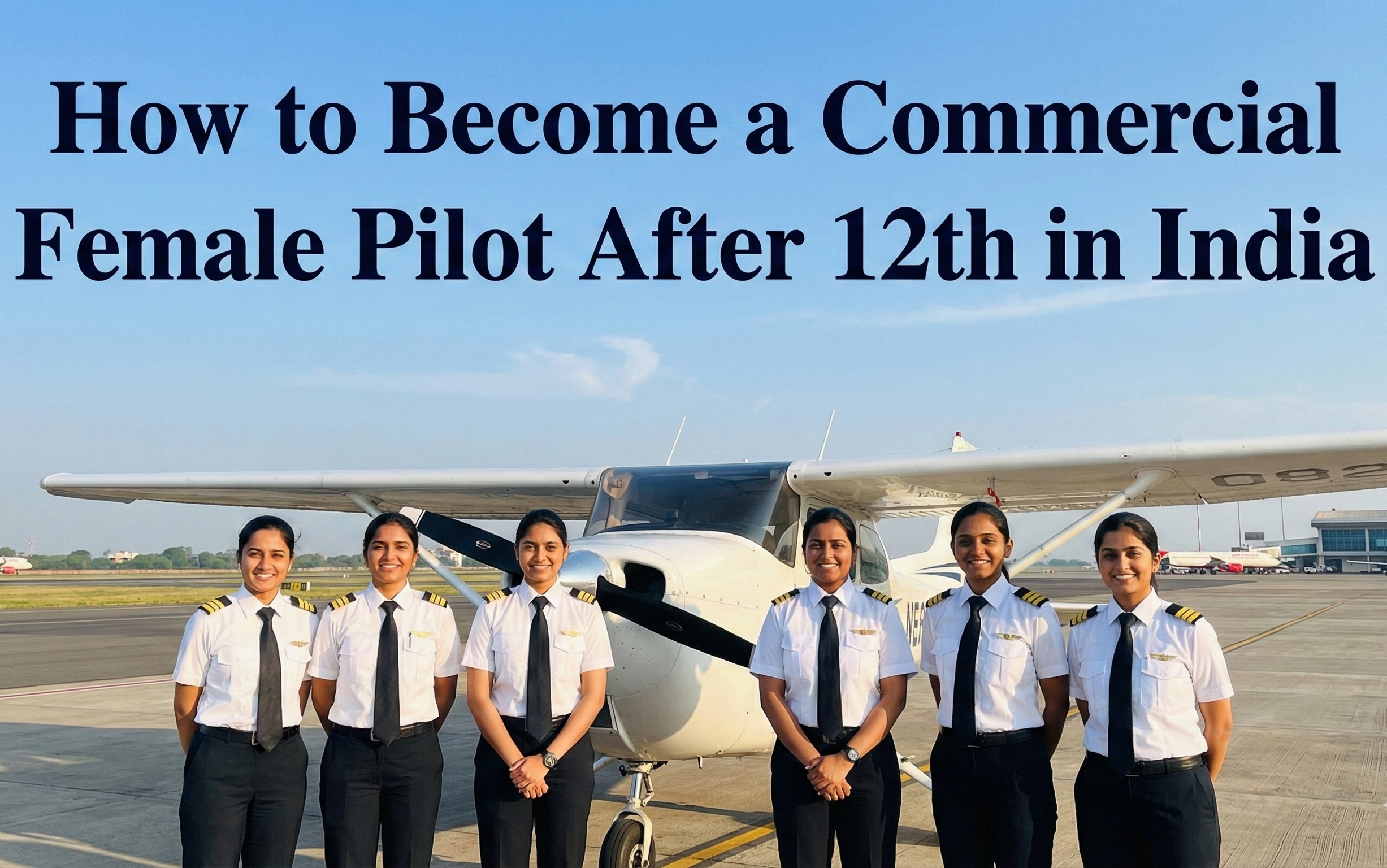
India has the highest proportion of female commercial pilots in the world. Women make up approximately 15% of India’s pilot workforce, compared to about 5% in the United States.
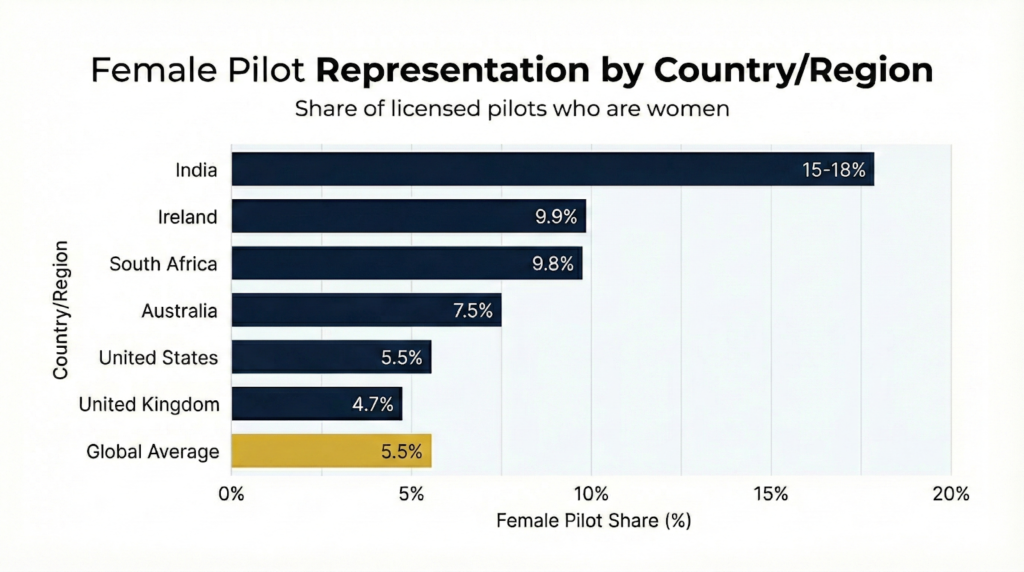
When you enter an airport briefing room, you won’t be the “only girl” there. You will be joining a workforce where women like Captain Zoya Agarwal, who flew over the North Pole have already normalized the idea that the cockpit belongs to anyone with skill.
Now, let us move past the inspiration and get to the hard work.
Becoming a pilot takes more than just being enthusiastic about aviation. It demands a strong grip on Physics and Mathematics, plus a clear understanding of different pilot licenses. It also demands consistent discipline, training at a top flying school, Vision Flying Training Institute (VFTI), and the ability to perform confidently in high-stress situations.
This blog is a practical roadmap for every female pilot aspirant. With institutes like Vision Flying Training Institute (VFTI), your path to becoming a pilot becomes clearer, more structured, and genuinely achievable.
What Are the Different Types of Pilot Licenses in India?
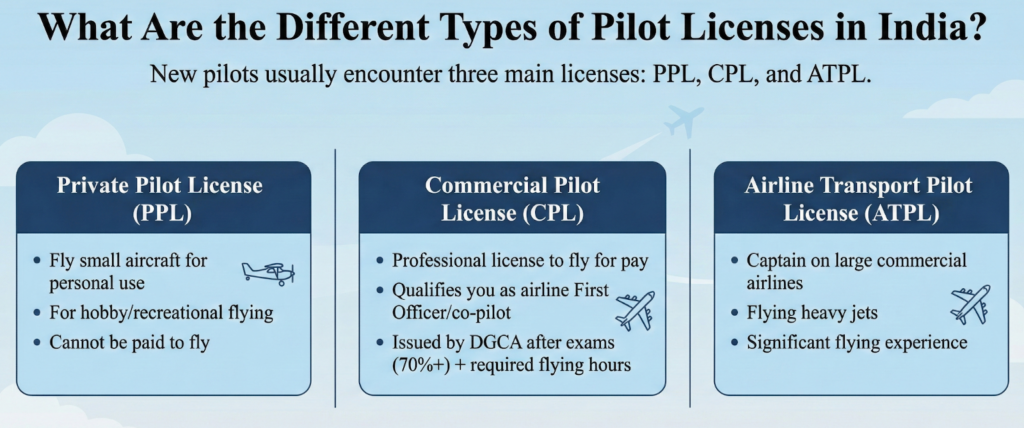
When starting out, you will hear terms like PPL, CPL, and ATPL. As a beginner, it can be difficult to understand what they mean and which one you need for a full-fledged career in aviation. We have explained each pilot license below.
- Private Pilot License (PPL)
A PPL allows you to fly small aircraft for personal hobby or sport, but not for commercial work. It’s often a first step for enthusiasts, you learn to fly and carry passengers, but you cannot earn a salary with a PPL.
- Commercial Pilot License (CPL)
The CPL is the professional license. With a CPL, you are allowed to fly aircraft and get paid as a first officer or co-pilot with an airline. This is the license every female pilot aspirant needs to become a commercial pilot in India.
The Directorate General of Civil Aviation (DGCA) issues the CPL once you meet all requirements, including passing exams with 70% and logging required flying hours.
- Airline Transport Pilot License (ATPL)
The ATPL is the highest level of pilot certification. It’s what you eventually obtain to become a Captain of an airliner or to fly large transport aircraft.
In India, you need to be at least 21 years old and have about 1,500 hours of flight experience among other criteria to get an ATPL.
Typically, female pilots first earn a CPL, then build experience and clear additional exams to achieve an ATPL.
After Class 12, every female pilot aspirant’s immediate goal should be to obtain a CPL. The CPL will launch your career as a commercial pilot, after which you can work toward an ATPL as you gain experience.
Eligibility Criteria After 12th for Commercial Pilot Training for Women in India
Before you can start pilot training, you must meet certain eligibility requirements set by the DGCA and flying schools:
- Educational Qualifications: You must have completed 10+2 (Class XII) with Physics and Mathematics as core subjects. Good flying schools such as Vision Flying Training Institute typically require a minimum of 50–60% marks in these subjects.
If you did not have Physics or Math in 12th (for example, you were a Commerce or Arts student), you can qualify by passing these subjects via NIOS (National Institute of Open Schooling) or a recognised equivalent.
You can also read our detailed blog for complete guidance on “How a Commerce Student Can Become a Pilot Without Physics”.
English proficiency is also important, as all training and communication are in English.
- Age Requirement: The minimum age to start pilot training is 17 years, and you must be 18 years old to receive a Commercial Pilot License. There is no upper age limit to train, but airlines typically retire pilots by age 65.
- Medical Fitness: You must obtain a DGCA Class 2 Medical certificate to begin your flying training. This involves an examination by a DGCA-approved medical examiner to check your eyesight, hearing, cardiovascular fitness, and overall health.
Once you start training or approach your first solo flight, you will also need to get a Class 1 Medical certificate, which is required for acting as a commercial pilot.
- Nationality: You should be an Indian citizen for flying in India. Foreign nationals have separate procedures.
- Background Check: Expect to provide a police clearance or background check when applying for licenses, as aviation authorities make sure candidates have no disqualifying history.
The path is open regardless of gender. In fact, being a female pilot in India can be an advantage given the industry’s supportive stance on diversity
Process for Females to Obtain a Commercial Pilot License (CPL) After Class 12
Becoming a commercial pilot involves several stages. Below is a step-by-step roadmap to go from 12th pass to licensed CPL holder:
- Finish 10+2 with Required Subjects: Make sure you have Physics and Math in Class XII or complete them via NIOS if needed. Without these, you cannot get a CPL.
- Apply for a DGCA Computer Number: This is an ID issued by DGCA that registers you as a candidate for pilot exams. You apply through the DGCA Pariksha portal online. It’s basically your exam registration number for all DGCA theory exams.
- Obtain Your Class 2 Medical Certificate: Find a DGCA-approved medical examiner and get your Class II Medical done early. Once you pass, you will receive a file number. With that, apply for a Class 1 Medical appointment. You can even begin ground classes while your Class 1 is in process. You will need Class 1 before you can exercise the privileges of a CPL.
- Enroll in a DGCA-Approved Flying School: It’s crucial to train at a DGCA-approved Flying Training Organization (FTO). Schools like Vision Flying Training Institute (VFTI) are approved FTOs, meaning DGCA recognizes their training. Enroll in a Commercial Pilot License course.
- Ground School and DGCA Exams: Ground school is where you learn the theoretical subjects required for pilots. These include Air Regulations, Aviation Meteorology, Air Navigation, Technical General, Technical Specific (aircraft and engines), and Radio Telephony. The DGCA exams are held quarterly. You need at least 70% to pass each subject.
- Flight Training (200 Hours): Alongside or after passing your written exams, you will undergo flight training with instructor pilots. DGCA mandates a minimum of 200 hours of flight time for a CPL. Those 200 hours will include:
- 100 hours as Pilot-in-Command (solo flying) where you are the sole occupant controlling the aircraft.
- 50 hours of cross-country flying to multiple airports independently as the pilot.
- 40 hours of instrument flying to learn how to fly in low visibility, with up to 20 hours allowed on an approved simulator.
- 10 hours of night flying to get comfortable with night take-offs and landings.
- 10 hours on multi-engine aircraft. This is required to fly planes with more than one engine and is highly recommended for airline aspirants.
- You will start with dual flights with an instructor, progress to solo flights once proficient, do navigation sorties, and gradually fulfill each of these requirements. This phase typically takes 12–18 months depending on weather and aircraft availability. At VFTI’s base in Gujarat, one big advantage is 365 days of flyable weather and uncongested airspace, which helps students log hours consistently without long delays.
- Clear the Flying Skill Tests: When you complete your flying hours and pass the written exams, you will undergo practical skill tests. DGCA examiners will test you on general flying skills, instrument flying, and navigation in an aircraft. These checks make sure you can safely handle the aircraft and procedures.
- License Issuance: Submit all required documents such as logbook, exam results, medicals, etc. to DGCA for license issuance. Within a few weeks, you will receive your Commercial Pilot License.
- Type Rating and Further Training: A Type Rating is specialized training for the specific aircraft e.g., Boeing 737 or Airbus A320 that you will fly in an airline job. After CPL, many pilots enroll in type rating courses. Meanwhile, you can also build experience by working as a junior pilot or flight instructor.
- Upgrade to ATPL: Once you accumulate 1,500+ hours and meet the required flying experience criteria, you can apply for an ATPL. When you meet all the requirements, DGCA will grant you an ATPL.
However, this step comes later in your career. Many pilots earn their ATPL in their late 20s or 30s when they are ready to command an aircraft.
Many before you have followed these steps successfully. With determination, you can too!
Government Schemes & Scholarships for Women Pilot Aspirants in India
There are government-backed schemes and scholarships that can help women pilot aspirants in India fund their journey.
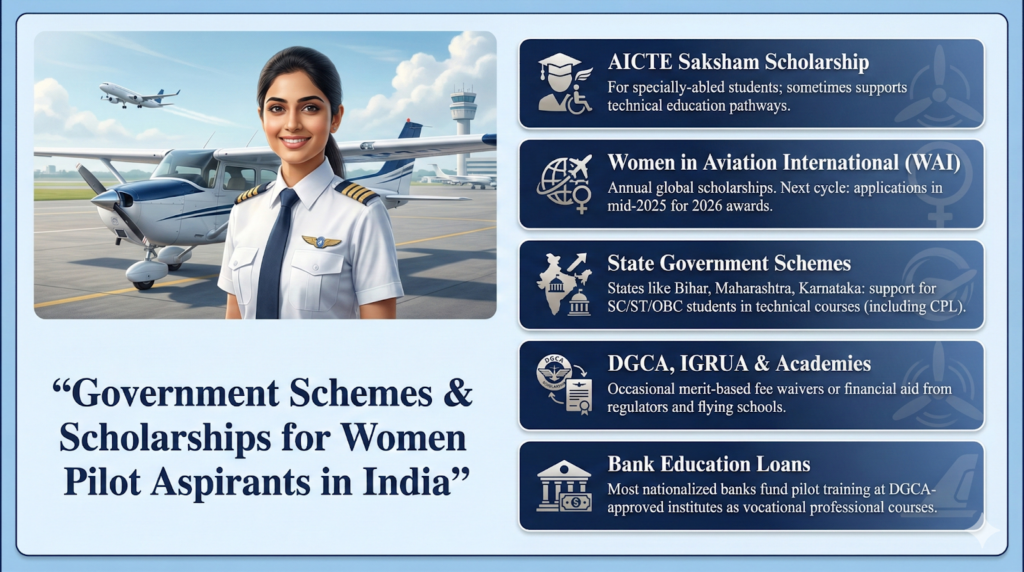
- AICTE Saksham Scholarship: Specifically for specially-abled students, but often has broader technical education overlaps.
- Women in Aviation International (WAI) Scholarships: WAI offers substantial scholarships annually. The application cycle usually opens in mid-2025 for the 2026 awards.
- State Government Schemes: States like Bihar, Maharashtra, and Karnataka often have scholarship schemes for SC/ST/OBC students pursuing technical courses like CPL.
- DGCA, IGRUA, and private academies occasionally offer merit-based financial aid.
- Bank Loans: Since pilot training is a vocational professional course, most nationalized banks offer education loans for DGCA-approved institutes
Advantages of Being a Female Pilot in India
Choosing to become a pilot is a bold and exciting move for anyone, especially as a woman in India. Here are some benefits and encouraging facts for female pilots in India:
- Airlines in India are expanding rapidly, creating a high demand for pilots. IndiGo, Air India, and others are expected to hire thousands of pilots in the coming years. This demand means that if you train well and perform consistently, you have a strong chance of landing a great job.
- Both government bodies and private organizations are encouraging female aviators. The Indian Air Force started inducting women as pilots decades ago, and today women even fly fighter jets. State governments like Haryana have, at times, subsidized pilot training for female cadets, and some companies have also offered full scholarships to women for pilot training.
- India has no shortage of inspiring female pilot role models, such as Captain Nivedita Bhasin, who became the world’s youngest female airline captain in 1989. Many are active on social media or training organizations and are ready to mentor the next generation.
With passion and perseverance, becoming a female pilot in India can be a highly rewarding career both financially and personally.
Career Opportunities for Female Pilots After Getting a CPL
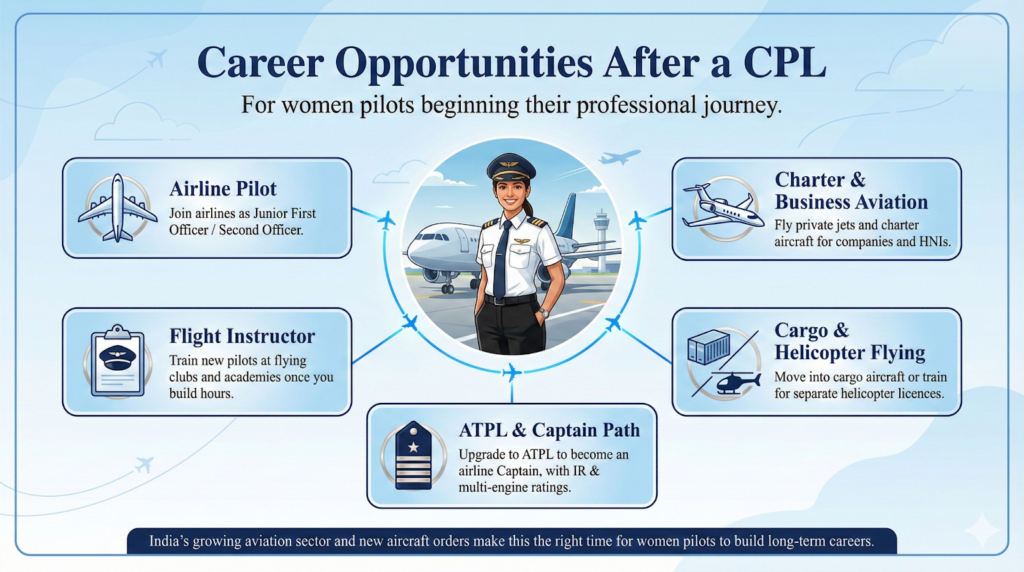
The moment you complete your CPL, you become eligible for a variety of pilot career routes.
Airline Pilot: This is the most popular route. With a CPL, you can join an airline as a Junior First Officer or Second Officer.
Charter and Business Aviation: With a CPL, you can also fly private charter aircraft or business jets. Many companies, high-net-worth individuals, and charter operators hire pilots to fly aircraft such as Cessna Citations and Bombardier Challengers. These roles can be quite lucrative and may offer more flexible schedules than airline jobs.
Flight Instructor: Some CPL holders choose to become instructors at flying clubs or academies. As a young female instructor, you can become a role model for other girls entering the field. Once you cross around 750 hours and meet DGCA criteria, you can qualify as a Grade I or Grade II instructor.
Cargo and Helicopter Pilot: With further training or conversion, pilots can fly cargo aircraft or train for helicopter licences. Since helicopters require a separate licence, this is a great option if rotorcraft interest you.
Airline Transport Pilot Licence (ATPL) and Beyond: Over time, you will take the ATPL exams and upgrade your licence. An ATPL is needed to captain commercial flights. Many pilots also pursue an Instrument Rating and Multi-Engine Rating to expand the types of aircraft they can fly and the conditions they can operate in. Some even go abroad for advanced training or pursue certifications such as a Federal Aviation Administration (FAA) licence if they plan to work internationally.
Career growth in aviation is significant. India, especially, is full of opportunities now. With new airlines launching and existing carriers ordering hundreds of aircraft, the future looks very promising for aspiring pilots.
Conclusion
The Indian aviation market is booming. But airlines do not just want license holders; they want skilled female aviators.
Vision Flying Training Institute does not just sell you flying hours. We train you to survive and grow in the airline world.
We respect the investment your family is making, and we match it with transparency and training rigour.
Visit us at Amreli or our Delhi office. Talk to our instructors.
Call our Admission Desk: +91-9319193602 / +91-9319193605
Email: enquiry@vfti.in