The Directorate General of Civil Aviation (DGCA) conducts pilot license exams for the Private Pilot License (PPL), Commercial Pilot License (CPL), and Airline Transport Pilot License (ATPL). Its flight crew examination system also covers other categories under the same portal.
The DGCA exam journey is not just about one license. It is a step-by-step process that builds your knowledge from the basic level to the professional level.
We will explain the DGCA exam syllabus and subjects so you can clearly understand what to study, how the papers are structured, and how to prepare smartly for your pilot career in India.
What is the DGCA Exam?
The DGCA exam refers to the set of Commercial Pilot License (CPL) ground theory examinations conducted by the Directorate General of Civil Aviation (DGCA), which operates under the Ministry of Civil Aviation, Government of India.
These exams test whether a student pilot has mastered the theoretical knowledge required for safe flight operations. Every pilot who wants to fly commercially in India must clear these exams.
| Detail | Information |
| Conducted by | DGCA, Ministry of Civil Aviation, Government of India |
| Mode | Computer-Based Test (CBT) – Online MCQ format |
| Exam Portal | Pariksha DGCA Portal (pariksha.dgca.gov.in) |
| Eligibility | Class 12 with Physics & Mathematics + DGCA Medical Clearance |
| Passing Marks | 70% in each subject |
| Negative Marking | None |
| Exam Frequency | 4 times a year (Quarterly) |
| Result Validity | 5 years from date of first pass |
Who Needs to Clear the DGCA Exam?
- Students pursuing a Commercial Pilot License (CPL) in India
- Students who trained abroad and are converting their foreign license to a DGCA license
- Students pursuing a Private Pilot License (PPL)
In short, if you want to fly legally and professionally in Indian airspace, you need to clear the DGCA exam as it is non-negotiable.
After clearing the DGCA exams and meeting other requirements, such as completing 200 hours of flight training, you become eligible for a commercial pilot license.
Registration Process for DGCA Exam
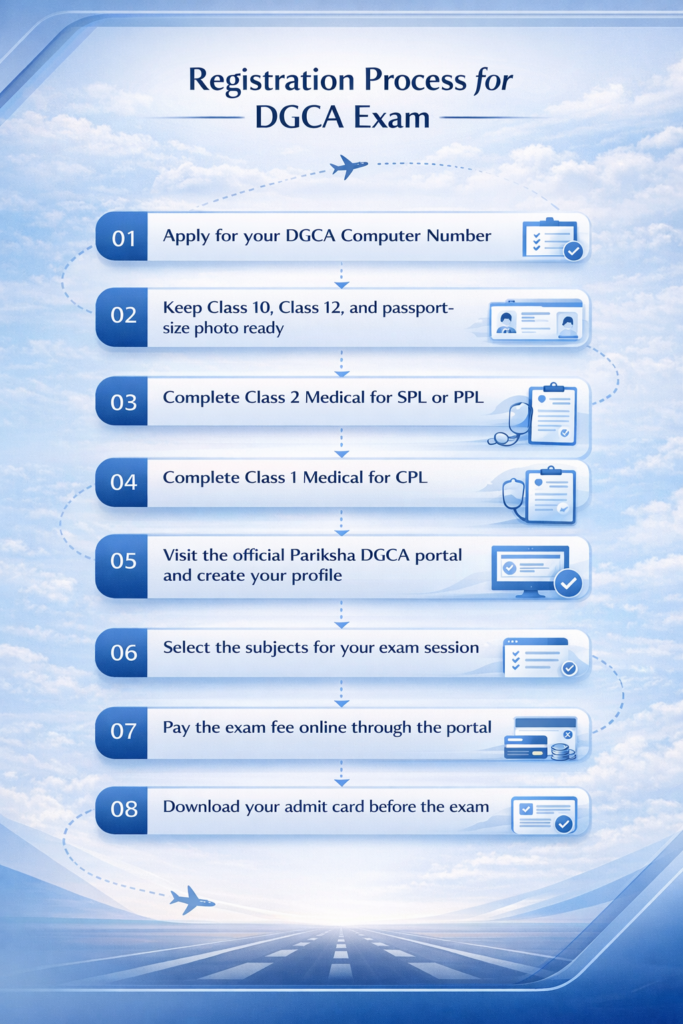
The entire registration process is done online through the Pariksha portal of the Directorate General of Civil Aviation (DGCA).
Here is a simple step-by-step breakdown:
- Start by applying for your computer number on the eGCA portal. You will usually need your Class 10 certificate, Class 12 certificate, and a recent passport-size photograph.
- If you are applying for a Student Pilot License (SPL) or a Private Pilot License (PPL), you will need a Class 2 Medical. If you are preparing for a Commercial Pilot License (CPL), you must complete a Class 1 Medical. This pilot medical test in India must be done through a DGCA-approved Aviation Medical Examiner (AME).
- Once your documents are ready, go to the official Pariksha DGCA portal to create your candidate profile.
- Choose the subjects you want to appear for in that particular exam session, based on your preparation.
- Pay the exam fee through the portal. The fee is usually around ₹2,500 per subject, but you should always check the latest amount on the portal before making the payment.
- Before the exam window begins, your admit card will be made available on the portal. Download it in time and keep it ready for the exam.
Eligibility Criteria for DGCA CPL Ground Exams
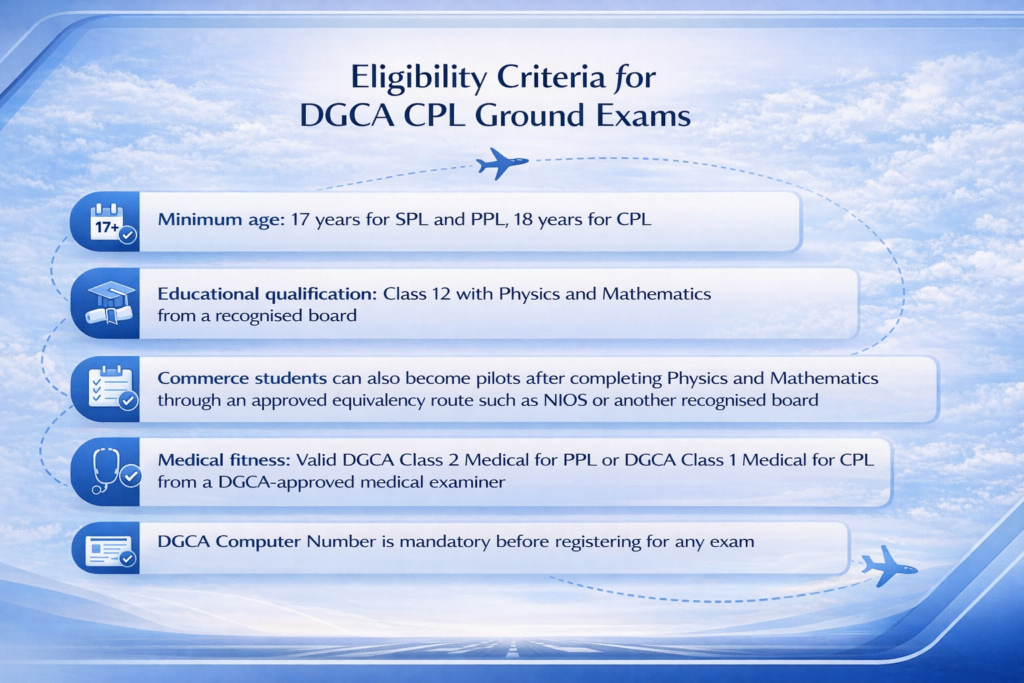
Before you appear for the DGCA theory exams, you need to meet the following basic requirements:
Age: Minimum 17 years for SPL/PPL; minimum 18 years for CPL
Educational Qualification: Class 12 (10+2) with Physics and Mathematics as compulsory subjects from a recognised board
A commerce student can also become a pilot in India. However, before applying, they must first complete Physics and Mathematics through an approved equivalency route, such as the National Institute of Open Schooling (NIOS) or another recognized board.
Medical Fitness: Valid DGCA Class 2 Medical (for PPL) or DGCA Class 1 Medical (for CPL) issued by a DGCA-approved medical examiner
Apply for a DGCA Computer Number: A unique identification number allotted by DGCA upon registration on the eGCA portal. This is mandatory before registering for any exam
DGCA Exam Subjects for Pilot
The core subjects are the same for both PPL and CPL. However, CPL exams are more detailed, go deeper into each topic, and have a higher number of questions in subjects like Navigation and Technical General. The depth of knowledge tested at CPL level is significantly greater than at PPL level.
| Subject | Questions | Duration | Pass Mark |
| Air Navigation | ~100 | 3 hours | 70% |
| Aviation Meteorology | ~50 | 2 hours | 70% |
| Air Regulations | ~50 | 2 hours | 70% |
| Technical General | ~100 | 3 hours | 70% |
| Technical Specific | ~50 | 2 hours | 70% |
| RTR(A) | Practical + Oral | Variable | Pass/Fail |
Detailed DGCA Exam Syllabus for all Subjects
When you want to obtain a Commercial Pilot Licence in India, you must clear six theory subjects along with the RTR(A) communication exam.
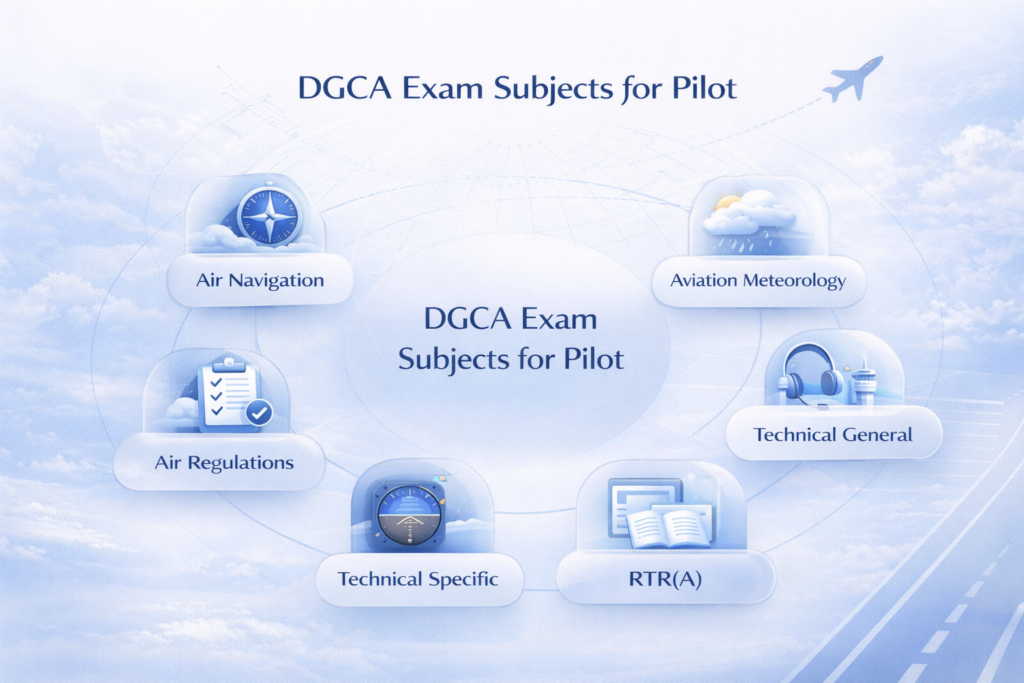
Here is each subject in complete detail.
Subject 1: Air Navigation
Air Navigation is widely considered the most challenging and the most important subject in the DGCA exam syllabus. It tests your ability to plan and execute flights accurately using both mathematical and instrument-based methods.
Key Topics Covered:
- Latitude, longitude, and the shape of the Earth
- Time calculations: UTC, IST, and Local Mean Time (LMT)
- Great circle and rhumb line navigation
- Compass deviation, variation, and magnetic heading
- Dead Reckoning (DR) navigation
- Radio navigation aids: VOR, DME, ADF, ILS, and GPS principles
- Position fixing and track monitoring
- ETA and ETD calculations
- Fuel planning and consumption calculations
- Performance-Based Navigation (PBN)
- Flight planning and flight monitoring
- Aviation maps and chart reading (Jeppesen charts, topographic charts)
- Use of the CX-3 flight computer (allowed in exam)
| Detail | Information |
| Number of Questions | ~100 MCQs |
| Duration | 3 hours |
| Passing Marks | 70% |
| Calculator Allowed | Yes, CX-3 and Scientific Calculator |
| Negative Marking | None |
| Recommended Books | RK Bali (Air Navigation), Oxford Navigation, Keith Williams |
Subject 2: Aviation Meteorology
Aviation Meteorology covers everything about weather that affects flight safety. This is a subject where concepts matter more than rote memorization.
Key Topics Covered:
- Structure and composition of the atmosphere
- Pressure, temperature, and density relationships
- Wind systems: local winds, global circulation, and jet streams
- Cloud types, cloud formation, and classification (ICAO cloud codes)
- Stability and instability of the atmosphere
- Frontal systems: warm front, cold front, occluded front
- Thunderstorms: formation, development, and avoidance
- Icing conditions and their effect on aircraft performance
- Fog types: radiation fog, advection fog, and sea fog
- Turbulence: causes, types, and reporting
- Reading and interpreting METARs, TAFs, SIGMETs, AIRMETs
- Significant weather charts (SIGWX) and upper-air charts
- VOLMET broadcasts and weather decision-making for flight planning
| Detail | Information |
| Number of Questions | ~50 MCQs |
| Duration | 2 hours |
| Passing Marks | 70% |
| Calculator Allowed | No |
| Negative Marking | None |
| Recommended Books | I.C. Joshi (Aviation Meteorology), Oxford Meteorology |
Subject 3: Air Regulations
Air Regulations is the legal framework of aviation in India. It covers the laws, rules, and procedures that govern how pilots, aircraft, and airways operate.
Key Topics Covered:
- Chicago Convention and ICAO Annexes
- Aircraft Act, 1934 and Aircraft Rules, 1937 (Indian aviation law)
- Civil Aviation Requirements (CARs) issued by DGCA
- Rules of the Air (ICAO Annex 2)
- Airspace classifications in India (Class A to Class G)
- Pilot licensing requirements and privileges
- Flight crew duties and responsibilities
- Air Traffic Services (ATC procedures)
- Search and Rescue (SAR) operations
- Aircraft registration and airworthiness
- Flight operations requirements
- Emergency procedures under ICAO standards
- Enforcement procedures and penalties
| Detail | Information |
| Number of Questions | ~50 MCQs |
| Duration | 2 hours |
| Passing Marks | 70% |
| Calculator Allowed | No |
| Negative Marking | None |
| Recommended Books | RK Bali (Air Regulations), DGCA Civil Aviation Requirements (CARs) |
Subject 4: Technical General
Technical General is an aircraft engineering subject. It covers the design, systems, and working principles of aircraft in general and not specific to any single aircraft type.
Key Topics Covered:
- Principles of aerodynamics: lift, drag, thrust, and weight
- Aerofoil theory and the effect of flaps and slats
- Stability and control: longitudinal, lateral, and directional stability
- Aircraft structures and materials (stress, strain, fatigue)
- Piston engines: four-stroke cycle, carburetion, ignition, and supercharging
- Turbine/jet engines: types, components, thrust calculation
- Propellers: fixed pitch, variable pitch, constant speed
- Fuel systems: types, fuel grades, and contamination
- Electrical systems: AC and DC systems, batteries, generators
- Hydraulic systems: pumps, actuators, and circuits
- Environmental control systems: pressurisation and air conditioning
- Flight instruments: pitot-static, gyroscopic, and magnetic instruments
- Avionics: FMS, autopilot systems, GPWS, TCAS (basic overview)
- Aircraft performance: V-speeds, stall, load factor, and weight & balance
| Detail | Information |
| Number of Questions | ~100 MCQs |
| Duration | 3 hours |
| Passing Marks | 70% |
| Calculator Allowed | Yes, Scientific Calculator |
| Negative Marking | None |
| Recommended Books | Oxford (Airframes & Systems, Electrics, Powerplant) |
Subject 5: Technical Specific
Unlike the other subjects, Technical Specific is based directly on the aircraft type you flew during your CPL training. If you are trained on a Cessna 172 or a Tecnam P Mentor, your exam will cover that aircraft’s systems, limitations, and procedures.
Key Topics Covered:
- Aircraft-specific systems and their operation
- Operating limitations (Vne, Vno, Vs, Vfe, etc.)
- Weight and balance calculations specific to the aircraft
- Fuel system specifics and usable/unusable fuel
- Emergency procedures as per the Pilot Operating Handbook (POH)
- Performance charts: takeoff distance, climb, cruise, and landing
- Avionics fitted in the aircraft
- Normal and abnormal checklists
| Detail | Information |
| Number of Questions | ~50 MCQs |
| Duration | 2 hours |
| Passing Marks | 70% |
| Calculator Allowed | Yes, Scientific Calculator |
| Negative Marking | None |
| Key Study Material | POH/AFM of your training aircraft + ground school modules |
Subject 6: RTR(A) – Radio Telephony Restricted (Aeromobile)
The RTR(A) is conducted by the DGCA. It certifies that you can legally operate aircraft radio equipment. Every pilot in India must hold this certificate.
Key Topics Covered:
- ICAO standard aviation phraseology
- RT procedures for taxi, takeoff, en-route, and landing
- Emergency RT procedures: MAYDAY, PAN-PAN calls
- Communication failure procedures (NORDO)
- Distress and urgency signals
- Use of ATC frequencies: ATIS, Ground, Tower, Approach, Departure, Centre
- VHF and HF communication principles
- Position reporting procedures
The RTR(A) exam has two parts:
Part 1 – Written/Oral: Tests knowledge of RT procedures and phraseology
Part 2 – Practical: Mock RT communication with ATC, including emergency scenarios
How are the DGCA Exams Conducted?
All DGCA theory exams are now conducted in an online Computer-Based Test (CBT) format through the official Pariksha DGCA portal.
- All questions are multiple-choice questions (MCQs) with four options
- Only one answer is correct per question
- There is no negative marking
- Results for CBT exams are displayed on-screen immediately after submission
- Exam centres are located across major cities: Delhi, Mumbai, Bengaluru, Chennai, Kolkata, and Hyderabad
DGCA Exam Fees
| Subject | Approximate Fee |
| Air Navigation | ₹2,500 |
| Aviation Meteorology | ₹2,500 |
| Air Regulations | ₹2,500 |
| Technical General | ₹2,500 |
| Technical Specific | ₹2,500 |
* Fees are subject to revision. Always verify current fees on the official Pariksha DGCA portal.
Best Books for DGCA CPL Ground Exams
Pilot students should always begin with the official study material listed on the Pariksha DGCA portal. The portal provides a subject-wise list of reference books and study resources for the Private Pilot License (PPL), Commercial Pilot License (CPL), and Airline Transport Pilot License (ATPL) exams. Candidates should study the relevant topics according to the syllabus prescribed in the Civil Aviation Requirements (CAR) for the specific pilot license examination they plan to appear for.
Click here for the portal link.
How VFTI Prepares you for the DGCA Exam
Vision Flying Training Institute (VFTI) does not just train you to fly an aircraft. We prepare you to understand aviation from the ground up. VFTI is among the top 10 DGCA-approved Flying Training Organizations (FTOs) located in Amreli, Gujarat, with an admission and ground school office in Dwarka, New Delhi.
We bring both academic rigor and practical aviation expertise to our students.
Expert Ground Instructors: Our instructors teach each DGCA subject with clarity, connecting theoretical concepts to real flying situations so the knowledge stays with you long after the exam.
Structured Syllabus Mapping: Our ground school program is mapped to the full DGCA exam syllabus, with dedicated sessions for each subject and regular topic-wise assessments.
Integrated Training: Your ground school happens alongside your actual flight training at VFTI. Flying the Cessna 172 SkyHawk or Tecnam P2008 JC reinforces what you learn in ground school, particularly for Technical Specific and Navigation.
Modern Fleet: Students train on a well-maintained fleet including the Tecnam P2008 JC, Cessna 172 SkyHawk, and Tecnam P-Mentor, all maintained by our own CAR 145-approved in-house MRO facility.
365-Day Flying Weather: Our Amreli, Gujarat base offers near year-round flyable weather, which means you complete your flying hours faster and face fewer training delays. This gives a significant advantage over many other FTOs in India.
Complete support from DGCA medical assistance and eGCA registration to exam preparation and career counseling, we guide you at every step.
Conclusion
The DGCA exam syllabus covers six subjects that form the complete theoretical foundation of a pilot’s knowledge in India. Each subject serves a specific purpose in making you a competent professional pilot.
These exams are challenging, but they are absolutely manageable with the right preparation. Understand the syllabus, join a structured ground school, practice mock tests, and stay consistent.
If you are ready to take that first step, Vision Flying Training Institute is ready to guide you from your first ground class to your CPL and beyond.
Frequently Asked Questions (FAQs)
Q1. How many subjects are there in the DGCA CPL exam?
There are 5 core theory subjects: Air Navigation, Aviation Meteorology, Air Regulations, Technical General, and Technical Specific, plus the RTR(A) exam. All six must be cleared to obtain a CPL in India.
Q2. What are the passing marks for DGCA exams?
A minimum of 70% in each subject is required to pass the DGCA theory exams. There is no negative marking.
Q3. Can I appear for DGCA exams without Class 12 Physics and Mathematics?
No. Physics and Mathematics are mandatory subjects in Class 12 for appearing in the DGCA CPL theory exams. Students from non-Science backgrounds must clear an equivalency examination first.
Q4. How many times is the DGCA exam conducted in a year?
The exam is conducted 4 times a year (quarterly). Dates are published on the Pariksha DGCA portal (pariksha.dgca.gov.in).
Q5. How long are DGCA exam results valid?
Passed subject results are valid for 5 years from the date you cleared your first subject. You must obtain your CPL license within this period.
Q6. Is there a limit on DGCA exam attempts?
No. There is no limit on the number of attempts for any DGCA theory subject.
Q7. Can I appear for DGCA exams before completing flying hours?
Yes. Many students begin appearing for DGCA theory exams while simultaneously doing their flying training. In fact, appearing for theory exams early is a common and recommended approach.
Q8. Where can I find the official DGCA exam syllabus?
The official syllabus, exam schedule, and study material guidelines are published on the DGCA website (dgca.gov.in) and the Pariksha portal (pariksha.dgca.gov.in).
Q9. What is a DGCA Computer Number and how do I get it?
A DGCA Computer Number is a unique identification number that DGCA assigns to every pilot applicant. You apply for it through the eGCA portal (egca.dgca.gov.in) with your educational and medical documents.
Q10. Does clearing DGCA exams guarantee a pilot job?
No. Clearing DGCA exams is one step in a multi-stage process. You also need 200 flying hours, a valid Class 1 Medical, a DGCA CPL, and successful completion of airline selection processes.