Tag: dgca exam

  • DGCA Syllabus & Subjects for Pilot Training in India

    DGCA Syllabus & Subjects for Pilot Training in India

    The Directorate General of Civil Aviation (DGCA) conducts pilot license exams for the Private Pilot License (PPL), Commercial Pilot License (CPL), and Airline Transport Pilot License (ATPL). Its flight crew examination system also covers other categories under the same portal. 

    The DGCA exam journey is not just about one license. It is a step-by-step process that builds your knowledge from the basic level to the professional level. 

    We will explain the DGCA exam syllabus and subjects so you can clearly understand what to study, how the papers are structured, and how to prepare smartly for your pilot career in India.

    What is the DGCA Exam?

    The DGCA exam refers to the set of Commercial Pilot License (CPL) ground theory examinations conducted by the Directorate General of Civil Aviation (DGCA), which operates under the Ministry of Civil Aviation, Government of India.

    These exams test whether a student pilot has mastered the theoretical knowledge required for safe flight operations. Every pilot who wants to fly commercially in India must clear these exams.

    DetailInformation
    Conducted byDGCA, Ministry of Civil Aviation, Government of India
    ModeComputer-Based Test (CBT) – Online MCQ format
    Exam PortalPariksha DGCA Portal (pariksha.dgca.gov.in)
    EligibilityClass 12 with Physics & Mathematics + DGCA Medical Clearance
    Passing Marks70% in each subject
    Negative MarkingNone
    Exam Frequency4 times a year (Quarterly)
    Result Validity5 years from date of first pass

    Who Needs to Clear the DGCA Exam?

    • Students pursuing a Commercial Pilot License (CPL) in India
    • Students who trained abroad and are converting their foreign license to a DGCA license
    • Students pursuing a Private Pilot License (PPL)

    In short, if you want to fly legally and professionally in Indian airspace, you need to clear the DGCA exam as it is non-negotiable.

    After clearing the DGCA exams and meeting other requirements, such as completing 200 hours of flight training, you become eligible for a commercial pilot license. 

    Registration Process for DGCA Exam
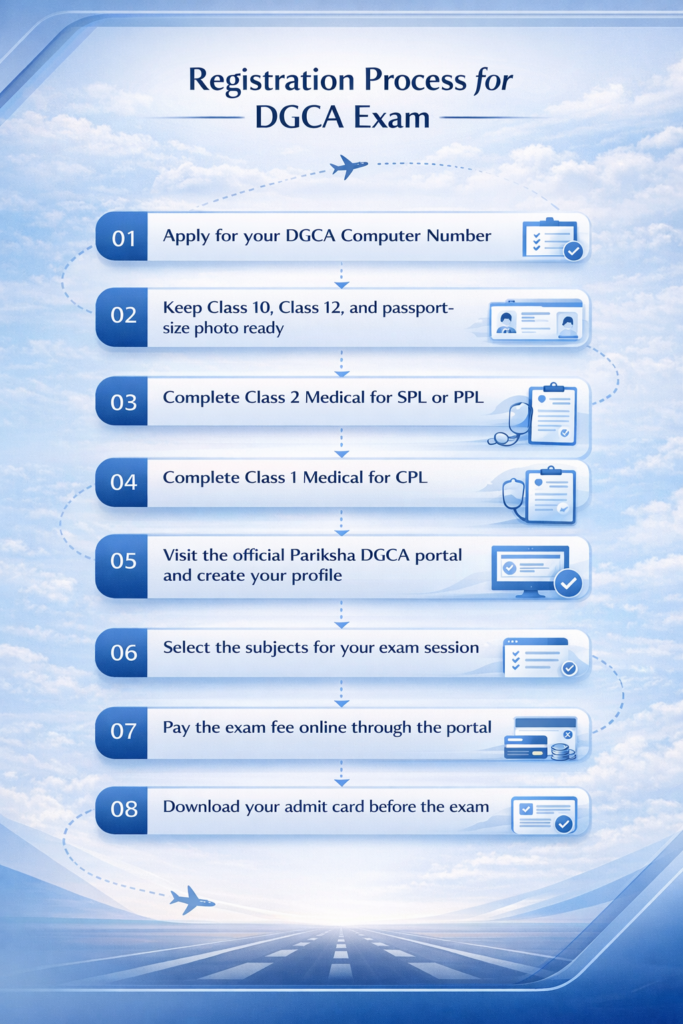
    step by step DGCA exam registration process including computer number medical exam subject selection and admit card download

    The entire registration process is done online through the Pariksha portal of the Directorate General of Civil Aviation (DGCA)

    Here is a simple step-by-step breakdown:

    1. Start by applying for your computer number on the eGCA portal. You will usually need your Class 10 certificate, Class 12 certificate, and a recent passport-size photograph.
    2. If you are applying for a Student Pilot License (SPL) or a Private Pilot License (PPL), you will need a Class 2 Medical. If you are preparing for a Commercial Pilot License (CPL), you must complete a Class 1 Medical. This pilot medical test in India must be done through a DGCA-approved Aviation Medical Examiner (AME).
    3. Once your documents are ready, go to the official Pariksha DGCA portal to create your candidate profile.
    4. Choose the subjects you want to appear for in that particular exam session, based on your preparation.
    5. Pay the exam fee through the portal. The fee is usually around ₹2,500 per subject, but you should always check the latest amount on the portal before making the payment.
    6. Before the exam window begins, your admit card will be made available on the portal. Download it in time and keep it ready for the exam.

    Eligibility Criteria for DGCA CPL Ground Exams
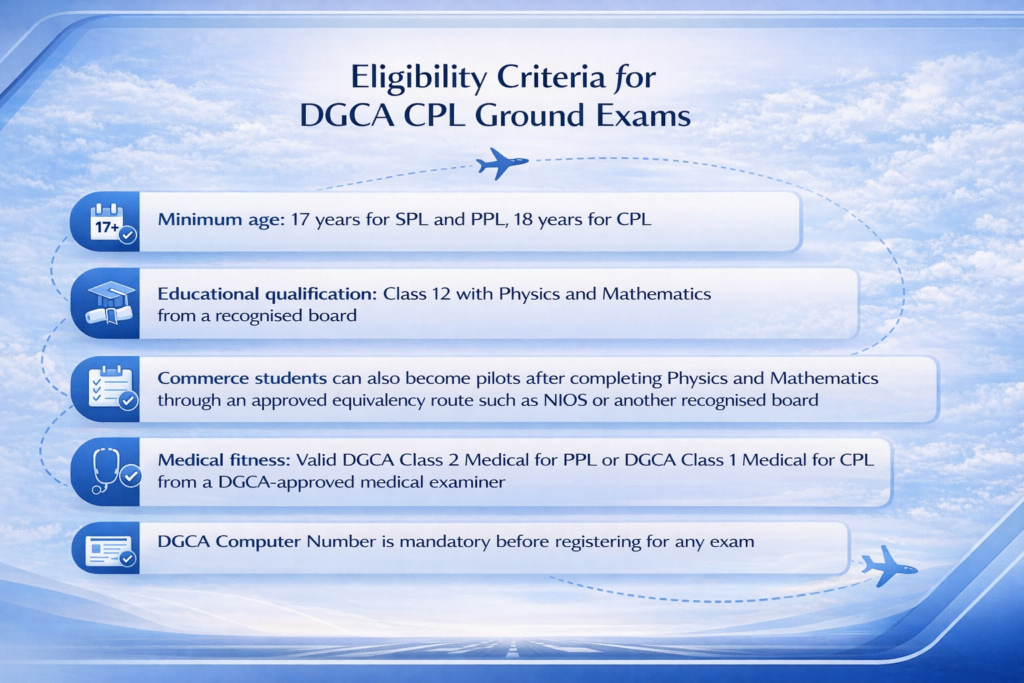
    DGCA CPL ground exam eligibility criteria including age education medical fitness and computer number requirement

    Before you appear for the DGCA theory exams, you need to meet the following basic requirements:

    Age: Minimum 17 years for SPL/PPL; minimum 18 years for CPL

    Educational Qualification: Class 12 (10+2) with Physics and Mathematics as compulsory subjects from a recognised board

    A commerce student can also become a pilot in India. However, before applying, they must first complete Physics and Mathematics through an approved equivalency route, such as the National Institute of Open Schooling (NIOS) or another recognized board.

    Medical Fitness: Valid DGCA Class 2 Medical (for PPL) or DGCA Class 1 Medical (for CPL) issued by a DGCA-approved medical examiner

    Apply for a DGCA Computer Number: A unique identification number allotted by DGCA upon registration on the eGCA portal. This is mandatory before registering for any exam

    DGCA Exam Subjects for Pilot

    The core subjects are the same for both PPL and CPL. However, CPL exams are more detailed, go deeper into each topic, and have a higher number of questions in subjects like Navigation and Technical General. The depth of knowledge tested at CPL level is significantly greater than at PPL level.

    SubjectQuestionsDurationPass Mark
    Air Navigation~1003 hours70%
    Aviation Meteorology~502 hours70%
    Air Regulations~502 hours70%
    Technical General~1003 hours70%
    Technical Specific~502 hours70%
    RTR(A)Practical + OralVariablePass/Fail

    Detailed DGCA Exam Syllabus for all Subjects

    When you want to obtain a Commercial Pilot Licence in India, you must clear six theory subjects along with the RTR(A) communication exam. 
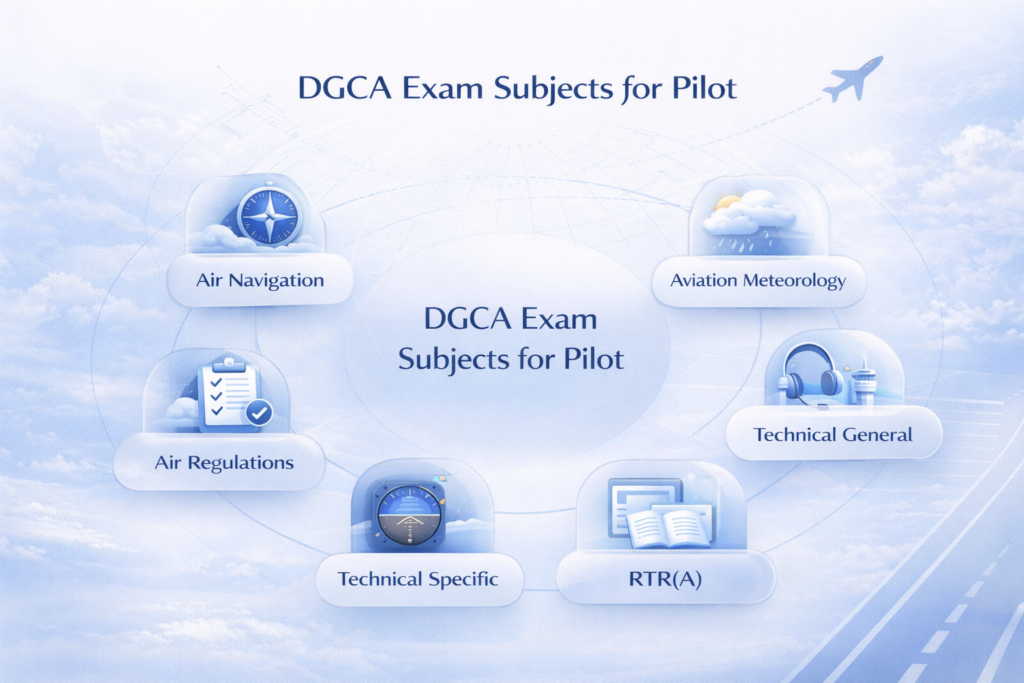
    DGCA pilot exam subjects including air navigation meteorology air regulations technical general specific and RTR

    Here is each subject in complete detail.

    Subject 1: Air Navigation

    Air Navigation is widely considered the most challenging and the most important subject in the DGCA exam syllabus. It tests your ability to plan and execute flights accurately using both mathematical and instrument-based methods.

    Key Topics Covered:

    • Latitude, longitude, and the shape of the Earth
    • Time calculations: UTC, IST, and Local Mean Time (LMT)
    •  Great circle and rhumb line navigation
    • Compass deviation, variation, and magnetic heading
    • Dead Reckoning (DR) navigation
    • Radio navigation aids: VOR, DME, ADF, ILS, and GPS principles
    • Position fixing and track monitoring
    • ETA and ETD calculations
    • Fuel planning and consumption calculations
    • Performance-Based Navigation (PBN)
    • Flight planning and flight monitoring
    • Aviation maps and chart reading (Jeppesen charts, topographic charts)
    • Use of the CX-3 flight computer (allowed in exam)

    DetailInformation
    Number of Questions~100 MCQs
    Duration3 hours
    Passing Marks70%
    Calculator AllowedYes, CX-3 and Scientific Calculator
    Negative MarkingNone
    Recommended BooksRK Bali (Air Navigation), Oxford Navigation, Keith Williams

    Subject 2: Aviation Meteorology

    Aviation Meteorology covers everything about weather that affects flight safety. This is a subject where concepts matter more than rote memorization.

    Key Topics Covered:

    • Structure and composition of the atmosphere
    • Pressure, temperature, and density relationships
    • Wind systems: local winds, global circulation, and jet streams
    • Cloud types, cloud formation, and classification (ICAO cloud codes)
    • Stability and instability of the atmosphere
    • Frontal systems: warm front, cold front, occluded front
    • Thunderstorms: formation, development, and avoidance
    • Icing conditions and their effect on aircraft performance
    • Fog types: radiation fog, advection fog, and sea fog
    • Turbulence: causes, types, and reporting
    • Reading and interpreting METARs, TAFs, SIGMETs, AIRMETs
    • Significant weather charts (SIGWX) and upper-air charts
    • VOLMET broadcasts and weather decision-making for flight planning

    DetailInformation
    Number of Questions~50 MCQs
    Duration2 hours
    Passing Marks70%
    Calculator AllowedNo
    Negative MarkingNone
    Recommended BooksI.C. Joshi (Aviation Meteorology), Oxford Meteorology

    Subject 3: Air Regulations

    Air Regulations is the legal framework of aviation in India. It covers the laws, rules, and procedures that govern how pilots, aircraft, and airways operate.

    Key Topics Covered:

    • Chicago Convention and ICAO Annexes
    • Aircraft Act, 1934 and Aircraft Rules, 1937 (Indian aviation law)
    • Civil Aviation Requirements (CARs) issued by DGCA
    • Rules of the Air (ICAO Annex 2)
    •  Airspace classifications in India (Class A to Class G)
    •  Pilot licensing requirements and privileges
    • Flight crew duties and responsibilities
    •  Air Traffic Services (ATC procedures)
    • Search and Rescue (SAR) operations
    •  Aircraft registration and airworthiness
    • Flight operations requirements
    • Emergency procedures under ICAO standards
    • Enforcement procedures and penalties

    DetailInformation
    Number of Questions~50 MCQs
    Duration2 hours
    Passing Marks70%
    Calculator AllowedNo
    Negative MarkingNone
    Recommended BooksRK Bali (Air Regulations), DGCA Civil Aviation Requirements (CARs)

    Subject 4: Technical General

    Technical General is an aircraft engineering subject. It covers the design, systems, and working principles of aircraft in general and not specific to any single aircraft type.

    Key Topics Covered:

    • Principles of aerodynamics: lift, drag, thrust, and weight
    • Aerofoil theory and the effect of flaps and slats
    • Stability and control: longitudinal, lateral, and directional stability
    • Aircraft structures and materials (stress, strain, fatigue)
    • Piston engines: four-stroke cycle, carburetion, ignition, and supercharging
    • Turbine/jet engines: types, components, thrust calculation
    • Propellers: fixed pitch, variable pitch, constant speed
    • Fuel systems: types, fuel grades, and contamination
    • Electrical systems: AC and DC systems, batteries, generators
    • Hydraulic systems: pumps, actuators, and circuits
    • Environmental control systems: pressurisation and air conditioning
    • Flight instruments: pitot-static, gyroscopic, and magnetic instruments
    • Avionics: FMS, autopilot systems, GPWS, TCAS (basic overview)
    • Aircraft performance: V-speeds, stall, load factor, and weight & balance

    DetailInformation
    Number of Questions~100 MCQs
    Duration3 hours
    Passing Marks70%
    Calculator AllowedYes, Scientific Calculator
    Negative MarkingNone
    Recommended BooksOxford (Airframes & Systems, Electrics, Powerplant)

    Subject 5: Technical Specific

    Unlike the other subjects, Technical Specific is based directly on the aircraft type you flew during your CPL training. If you are trained on a Cessna 172 or a Tecnam P Mentor, your exam will cover that aircraft’s systems, limitations, and procedures.

    Key Topics Covered:

    •  Aircraft-specific systems and their operation
    • Operating limitations (Vne, Vno, Vs, Vfe, etc.)
    • Weight and balance calculations specific to the aircraft
    • Fuel system specifics and usable/unusable fuel
    • Emergency procedures as per the Pilot Operating Handbook (POH)
    • Performance charts: takeoff distance, climb, cruise, and landing
    • Avionics fitted in the aircraft
    • Normal and abnormal checklists
    DetailInformation
    Number of Questions~50 MCQs
    Duration2 hours
    Passing Marks70%
    Calculator AllowedYes, Scientific Calculator
    Negative MarkingNone
    Key Study MaterialPOH/AFM of your training aircraft + ground school modules

    Subject 6: RTR(A) – Radio Telephony Restricted (Aeromobile)

    The RTR(A) is conducted by the DGCA. It certifies that you can legally operate aircraft radio equipment. Every pilot in India must hold this certificate.

    Key Topics Covered:

    • ICAO standard aviation phraseology
    • RT procedures for taxi, takeoff, en-route, and landing
    • Emergency RT procedures: MAYDAY, PAN-PAN calls
    • Communication failure procedures (NORDO)
    • Distress and urgency signals
    • Use of ATC frequencies: ATIS, Ground, Tower, Approach, Departure, Centre
    • VHF and HF communication principles
    • Position reporting procedures

    The RTR(A) exam has two parts:

    Part 1 – Written/Oral: Tests knowledge of RT procedures and phraseology

    Part 2 – Practical: Mock RT communication with ATC, including emergency scenarios

    How are the DGCA Exams Conducted?

    All DGCA theory exams are now conducted in an online Computer-Based Test (CBT) format through the official Pariksha DGCA portal.

    • All questions are multiple-choice questions (MCQs) with four options
    • Only one answer is correct per question
    • There is no negative marking
    • Results for CBT exams are displayed on-screen immediately after submission
    • Exam centres are located across major cities: Delhi, Mumbai, Bengaluru, Chennai, Kolkata, and Hyderabad

    DGCA Exam Fees

    SubjectApproximate Fee
    Air Navigation₹2,500
    Aviation Meteorology₹2,500
    Air Regulations₹2,500
    Technical General₹2,500
    Technical Specific₹2,500

    * Fees are subject to revision. Always verify current fees on the official Pariksha DGCA portal.

    Best Books for DGCA CPL Ground Exams

    Pilot students should always begin with the official study material listed on the Pariksha DGCA portal. The portal provides a subject-wise list of reference books and study resources for the Private Pilot License (PPL), Commercial Pilot License (CPL), and Airline Transport Pilot License (ATPL) exams. Candidates should study the relevant topics according to the syllabus prescribed in the Civil Aviation Requirements (CAR) for the specific pilot license examination they plan to appear for.

    Click here for the portal link. 

    How VFTI Prepares you for the DGCA Exam 

    Vision Flying Training Institute (VFTI) does not just train you to fly an aircraft. We prepare you to understand aviation from the ground up. VFTI is among the top 10 DGCA-approved Flying Training Organizations (FTOs) located in Amreli, Gujarat, with an admission and ground school office in Dwarka, New Delhi. 

    We bring both academic rigor and practical aviation expertise to our students. 

    Expert Ground Instructors: Our instructors teach each DGCA subject with clarity, connecting theoretical concepts to real flying situations so the knowledge stays with you long after the exam.

    Structured Syllabus Mapping: Our ground school program is mapped to the full DGCA exam syllabus, with dedicated sessions for each subject and regular topic-wise assessments.

    Integrated Training: Your ground school happens alongside your actual flight training at VFTI. Flying the Cessna 172 SkyHawk or Tecnam P2008 JC reinforces what you learn in ground school, particularly for Technical Specific and Navigation.

    Modern Fleet: Students train on a well-maintained fleet including the Tecnam P2008 JC, Cessna 172 SkyHawk, and Tecnam P-Mentor, all maintained by our own CAR 145-approved in-house MRO facility.

    365-Day Flying Weather: Our Amreli, Gujarat base offers near year-round flyable weather, which means you complete your flying hours faster and face fewer training delays. This gives a significant advantage over many other FTOs in India.

    Complete support from DGCA medical assistance and eGCA registration to exam preparation and career counseling, we guide you at every step.

    Conclusion

    The DGCA exam syllabus covers six subjects that form the complete theoretical foundation of a pilot’s knowledge in India. Each subject serves a specific purpose in making you a competent professional pilot.

    These exams are challenging, but they are absolutely manageable with the right preparation. Understand the syllabus, join a structured ground school, practice mock tests, and stay consistent.

    If you are ready to take that first step, Vision Flying Training Institute is ready to guide you from your first ground class to your CPL and beyond.

    Frequently Asked Questions (FAQs)

    Q1. How many subjects are there in the DGCA CPL exam?

    There are 5 core theory subjects: Air Navigation, Aviation Meteorology, Air Regulations, Technical General, and Technical Specific, plus the RTR(A) exam. All six must be cleared to obtain a CPL in India.

    Q2. What are the passing marks for DGCA exams?

    A minimum of 70% in each subject is required to pass the DGCA theory exams. There is no negative marking.

    Q3. Can I appear for DGCA exams without Class 12 Physics and Mathematics?

    No. Physics and Mathematics are mandatory subjects in Class 12 for appearing in the DGCA CPL theory exams. Students from non-Science backgrounds must clear an equivalency examination first.

     Q4. How many times is the DGCA exam conducted in a year?

    The exam is conducted 4 times a year (quarterly). Dates are published on the Pariksha DGCA portal (pariksha.dgca.gov.in).

     Q5. How long are DGCA exam results valid?

    Passed subject results are valid for 5 years from the date you cleared your first subject. You must obtain your CPL license within this period.

     Q6. Is there a limit on DGCA exam attempts?

    No. There is no limit on the number of attempts for any DGCA theory subject.

     Q7. Can I appear for DGCA exams before completing flying hours?

    Yes. Many students begin appearing for DGCA theory exams while simultaneously doing their flying training. In fact, appearing for theory exams early is a common and recommended approach.

     Q8. Where can I find the official DGCA exam syllabus?

    The official syllabus, exam schedule, and study material guidelines are published on the DGCA website (dgca.gov.in) and the Pariksha portal (pariksha.dgca.gov.in).

     Q9. What is a DGCA Computer Number and how do I get it?

    A DGCA Computer Number is a unique identification number that DGCA assigns to every pilot applicant. You apply for it through the eGCA portal (egca.dgca.gov.in) with your educational and medical documents.

     Q10. Does clearing DGCA exams guarantee a pilot job?

    No. Clearing DGCA exams is one step in a multi-stage process. You also need 200 flying hours, a valid Class 1 Medical, a DGCA CPL, and successful completion of airline selection processes.

  • How to Clear DGCA Exams in India [2026]

    How to Clear DGCA Exams in India [2026]

    Every pilot who flies over Indian skies first had to sit down, open a book, and pass the DGCA exams. 

    The DGCA (Directorate General of Civil Aviation) exams are the official theory tests that every aspiring pilot in India must clear to earn a Commercial Pilot Licence (CPL). These exams test your knowledge of aviation subjects before you are ever allowed to fly commercially. 

    These exams are designed to make sure that when you sit in that cockpit, you know exactly what you are doing.

    Here is everything you need to know to clear your DGCA exams and earn your wings.

    Overview of Passing the DGCA Exams on the First Attempt

    The requirements for qualifying DGCA exams on the first attempt are as follows: 

    1. First, meet the basic eligibility: you should have passed Class 10+2 with Physics and Maths, hold a valid Class 2 Medical Test Certificate, and be at least 17 years old.
    2. Get your DGCA Computer Number through the Pariksha portal.
    3. Prepare for and clear all five CPL theory subjects: Air Navigation, Meteorology, Air Regulations, Technical General, and Technical Specific, with at least 70% in each paper.
    4. Clear the RTR(A) Radio Telephony exam.
    5. Complete your required flying hours at the top DGCA-approved Flying Training Organisation, such as Vision Flying Training Institute (VFTI).
    WHAT YOU WILL LEARN IN THIS ARTICLEKEY FACTS OF THE DGCA EXAM 
    Exact eligibility requirements for DGCA CPL exams.

    How to apply for a DGCA Computer Number (step-by-step)

    All 5 CPL subjects and their full syllabusExam pattern, passing marks, and format details

    DGCA exam schedule & OLODE on-demand exams

    How to register on the DGCA Pariksha portal

    Best books and study resources for each subject

    Subject-wise preparation strategies that actually work

    A realistic 12–18 month study timeline

    Common mistakes that cause students to fail

    How VFTI’s DGCA-approved program prepares you
    You need to clear five CPL theory subjects along with RTR(A).

    The minimum passing marks are 70% in each subject.

    DGCA exams are usually held around four times a year.There is no negative marking in the exam.

    There is no limit on the number of attempts.Each passed exam result remains valid for five years.

    The minimum age to appear is 17 years.The exam is conducted in computer-based mode through the Pariksha Portal.

    What Are DGCA Exams?

    The DGCA exams are a mandatory series of Computer-Based Theory Tests (CBT) that every aspiring pilot in India must clear before obtaining a Commercial Pilot License (CPL), Private Pilot License (PPL), or Airline Transport Pilot License (ATPL). DGCA, the regulatory authority under the Ministry of Civil Aviation, Government of India, conducts the exams.

    The DGCA CPL exams test your theoretical knowledge in aviation, including navigation, weather, aircraft systems, and Indian aviation law. They do not test your flying ability. But pilots who understand aviation theory deeply become more confident in the cockpit. The DGCA exams build that foundation.

    Important: All DGCA CPL theory exams are conducted online through DGCA’s official Pariksha portal.All results, admit cards, exam schedules, and applications are managed through this single portal.

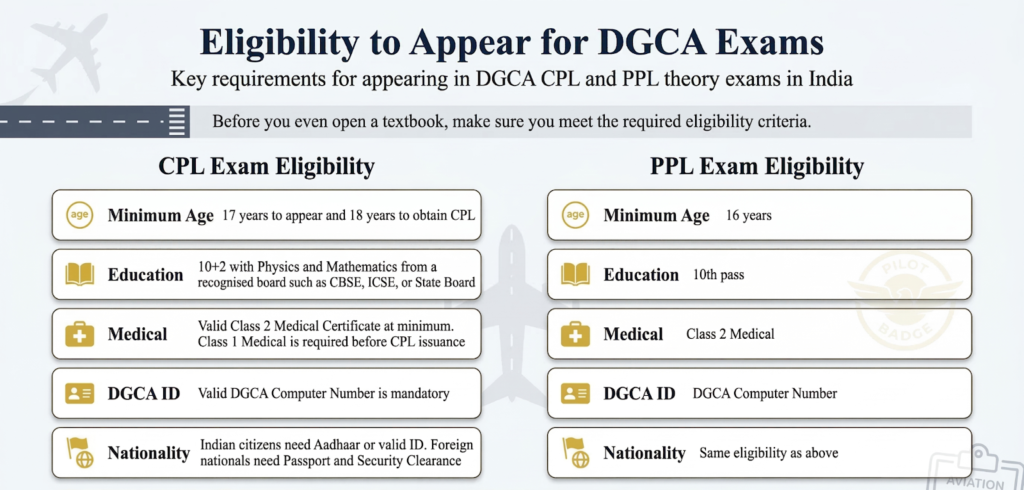
    Eligibility to Appear for DGCA Exams

    Before you even open a textbook, you need to make sure you qualify. 

    step-by-step process to register for DGCA exams in India

    Here is the eligibility checklist for appearing in DGCA CPL theory exams:

    RequirementCPL ExamPPL Exam
    Minimum Age17 years (to appear) and 18 years (to obtain CPL)16 years
    Education10+2 with Physics & Mathematics from a recognised board (CBSE/ICSE/State Board)10th pass
    MedicalValid Class 2 Medical Certificate (minimum); Class 1 required before CPL issuanceClass 2 Medical
    DGCA IDValid DGCA Computer Number – mandatoryDGCA Computer Number
    NationalityIndian citizens (Aadhaar/ID); Foreign nationals need Passport + Security ClearanceSame

    💡 Don’t Have Physics & Maths in Class 12?

    You can still fulfil this requirement through NIOS – the National Institute of Open Schooling. DGCA accepts NIOS pass certificates for Physics and Mathematics. Many students have taken this route and gone on to become commercial pilots. 

    Now, Arts as well as Commerce students can become pilots in India

    DGCA Computer Number: Your First Official Step

    The DGCA Computer Number (CN) is a unique 10-digit alphanumeric identification number issued by DGCA to every aspiring pilot in India. Think of it as your official student ID in the DGCA system. Without a Computer Number, you cannot register for any DGCA exam. It is the very first administrative step in your pilot journey.

    How to Apply for DGCA Computer Number Step by Step

    1. Visit the Pariksha Portal: Go to the Pariksha portal using Chrome or Firefox, which are the recommended browsers. Select “New Candidate Registration” under the Flight Crew section.
    2. Fill in Your Personal Details: Enter your full name exactly as it appears on your Class 10th certificate, date of birth, gender, nationality, and contact information. Even a minor spelling mismatch can delay your application.
    3. Verify via OTP & Create Login: Verify your email and mobile number using OTPs. Create a unique login ID and password. Keep these credentials safe; you will use them every time you interact with DGCA.
    4. Upload Required Documents: Upload your Class 10th & 12th mark sheets, Aadhaar card, a passport-size photograph (MATT finish, white background, max 70KB), and your digital signature (max 20KB).
    5. Submit & Send Hard Copy: After submitting online, print the application form, get it attested by a Gazetted Officer/Notary, attach self-attested copies of all documents, and send via Speed Post to DGCA within 10 working days.
    6. Receive Your Computer Number: DGCA verifies documents and issues your Computer Number within 15–30 working days (faster for DigiLocker users). Download and keep your CN PDF safely.

    DGCA CPL Exam Subjects & Syllabus

    Earning a Commercial Pilot License in India requires you to clear five core ground theory subjects along with one separate radio examination. Here is a complete breakdown of each subject:

    SubjectKey Topics CoveredFormat
    Air NavigationFlight planning, UTC/IST/LMT time calculations, great circle & rhumb line, VOR, DME, ADF, ILS, drift correction, ETA/ETD, fuel planning, aviation charts~100 MCQs · 3 hrs
    Aviation MeteorologyAtmosphere structure, pressure systems, wind patterns, cloud types, fronts, thunderstorms, icing, fog, turbulence, METAR, TAF, SIGMET, weather charts~50 MCQs · 2 hrs
    Air RegulationsIndian aviation law, ICAO standards, Civil Aviation Requirements (CARs), airspace classification, ATC procedures, licensing rules, emergencies, RVSM~50–100 MCQs · 2 hrs
    Technical GeneralAerodynamics, forces on aircraft, stability, structures, fuel & hydraulic systems, electrical systems, piston & turbine engines, propellers, avionics~50–100 MCQs · 2–3 hrs
    Technical SpecificAircraft-type specific systems, performance & limitations for your training aircraft (piston single/multi-engine). Study from the POH/AFM.~50 MCQs · 2 hrs
    RTR(A) – Radio TelephonyAviation radio communication, standard phraseology, emergency communication, ATC interactions. Separate from the 5 theory papers.Written and Viva · Pass/Fail

    Exam Pattern, Format & Passing Marks

    Understanding exactly how the exam works before you sit in the exam chair is as important as knowing the syllabus.

    SubjectQuestionsDurationPass MarkNegative Marking
    Air Navigation~100 MCQs3 hours70%None
    Aviation Meteorology~50 MCQs2 hours70%None
    Air Regulations~50–1002 hours70%None
    Technical General~50–1002–3 hours70%None
    Technical Specific~50 MCQs2 hours70%None
    RTR(A)Written + OralAs per WPCPass/Fail

    DGCA Exam Schedule & OLODE Exams 

    DGCA conducts flight crew theory exams in two modes: Regular Sessions and Online On-Demand Exams (OLODE).

    Exam TypeFrequencyApprox. SessionsNotes
    Regular Session4 times per yearMarch · June · September · DecemberMain scheduled cycle; most seats available
    OLODE (On-Demand)IntermittentBetween regular sessionsLimited seats; check Pariksha portal regularly

    Failing a subject in a regular session means waiting for the next cycle, which is roughly a 2 to 3-month gap. This is why every attempt matters. A single failed paper can delay your overall training timeline by a quarter.

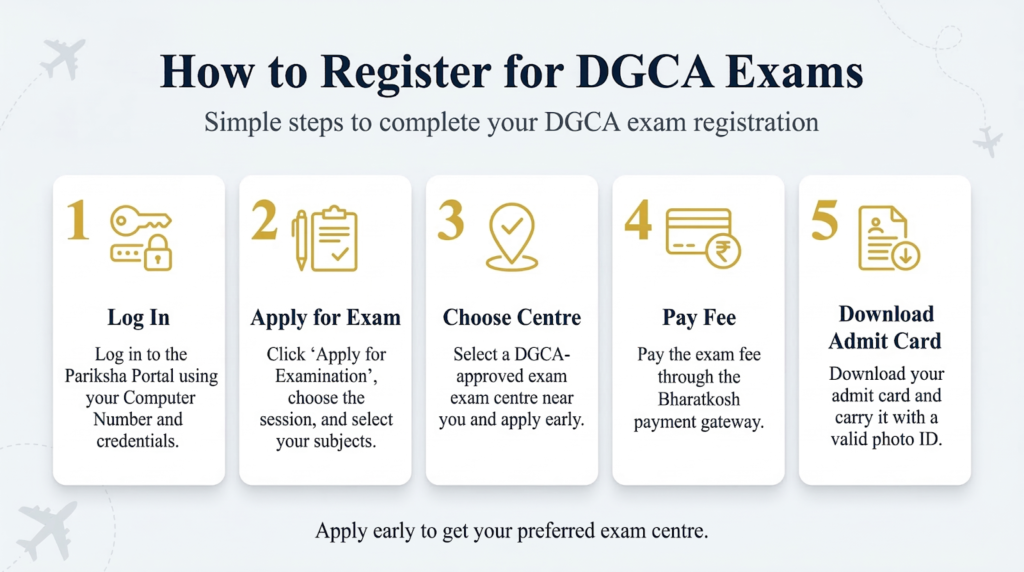
    How to Register for DGCA Exams

    Once you have your DGCA Computer Number, registering for an exam is a straightforward process:

    1. Log In to the Pariksha Portal: Visit and log in with your Computer Number and date of birth (for first-time login) or your registered credentials.
    2. Select Exam Application: Click ‘Apply for Examination.’ Select the session (Regular or OLODE) and choose the subjects you wish to attempt. You can appear for one or multiple subjects in a single session.
    3. Choose Your Exam Centre: Select a DGCA-approved exam centre near you. Available centres include Delhi, Mumbai, Bengaluru, Chennai, Kolkata, Hyderabad, and other approved locations. Apply early because popular centres fill up fast.
    4. Pay the Exam Fee: Exam fees range from approximately ₹2,500 to ₹5,000 per subject. Payment is processed through the Bharatkosh government payment gateway via net banking, debit, or credit card.
    5. Download Your Admit Card: Once confirmed, download and print your admit card from the portal. Carry it with a valid photo ID proof to the exam centre on exam day.

    Best Books for DGCA CPL Exam Preparation

    The right study material can make all the difference between a first-attempt pass and repeated retakes.

    SubjectRecommended Books / MaterialsKey Tip
    Air NavigationRK Bali (Air Navigation) · Oxford Aviation Navigation · Keith Williams NavigationPractice numericals daily. Understand the concepts, not just the formulas.
    Aviation MeteorologyRK Bali (Meteorology) · Oxford Aviation Meteorology · ICAO Doc 8896Focus on METAR/TAF decoding, fronts, and icing conditions.
    Air RegulationsRK Bali (Air Regulations) · DGCA CARs directly · Mock test guidesAlways cross-check with the latest official DGCA circulars before the exam.
    Technical GeneralRK Bali (Technical General) · AC Kermode – Mechanics of Flight · Ground school notesConceptual understanding matters more than rote learning here.
    Technical SpecificAircraft Flight Manual (AFM) · Pilot Operating Handbook (POH) · Ground school notesStudy with your CFI. This paper aligns directly with your training aircraft.
    RTR(A)WPC RTR Syllabus · ICAO Aviation Phraseology Manual · RT Communication Practice GuidesPractise speaking aviation phraseology aloud. The viva tests fluency, not just knowledge.
    Mock TestsDGCA question bank guides via ground schools · Online DGCA mock test platformsReputable question banks reflect years of exam patterns. Essential for exam readiness.

    Subject-Wise Preparation Tips for Qualifying the DGCA Exams

    Air Navigation – The Most Challenging Subject

    Solve at least 10–15 numerical problems every single day. Understand the concepts behind magnetic variation, deviation, and track calculations; do not just memorise formulas. Spend extra time on radio navigation aids (VOR, DME, ILS). This subject has the most questions and the longest exam duration.

    Aviation Meteorology -Begin your Preparation with this Subject

    Learn to decode METAR and TAF reports fluently. Understand how fronts develop and how they affect flying conditions practically. Study cloud types and their associated weather. Connecting theory to real-world aviation scenarios, this improves recall during the exam.

    Air Regulations – The Most Scoring Subject

    Read DGCA’s Civil Aviation Requirements (CARs) directly, especially sections on licensing, flight rules, and airspace. This subject is regularly updated; always check for the latest DGCA circulars. Memorise specific numbers (altitudes, distances, time limits) that frequently appear in questions.

    Technical General – Build Your Aircraft Knowledge

    Start with aerodynamics and build upward to aircraft systems. Understand how each system works at a conceptual level. Diagrams and flowcharts help. Avoid the trap of memorising without understanding. Exam questions test whether you truly understand the concepts.

    Technical Specific – The Easiest Paper If Prepared

    Study the Pilot Operating Handbook (POH) of your training aircraft thoroughly. This subject rewards students who have been paying close attention during their actual flying. Work closely with your Certified Flight Instructor (CFI) to identify the exact systems and limitations covered in this paper.

    RTR(A) – Radio Telephony Restricted (Aeronautical)

    Practise radio calls aloud. Record yourself doing standard Air Traffic Control (ATC) communication and listen back. Study the phonetic alphabet until it is completely automatic. Speak clearly and at the right pace during the viva; confidence and fluency are assessed, not just knowledge.

    How to Prepare for DGCA Exams After Class 12th

    Most students who want to fly have no idea what to do the day after their Class 12 results come out. The process is straightforward; you just need to know the right order.

    Step 1: Get Your Class 2 Medical Certificate: Get your DGCA-approved pilot medical tests done first. If you don’t clear the medical, nothing else matters.

    Step 2: Get Your DGCA Computer Number: Register on the eGCA portal. Upload your Class 10 and 12 marksheets, Aadhaar, photo, and signature. CBSE/DigiLocker students get it in 48 hours. State board students wait 20–30 days. You cannot register for any exam without this.

    Step 3: Download the Official DGCA Syllabus: Go to the DGCA portal → Examinations section. Download the syllabus PDF for each subject. Study from this only and not from outdated notes or third-party material.

    Step 4: Join a DGCA Ground School: Self-study works, but a structured ground school keeps you on track, gives you updated notes, and runs mock tests. At VFTI, ground school runs alongside your flight training, so theory and flying reinforce each other.

    Step 5: Study One or Two Subjects at a Time: Spread preparation over 6 to 9 months. Start with Air Regulations and Meteorology. Tackle Air Navigation and Technical General later, both are calculation-heavy and need more time.

    Step 6: Take Mock Tests Before Every Exam: Do at least 2 to 3 full mock tests per subject before the actual exam. This is where you catch gaps, build speed, and get comfortable with the CBT format.

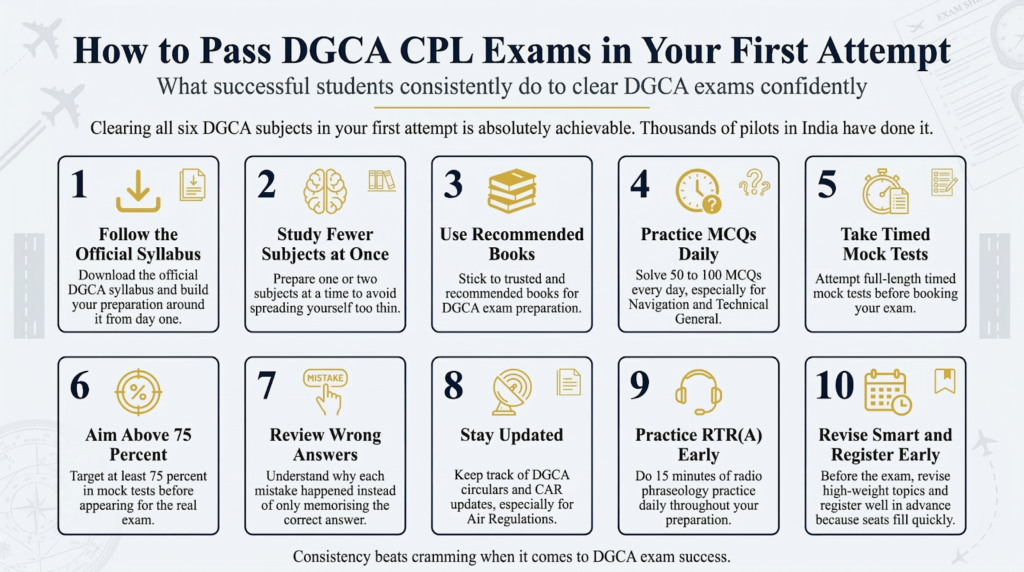
    How to Pass DGCA CPL Exams in Your First Attempt

    Clearing all six DGCA subjects in your first attempt is absolutely achievable. Thousands of pilots in India have done it. Here is what the successful ones consistently do:

    1. Follow the official DGCA syllabus for pilot courses from day one. Download it from and build your entire preparation around it.
    2. Study one or two subjects at a time. Attempting too many subjects in one exam session often leads to spreading yourself too thin and failing multiple papers.
    3. Use recommended books to prepare for your DGCA exams.
    4. Solve at least 50 to 100 MCQs daily. Particularly for Navigation and Technical General, daily practice is non-negotiable.
    5. Take full-length timed mock tests for every subject before booking your exam. Aim for 75% or above in mock tests before you sit for the real one.
    6. Review every wrong answer in your mock tests. Do not just note the correct answer; understand why you got it wrong.
    7. Stay current with DGCA circulars and CAR updates, especially for Air Regulations.
    8. Start RTR(A) practice early and never stop. Do 15 minutes of radio phraseology practice daily throughout your preparation period.
    9. Before the exam, re-read high-weight topics, not the entire syllabus. Focus on areas where questions are most frequently asked.
    10. Register for the exam well in advance. Do not wait until the last week of registration; exam seats fill quickly, especially in major cities.

    Suggested Study Timeline for DGCA Exams (12-18 Months)

    Most students who pass all five DGCA subjects without repeating spend 12 to 18 months in dedicated preparation alongside their actual flight training. All the effort, discipline, and long study hours are worth it when you consider the salary of a pilot in India, which makes this career path both prestigious and financially rewarding. Here is a realistic study timeline:

    PhaseDurationFocus AreasGoal
    Phase 1Month 1–2DGCA Computer Number · Class 2 Medical · Enroll in ground school · Begin Air Regulations and MeteorologyAdministrative groundwork complete; first two subjects started
    Phase 2Month 3–5Complete Air Regulations and Meteorology · Start Air Navigation · Begin mock tests for completed subjectsAttempt Air Regulations and Meteorology in Session 1
    Phase 3Month 6–9Complete Air Navigation (high revision focus) · Begin Technical General · Mock tests dailyAttempt Air Navigation in Session 2
    Phase 4Month 10–14Complete Technical General and Technical Specific · RTR(A) preparation · Full syllabus revision for all subjectsClear Technical General, Specific and RTR(A) in Sessions 3–4
    Phase 5Month 15–18Complete flying hours · Class 1 Medical · CPL application preparationAll 5 DGCA subjects and RTR(A) cleared; CPL application ready

    Common Mistakes to Avoid while Preparing for DGCA Exams

    Thousands of Indian students appear for DGCA exams every year. Many who fail do so not because they lack ability, but because they fall into predictable traps:

    ❌  Relying Only on Memorisation

    DGCA questions are crafted to test understanding, not memory. Students who memorise without understanding are easy to trip up. Focus on the ‘why’ behind every concept, not just the ‘what.’

    ❌  Skipping the DGCA Question Bank

    Well-established question banks reflect years of repeated exam patterns. Ignoring them means missing out on high-frequency topics and predictable question phrasing, costly for a 70% pass threshold.

    ❌  Underestimating Meteorology and Navigation

    Many students treat Meteorology and Navigation as ‘easy theory.’ Both involve calculations, charts, and decoding real-world data. These two subjects consistently have among the lowest pass rates.

    ❌  Attempting All Subjects in One Session

    Registering for all five subjects at once stretches your preparation too thin. Focus on one or two subjects per session. A first-attempt pass in two subjects beats a fail in five.

    ❌  Not Tracking the 5-Year Validity Window

    If you pass Air Navigation in 2025 and delay the rest of your training, your result expires in 2030. Students who delay flight training often find their earlier results have lapsed, costing them time and money on retakes.

    ❌  Ignoring RTR(A) Preparation

    The RTR(A) exam’s oral/viva component surprises many candidates who have only prepared for the written part. If your radio communication sounds hesitant during the viva, you will not pass, even if you aced the written test.

    ❌  Not Keeping Up with DGCA Regulation Updates

    Air Regulations is a dynamic subject. DGCA frequently updates its Civil Aviation Requirements (CARs). Studying outdated material is one of the most avoidable errors.

    Can You Clear DGCA Exams Through Self-Study, or Should You Join a Ground School?

    Yes, you can self-study, but a ground school gets you there faster and with fewer failed attempts.

    This is one of the most common questions among aspiring pilots.  

    It is possible to clear DGCA exams through self-study. People have done it. However, the path is significantly harder and longer. Self-study for all six subjects typically takes 12 to 18 months or more. You have to figure out everything on your own, including which books to use, which topics are high-priority, how to interpret complex navigation formulas, and how to practise RTR. Without structured guidance, you will spend time on the wrong materials and miss important syllabus updates.

    Self-study works reasonably well for Air Regulations and Aviation Meteorology because they are more conceptual and text-based. 

    Air Navigation and Technical General are a different matter. Both involve complex calculations and system-level knowledge, and without proper guidance, most students fail these on the first attempt.

    On the other side, a good DGCA ground school condenses months of self-study into 6 to 8 weeks per subject. They provide structured concept teaching and offer mock tests that reflect the actual DGCA exam pattern. Expert instructors help you understand the concept better.

    The most efficient approach is a combination of both.  

    At Vision Flying Training Institute, our integrated ground school programme runs alongside your flight training. You get structured theory instruction, subject-wise mock tests, and instructor support, all in one place. This means your theory preparation stays aligned with what you are actually learning in the cockpit, creating a deeper understanding of both.

    How VFTI Prepares You for DGCA Exams

    Clearing DGCA exams requires more than self-study. The students who consistently pass on the first attempt are those who have access to structured ground school training, experienced instructors, and an environment where theory is connected to real flying. Vision Flying Training Institute (VFTI) is a DGCA-approved Flying Training Organisation (FTO) based in Amreli, Gujarat, with its admission office in Dwarka, New Delhi. VFTI is part of the Vision Group of Institutions, an organisation with over two decades of experience in education.

    • Experienced Flight Instructors: Seasoned CPL-certified instructors who teach ground theory from real-world cockpit experience, not just textbook knowledge. Theory and flying are taught in context.
    • Modern Aircraft Fleet: Tecnam P2008 JC, Cessna 172 Skyhawk, Tecnam P-Mentor, Multi-Engine Simulator. Your Technical Specific preparation aligns with the actual aircraft you fly.
    • 365-Day Flying Weather: Amreli, Gujarat, offers year-round ideal flying conditions. Your flight hours are never delayed by poor weather, keeping your 5-year result validity window well within reach.
    • In-House MRO & CAMO: CAR-145 approved Maintenance, Repair & Overhaul facility on-site. Minimum aircraft downtime keeps your training and exam preparation schedule on track.
    • International Standards: Training delivered to ICAO-aligned standards, giving you both DGCA exam readiness and preparation for international aviation careers.
    • Career Support: Dedicated career guidance to help you navigate from ground school to airline selection, including support with documentation, licensing, and placement.  

    When you train at Vision Flying Training Institute, your ground theory classes and your flying hours happen in the same environment. The instrument panel you studied in Technical Specific class is the same one in the cockpit you fly. That alignment is what makes the difference between a student who barely passes and a pilot who understands aviation.

    Frequently Asked Questions (FAQs)

    1. What is the passing mark for DGCA exams?

    You must score a minimum of 70% in each subject to pass the DGCA Commercial Pilot License theory exams. This threshold applies to all five ground theory papers. There is no negative marking and no combined average; each paper stands independently. For RTR(A), the assessment is pass/fail.

    1. How many times is the DGCA exam conducted in a year?

    DGCA conducts Regular exams approximately 4 times a year (roughly in March, June, September, and December). In addition, DGCA also holds OLODE (Online On-Demand Examination) sessions in between regular cycles, subject to availability.

    1. What subjects are there in DGCA CPL exams?

    DGCA CPL theory exams consist of 5 core subjects: 

    • Air Navigation, 
    • Aviation Meteorology, 
    • Air Regulations, 
    • Technical General, and 
    • Technical Specific. 

    All CPL candidates must also clear RTR(A), the Radio Telephony exam.

    1. Is there a limit on the number of attempts for DGCA Exams?

    No. DGCA does not impose any limit on the number of attempts for any subject. However, all subjects must be cleared within 5 years of passing your first paper, as individual subject results expire after 5 years.

    1. What is a DGCA Computer Number, and how do I get one?

    The DGCA Computer Number is a unique 10-digit alphanumeric ID issued by DGCA to every aspiring pilot. Apply on the Pariksha portal by submitting your Class 10 & 12 mark sheets, Aadhaar, photograph, and signature. CBSE/DigiLocker students can receive it in ~48 hours; others may take 20–30 days.

    1. What is the eligibility to appear for DGCA CPL exams?

    You must be at least 17 years old, have passed Class 10+2 with Physics and Mathematics from a recognised board, hold a valid Class 2 Medical Certificate, and possess a valid DGCA Computer Number. A Class 1 Medical Certificate is required before the final CPL is issued.

    1. How long are DGCA exam results valid?

    Each passed DGCA subject paper is valid for 5 years from the date of passing. You must clear all remaining subjects and complete your CPL requirements within this 5-year window.

    1. Can I clear DGCA exams while doing my flying training?

    Yes, and this is the recommended approach. Most students pursue their DGCA ground theory exams simultaneously with their flight training at an FTO. Studying theory alongside actual flying reinforces concepts practically, especially for Technical Specific and Air Navigation.

    1. Is there negative marking in DGCA exams?

    No. DGCA CPL theory exams carry zero negative marking. A wrong answer costs you nothing. Always attempt every question; an educated guess is always better. 

    1. Is the DGCA Exam tough?

    Yes, DGCA CPL exams are genuinely challenging. They are not designed to be easy, and they should not be. A commercial pilot carries the responsibility of hundreds of lives, and the DGCA exam system exists to ensure that every certified pilot has solid, tested aviation knowledge.

    1. Can I appear for DGCA exams without joining a flying school?

    Yes, you can appear for DGCA theory exams independently; you do not need to be enrolled in a flying school at the time of the exam. However, for CPL issuance, you will need to complete your flying hours at a DGCA-approved Flying Training Organisation.

    1. Is the RTR(A) exam conducted by the DGCA?

    No. The RTR(A) – Radio Telephony Restricted (Aeronautical) exam is conducted by the WPC (Wireless Planning and Coordination) Wing of the Ministry of Communications. However, passing RTR(A) is mandatory for CPL issuance. It includes both a written paper and an oral viva component.

    1. Can students from arts or commerce backgrounds appear for DGCA exams?

    Yes, but they must first complete Physics and Mathematics at the Class 12 level. This can be done through NIOS (National Institute of Open Schooling) or another recognised open schooling platform. Once these subjects are cleared, arts and commerce students are fully eligible to apply for a Commercial Pilot License.

    1. How much does it cost to appear for DGCA exams?

    DGCA exam fees are nominal compared to your overall pilot training cost. You pay per subject when you register through the Pariksha DGCA portal. Ground school fees vary depending on the institute; most reputed DGCA ground school programmes charge between ₹1.5 lakh and ₹2.5 lakh for all six subjects, though this varies significantly by provider and format (offline, online, or hybrid).

    Your Path to the Cockpit Starts Here

    Every aviation professional who flies in Indian skies has cleared these same DGCA papers at some point in their career. The path is simple: get your DGCA Computer Number, enrol in structured ground school training, follow a subject-wise study plan, practise numericals daily, and step into the cockpit as a pilot who genuinely understands the sky.

    At Vision Flying Training Institute (VFTI), we do not just train pilots; we build aviation professionals. Our DGCA-approved program at Amreli, Gujarat, combines world-class ground instruction with hands-on flying on a modern aircraft fleet, in weather conditions that allow you to fly 365 days a year. This is where your pilot journey should begin.