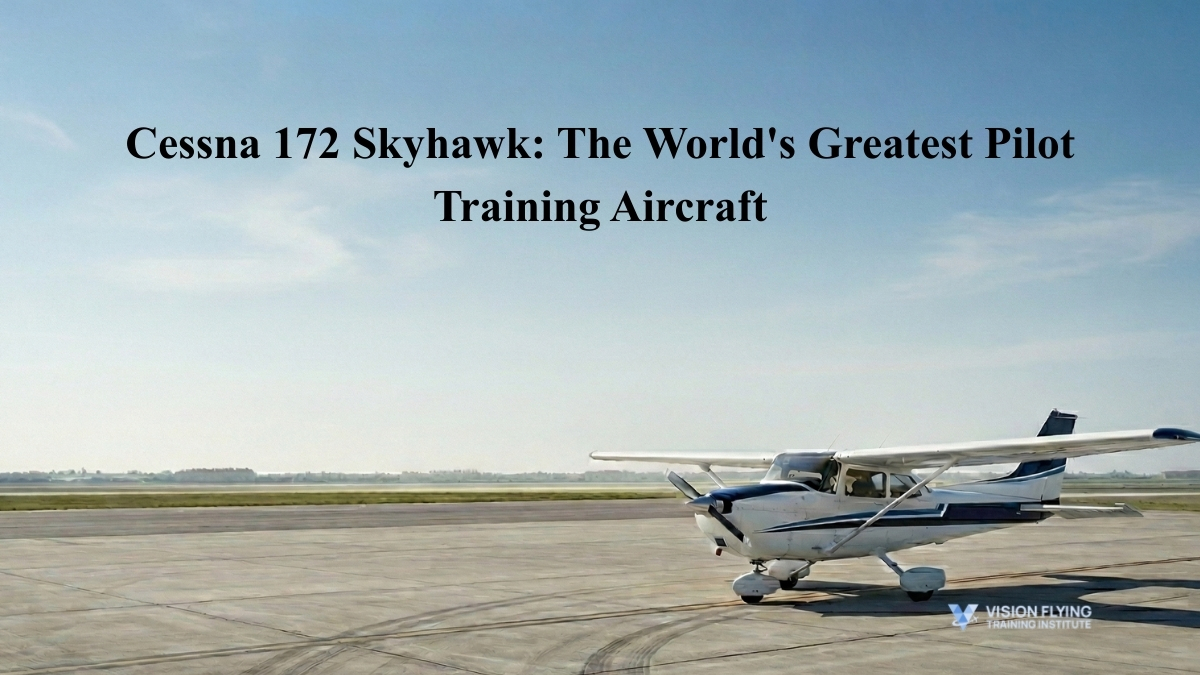
In India, pilot training for many aspiring commercial airline pilots begins in a specific aircraft: the Cessna 172 Skyhawk.
Ask any pilot, from a first officer at IndiGo to a senior captain at Air India, and the majority of them will give you the same answer: they learned to fly in the Skyhawk. More pilots have earned their wings in the Cessna 172 than in any other aircraft in the history of aviation.
The aviation industry in India is expanding at a rapid rate. Begin your training with a DGCA-approved flying training organization where you know the pilot course fees and expected timeline upfront, along with the right aircraft, the right instructors, and the right environment.
At Vision Flying Training Institute (VFTI), located in Amreli, Gujarat, you will get to fly the Cessna 172 Skyhawk as part of your Commercial Pilot License (CPL) and Private Pilot License (PPL) courses.
Here is all you need to know about this incredible aircraft and its importance for your pilot career in India.
The Aircraft That Has Trained More Pilots Than Any Other in History
The Cessna 172 Skyhawk aircraft was first designed in 1955 and went into production in 1956. In the last almost seven decades, it has become the most manufactured aircraft in the history of aviation, with more than 44,000 units manufactured and still counting.
The Skyhawk aircraft has been manufactured by Textron Aviation (previously known as Cessna Aircraft Company) in the United States of America. The Skyhawk has been continuously developing while retaining the essential characteristics that made it a legend: stability, simplicity, safety, and reliability.
Over 50% of the world’s commercial pilots have started their training careers with the Cessna 172 Skyhawk aircraft. It is not only a popular choice but also the global standard for initial pilot training. From the DGCA-approved top flying institutes in India to the legendary flight schools in the United States of America, the Cessna 172 is ubiquitous, and for all the right reasons.
Technical Specifications of Cessna 172 Skyhawk
Before you buckle up and begin taxiing towards the runway, it is useful to familiarize yourself with the aircraft you are about to fly.
Below are the full technical details of the Cessna 172 Skyhawk (172S), which is the model of aircraft used at most DGCA-approved Flight Training Organizations in India:
| Specification | Details |
| Aircraft Type | Single-Engine, High-Wing, Fixed Gear |
| Engine | Lycoming IO-360-L2A — 180 HP |
| Seats | 4 (Ideal for Dual & Solo Training) |
| Cruise Speed | 124 Ktas |
| Max Speed | 230 km/h |
| Rate of Climb | 730 Feet Per Minute (FPM) |
| Service Ceiling | 14,000 Feet (4,267 m) |
| Range | Up to 640 Nautical Miles |
| Fuel Capacity | 201 Litres (53 US Gallons) |
| Avionics | Garmin G1000 NXi Glass Cockpit |
| Certification | FAA Certified (Normal & Utility Category) |
| First Introduced | 1956 (Continuously Updated) |
| Total Produced | Over 44,000 Aircraft Worldwide |
The 180 HP Lycoming engine equips the Skyhawk with a strong climb rate of 730 feet per minute, which means you will reach training altitude quickly and efficiently. With a service ceiling of 14,000 feet, this aircraft provides more than enough altitude range for all the maneuvers required during your DGCA PPL and CPL training.
The Garmin G1000 NXi glass cockpit is, without a doubt, the most significant feature of this aircraft for aspiring Indian pilots, and we will discuss why in the next section.
Why is the Cessna 172 Skyhawk perfect for DGCA CPL/PPL Training in India?
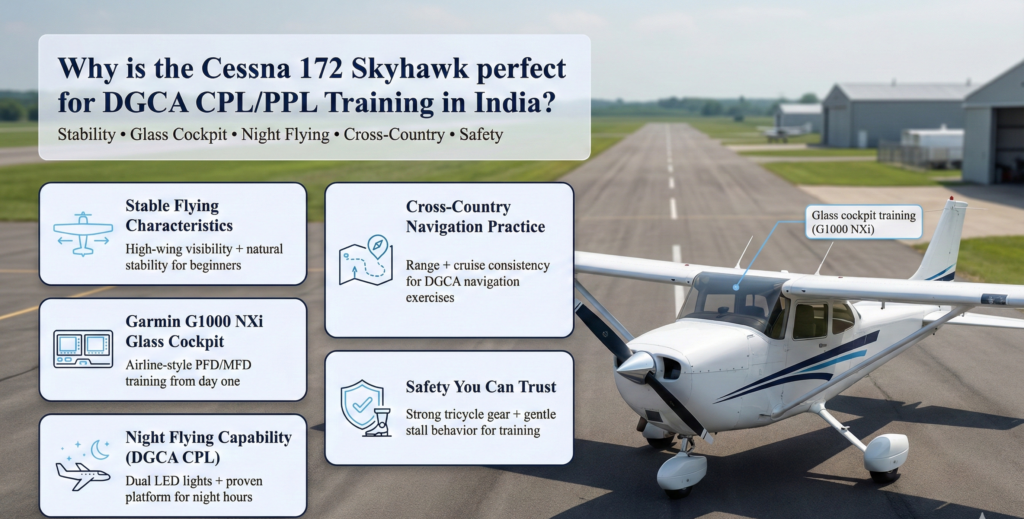
- Stable flying characteristics for Student Pilots in Training
One of the most difficult aspects of being a new student pilot is the amount of information that has to be simultaneously processed. This includes radio communications, aircraft instruments, weather, airspace, and aircraft control.
The Cessna 172 Skyhawk has a high-wing design that gives excellent visibility and natural stability during flight. If you make a small error in attitude or power control, the Skyhawk will naturally return to a stable condition instead of careening out of control.
This is exactly the type of plane you want when you are learning to fly for the first time.
- Garmin G1000 NXi glass cockpit for modern training with airline-ready avionics
The latest Cessna 172S comes with the Garmin G1000 NXi glass cockpit avionics system, which is a highly advanced glass cockpit system that displays all flight instruments, navigation, communication, and situational awareness information on high-resolution screens.
The fact that you will be training on glass cockpit avionics from day one itself is a major plus for Indian student pilots who want to fly with IndiGo, Air India, or Vistara airlines in the future.
You will be very comfortable reading Primary Flight Displays (PFDs) and Multi-Function Displays (MFDs) long before you receive your airline type rating.
The G1000 NXi glass cockpit avionics system also includes wireless database updates, HSI map overlay, NEXRAD weather integration, terrain awareness (TAWS), and traffic information, which will make you a modern, situationally aware pilot.
- Night flying capability required for DGCA CPL
The training for DGCA CPL requires a certain number of night flying hours. The Cessna 172 Skyhawk has dual LED landing and recognition lights that provide brilliant illumination during night flying.
The aircraft has a proven design and engine that instills confidence in student pilots to enable them to complete their mandatory night flying training.
- Cross-country navigation practice for airline-focused flying skills
With a maximum range of 640 nautical miles and a consistent cruise speed, the Cessna 172 is the best aircraft for the cross-country navigation exercises that are part of DGCA flight training.
During these lessons, you will acquire the skills necessary to plan a route, handle fuel consumption, interpret airways charts, communicate with Air Traffic Control (ATC), and navigate to various airports, all of which are critical to becoming a commercial pilot.
- Safety features: The Most Trusted Training Aircraft in the World
The Cessna 172 Skyhawk has one of the safest records of any general aviation aircraft. Its strong tricycle landing gear can withstand the hard landings that are an inevitable part of learning to fly.
Its stall behavior is gentle and predictable, which makes stall training, a DGCA essential, both safe and effective. This is a huge relief for parents and families of aspiring pilots.
How your DGCA pilot training journey begin in the Cessna 172 Skyhawk?
Here is a stage-by-stage explanation of how the Cessna 172 Skyhawk will be incorporated into your DGCA Commercial Pilot License training program:
| Training Stage | Aircraft Used | DGCA Requirement | What You Learn |
| Student Pilot License (SPL) | Cessna 172 Skyhawk | Minimum 10 hours dual | Basic controls, straight & level, turns |
| Private Pilot License (PPL) | Cessna 172 Skyhawk | 40 hours total (20 dual + 10 solo) | Navigation, night flying, cross-country |
| Hour Building (CPL Phase) | Cessna 172 Skyhawk | 150 SE hours minimum | PIC hours, long cross-country flights |
| Instrument Rating (IR) | Cessna 172 / Multi-Engine | 50 hours IFR flight time | ILS, VOR approaches, IMC flying |
| Commercial Pilot License (CPL) | Multi-Engine Aircraft | 200 hours total | DGCA skill test, airline readiness |
The Cessna 172 Skyhawk is the backbone of your pilot training course, from the very first flight you take all the way through to the all-important hour-building stage.
After you accumulate your minimum 150 hours of single-engine time and progress on to multi-engine and instrument rating training, the skills you have developed on the Skyhawk will be the solid foundation upon which all else is built.
What’s the difference between the Cessna 172 Skyhawk and the Cessna 152?
Many aspiring pilots come across both the Cessna 152 and the Cessna 172 when researching flying schools in India. Here is a simple comparison so you understand the difference:
| Feature | Cessna 172 Skyhawk | Cessna 152 |
| Seats | 4 | 2 |
| Engine Power | 180 HP | 110 HP |
| Glass Cockpit | Yes (Garmin G1000 NXi) | No (Conventional) |
| Night Flying | Yes (Dual LED Lights) | Limited |
| Cross-Country Range | 640 NM | ~415 NM |
| CPL Training Suitability | Excellent | Basic / SPL Stage Only |
| Instrument Training | Yes (IFR Capable) | No |
| Used at VFTI | ✓ Yes | ✗ No |
The Cessna 172 Skyhawk is the superior training aircraft for pilots aiming for a DGCA CPL. It takes you through all stages of training, from your first dual flight to night flying and cross-country navigation, in one aircraft.
At VFTI, you will be flying the Cessna 172 Skyhawk, ensuring you are always training on the best aircraft available.
We also train students on modern aircraft like the Tecnam P Mentor and the Tecnam P2008 JC, which are widely used in structured pilot courses.
Why does training on the Cessna 172 Skyhawk at VFTI feel different?
Vision Flying Training Institute (VFTI) is a DGCA-approved Flying Training Organisation (FTO) based at Amreli Airport, Gujarat. We are a part of the Vision Group of Institutions, which has over two decades of experience in the education sector.
At VFTI, when you join us, you are not only registering for a pilot training course but also becoming a part of a planned and safety-oriented training environment, which will help us produce competent and confident pilots, ready to fly for airlines.
Every hour you log here moves you one step closer to airline eligibility and better Pilot Salary prospects in India.
Here’s what makes VFTI different from other pilot training institutes in India:
- Cessna 172 Skyhawk in Our Fleet: You will fly the same aircraft that airlines around the world use. Our Cessna 172 Skyhawk provides you with practical flying experience with modern avionics from your very first flying lesson.
- 365 Days of Flying Weather in Gujarat: Amreli has the most favorable flying weather conditions throughout the year. Unlike other parts of India, we have fewer monsoon interruptions, which means you finish your training hours faster and on time.
- CAR-145 Approved In-House MRO: VFTI is the only FTO in the area with an in-house, DGCA-approved Maintenance, Repair & Overhaul (MRO) facility and a Continuing Airworthiness Management Organisation (CAMO). This ensures that our aircraft are maintained to the highest standards in-house and under our direct supervision.
- Highly Experienced Flight Instructors: Our flight instructors have extensive operational and teaching experience. Their aim is not to get you through the DGCA flying tests, but to make you a pilot that any airline would be eager to hire.
- CPL & PPL Training Programs: Our training programs are well-structured, transparent, and meet DGCA requirements. You will know exactly what to expect at every stage of your training.
Frequently Asked Questions About the Cessna 172 Skyhawk and Pilot Training in India
- Is the Cessna 172 Skyhawk approved by DGCA for CPL training in India?
Yes. The Cessna 172 Skyhawk is approved by the Directorate General of Civil Aviation (DGCA) and is one of the most widely used training aircraft at DGCA-approved flying training organizations (FTOs) in India.
- How many hours will I fly in the Cessna 172 during my CPL training?
You require a minimum of 200 total flying hours for a DGCA CPL. The Cessna 172 usually comprises your SPL, PPL, and solo hour-building periods, which are approximately 150 single-engine hours.
- Does the Cessna 172 at VFTI have a glass cockpit?
Yes. At Vision Flying Training Institute (VFTI), the Cessna 172 Skyhawk is fitted with state-of-the-art avionics, which enable student pilots to become familiar with glass cockpit systems from the very start of their training.
- Can I do night flying in the Cessna 172?
Absolutely. The Cessna 172 is fitted with dual LED landing and recognition lights, which make it fully operational at night, a requirement for DGCA CPL training.
- What is the cost of flying the Cessna 172 in India?
The cost of flying in Indian FTOs usually varies between ₹8,000 to ₹13,000 per hour for the Cessna 172 Skyhawk, depending on the institution and location. Contact VFTI at enquiry@vfti.in for the latest information.
Take the Controls of the Cessna 172 Skyhawk! Start Here.
The Cessna 172 Skyhawk is not just an aircraft; it is the starting line of a pilot’s career. Every time a student at VFTI walks across the tarmac at Amreli Airport, does their pre-flight check, climbs into the cockpit, calls ground for taxi clearance, and lines up on the runway for their first takeoff, they are joining a tradition shared by the majority of the world’s commercial pilots.
The aviation sector in India requires pilots. Airlines are expanding, new routes are being added, and the need for DGCA-licensed commercial pilots will only increase in the next two decades.
The opportunity is here and now. The question is, will you be prepared?
At Vision Flying Training Institute, we will make sure that you are. Train on the Cessna 172 Skyhawk, in one of the best flying weather conditions in the country, with DGCA-approved training programs, in-house aircraft maintenance, and trainers who are committed to your success.
Your cockpit awaits.
Contact VFTI
Phone: +91-9319193602, +91-9319193605
Email: enquiry@vfti.in
Admission Office / Ground Classes: 3rd Floor, D-405, Saini Plaza, Sector-7, Ramphal Chowk, Block D, Palam Extension, Dwarka, New Delhi-110075Airbase: Amreli Airport, Amreli, Gujarat – 365601