CAMO stands for Continuing Airworthiness Management Organisation. It is the team that plans and controls all the work needed to keep an aircraft fit to fly. In India, CAMO works under the Civil Aviation Requirements (CAR) rules of the DGCA. These rules are called CAR-M, CAR-CAMO, CAR-ML, and CAR-145.
A CAMO does not do the maintenance work on its own. The maintenance is done by an MRO (Maintenance, Repair, and Overhaul) organisation. The CAMO decides what to do and when to do it. They also check that the work is completed correctly.
A flying school’s CAMO quality plays an important role in the training experience of pilot students in India. It directly affects how many flying hours you get every month, how long your CPL course takes, and how safe your flights are.
Top flying institutes in India run their own CAMO, like Vision Flying Training Institute (VFTI) in Amreli, Gujarat. It gives students a real advantage during their training.
This blog explains what CAMO is, its main types, the techniques it uses, the strategic roles it plays, and why every CPL aspirant in India should care about it.
What is CAMO in Aviation?
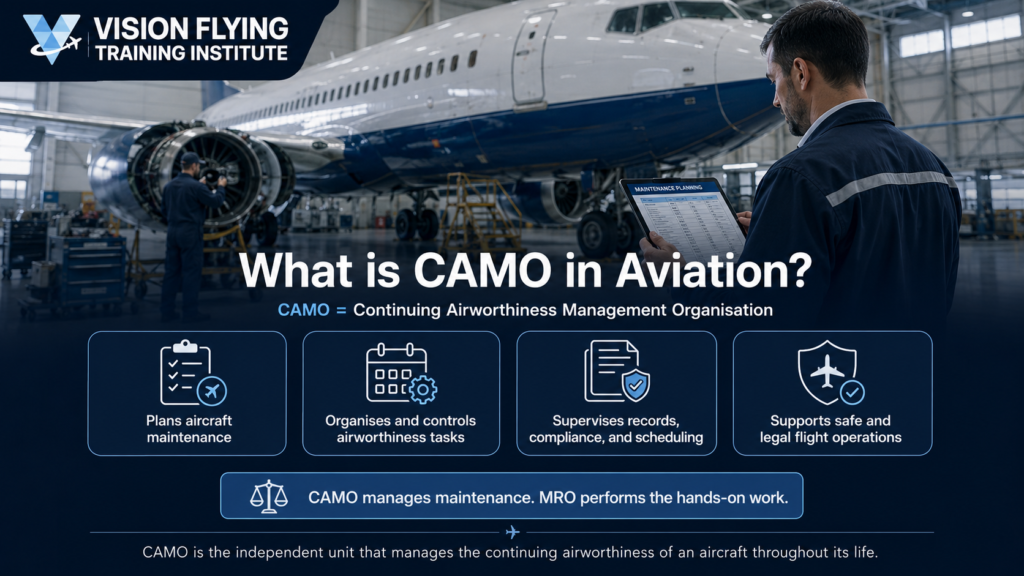
CAMO stands for Continuing Airworthiness Management Organisation. It is an organisation that is approved by the aviation regulator to manage the airworthiness of an aircraft throughout its life.
In simple words, the CAMO is the planner and manager of aircraft maintenance. Its main job is to plan, organise, implement, and control all the maintenance activities related to aircraft. The CAMO is responsible for the continuation of all the important tasks that are needed to meet high airworthiness standards.
The CAMO itself does not turn the spanner or change the engine oil. That work is done by another approved organisation, called the MRO. The CAMO sits above the maintenance work. It decides what is needed, plans it, supervises it, and keeps the records.
The whole management of aircraft maintenance inside an airline or operator is handled by the CAMO department. The CAMO is an independent unit. It lines up all the available resources, people, and time so that the goals of safe and legal flight operations can be met.
Where Did the CAMO Concept Come From?
The idea of CAMO was first introduced by EASA, the European Union Aviation Safety Agency, in 2003. It was part of a rule called EASA Part-M. In 2021, EASA gave CAMO its own separate rule, called Part-CAMO.
In India, the DGCA followed the same idea. It introduced CAR-M, which is harmonised with EASA Part-M. Indian operators who need to manage continuing airworthiness must follow CAR-M Subpart-G or the newer CAR-CAMO rules.
Types of CAMO in Aviation
The way a CAMO is organized can vary from one aviation organization to another. The type of CAMO depends on who runs it and who it serves.
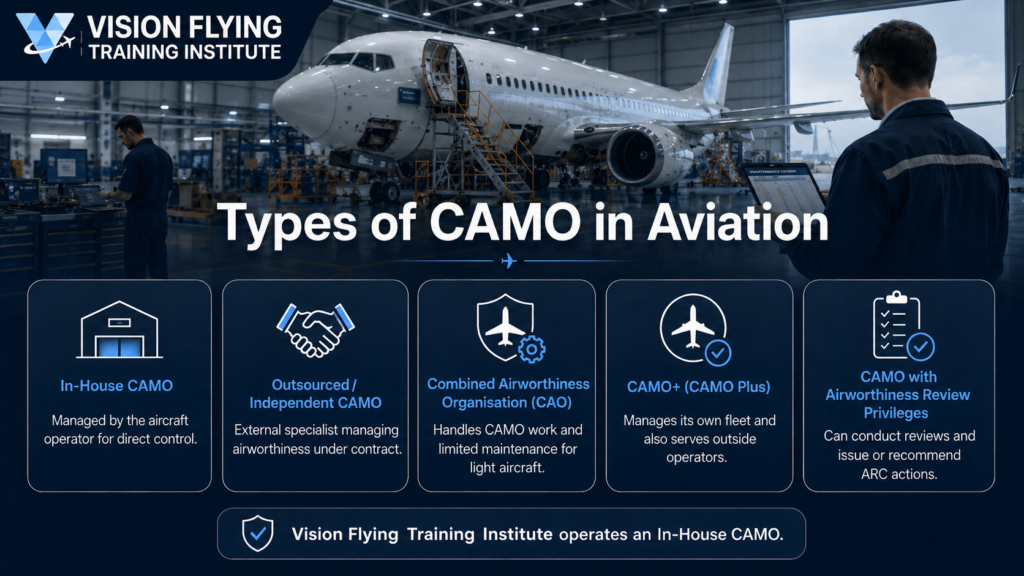
Knowing these types helps you understand why an airline CAMO looks very different from a pilot training institute’s CAMO.
- In-House CAMO
An in-house CAMO is owned and operated by the same company that uses the aircraft. Large airlines like IndiGo and Air India operate their own internal CAMO departments. This gives them direct control over maintenance schedules, technical decisions, and aircraft availability.
A flying training institute with an in-house CAMO has the same advantage. Decisions about training aircraft are taken on the same campus where students fly. Vision Flying Training Institute runs its own in-house CAMO department in this way. It manages all aspects of continuing airworthiness for its Tecnam and Cessna 172 training fleet under DGCA rules.
- Outsourced or Independent CAMO
An outsourced CAMO is a separate company that is hired under contract. This is common with private jet owners, lessors, charter operators, and smaller operators who cannot afford a full in-house CAMO team. An independent CAMO brings expertise, software, and trained staff. The trade-off is that day-to-day decisions sit outside the operator’s direct control.
- Combined Airworthiness Organisation (CAO)
A CAO is a newer type of organisation. It is allowed to do both CAMO work and some maintenance work on light, non-complex aircraft. The DGCA introduced CAR-CAO in line with EASA Part-CAO. The aim is to make airworthiness management easier and cheaper for private operators and small aero clubs.
- CAMO+ (CAMO Plus)
A CAMO+ is a CAMO that not only manages its own fleet, but also offers continuing airworthiness management services to other operators. It works like an in-house CAMO for its parent company and like an outsourced CAMO for outside clients.
- CAMO with Airworthiness Review Privileges
Some CAMOs are given extra privileges by the regulator. These extra privileges are called second privileges. A CAMO with these privileges is allowed to do the following:
- Carry out the physical Airworthiness Review of the aircraft
- Issue or recommend the issue of the Airworthiness Review Certificate (ARC)
- Issue a Permit to Fly for special maintenance check flights
An operator or institute with a CAMO that holds these privileges enjoys faster turnaround and lower dependence on outside reviewers.
Core Techniques and Functions of a CAMO
The work of a CAMO may look complicated from the outside. But it is built on a set of clear techniques. Each of these is required by DGCA CAR-M and CAR-CAMO, and the regulator audits these functions on a regular basis.
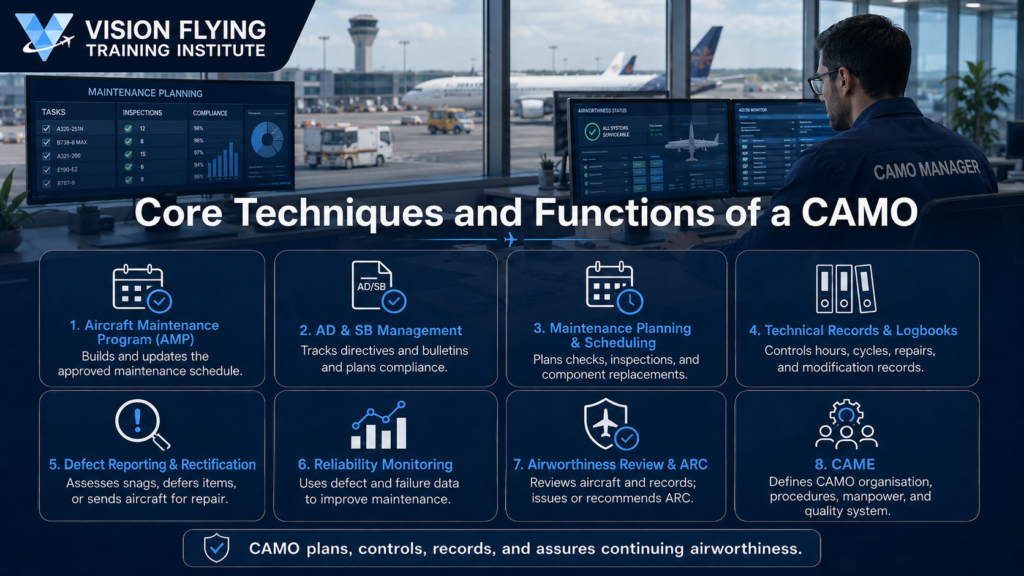
Here are the main ones every aviation student should understand.
- Developing the Aircraft Maintenance Program (AMP)
The Aircraft Maintenance Program is the master schedule of all inspections, checks, and component replacements for an aircraft. The CAMO builds this program using the manufacturer’s Maintenance Planning Document (MPD) and the Maintenance Review Board Report (MRBR). The completed AMP is then submitted to the DGCA for approval. Every change to the AMP also needs CAMO approval and acceptance by the regulator.
- Managing Airworthiness Directives and Service Bulletins
Airworthiness Directives, or ADs, are mandatory safety instructions issued by an authority such as the DGCA, FAA, or EASA. They are issued when a defect is found that affects flight safety.
Service Bulletins, or SBs, are issued by the aircraft manufacturer. Some SBs are mandatory, and some are recommended.
The CAMO tracks every AD and SB that applies to its fleet. It plans the compliance work within the deadline. It also keeps proof that the work has been completed. Missing even one AD can ground an aircraft instantly.
- Maintenance Planning and Scheduling
The CAMO plans every check needed for the aircraft. This includes the daily inspection, the 50-hour check, the 100-hour check, the annual inspection, and the replacement of hard-time components. Good planning keeps the aircraft on the ground for the shortest possible time.
- Technical Records and Logbook Management
The CAMO is the legal custodian of the aircraft’s technical history. This includes the following:
- Aircraft and engine logbooks
- Total flight hours and cycles
- Component time tracking for life-limited parts
- All inspection and repair records
- Modification and Supplemental Type Certificate (STC) records
These records must be tamper-proof and kept in a controlled environment. The CAMO must present them during every audit. These records also prove that the training aircraft used by a CPL student was legal to fly on the day of every flight.
- Defect Reporting and Rectification
Every snag written by a pilot in the Pilot Defect Report or the technical log comes to the CAMO. The CAMO then decides one of the following:
- Whether the aircraft is still airworthy and can keep flying
- Whether the defect can be deferred under the Minimum Equipment List (MEL)
- Or whether the aircraft must be grounded for repair by the MRO
- Reliability Monitoring
Modern CAMOs run a reliability program. This program uses data from in-service performance, repeat defects, and component failures. If a part is failing more often than expected, the CAMO triggers an investigation or adjusts the maintenance program. This is one of the most strategic and data-driven activities in airworthiness.
- Airworthiness Review and ARC Issuance
A CAMO with the right privileges performs a yearly Airworthiness Review. This is a combined physical survey of the aircraft and a review of its records. If everything is in order, the CAMO issues or recommends an Airworthiness Review Certificate (ARC).
The ARC is generally valid for one year. It can be extended by an approved CAMO, up to the limits set under CAR-M or CAR-CAMO.
- The Continuing Airworthiness Management Exposition (CAME)
Every approved CAMO must publish a CAME. This is a single master document approved by the DGCA. It explains the CAMO’s organisation, its procedures, its manpower, and its quality system. The CAME is the rulebook that the CAMO must follow every day. The DGCA audits the CAMO against its CAME.
DGCA Rules Governing CAMO in India
India has a clear and updated regulatory system for airworthiness. The DGCA notified an updated version of CAR-M on 31 July 2024. It also introduced three new rules called CAR-ML, CAR-CAO, and CAR-CAMO. These three new rules came into effect on 1 January 2025. They were brought in to reduce the compliance burden for light aircraft and non-scheduled operators, while still keeping safety standards high.
Here is a simple comparison of the main DGCA rules that deal with airworthiness:
| Rule | Full Name | What It Covers | Aligned With |
| CAR-M | Continuing Airworthiness Requirements | All aircraft, including scheduled airlines, non-scheduled operators, flying training, general aviation, and private use | EASA Part-M |
| CAR-145 | Approved Maintenance Organisation (AMO or MRO) | Maintenance of complex aircraft and aircraft used in commercial operations | EASA Part-145 |
| CAR-ML | Maintenance, Light | Simplified rules for light aircraft that are not used by scheduled air carriers | EASA Part-ML |
| CAR-CAMO | Continuing Airworthiness Management Organisation | Approval and operation of the CAMO function, as a separate rule | EASA Part-CAMO |
| CAR-CAO | Combined Airworthiness Organisation | Combined CAMO and limited maintenance approval for non-complex aircraft | EASA Part-CAO |
The most useful rules for an Indian flying training institute are CAR-M or CAR-ML, CAR-CAMO, and CAR-145.
Why CAMO Matters for Indian Pilot Students
When you choose a pilot course in India, you are not only choosing instructors and aircraft. You are also depending on the CAMO that keeps those training aircraft safe, legal, and ready to fly.
Here is how it affects you directly:
- It decides how many flying hours you get per month. A good CAMO keeps the aircraft serviceable and ready.
- It controls your training duration. Many CPL students complete their pilot course in 18 to 24 months instead of the advertised 8 to 12. A weak CAMO is one of the main hidden reasons for this delay.
- It protects your safety. Every Airworthiness Directive, every component life, and every defect record is tracked by the CAMO.
- It protects the value of your logged hours. Only the hours flown on properly maintained and regulator-approved aircraft are accepted by the DGCA and by airlines.
This is why a DGCA-approved flying training institute that runs its own in-house CAMO, like VFTI in Amreli, Gujarat, gives a real advantage to its students.
CAMO vs. MRO: What is the Difference?
This is one of the most common doubts among aviation students. CAMO and MRO are different, but they are partners. Neither one can function without the other.
| Aspect | CAMO | MRO (CAR-145) |
| Full Form | Continuing Airworthiness Management Organisation | Maintenance, Repair, and Overhaul Organisation |
| Primary Role | Plans, manages, and supervises airworthiness | Physically performs maintenance, repair, and overhaul work |
| Approval | DGCA CAR-M Subpart-G or CAR-CAMO | DGCA CAR-145 |
| Output | Aircraft Maintenance Programme, ARC, technical records | Certificate of Release to Service (CRS), serviceable aircraft |
| Hands-on Work | No. It is strategic and supervisory. | Yes. Done in the hangar with tools and components. |
| Reports To | Accountable Manager and DGCA | CAMO and DGCA |
A simple way to remember it is this. The CAMO is like a doctor who decides the treatment. The MRO is like a surgeon who performs the operation. Both are essential, and both must be DGCA-approved.
VFTI operates both a CAR-145-approved in-house aircraft MRO and an in-house CAMO department. This combination is rare in India. It is one of the strategic reasons VFTI’s training aircraft stay in the air, instead of sitting on the ground.
Strategic Uses of CAMO in Aviation
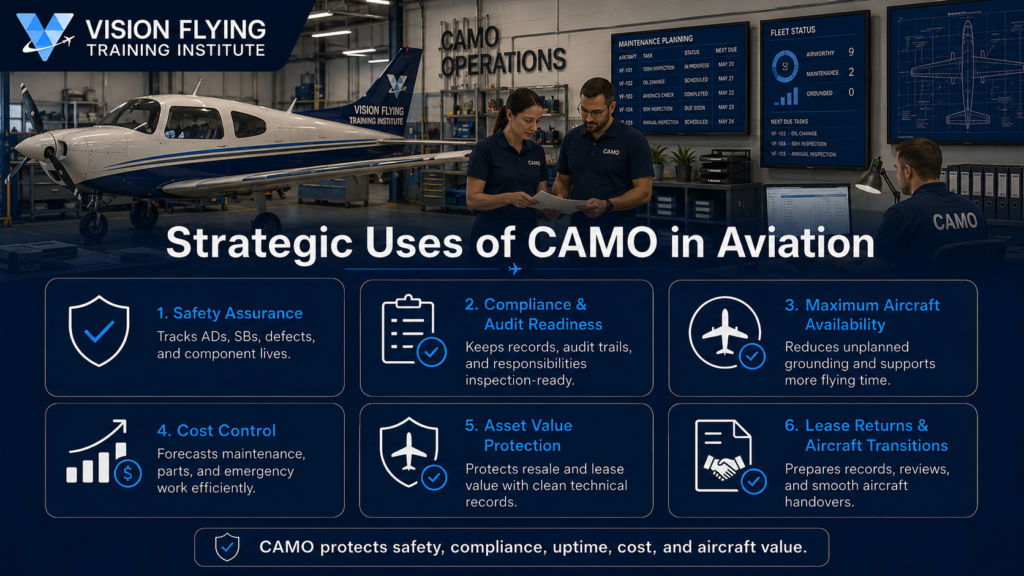
CAMO is a strategic asset for any aircraft operator. The reasons below show why airlines, lessors, flying training organisations, and private owners invest so much in their CAMO functions.
- Safety Assurance: CAMO makes sure that every flight takes off with full regulatory backing. By tracking ADs, SBs, component lives, and defect history, it reduces the chance of in-flight technical failure.
- Regulatory Compliance and Audit Readiness: The DGCA, EASA, and FAA can carry out inspections on very short notice. A properly run CAMO keeps all technical records, audit trails, and post-holder responsibilities ready for inspection on any day.
- Maximum Aircraft Availability: A well-planned CAMO reduces unplanned grounding. For a flying training institute, this means more flying slots for students. It also means faster completion of the 200 minimum flying hours, one of the DGCA Commercial Pilot Licence requirements in India.
- Cost Control: By forecasting maintenance needs, ordering parts on time, and avoiding emergency work, a CAMO directly controls the operating costs of a fleet. This is one of the biggest reasons airlines and flying schools invest in strong CAMOs. The savings show up clearly in the bottom line.
- Asset Value Protection: A well-maintained aircraft with clean and traceable CAMO records keeps a much higher resale or lease-return value. For aircraft lessors and finance companies, the CAMO is what protects the market value of the asset over its life.
- Lease Returns and Aircraft Transitions: When an aircraft is leased or sold, the new operator demands complete technical records. The CAMO is the team that prepares these records, manages the airworthiness review, and ensures a smooth handover.
CAMO in a Flying Training Organisation (FTO)
A pilot training institute is one of the toughest environments for a CAMO. The training aircraft flies several sectors in a day. They are handled by student pilots who are still learning. They operate from semi-controlled airfields. And they must be airworthy for every new slot.
In this environment, a strong CAMO delivers the following:
- High daily aircraft availability for cadet flying.
- Full compliance with CAR-M or CAR-ML and with CAR-CAMO, depending on the aircraft category.
- Tight management of training aircraft components, such as piston engines, propellers, brakes, and tyres, which see heavy wear during student flying.
- Smooth coordination with DGCA-licensed AMEs and CAR-145 engineers to keep turnaround short.
- Clean technical records that protect the legal value of the student’s logged flight hours.
What Makes VFTI Stand Out Among DGCA-Approved Flying Schools?
VFTI is a DGCA-approved Flying Training Organisation based at Amreli, Gujarat. It is part of the Vision Group of Institutions, which has over two decades of experience in education. What makes VFTI different on the airworthiness side is the integration of CAMO and MRO under one roof.
Here is what that means for a student who joins VFTI:
- CAR-145 approved in-house MRO. Your training aircraft are maintained on the same airbase where you fly.
- An in-house CAMO department that manages flight hours, cycles, ADs, SBs, technical records, and DGCA compliance for the entire training fleet.
- DGCA-licensed Aircraft Maintenance Engineers and experienced technicians who keep turnaround short.
- A modern training fleet that includes the Tecnam P2008 JC, Cessna 172 SkyHawk, Tecnam P-Mentor, and a Tecnam Multi-Engine Simulator.
- 365-day flying weather in the Amreli region, which helps convert maintenance day savings into actual flying days for students.
- Maintenance capability across multiple aircraft types, including the Cessna series, Tecnam, Diamond DA40 and DA42, and Piper PA-28.
This combination is exactly what CAR-M and CAR-CAMO are meant to encourage. It is a controlled, integrated, and audit-ready training environment. This is one of the most underrated factors that decides whether a CPL gets completed in 12 months or in 24.
Conclusion
When you choose a flying school for your pilot courses, do not stop at fleet size and brochure photos. Ask deeper questions. Is the school DGCA-approved? Does it have an in-house CAR-145 MRO? Does it run its own CAMO? Who is the Continuing Airworthiness Manager? The answers to these questions tell you more about your future flying hours than any advertisement.
A strong CAMO is not only about safety. It is about the predictability of your training, the integrity of your logged hours, and the professional foundation you carry into your airline career.
The aviation industry will judge you not only on how well you fly, but also on how well you understand the system that keeps you in the air.
If you are ready to train at a DGCA-approved Flying Training Organisation that gives you the rare combination of an in-house CAMO and CAR-145 MRO, year-round flying weather in Amreli, a modern Tecnam and Cessna fleet, and experienced flight instructors, then Vision Flying Training Institute (VFTI) is built for exactly that.
Take off with the right setup. Take off with VFTI.
Frequently Asked Questions (FAQs)
- What is CAMO in aviation, in simple words?
CAMO stands for Continuing Airworthiness Management Organisation. It is a team approved by the DGCA, EASA, or FAA that decides what maintenance an aircraft needs, when it needs it, and whether it is fit to fly. The CAMO does not do the maintenance itself. That work is done by a CAR-145-approved MRO.
- What is the difference between CAMO and MRO?
A CAMO manages and plans airworthiness. An MRO physically performs the maintenance. The CAMO is approved under CAR-M or CAR-CAMO. The MRO is approved under CAR-145. Both are needed, and they work as partners.
- Is CAMO mandatory for a flying training institute in India?
Yes. Any aircraft used for commercial flying training in India must have its continuing airworthiness managed under DGCA CAR-M, CAR-ML, or CAR-CAMO. The exact rule depends on the aircraft category. The CAMO function can be in-house or contracted to an approved CAMO.
- What is the full form of CAME in aviation?
CAME stands for Continuing Airworthiness Management Exposition. It is the approved master document that explains how a CAMO works. The DGCA audits the CAMO against its CAME.
- What is the validity of an Airworthiness Review Certificate (ARC)?
An ARC is typically valid for one year. It can be extended by an approved CAMO, generally for up to two further years, subject to the conditions set under CAR-M or CAR-CAMO.
- Why is CAMO important for a CPL student?
The quality of the CAMO behind a flying school decides aircraft availability. It also decides your monthly flying hours, the safety of every sortie, and the legality of the hours you log in your DGCA logbook.
- Does VFTI have its own CAMO?
Yes. VFTI operates its own in-house CAMO department alongside a DGCA CAR-145-approved MRO, both based at the Amreli airbase. This integrated setup is one of the reasons VFTI is able to maintain consistent aircraft availability for cadet flying.