Tag: apply for pilot training in india

  • How to Apply for Pilot Training in India: Guide [2027]

    How to Apply for Pilot Training in India: Guide [2027]

    Becoming a commercial pilot is a career goal for many students in India. However, for many aspiring pilots, the biggest challenge is understanding the correct process to achieve it. 

    Questions like:

    • Can I become a pilot after Class 12?
    • What qualifications are required for pilot training in India?
    • How much does CPL training cost?
    • Which flying school should I choose?
    • How long does it take to become a commercial pilot?

    are common among students and parents planning an aviation career.

    The process of becoming a pilot in India is structured and regulated by the Directorate General of Civil Aviation (DGCA), the regulatory authority responsible for civil aviation safety and licensing in India. Candidates must complete specific eligibility requirements, medical examinations, theoretical training, flying hours, and DGCA examinations before obtaining a Commercial Pilot Licence (CPL) in India.

    Choosing the right flying school is one of the most important decisions in this journey. A good DGCA-approved Flying Training Organisation (FTO) provides structured training, experienced instructors, aircraft availability, safety-focused operations, and proper guidance throughout the licensing process.

    This guide explains how to apply for pilot training in India in 2026. It covers every important step, from checking eligibility requirements to completing CPL training and beginning your aviation career. 

    Key Steps to Follow When Applying for Pilot Training in India 

    The process of becoming a commercial pilot in India follows a structured pathway that combines academic eligibility, medical fitness, theoretical knowledge, and practical flight training.  
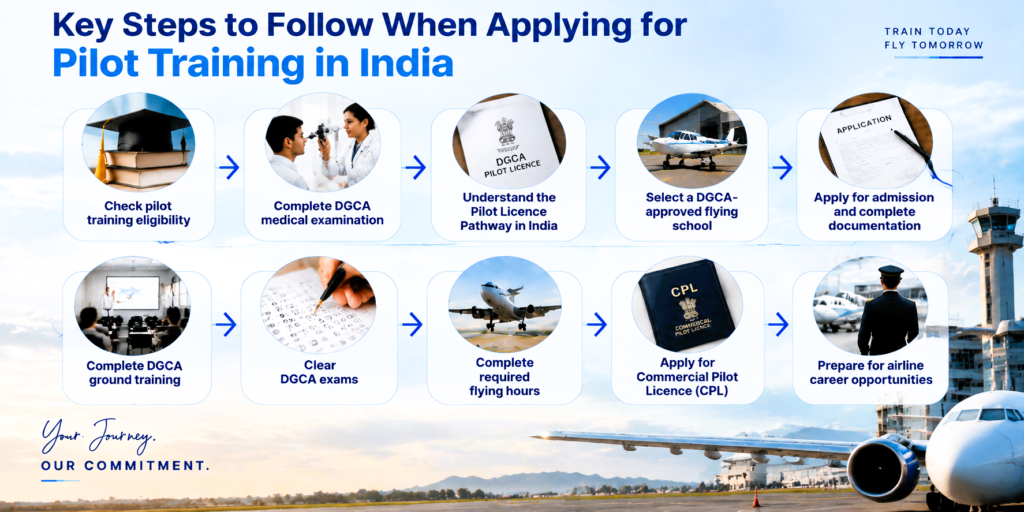
    Pilot training pathway in India, from eligibility and DGCA medical exams to flight training, CPL, and airline career opportunities.

    The following steps provide proper guidance on the pilot training process in India. 

    1. Check pilot training eligibility
    2. Complete DGCA medical examination
    3. Understand the Pilot Licence Pathway in India 
    4. Select a DGCA-approved flying school
    5. Apply for admission and complete documentation
    6. Complete DGCA ground training
    7. Clear DGCA exams
    8. Complete required flying hours
    9. Apply for Commercial Pilot Licence (CPL)
    10. Prepare for airline career opportunities

    Step 1: Check Your Eligibility for Pilot Training in India 

    Before applying to any flying school, candidates should first confirm whether they meet the basic eligibility requirements for commercial pilot training.

    The DGCA has defined specific criteria related to age, education, medical fitness, and documentation.

    RequirementDetails
    Minimum Age 17 years to begin flight training 
    Education 10+2 or equivalent qualification 
    Subjects Required Physics and Mathematics 
    Medical Fitness DGCA-approved medical assessment 
    Language Requirement Ability to read, write, and communicate in English 

    Educational Qualification Required for Pilot Training

    Candidates applying for CPL training in India must meet the following requirements: 

    • Passed Class 12 (10+2) or equivalent examination
    • Studied Physics and Mathematics as compulsory subjects

    Students who did not have Physics and Mathematics in Class 12 can complete these subjects separately through recognised boards such as NIOS before applying for CPL training.

    Why Are Physics and Mathematics Important Eligibility Requirements for Pilot Training? 

    Pilot training involves technical subjects such as:

    • Aircraft performance
    • Navigation calculations
    • Weather interpretation
    • Flight planning
    • Aviation principles

    A basic understanding of mathematics and physics helps students understand these concepts effectively during their pilot training.

    Step 2: Complete DGCA Medical Examination Before Starting Training 

    Medical fitness is one of the most important requirements for becoming a pilot.

    Many students make the mistake of investing significant time and money into their preparation without completing their medical assessment first.

    Completing the DGCA-approved medical tests at an early stage helps candidates understand whether they meet aviation fitness standards before beginning professional training.
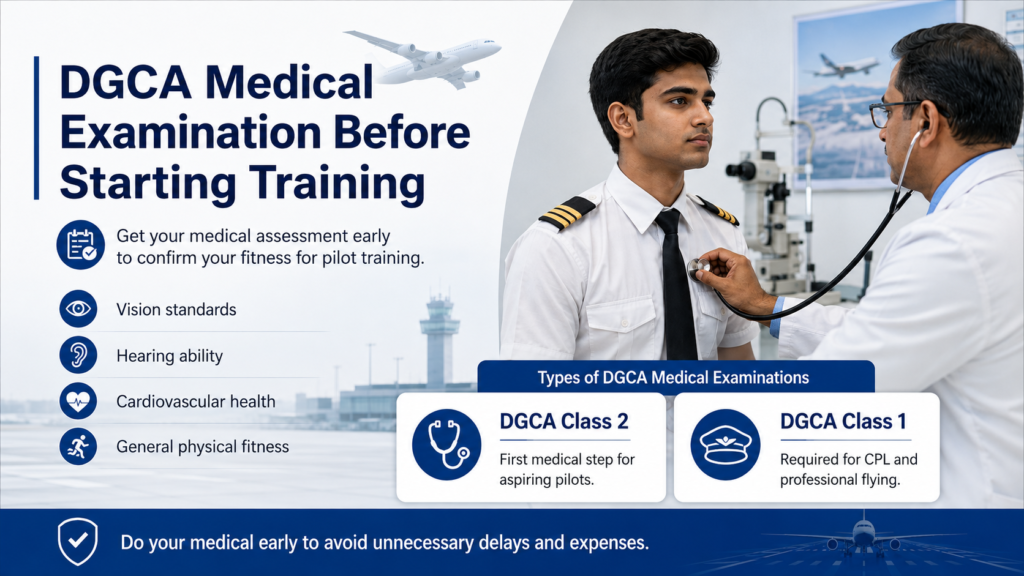
    DGCA medical examination for aspiring pilots, covering vision, hearing, cardiovascular health, and physical fitness.

    Types of DGCA Medical Examinations for Pilots

    DGCA Class 2 Medical Examination

    Class 2 medical is generally the first medical assessment completed by aspiring pilots.

    It confirms that a candidate meets the basic health requirements necessary to begin flight training.

    DGCA Class 1 Medical Examination

    Class 1 medical certification is required for commercial pilots who want to obtain their CPL and work professionally.

    The examination evaluates several health parameters, including:

    • Vision standards
    • Hearing ability
    • Cardiovascular health
    • General physical fitness
    • Overall medical suitability for aviation duties

    Candidates should always complete their medical assessment through a DGCA-approved medical examiner.

    Aspiring pilots should complete their DGCA Class 1 Medical Examination before starting their pilot training. This is a smart step to make sure that they meet the required medical standards for obtaining a Commercial Pilot Licence (CPL). 

    Since flight training involves a significant investment of time and money, completing the medical assessment at the beginning helps candidates avoid unnecessary expenses and ensures they can confidently continue their journey toward becoming a professional pilot. 

    Step 3: Understand the Pilot Licence Pathway in India 

    Before selecting a flying school, students should understand the different pilot training courses available. 

    Types of Pilot Training Courses in India 

    Pilot training courses in India follow a structured licensing system regulated by the Directorate General of Civil Aviation (DGCA). Each licence represents a different stage of a pilot’s development and is designed for a specific purpose. Understanding these licences helps aspiring pilots choose the right training pathway based on their career goals.
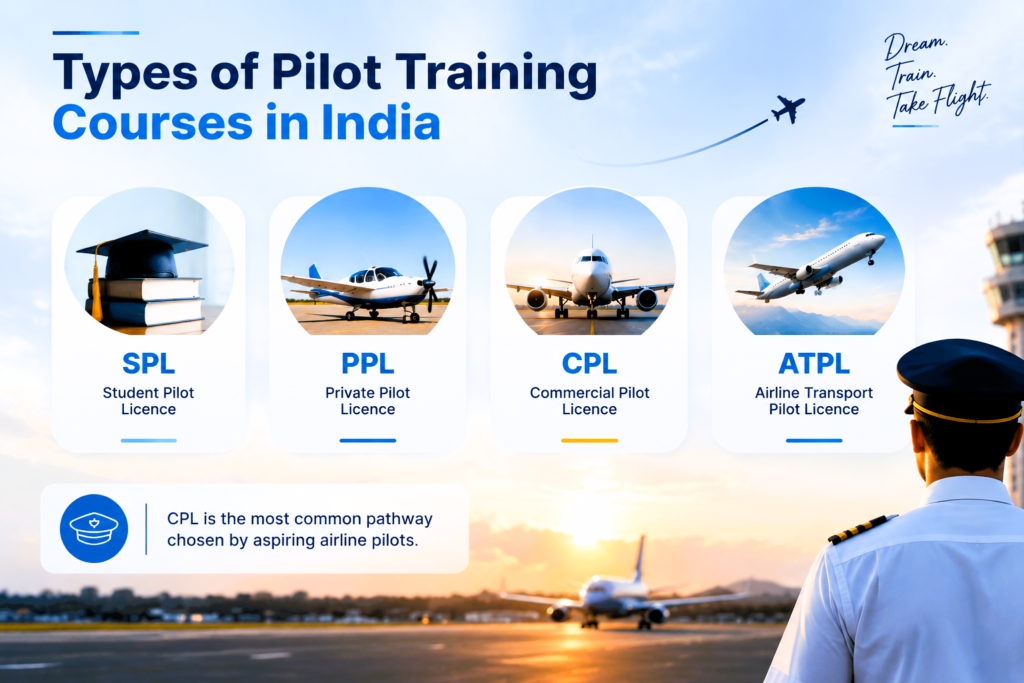
    Types of pilot training courses in India: SPL, PPL, CPL and ATPL.

    The major pilot training licences in India include: 

    • Student Pilot Licence (SPL) 
    • Private Pilot Licence (PPL) 
    • Commercial Pilot Licence (CPL) 
    • Airline Transport Pilot Licence (ATPL) 

    Among these licences, the Commercial Pilot Licence (CPL) is the most common pathway chosen by aspiring airline pilots. Completing CPL training allows candidates to meet the required qualifications and build the foundation needed to pursue a professional flying career. 

    Step 4: Choose the Right DGCA Approved Flying School

    Selecting the right flying school is one of the most important decisions an aspiring pilot will make. The institute you choose plays a major role in shaping your training experience, flying skills, and overall journey toward obtaining a Commercial Pilot Licence (CPL).

    Factors such as training quality, aircraft availability, instructor experience, maintenance standards, student support, and operational efficiency directly impact how smoothly and quickly a student can complete their CPL training.

    While comparing flying schools, students should not make their decision based only on the course fees. A school offering lower fees may not always provide the best value if it has limited aircraft availability, longer waiting periods, or delays in completing required flying hours. These factors can increase both the overall training duration and the total cost of becoming a pilot.

    Vision Flying Training Institute (VFTI) is among the best flying institutes for pilot training in India, offering structured pilot training programs designed for students who want to build a professional aviation career. 

    Step 5: Apply for Admission to a DGCA-Approved Flying School

    Once you have confirmed your eligibility and selected a suitable flying school, the next step is to complete the admission process.

    Every flying school may have a slightly different admission procedure, but the overall process generally includes document verification, medical clearance, registration formalities, and student onboarding.

    A professional flying school will guide students through the documentation process and explain the complete training roadmap before they begin their classes.

    How to Apply for Pilot Training Admission at VFTI

    The admission process at VFTI begins with an enquiry and eligibility assessment. Students interested in starting their pilot training journey can connect with the admissions team to understand the course structure, eligibility requirements, and next steps.

    The general admission process includes:

    • Submit an enquiry through the VFTI admission form or contact the admissions team 
    • Qualifying eligibility requirements 
    • Complete the required DGCA medical assessment 
    • Submit the required documents for verification 
    • Complete admission formalities and begin your pilot training program 

    VFTI provides guidance to aspiring pilots throughout the admission process, helping students understand the requirements before starting their CPL journey. 

    Step 6: Complete DGCA Ground School Training

    Flying an aircraft requires more than practical flying skills. Before entering the cockpit, pilots must understand aviation theory, regulations, aircraft systems, weather conditions, navigation procedures, and communication standards.

    This classroom-based learning is known as ground school training.

    During ground classes, students develop the technical knowledge required to safely operate an aircraft and clear DGCA examinations.

    Step 7: Clear DGCA Pilot Examinations

    After completing ground training, students must clear the required DGCA examinations.

    These examinations test whether a candidate has sufficient theoretical knowledge to operate aircraft safely.

    Step 8: Begin Flight Training and Build Flying Experience

    After completing the required initial training stages, students begin practical flight training.

    This is the stage where classroom knowledge is applied in real aircraft operations under the supervision of qualified flight instructors.

    Flight training gradually progresses from basic aircraft handling to advanced flying skills required for commercial aviation.

    Step 9: Apply for Commercial Pilot Licence (CPL) 

    After completing all DGCA requirements, including examinations and flight training, candidates can apply for their Commercial Pilot Licence.

    The CPL is the professional licence that allows pilots to pursue commercial aviation opportunities.

    After obtaining a CPL, pilots may explore careers such as:

    • Airline pilot
    • Charter pilot
    • Corporate aviation pilot
    • Flight instructor
    • Aviation operations roles

    However, CPL is not the final step for airline employment. Airlines usually conduct their own selection process.

    How Long Does It Take to Become a Pilot in India?

    The duration of pilot training varies depending on the student’s progress and the operational capability of the flying school.

    On average, students may complete their CPL training within approximately 18 to 24 months.

    Factors that can affect completion time include:

    • Weather interruptions
    • Aircraft maintenance schedules
    • Student availability
    • Flying frequency
    • Examination preparation

    Students should choose the right Flying Training Organisation that focuses not only on admission numbers but also on timely training completion.

    Skills That Help Pilots Build a Successful Aviation Career

    A pilot’s career depends on much more than technical flying ability. Successful pilots develop a combination of technical knowledge, professional discipline, and personal skills that help them handle complex aviation situations safely and effectively.
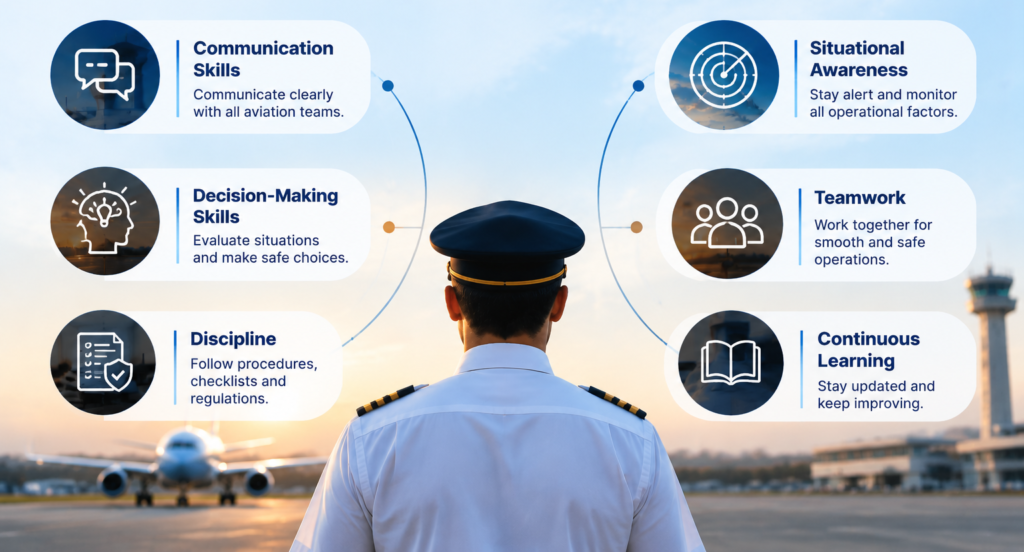
    Key skills for aspiring pilots, including communication, decision-making, discipline, situational awareness, teamwork, and continuous learning.

    Key skills every successful pilot should develop include:

    • Communication Skills: Pilots must communicate clearly and effectively with co-pilots, cabin crew, air traffic controllers (ATC), and ground teams to ensure safe flight operations.
    • Decision-Making Skills: Pilots need strong decision-making abilities to evaluate situations, manage risks, and make safe choices during normal and unexpected flight conditions.
    • Discipline: Aviation requires strict adherence to procedures, checklists, safety protocols, and regulations. Professional discipline is essential for maintaining flight safety.
    • Situational Awareness: Pilots must continuously monitor their surroundings, aircraft performance, weather conditions, and operational factors to make informed decisions.
    • Teamwork: Pilots work closely with flight crew, air traffic controllers, engineers, and aviation professionals. Strong teamwork ensures smooth and safe operations.
    • Continuous Learning: Aviation technology, regulations, and procedures continue to evolve. Successful pilots stay updated and continue improving their knowledge and skills.

    A strong foundation during pilot training helps students develop these professional qualities early and prepares them for the responsibilities of a commercial aviation career.

    Learn more about the essential skills required to build a successful aviation career in our detailed blog: “What Skills Do Pilots Need to Get Hired as a Pilot?”


    Why Vision Flying Training Institute (VFTI) is a Preferred Choice for Pilot Training in India

    Vision Flying Training Institute (VFTI) provides structured pilot training for students who want to build a professional aviation career. Located at Amreli Airport, Gujarat, VFTI offers an aviation-focused environment where students can concentrate on developing their flying skills and theoretical knowledge. 

    The following points should be taken into account regarding VFTI: 

    1. VFTI follows DGCA-approved training standards to help students complete their pilot course according to Indian aviation requirements.
    2. VFTI provides training aircraft designed for student pilot development, including modern single-engine training aircraft.
    3. Students receive guidance throughout their pilot training journey.
    4. They focus on providing students with structured training and practical exposure needed to develop confidence as future aviation professionals.

    Conclusion

    Becoming a pilot in India requires planning, commitment, and choosing the right training pathway.

    The process may seem complex at first, but when broken into clear steps, it becomes easier to understand. 

    Your journey from a student pilot to a professional aviator begins with choosing the right training partner. 

    Contact our admission consultants today!

    Call: +91 9319193602, +91 9319193605 

    Email: enquiry@vfti.in

    Vision Flying Training Institute helps aspiring pilots take that first step toward the cockpit.

  • Pilot Course Fees & Duration in India [2027 Guide]

    Pilot Course Fees & Duration in India [2027 Guide]

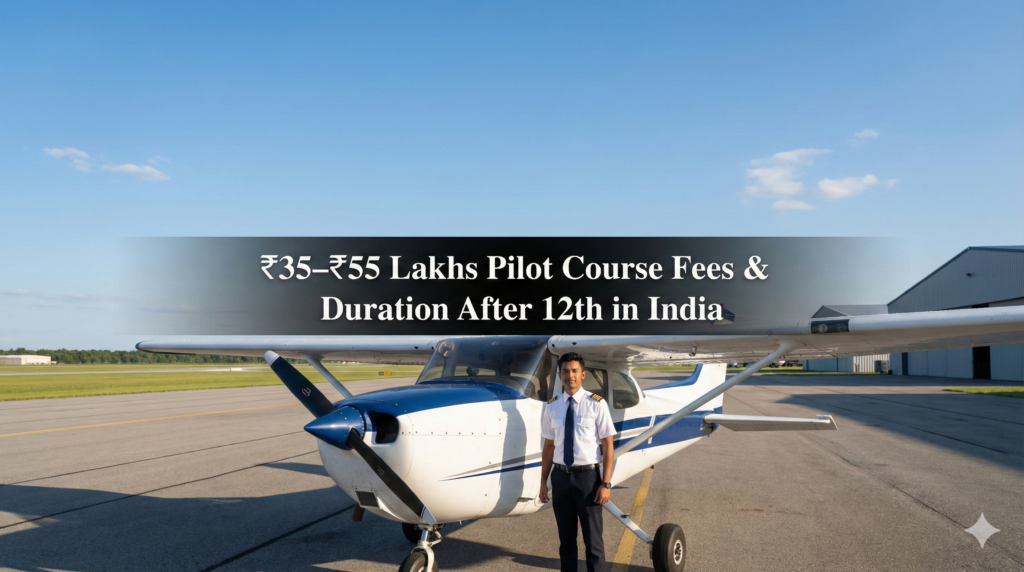
    An image featuring a pilot and trainer aircraft.

    There’s so much data online about pilot course fees, and incorrect information may mislead people from pursuing their ambition, assuming it’s out of budget. When any student searches for “pilot course fees & duration”, many websites just throw random numbers.

    While in actual some Indian students spend around ₹ 70–₹ 80 lakh, while others spend about ₹ 35–₹ 45 lakh for DGCA CPL training in India. 

    The difference depends on the flying institute, per-hour flying rates, training speed, aircraft availability, and how fast you clear DGCA exams. 

    This guide breaks down pilot training costs in and outside India to help you budget smart and choose the top flying institute, like Vision Flying Training Institute, a school that gets you flying rather than making you scared of the fees.

    What does a “pilot course” usually mean in India

    There are mainly two types of pilot licenses: a private pilot license and a commercial pilot license. 

    In India, when people refer to a “pilot course,” they usually mean the Commercial Pilot Licence (CPL). This licence is essential for securing airline jobs, including for students searching “How to Become a Commercial Female Pilot After 12th.”

    Checkout our guide on how to apply for pilot training in India which walks you through the process before you dive into the numbers.

    However, CPL is not a single fee or a fixed timeline. It involves multiple steps: 

    • DGCA eligibility and medical exams 
    • DGCA ground school and exams 
    • Flying training, which must meet the minimum hours set by DGCA 
    • Skill Tests and Licence paperwork 
    • Multi-Engine and Instrument Rating, often included in “airline-ready” training
    • Type Rating for aircraft like the Airbus A320 or Boeing 737


    Pilot Course Duration in India


    Many flight institutes mention a single fixed duration, but in reality, timelines often vary. 

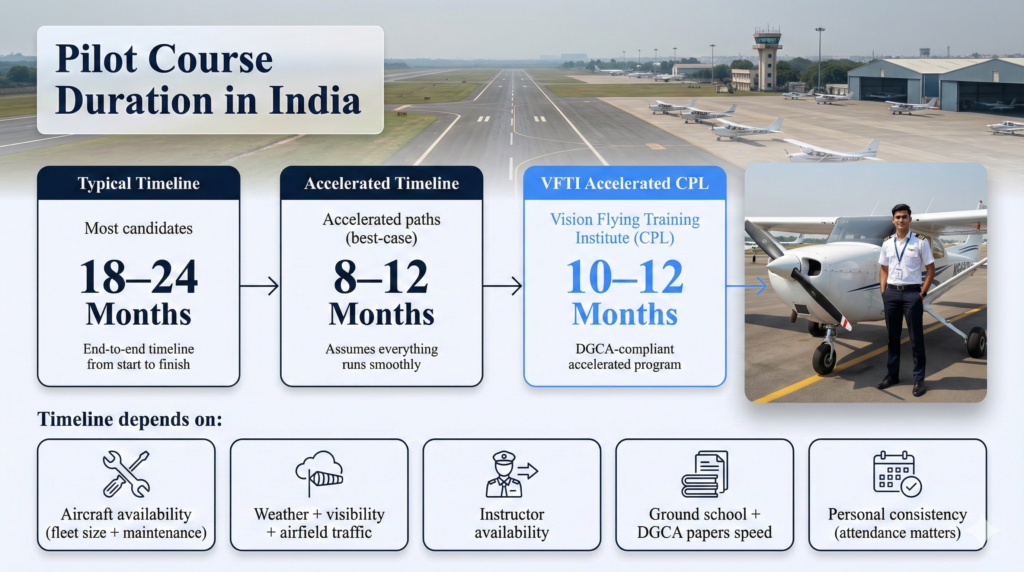
    Your timeline depends on:

    1. Aircraft availability, including fleet size and maintenance schedule
    2. Weather days, visibility, and airfield traffic
    3. Instructor availability
    4. How quickly you finish Ground school and complete DGCA papers, as many delays begin here
    5. Your personal consistency, since your attendance matters more than motivational quotes

    Most candidates take about 18 to 24 months from start to finish. Some accelerated paths advertise 8 to 12 months, but that usually assumes everything goes smoothly. 

    Vision Flying Training Institute’s Commercial Pilot License (CPL) program is designed to offer high-quality, DGCA-compliant pilot training within a 10 to 12-month accelerated timeline.


    A Realistic Pilot Training Duration & Timeline for Becoming a Pilot

    This structure matches how pilot training is typically organised across India.

    PhasePilot Training ProcessTypical Duration
    Step 1Medical + DGCA computer number + onboarding2-6 weeks
    Step 2Ground school + DGCA exam prep3-6 months
    Step 3Flight training hours building8-18 months
    Step 4Skill test + licence processing4-10 weeks
    Step 5 (Optional)Type rating + airline readiness1-3 months

    Pilot Course Duration by Path in India

    PathWhat You GetTypical Duration
    Traditional CPL routeDGCA CPL (plus your chosen add-ons)10 to 12 months (common planning range)
    CPL + Type Rating laterCPL first, then type rating when ready15 to 30 months, depending on the gap
    Cadet Pilot ProgramStructured airline training  and type ratingOften ~18 to 24 months (varies by program) 

    Pilot course duration without Physics and Mathematics

    DGCA’s published rules still require Physics and Mathematics (10+2) for a Commercial Pilot Licence (CPL) and for a Student Pilot Licence (SPL).  You usually cannot start flight training in India until you complete these subjects. 

    Commerce students can become pilots in India only after passing these subjects. 

    Therefore, the pilot course duration without Physics and Mathematics effectively becomes: the time to add Physics or Mathematics plus the usual CPL duration. 

    You can fill this eligibility gap through NIOS (National Institute of Open Schooling): 

    NIOS Public Exams take place twice a year: April-May and October-November. 

    NIOS On-Demand Examination System (ODES/ODE) allows learners to take exams based on their readiness, not just fixed annual dates. Results are usually published in the last week of each month for exams conducted in the previous month.

    How soon you complete pilot training depends on how fast you become eligible and then complete the 10–12 month CPL program.

    What Factors Decide the Total Pilot Training Fees?

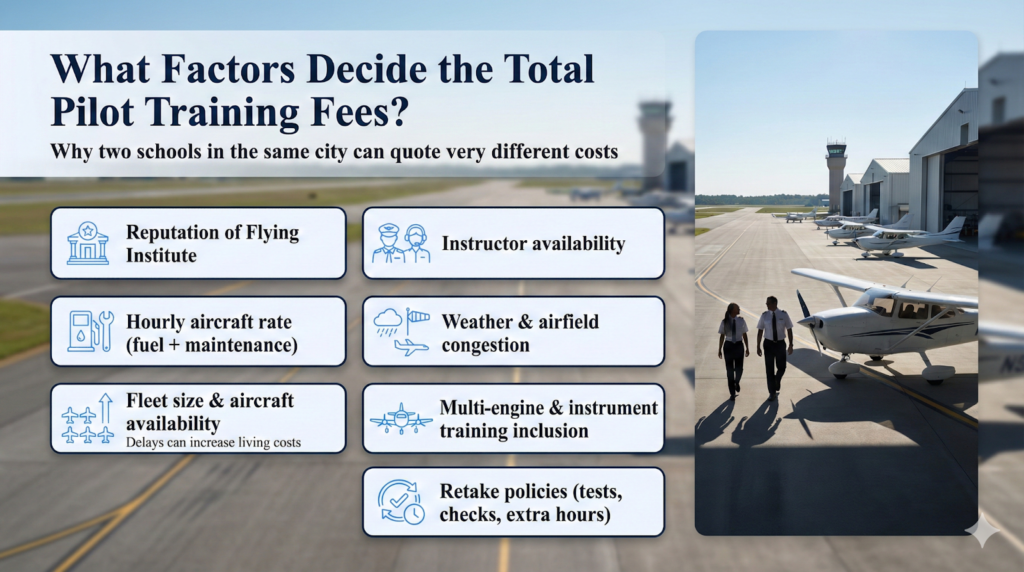
    An educational infographic explaining the variables that impact the total cost of pilot training.

    Even in the same city, two schools can report very different numbers due to:

    • Reputation of Flying Institute
    • Hourly aircraft rate and fuel/maintenance costs
    • Fleet size and aircraft availability (delays lead to higher living costs)
    • Instructor availability
    • Weather and airfield congestion
    • Inclusion of multi-engine and instrument training
    • Retake policies (tests, checks, extra hours)

    Here’s the cost structure for the pilot training course you should budget for:

    Cost HeadWhat it coversNotes
    Flying hours (single-engine)The bulk of your 200-hour requirementBiggest cost driver
    Multi-engine flyingOften 10–15 hours, depending on school/packageHelps with airline readiness
    Simulator sessionsInstrument practice; some hours can count toward requirementsDGCA allows limited simulator credit for instrument time
    Ground schoolDGCA theory subjects + internal testsQuality matters a lot for DGCA papers
    DGCA exam feesDGCA Pariksha exam fee per paperCommonly published as ₹2500 per paper (plus other DGCA-related processing costs)
    Medical (Class 1/2), admin, uniform, materialsRequired formalities + logisticsOften underestimated by students
    Stay + foodMonthly expense during training A major cost leak. So duration is not just time, it’s literally money.

    Pilot Course Facilities in India vs International Flight Schools

    Choosing where to do pilot training is important because it affects cost, how quickly you train, and the cockpit technology you learn on. Two schools might both offer “CPL training,” but the equipment you use, such as aircraft, avionics, simulators, and planning systems, can make a big difference in your experience.

    When flight schools mention “good facilities,” they are generally referring to:

    • Fleet and dispatch reliability (how many aircraft are actually flying each day)
    • Simulators (which are especially useful for instrument training)
    • Ground school setup (briefing rooms, computer-based training, mock tests, instructor support)
    • Maintenance support (downtime leads to delays and higher living costs)
    • Airport + airspace environment (traffic, ATC restrictions, slot issues)
    • Training environment (weather, airspace congestion, runway access)

    India has also expanded training capacity. There are now 40 DGCA-approved flight training organizations with 385 trainer aircraft as of January 22, 2026.

    Even though the pilot training facilities at International Flight Schools are more advanced than those in India. Before you choose a pilot training school, whether in India or abroad, consider how to make your decision.

    Here is a side-by-side comparison:

    Facility factorIndia (DGCA-approved FTOs)International (typical FAA Part 141 / EASA ATO style)
    Training aircraftMany schools use proven single-engine trainers; multi-engine exposure depends on the instituteLarger academies often have more structured fleet planning; multi-engine access may be easier in bigger setups
    Cockpit technology (Avionics)A mix of analogue and glass cockpit, depending on the school/fleetGlass cockpit training is common in structured programs; modern avionics are often standard
    SimulatorsUsually Limited full-motion simulators,  Flight and Navigation Procedures Trainer (FNPT) devicesClear device classification and heavy full-motion simulator integration are common
    Ground school toolsClassroom and instructor-led learning; quality depends onthe  instituteStrong use of structured syllabi, CBT tools, and standardised stage checks is common
    Training speed (realistic completion)More dependent on aircraft availability  and scheduling disciplineOften faster in large academies due to stronger infrastructure and tighter systems
    Student support systemsHostel/transport/support varies widely; always confirm what’s included vs self-managed.Many bigger academies package support systems (housing coordination, transport guidance), but costs can be higher

    In India, the top pilot training facilities operate with international systems, a modern fleet, proper simulator use, careful training planning, and strong maintenance discipline.

    Vision Flying Training Institute, one of the best institutions for pilot training, offers:

    • Modern training fleet and simulator ecosystem: Tecnam P2008 JC, Tecnam P-Mentor, Cessna 172 Skyhawk, and a Tecnam Multi-Engine Simulator as part of their fleet.
    • Glass cockpit training on the Cessna 172: Their C172 features the Garmin G1000 glass cockpit. This helps students become familiar with the screen-based navigation style used in modern flying.
    • Training airbase in Gujarat: VFTI mentions its airbase at Amreli Airport, Gujarat, which supports dedicated training operations away from the crowded metro areas.
    • “365 Days Weather” positioning: VFTI highlights its year-round flying weather as a key benefit for consistent hour-building.
    • CAR-approved in-house maintenance: VFTI states it has an in-house MRO facility and notes CAR-145 approval along with CAMO/MRO services. This is vital for reducing downtime and maintaining high aircraft serviceability.

    Pilot course fees in India after 12th

    After completing 12th grade with Physics and Maths, many aspiring pilot students’ main goal is often a DGCA Commercial Pilot Licence (CPL). 

    Most Indian students should plan to spend ₹40 lakh to ₹60 lakh for CPL training in India, which includes ground training, flying, and basic courses.

    Costs can be lower at some government or state flying clubs. However, they may increase if you require extra flying hours, encounter weather or aircraft delays, or choose premium options.

    Typical Pilot Course Fees for Different Pilot Licences

    Here’s a quick overview of the typical fees and time needed for each pilot license (SPL, PPL, CPL, and more). This will help you plan your budget and timeline without getting confused by random estimates.

    Course / StepTypical fee range (India)
    Student Pilot Licence (SPL) for Aeroplane₹0.5-1 lakhs
    Student Pilot Licence (SPL) for Helicopter₹0.5-1.5 lakhs
    Private Pilot Licence (PPL) for Aeroplane₹8-12 lakhs
    Private Pilot Licence (PPL) for  Helicopter₹15-30 lakh
    Commercial Pilot Licence (CPL) for Aeroplane₹45-55 lakhs
    Commercial Pilot Licence (CPL) for Helicopter₹35-55 lakh
    Airline Transport Pilot Licence for Aeroplane4-8 lakh (exams only)
    Airline Transport Pilot Licence for Helicopter4-9 lakh (exams only)

    Commercial Pilot License cost breakdown

    A Commercial Pilot Licence (CPL) is a professional pilot training program that can lead to airline jobs and a pilot’s salary in India. This cost breakdown gives a reliable benchmark of what CPL training typically costs in India.

    ComponentWhat you pay forTypical Range
    Flying school CPL trainingAircraft, instructor, and operations₹35-₹55 lakhs
    Ground schoolDGCA subjects, tests, and study support₹1.5-4 lakhs
    DGCA exams and licensing/adminDGCA attempts and  paperwork₹50,000-₹1.5 lakh
    Medicals (Class 1/2)Tests and renewals if needed₹10,000-₹50,000
    Instrument exposure within CPL10 hours of instrument time requiredUsually bundled
    Multi-Engine add-onRequired by many airlines (preferred)₹3-8 lakhs
    Type Rating (A320/B737 etc.)Usually post-CPL₹12-25+ lakh
    Equipment & miscHeadset, uniform, charts, logbookOften ₹1-₹3 lakhs, depending on brand/requirements

    Pilot Course Fees in Government Flying Institutes

    When people mention “government pilot course fees,” they usually refer to flying training programs that are run by the government or are linked to it. 

    Government Flying Institutes do not offer cheaper pilot training. These flying schools, like private ones, also charge between ₹ 45 and ₹ 50 lakhs for pilot courses.


    Published examples of “government/state-linked” fee structures

    Instead of vague ‘starting from’ figures, the table below shows real, published government/state-linked pilot course fee structures.

    Institute / Flying ClubPublished feeWhat it shows
    Madhya Pradesh Flying Club (MPFC)≈ ₹42,15,500 (estimate)Includes 185 hrs @ ₹18,000/hr, 15 hrs @ ₹45,000/hr, simulators, and approx. “other expenses.”
    Haryana Institute of Civil Aviation (HICA) CPL estimate shown around ₹51L+ with hourly rates like ₹9,000/hr (C152) and ₹10,000/hr (C172)Good example of how per-hour pricing shapes totals
    Indira Gandhi Rashtriya Uran Akademi₹55,00,000 (Ab-initio to CPL with IR & multi-engine endorsement)One of India’s most referenced government-linked benchmarks

    Pilot Course Fees in Government vs Private Flying Institutes

    Government and state-linked institutes often publish clear rate cards for per-hour aircraft charges or fixed packages, which is great for transparency. However, seats and timelines can be competitive. 

    On the other hand, private DGCA-approved schools can be faster or more flexible. Pricing varies a lot based on fleet availability and what is bundled. As a result, the same “CPL fee” can look similar on paper but still end up being different in your final bill if the inclusions are not clearly listed.

    Cost areaGovernment/state examplesPrivate DGCA-approved Schools
    Flying hourly rate (single-engine examples)Can be ~₹9,000–₹10,000/hr in published structures (aircraft dependent)Varies widely; usually higher when demand is high, and fleets are limited
    Course package examplesIGRUA published a package for ab-initio to CPL with IR + multi-engine: ₹55,00,000Many market ranges cluster around ₹45–₹55 lakh for CPL planning 
    Best forStudents who want published/structured fee frameworks and govt-backed processesStudents optimizing for faster timelines, location preferences, or specific operational advantages
    Watch-outsSeat availability and selection timelinesHidden extras, if not clearly listed in the fee sheet

    Pilot Course Abroad (International Flying Organizations)

    A lot of Indian students look into training abroad for a few reasons:

    • Faster flying hour accumulation in certain places.
    • Different weather patterns.
    • Better training facilities.

    However, you also need to think about license conversion, DGCA papers, and documentation.

    Now we will compare pilot course fee ranges across India and four major overseas options.


    Comparison of Pilot Course Fees in India, USA, Europe, Australia, and Canada

    Here’s a country-by-country look at pilot training fees across top aviation hubs.

    RegionLicence/RegulatorCore Minimum Flight TimeCost Reference
    IndiaDirectorate General of Civil Aviation (DGCA) CPLDGCA CPL requirements are 200 hours of flying trainingIGRUA course fee example ₹55,00,000
    USAFederal Aviation Administration (FAA) CPL250 hours required for Commercial Pilot (Aeroplane)Fast-track pricing published by ATP Flight School: $123,995 (zero-to-commercial and instructor certificates)
    EuropeEuropean Union Aviation Safety Agency (EASA) CPL trackEASA integrated CPL training course includes at least 150 hours of flying training FTEJerez price sheet lists €126,500 for an airline first officer program package
    AustraliaCivil Aviation Safety Authority (CASA) CPLCASA guidance shows 200 hours for non-integrated CPL; integrated pathways can be lower RMIT lists 2026 flight training fees as AU$87,260
    CanadaTransport Canada CPLStandard 421 shows 200 hours flight time requirement (with PIC requirements) Costs vary widely by province, aircraft rates, and training pace


    Is Pilot Training Worth the Cost in 2026?

    This is a big-ticket decision for most aspiring pilots in India. However, in 2026, India’s airlines have ordered large aircraft in the last two years, which normally indicates a demand for more pilots, instructors, and airline-ready crew in the long run.

    On the demand side, there are a few factors that point towards a positive demand scenario for pilots in India:

    Long-term demand forecasts: Boeing’s 2025 report predicts India & South Asian demand for 141,000 new aviation professionals by 2044. The prediction is based on fleet and traffic growth.

    Near-term hiring pressure: IndiGo was planning to hire 1,000+ pilots following disruptions related to crew shortages and rest-related issues.

    So, is it “worth it”? 

    Yes! 

    Aviation in India is growing, and airlines are planning to increase their capacity, so, yes, the profession can absolutely justify the investment.

    Ways to Reduce Pilot Course Fees in India Through Scholarships and Financial Aid

    Pilot training can also be costly. Although full “CPL scholarships” are scarce, you can minimize the costs with a combination of scholarships, interest subsidies, and education loan assistance.

    • Women in Aviation International (WAI) Scholarships: WAI offers significant aviation scholarships. The WAI2027 cycle will open in July 2026. 
    • State Government Schemes: Many states have schemes through SC/ST/OBC welfare schemes. Check your state’s official website. 
    • MSJE Post-Matric (OBC) CPL Provision: The Ministry of Social Justice & Empowerment states that there is a CPL provision of ₹5,000 per flying hour up to a maximum of 200 hours under the OBC post-matric scholarship scheme. The scheme is implemented through states/UTs. 
    • Top Class Scholarship (SC): The top class scholarship scheme includes Commercial Pilot Training and Type Rating. The institutes can also be empanelled with the ministry. The application process is through the National Scholarship Portal (NSP). The institutes have to apply for empanelment. 
    • Bank Loans: Many banks/NBFCS have education loan schemes for pilot training. The loan application requires an admission letter to a good/reputed DGCA-approved flying school.

    Pilot Training Courses at Vision Flying Training Institute (VFTI)

    VFTI’s course lineup is built around the 3 most searched (and most practical) pilot tracks in India: CPL, PPL, and license/foreign conversion flying.

    CourseBest forWhat you get 
    Commercial Pilot Licence (CPL)Students aiming for airline/career flyingDGCA-aligned training with minimum 200 hours, ground school, key add-ons like instrument, night & multi-engine exposure 
    Private Pilot Licence (PPL)Flying for a hobby/early aviation entryMinimum 40 hours flying, PPL ground classes, simulator (IR training if needed
    Conversion Flying / CPL CustomisationForeign license conversion, renewals, and add-on requirementsOptions like CPL conversion/renewal, continuous flying, and multi-engine endorsement

    Why is Vision Flying Training Institute (VFTI)  among the best choices for Pilot Course Fees & CPL Training in India?

    Better training is not just about joining a flying school. It’s about choosing a setup that focuses on availability, safety, and standardization.
     

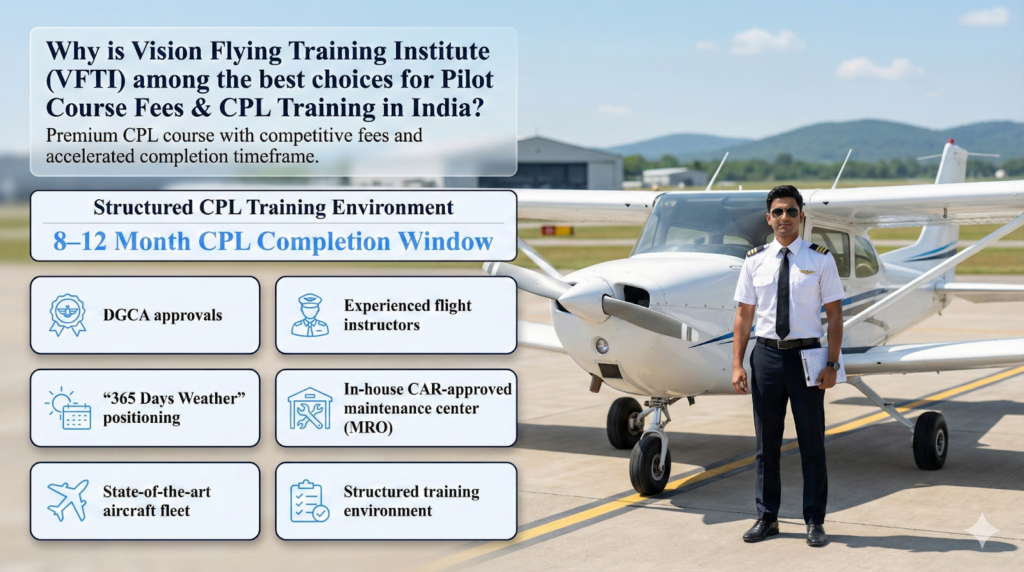
    This image features why Vision Flying Training Institute (VFTI) is a top choice for CPL training in India.


    Vision Flying Training Institute centres on a structured training environment and states an 8 to 12 month completion window for the CPL track.

    VFTI’s pilot training course includes:

    • DGCA approvals
    • Experienced flight instructors
    • “365 Days Weather” positioning
    • In-house CAR-approved maintenance center (MRO)
    • State-of-the-art aircraft fleet

    The in-house maintenance aspect is important because aircraft availability is one of the most common “hidden” reasons why students can take much longer to finish their training. VFTI specifically calls out their CAR-145 in-house MRO as a way to minimize downtime.

    Join a Top Pilot Training Institute for Pilot Licence Training at Competitive Pilot Course Fees

    Pilot training gets easier and way more predictable with admission at the best Flying Training Organizations. Vision Flying Training Institute (VFTI) is DGCA-approved and offers the core pathways most Indian pilot aspirants need. It is backed by a training setup designed to keep flying consistent.

    Contact VFTI 

    Phone: +91-9319193602, +91-9319193605

    Email: enquiry@vfti.in

    Admission Office / Ground Classes: 3rd Floor, D-405, Saini Plaza, Sector-7, Ramphal Chowk, Block D, Palam Extension, Dwarka, New Delhi-110075

    Airbase: Amreli Airport, Amreli, Gujarat – 365601

    Frequently Asked Questions

    How long does it take to become a pilot in India?

    The duration of CPL in India usually ranges between 18 and 24 months. This is due to the fact that the availability of flights, weather, as well as the pace of the student, influence the duration. VFTI’s CPL timeline is 10–12 months.

    What is the total cost of pilot training?

    The cost of completing a practical CPL in India is usually within the ₹40-₹55 lakh range. The cost of completing a DGCA CPL is dependent on factors like single-engine hours, multi-engine hours, simulator time, and ground classes.

    Can I be a pilot in 2 years?

    Yes, 2 years is totally doable for CPL in India when training stays consistent, and you do not get stuck in long gaps between flying slots.